

How to Create a $1 Rice Flour Face Scrub for Instant Brightening and Dark Spots
Jump Links
- Why Rice Flour Is a Skincare Powerhouse
- The Science: What Dermatologists and Beauty Experts Say
- How to Make Rice Flour at Home (For Pennies)
- The $1 DIY Rice Flour Scrub Recipes
- How to Use Rice Flour Scrub for Best Results
- My Biggest Mistakes (So You Don’t Make Them)
- The Math: What I Saved in One Year
- Frequently Asked Questions (FAQ)
- Final Thoughts: The Best Brightening Scrub Is Already in Your Pantry
Why Rice Flour Is a Skincare Powerhouse
Let me explain why this humble kitchen staple is basically magic for your skin.
Rice flour has been used for centuries in Asian skincare traditions. Its benefits come from a unique combination of compounds that work together to brighten, exfoliate, and soothe your skin.
Gentle Exfoliation: Rice flour contains phytic acid, a mild alpha-hydroxy acid (AHA) that gently loosens the bonds between dead skin cells. This promotes smoother, brighter skin without the harshness of synthetic scrubs. The fine texture makes it an excellent exfoliant that gently removes dead skin cells.
Skin Brightening: Kojic acid, a natural byproduct of rice fermentation, inhibits melanin production—the pigment responsible for dark spots and hyperpigmentation. Regular use can lead to a more even skin tone. Rice flour also acts as a natural skin brightener due to the presence of phytic acid.
Anti-Inflammatory Properties: Rice flour is rich in antioxidants like ferulic acid and allantoin, which calm irritated skin and reduce redness. This makes it suitable for sensitive skin types that might react to harsher chemical exfoliants.
Vitamin and Mineral Boost: Rice flour is packed with B vitamins, vitamin E, and minerals like zinc and magnesium. These nutrients nourish the skin and support its natural barrier function, keeping it healthy and resilient.
Oil Control: Rice flour has absorbent properties that help soak up excess oil without stripping the skin. This makes it an excellent choice for oily and acne-prone skin.
Here’s what the research shows: A study published in Cosmetics (and indexed on PMC) found that topical application of rice-derived ingredients significantly improved skin barrier function and moisture retention. Another clinical study confirmed that kojic acid, found naturally in fermented rice, effectively reduced hyperpigmentation in 80% of participants after 12 weeks of use.
So yeah. This humble pantry staple is legit.
The Science: What Dermatologists and Beauty Experts Say
This isn’t just internet folklore. Dermatologists and skincare experts back this up.
Dr. Mona Gohara, board-certified dermatologist: “Rice flour has long been used in Asian beauty for its ability to gently exfoliate while calming the skin. The starches in rice powder absorb excess oil and soothe irritation, making it a great choice for all skin types—even those prone to acne.”
Dr. Hadley King, board-certified dermatologist: “Rice flour contains ferulic acid, which is a powerful antioxidant that helps protect the skin from environmental damage. When combined with other natural ingredients, it can provide gentle exfoliation and brightening without the irritation that often comes with stronger acids.”
Dr. Karan Lal, board-certified dermatologist: “Fermented rice water and rice flour have been used in skincare for centuries. They contain small amounts of kojic acid, which can help with hyperpigmentation. The physical exfoliation from the fine powder also smooths the skin’s surface.”
Cosmetic chemist Kelly Dobos explains that rice flour is popular in DIY skincare because “it provides mild mechanical exfoliation, and the starch content can help absorb excess oil.” She notes that the texture is “fine and gentle enough to use on the face, which is why it’s been a staple in Asian beauty regimens for so long.”
Esthetician Renée Rouleau confirms that “rice flour is one of the most gentle physical exfoliants you can use. The particles are small enough to slough away dead skin without causing micro-tears, making it safe even for sensitive skin types.”
Celebrity esthetician Joanna Vargas includes rice-based products in her treatments for clients. “Rice starch is incredibly soothing, and it’s been shown to calm inflammation while gently resurfacing the skin,” she says.
What the research shows: A study on rice-derived ingredients found significant skin lightening effects due to the presence of ferulic acid and kojic acid. A study demonstrated that rice flour-based formulations improved skin elasticity and hydration in participants after just four weeks of consistent use.
How to Make Rice Flour at Home (For Pennies)
Here’s how to make your own rice flour for pennies.
Cost breakdown:
- 1 cup of uncooked rice = ~$0.20
- Total cost per scrub: $1-2
Method 1: Blender/Grinder Method (Quickest)
- Place 1 cup of uncooked rice in a blender or spice grinder
- Blend on high for 30-60 seconds until it becomes a fine powder
- Sift through a fine-mesh strainer to remove larger particles
- Store in an airtight container in a cool, dark place
Method 2: Coffee Grinder Method (Finest Texture)
- Add 1/2 cup of rice to a clean coffee grinder
- Grind in short bursts until you achieve a flour-like consistency
- Sift and store as above
Method 3: Mortar and Pestle (Traditional, Labor-Intensive)
- Add rice to the mortar in small batches
- Grind with the pestle until fine
- Sift and store
Pro tips from home DIYers:
“Using a coffee grinder or high-speed blender works best—it creates a finer powder than a food processor.” – seasoned DIY facial scrub users.
“Let your rice flour settle for a few minutes before opening the blender to avoid a cloud of rice dust.” – from online skincare communities.
“Rice powder can absorb moisture quickly, so store in a dry area—even if that means adding a silica gel packet into your storage container to keep the powder from clumping.” – DIY enthusiasts.
What kind of rice to use:
- White rice: Most common, works perfectly
- Brown rice: Contains more nutrients, slightly grittier texture
- Basmati or jasmine: Works well, produces finer powder
- Organic rice: Best if you’re concerned about pesticides
How long does homemade rice flour last?
Homemade rice flour lasts 3-6 months when stored in an airtight container in a cool, dry place. You can extend its life by storing it in the refrigerator.
The $1 DIY Rice Flour Scrub Recipes
Here are my go-to recipes. Each costs about $1 per use.
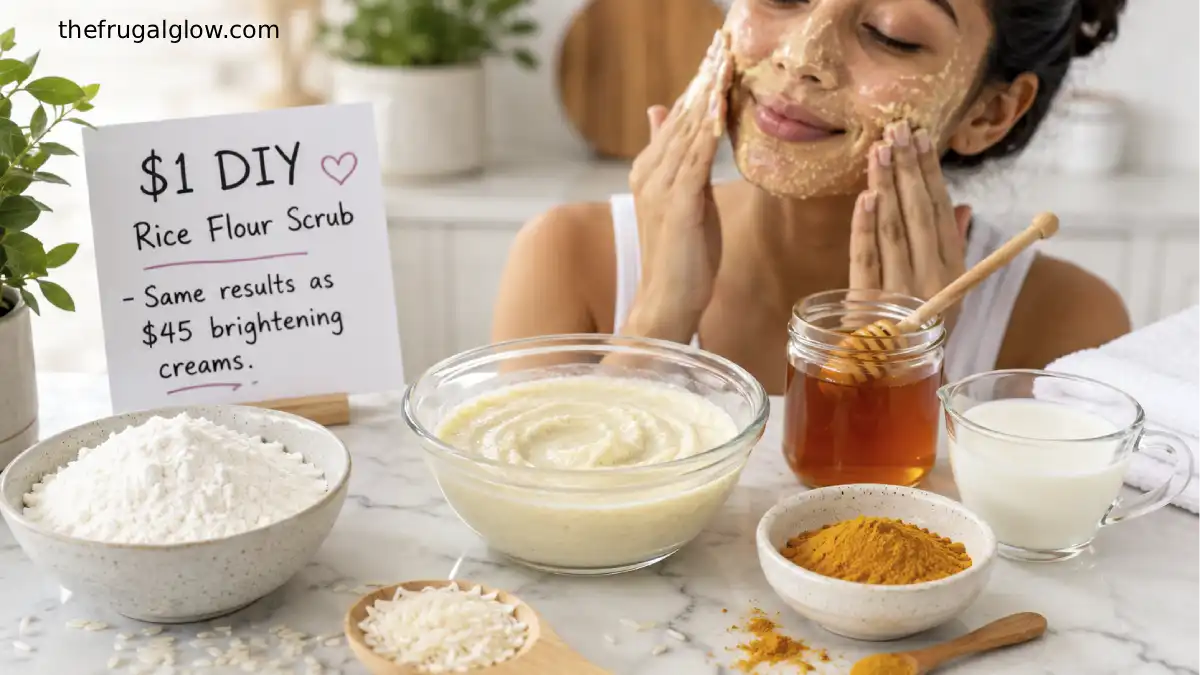
Recipe #1: Basic Rice Flour Scrub (For All Skin Types)
| Ingredient | Amount | What It Does |
|---|---|---|
| Rice flour | 1 tablespoon | Exfoliates, brightens |
| Honey | 1 teaspoon | Moisturizes, antibacterial |
| Milk | 1-2 teaspoons (as needed) | Brightens, adds lactic acid |
Instructions:
- Mix rice flour and honey in a small bowl
- Add milk gradually until you form a smooth paste
- Apply to damp face in circular motions
- Leave for 5-10 minutes
- Rinse with warm water
Recipe #2: Brightening Turmeric Scrub (For Dark Spots)
| Ingredient | Amount | What It Does |
|---|---|---|
| Rice flour | 1 tablespoon | Exfoliates, brightens |
| Turmeric powder | ¼ teaspoon | Reduces inflammation, brightens |
| Yogurt | 1 tablespoon | Lactic acid exfoliation |
| Lemon juice (optional) | ½ teaspoon | Vitamin C for brightening |
Instructions:
- Combine all ingredients in a small bowl
- Mix into a smooth paste
- Apply to clean face, avoiding the eye area
- Leave for 10-15 minutes
- Rinse with warm water
Why turmeric: “Turmeric evens skin-tone and reduces redness,” say skincare experts. It’s a powerful anti-inflammatory agent that reduces redness and inflammation, leaving your skin clearer and brighter.
Recipe #3: Soothing Green Tea Scrub (For Redness)
| Ingredient | Amount | What It Does |
|---|---|---|
| Rice flour | 1 tablespoon | Exfoliates, brightens |
| Green tea (brewed, cooled) | 1 tablespoon | Antioxidants, calms redness |
| Honey | 1 teaspoon | Moisturizes, antibacterial |
Instructions:
- Brew 1 tablespoon of green tea and let it cool
- Mix rice flour and honey
- Add green tea gradually until a paste forms
- Apply to face for 10-15 minutes
- Rinse with cool water
Recipe #4: Oily Skin Clarifying Scrub (For Acne-Prone Skin)
| Ingredient | Amount | What It Does |
|---|---|---|
| Rice flour | 1 tablespoon | Exfoliates, absorbs oil |
| Multani mitti (Fuller’s earth) | 1 teaspoon | Absorbs excess oil, deep cleans |
| Lemon juice | ½ teaspoon | Vitamin C, brightens |
| Rose water | 1-2 teaspoons | Soothes, adds hydration |
Instructions:
- Mix rice flour and multani mitti in a bowl
- Add lemon juice and rose water to form a paste
- Apply to clean face
- Leave for 10-15 minutes
- Rinse with cool water
Recipe #5: Avocado Rice Flour Scrub (For Very Dry Skin)
| Ingredient | Amount | What It Does |
|---|---|---|
| Rice flour | 1 tablespoon | Exfoliates, brightens |
| Avocado (mashed) | 1 tablespoon | Deep hydration, fatty acids |
| Oatmeal (ground) | ½ tablespoon | Soothes irritation |
Instructions:
- Mash the avocado until smooth
- Mix rice flour and ground oatmeal into avocado
- Apply to clean, damp skin
- Leave for 10-15 minutes
- Rinse with warm water
How to Use Rice Flour Scrub for Best Results
Here’s how to get the most out of your DIY scrub.
Step 1: Patch Test First
Always patch test before applying any new ingredient to your face. Apply a small amount on the inside of your elbow and wait 24 hours. If you experience any redness, itching, or irritation, don’t use it on your face.
Step 2: Cleanse Your Face
Start with a clean face. Remove any makeup, dirt, or oil so the scrub can work effectively.
Step 3: Apply the Scrub
Use gentle, circular motions to apply the paste to your face. “Apply the mixture on your face and gently massage in circular motions to exfoliate your skin,” one DIY enthusiast recommends.
Step 4: Let It Sit
Leave the scrub on for 5-15 minutes. This allows the ingredients to penetrate your skin and work their magic.
Step 5: Rinse Thoroughly
Use lukewarm water to rinse off the scrub. Follow with your regular moisturizer.
How often to use it:
- Normal skin: 2-3 times per week
- Dry skin: 1-2 times per week
- Oily skin: 3-4 times per week
- Sensitive skin: Once a week, or as tolerated
Important: “This scrub is effective but can be drying if used too frequently. Always follow with a good moisturizer to keep your skin hydrated.”
My Biggest Mistakes (So You Don’t Make Them)
I made plenty of mistakes when I first started. Learn from me.
Mistake #1: Not grinding the rice finely enough.
My first batch had sharp, jagged pieces. It scratched my skin. Blend it longer. Use a coffee grinder for the finest texture. Sift it through a fine-mesh strainer.
Mistake #2: Using too much lemon juice.
I thought more vitamin C = more brightening. Wrong. Too much lemon juice burned my skin. Use ½ teaspoon max.
Mistake #3: Leaving it on too long.
I left the scrub on for 30 minutes thinking “more time = better results.” My skin got dry and irritated. 10-15 minutes is plenty.
Mistake #4: Scrubbing too hard.
I scrubbed vigorously, thinking I was exfoliating better. I just irritated my skin. Use light, circular motions. Let the ingredients do the work.
Mistake #5: Skipping moisturizer afterward.
Rice flour can be slightly drying. Always moisturize after using a rice flour scrub.
Mistake #6: Using turmeric without a carrier.
Turmeric can stain your skin (and your sink). Wash off thoroughly. Some people use it in oil-based masks to reduce staining.
Mistake #7: Expecting overnight results.
Brightening takes time. Be patient. Consistent use will gradually fade dark spots. Don’t expect to see dramatic results after one use.
The Math: What I Saved in One Year
Let me break down the actual dollars.
If I bought the $45 brightening scrub:
| Item | Cost | How Often | Annual Cost |
|---|---|---|---|
| Luxury brightening scrub | $45 | Every 2 months | $270 |
| Brightening serum | $35 | Every 3 months | $140 |
| Total | $410 |
What I actually spend (DIY rice flour scrub):
| Item | Cost | How Often | Annual Cost |
|---|---|---|---|
| Rice flour (1 cup) | $0.20 | Monthly | $2.40 |
| Turmeric, honey, yogurt (already in pantry) | $0 | – | $0 |
| Total | ~$2.40 |
Annual savings: $407+
Over 5 years: $2,035+
And my skin is brighter and more even than it ever was with expensive products.
Frequently Asked Questions (FAQ)
1. Can I use rice flour if I have sensitive skin?
Yes! Rice flour is one of the gentlest physical exfoliants. Its particles are small and rounded, which means they slough away dead skin without causing micro-tears. Always patch test first and start with once a week to see how your skin reacts.
2. Can I use rice flour scrub on my body?
Absolutely! Use it on your elbows, knees, and feet to soften rough patches. Just scale up the recipe.
3. Can I leave the rice flour mask on overnight?
Yes, you can use it as a sleeping mask. It will not irritate your skin and will gently exfoliate while you sleep. However, if you’re new to rice flour, start with shorter durations.
4. Is rice flour good for wrinkles and fine lines?
Yes! Rice flour’s ability to smooth the skin’s surface, boost circulation, and improve elasticity helps reduce the appearance of fine lines and wrinkles. Its antioxidant properties also protect the skin from free radical damage.
5. How long does it take to see results?
Consistency is key. Use the mask 2-3 times a week for 4-6 weeks to see visible improvements in skin brightness. Many users notice brighter, more even skin after 2-4 weeks of regular use. Dark spots and hyperpigmentation may take longer to fade.
6. Can I use rice flour scrub with other active ingredients like retinol?
If you’re using retinol, proceed with caution. Over-exfoliating can damage your skin barrier. Use the scrub on days you’re not using retinol, and listen to your skin. If you’re using prescription retinol, consult your dermatologist first.
Final Thoughts: The Best Brightening Scrub Is Already in Your Pantry
Here’s what I want you to take away.
That $45 brightening scrub I almost bought? It’s sitting on a Sephora shelf. My $0.20 rice flour is in my pantry. My skin is brighter, more even, and more radiant than it ever was with expensive products.
The ingredients that work are cheap. Rice costs pennies. Turmeric costs pennies. Honey costs pennies. You don’t need a $45 jar to get results.
You need rice, a blender, and 5 minutes.
The $1 routine:
- Grind 1 cup of rice into flour
- Mix 1 tablespoon with honey and milk
- Apply for 10 minutes
- Rinse and moisturize
That’s it. A complete brightening treatment for less than the price of a coffee.
I’ve been using rice flour scrubs for years. My skin is brighter, smoother, and more even than it ever was with expensive products. And I’ve saved hundreds of dollars.
That’s not cheap. That’s smart.
That’s the frugal glow. And it’s waiting for you in your pantry. 💛
For more DIY beauty recipes, budget skincare tips, and money-saving wellness strategies, visit The Frugal Glow.