

The 33-Item Capsule Wardrobe Challenge: What It Is and How to Try It
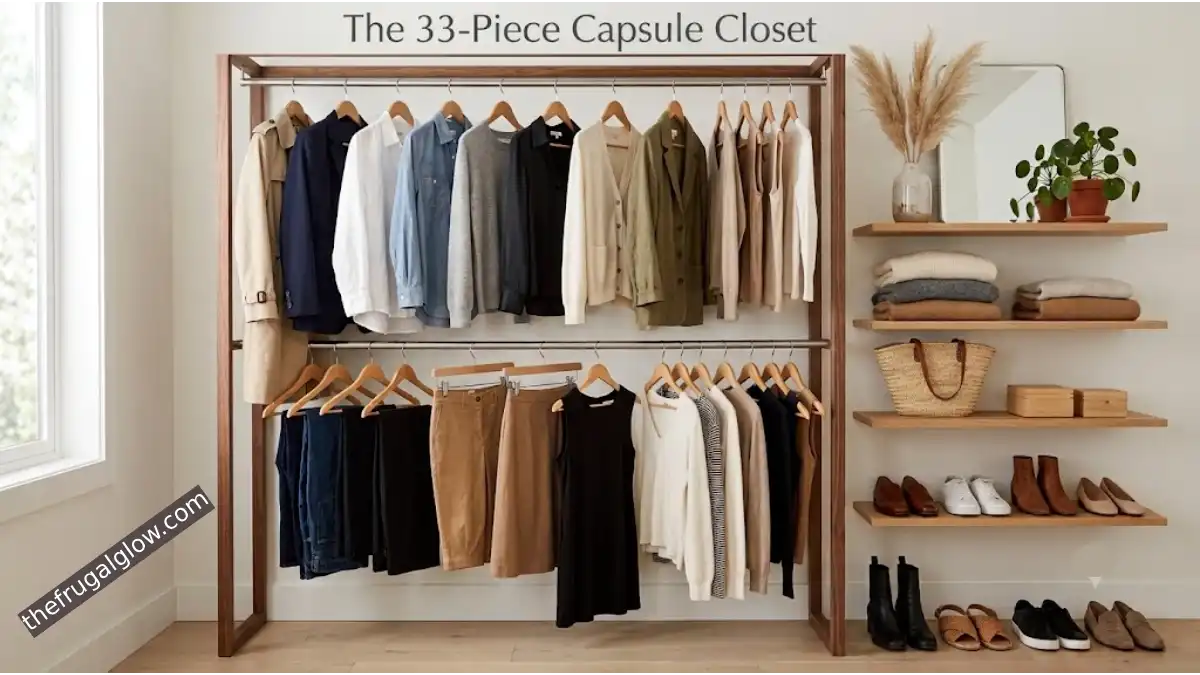
Stand in front of a closet packed full of clothes and still feel like you have nothing to wear? You’re far from alone, and it’s not actually a “not enough clothes” problem — it’s an “too many options, none of them working together” problem. That’s exactly the frustration behind one of the most talked-about style challenges of the last decade: the 33-item capsule wardrobe, better known as Project 333.
The idea sounds intense at first — pick just 33 items and wear only those for three whole months? — but once you understand the actual rules (and the surprisingly generous exceptions built into them), it turns out to be a lot more doable, and a lot more freeing, than it sounds. Here’s exactly what the challenge is, where it came from, and how to try it yourself without losing your mind by week two.
Jump Links
- What Is Project 333, Exactly
- The Official Rules
- What Counts Toward Your 33 Items (and What Doesn’t)
- Why This Challenge Actually Works
- How to Choose Your 33 Items: Step-by-Step
- Sample 33-Item Wardrobe Breakdown
- Project 333 vs. Other Capsule Approaches
- Common Challenges (and How to Handle Them)
- FAQ
- The Bottom Line
What Is Project 333, Exactly
Project 333 is a minimalist fashion challenge created by writer Courtney Carver back in 2010, built around a simple premise: choose 33 items of clothing, shoes, accessories, and jewelry, and dress exclusively from that collection for three months, storing everything else away out of sight. Carver started the challenge as a personal experiment on her blog, and it’s since grown into something followed by hundreds of thousands of people worldwide, along with a full book dedicated to it.
The number 33 isn’t some magic style formula — it’s simply the boundary Carver landed on that felt restrictive enough to force real decisions, but generous enough to still cover a full season of getting dressed comfortably. As she puts it herself, the challenge is not about suffering through limitation; if something needs to be swapped or adjusted along the way, that’s completely fine.
The Official Rules
While minimalism can sometimes feel like a rigid, all-or-nothing lifestyle, Project 333 is intentionally designed to be flexible. The core rules, straight from the challenge’s official guidelines, are refreshingly straightforward:
- Choose 33 items: This number covers your entire visible wardrobe for the period—including clothing, shoes, accessories, jewelry, and outerwear. It sounds tight, but it forces you to focus on the pieces you genuinely love and wear on repeat rather than collecting dust in the back.
- Wear only those items for three months: For the duration of the challenge, your chosen 33 pieces are your entire working wardrobe. Everything else gets packed away, boxed up, and placed completely out of sight. This physical separation is key to resetting your daily routine and removing the morning visual clutter.
- You can start anytime: The challenge traditionally follows a quarterly cycle (such as January to March or April to June), but creator Courtney Carver is always quick to emphasize that there is no “wrong” time to begin. You can start mid-month, mid-season, or whenever you feel ready to clear your space.
- It’s not a suffering project: If something stops working — whether it no longer fits, the weather shifts dramatically faster than expected, or a well-loved item wears out — you are completely allowed to swap it out for something else.
That final rule is arguably the most important, yet it’s the one people overlook the most. This challenge isn’t an endurance test or a competition in self-denial; it’s a tool to help you understand your style habits and buy less over time. If you find yourself struggling because a rigid rule is holding you back, you’re missing the point. The true objective is seeing what happens when decision fatigue gets removed from your closet entirely, leaving room for a simpler, more intentional way to get dressed.
What Counts Toward Your 33 Items (and What Doesn’t)
This is where a lot of the “I could never do that” hesitation actually clears up, because several everyday categories are excluded from the count entirely.
Counts toward your 33:
- Tops, bottoms, and dresses
- Outerwear (jackets, coats)
- Shoes
- Accessories (belts, bags, scarves)
- Jewelry
Does NOT count toward your 33:
- Workout clothing worn specifically for exercise
- Sleepwear
- Loungewear worn only at home
- Underwear and socks
That exclusion list is a bigger relief than it sounds. It means your entire “33” is dedicated purely to the clothes people actually see you in, rather than being eaten up by pajamas, gym leggings, and everyday underwear.
5 Target Basics That Look Exactly Like High-End Designer Brands (Under $20)
Why This Challenge Actually Works
The psychology behind this challenge lines up with something researchers call decision fatigue — the idea that your brain has a limited capacity for quality decision-making in a day, and it gets progressively more tired the more choices it has to make. A closet with hundreds of mismatched options forces dozens of tiny decisions every single morning before you’ve even left the house. A tightly curated 33-item wardrobe removes almost all of that friction, since every piece was chosen specifically because it works with the others.
There’s also a financial upside that goes beyond the closet itself. Since the whole point is working with what you already have (plus maybe one or two genuinely needed replacements), the challenge naturally curbs impulse shopping for the full three months, which is often where people notice real savings even if that wasn’t their original goal.
How to Choose Your 33 Items: Step-by-Step
- Pull everything out of your closet and sort into three piles: Love (wear constantly, feel great in), Maybe (uncertain, could go either way), and No (rarely or never worn).
- Start building your 33 from the Love pile first. These are your proven favorites, and they’ll likely make up the bulk of your final list.
- Fill any remaining gaps from the Maybe pile, specifically choosing pieces that mix well with what you’ve already selected from the Love pile rather than pieces you just feel unsure about letting go of.
- Check for basic outfit coverage — make sure you have enough tops, bottoms, one or two dresses if you wear them, outerwear appropriate for the season, and a reasonable range of shoes.
- Box up everything else and store it somewhere out of sight (a closet in another room, under-bed storage, or a spare closet all work) so it’s genuinely out of the daily decision-making loop.
- Set a start date and give yourself permission to adjust if something isn’t working — the rules explicitly allow for this, so don’t treat a swap as “failing” the challenge.
Sample 33-Item Wardrobe Breakdown
Here’s an example of how a 33-item wardrobe might actually break down across categories for one season, just to give you a sense of proportion.
| Category | Sample Item Count | Examples |
|---|---|---|
| Tops | 8 | T-shirts, blouses, sweaters |
| Bottoms | 6 | Jeans, trousers, one skirt |
| Dresses | 2 | One casual, one slightly dressier |
| Outerwear | 3 | Jacket, cardigan, coat |
| Shoes | 5 | Sneakers, flats, boots, one dressier pair, sandals |
| Accessories | 5 | Belt, scarf, two bags, sunglasses |
| Jewelry | 4 | Everyday earrings, a necklace, a watch, one statement piece |
| Total | 33 |
This breakdown isn’t a fixed formula — some people prefer more shoes and fewer accessories, or more dresses and fewer separates. The goal is coverage for your actual lifestyle, not matching this exact split.
Project 333 vs. Other Capsule Approaches
Project 333 is one specific version of the broader capsule wardrobe concept, and it’s worth understanding how it compares to other common approaches.
| Approach | Item Count | Duration | Flexibility | Best For |
|---|---|---|---|---|
| Project 333 | 33 items | 3 months per round | Moderate (swaps allowed if needed) | People wanting a defined, repeatable challenge |
| General capsule wardrobe | 15–25 items | Ongoing, no fixed timeline | High | People who prefer an evolving, informal approach |
| Seasonal capsule (37-piece method) | ~37 items | Per season | Moderate | People who want a slightly larger seasonal buffer |
| $100 budget capsule | 8 core basics | Ongoing foundation | High | People starting from scratch on a strict budget |
Project 333 stands out specifically because of its structure — a defined number, a defined timeframe, and a built-in “reset” every three months, which makes it easier to actually commit to compared to an open-ended capsule with no clear starting or ending point.
Common Challenges (and How to Handle Them)
- “My weather changes too much for one 33-item list.” Build outerwear and layering pieces into your 33 rather than treating each season as a completely separate wardrobe — a cardigan, a jacket, and a couple of layering tops can cover more temperature range than expected.
- “I have a job that requires specific dress. Split your 33 with intention: a portion for work-appropriate pieces and a portion for off-hours, rather than trying to keep two completely separate wardrobes running at once.
- “I’m worried people will notice I’m wearing the same things.” In practice, most people report the opposite — friends and coworkers are far more likely to notice that your outfits suddenly look more put-together and intentional than to notice repetition.
- “I can’t get down to just 33.” Start with a higher number, like 40 or 45, and treat it as a stepping stone. The exact number matters far less than the exercise of intentionally curating what you actually wear.
FAQ
Do I have to start Project 333 at the beginning of a season?
No. While it traditionally runs in three-month cycles, there’s no required start date, and you can begin at any point in the year that works for your schedule and current wardrobe.
What happens if something breaks or wears out during my 3 months?
You’re allowed to replace it. The challenge isn’t meant to force you into worn-out or damaged clothing; a genuine replacement doesn’t count as “breaking” the rules.
Do accessories and jewelry really count toward the 33-item total?
Yes, according to the official rules, accessories, jewelry, shoes, and outerwear are all included in the 33-item count, alongside your clothing.
Is Project 333 the same thing as a general capsule wardrobe?
It’s a specific, structured version of the broader capsule wardrobe concept. A general capsule wardrobe can have any number of pieces and no fixed timeline, while Project 333 specifically sets the number at 33 items for a defined 3-month period.
Can I do a modified version with a different number of items?
Absolutely. Many people adapt the challenge to a number that feels more realistic for their lifestyle, like 40 or 50 items, while keeping the core structure of a defined item count and timeframe.
Will I need to buy new clothes to do this challenge?
Not necessarily. The whole point is usually to build your 33 items from what you already own, choosing your favorites and best-mixing pieces rather than shopping for an entirely new wardrobe from scratch.
The Bottom Line
The 33-item capsule wardrobe challenge isn’t about deprivation — it’s about finally letting your closet do some of the thinking for you. Thirty-three pieces, three months, a handful of simple rules, and permission to adjust along the way is genuinely enough to break the “so many clothes, nothing to wear” cycle for good, no shopping spree required.
For more budget-friendly style guides and wardrobe-simplifying tips, check out more posts over at The Frugal Glow.