

The Pull Test: 3 Signs a Fast-Fashion Sweater Will Lose Its Shape in Two Washes
Jump Links
- Why Fast-Fashion Sweaters Fall Apart So Quickly
- The Pull Test Method (How to Spot a Loser in 30 Seconds)
- Sign #1: The Seam Gap Test (The Most Important One)
- Sign #2: The Fabric Recovery Test (The Elasticity Check)
- Sign #3: The Ribbing Test (Where Sweaters Die First)
- The Bonus Test: Inside Out (The Truth About Quality)
- What the Reviews Say (Real Evidence from Real Buyers)
- The Math: What I Saved in One Year
- Frequently Asked Questions (FAQ)
- Final Thoughts: The Pull Test Will Save You Money
The $25 sweater was sitting in my online cart. It looked great in the photos. The reviews were decent. The price was right. I almost clicked “buy.”
Then I remembered the last “bargain” sweater I bought. It looked amazing on day one. By day three, the neck had stretched out like a hammock. By the second wash, it looked like it belonged to someone twice my size. It went straight to the donation pile.
The problem wasn’t the price. The problem was the construction. Fast fashion is built to look good in the store—and fall apart in your closet.
Today, I’m sharing the three signs that a sweater will lose its shape in two washes. No special tools. No expertise. Just a 30-second “pull test” you can do right in the store.
Let’s get into it.
Why Fast-Fashion Sweaters Fall Apart So Quickly
Fast fashion is designed for speed and low cost, not longevity. The manufacturers cut corners on materials and construction. They use cheap yarns that lack resilience. They sew seams too loosely. They skip the quality control tests that premium brands run.
In the garment industry, there are actual tests for “dimensional stability” and “shape retention.” These tests measure whether a sweater will maintain its shape after washing and wearing. Manufacturers check things like shrinkage, stretching, and seam strength before shipping to stores.
But fast fashion? They don’t run these tests. They don’t care. They just ship it.
And that’s why you end up with a sweater that looks great in the store and falls apart in two washes.
According to a fashion educator, the secret to identifying well-made clothing is simple: “Turn the item inside out. Does it look as good on the inside as it does on the outside? If so, it’s a good indication you’ve got a decent quality garment.”
That’s exactly what we’re going to do with the pull test.
The Pull Test Method (How to Spot a Loser in 30 Seconds)
Here’s the test. You can do it in the store, at the thrift shop, or even on a sweater you already own.
Step 1: Turn the sweater inside out. This is where the truth lives.
Step 2: Find a seam. Any seam. The side seam, the sleeve seam, the shoulder seam. It doesn’t matter.
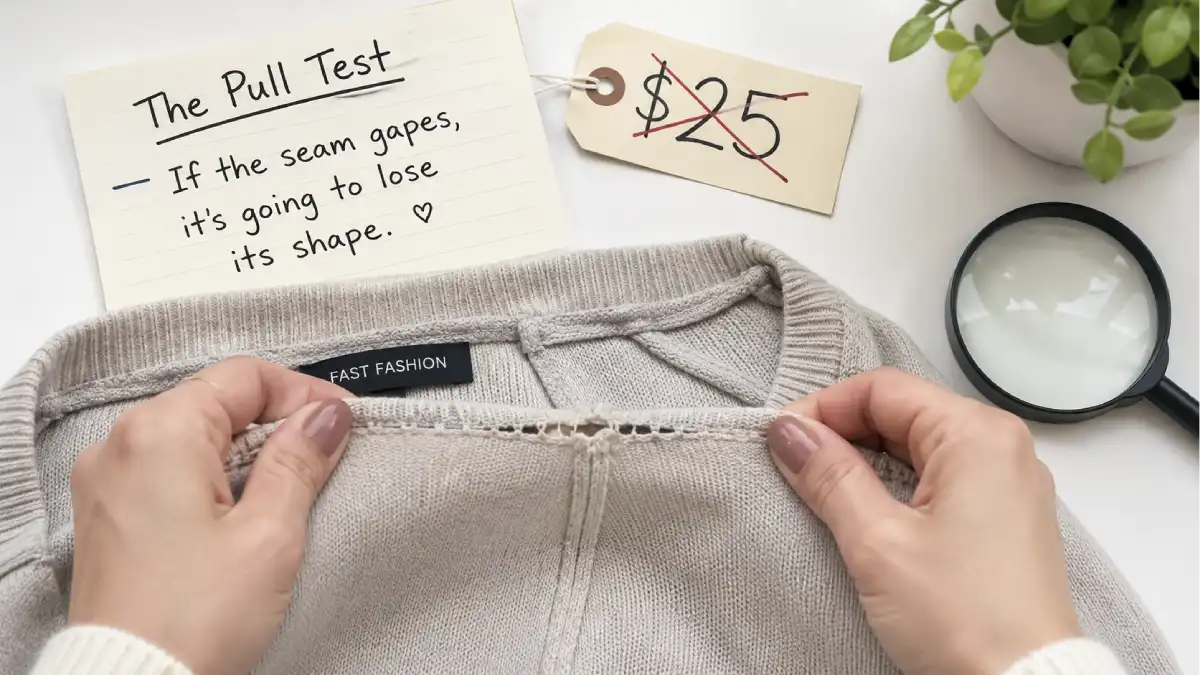
Step 3: Pinch the fabric on both sides of the seam. Pull gently but firmly. Pull in both directions—across the seam and along the seam.
Step 4: Watch what happens.
If the seam shows gaps, if the stitching pops, or if the fabric doesn’t snap back to its original position—the sweater is going to lose its shape.
If the seam holds firm and the fabric bounces back—you’ve found a keeper.
That’s it. Thirty seconds. No expertise required.
In the garment industry, this is called a “seam strength test” or “pull test.” Manufacturers do it to make sure seams can withstand daily wear and washing. If a sweater can’t pass this simple test in the store, it’s not going to survive your washing machine.
Sign #1: The Seam Gap Test (The Most Important One)
This is the most obvious and most common sign of a cheap sweater. And it’s the easiest to spot.
What to do: Turn the sweater inside out. Find a seam. Pinch the fabric on both sides. Pull gently. Look at the seam.
What to look for: If you see gaps between the threads, or if the seam opens up when you pull, the sweater is poorly constructed.
What it means: The stitching is too loose. The thread is too weak. The seam wasn’t properly tensioned during manufacturing. The result? Your sweater will stretch out at the seams, especially after washing. The neckline will gape. The sleeves will bag. The shoulders will sag.
In the garment industry, this is known as “seam slippage.” It’s a critical failure in knitwear construction, and it’s a sign that the manufacturer skipped the quality control tests that would have caught the problem.
The rule: If you can see gaps when you pull, put it back. It’s not going to survive.
Sign #2: The Fabric Recovery Test (The Elasticity Check)
This test measures the “recovery” of the fabric. Recovery is the fabric’s ability to bounce back after being stretched.
What to do: Pinch a section of the sweater between your thumb and forefinger. Stretch it gently. Not too hard—just enough to see how it reacts. Then release.
What to look for: If the fabric stays stretched out, if it doesn’t bounce back to its original shape, the sweater has poor recovery.
What it means: The yarn lacks resilience. It’s probably made from low-quality synthetic fibers, or it’s a loose knit that can’t hold its shape. Over time, especially after washing, the sweater will stretch out and never return to its original size.
Cotton sweaters are particularly prone to this. According to fabric experts, “cotton (without the addition of lycra) has poor recovery once it is stretched out.” Machine drying can sometimes help “shrink it back into shape,” but that’s a gamble.
The rule: If it doesn’t bounce back, it’s going to bag out. Don’t buy it.
Sign #3: The Ribbing Test (Where Sweaters Die First)
The ribbing—the cuffs, the hem, the neckline—is where sweaters show their true quality. It’s also where they die first.
What to do: Pinch the ribbing. Pull it gently. See how it reacts. Then do the same for the body of the sweater.
What to look for: If the ribbing is significantly looser or stretchier than the body, that’s a red flag. If the ribbing doesn’t snap back after being stretched, the sweater is going to look sloppy very quickly.
What it means: The ribbing is a structural element of the sweater. It’s supposed to hold the shape of the neckline, the cuffs, and the hem. If the ribbing is poorly constructed, the sweater will stretch out at the neck, the sleeves will bag, and the hem will sag.
A research from one user described how their cheap sweater “lost its shape” after just a couple of wears: “the neck widened and the sleeves expanded way beyond normal in the elbow area.” That’s exactly what happens when the ribbing is cheap and the seams can’t hold up.
The rule: If the ribbing is sloppy and the recovery is poor, the sweater is going to look like a mess in two weeks.
5 Best ‘Secondhand’ Apps (Beyond Poshmark) to Buy Designer Clothes for 70% Off
The Bonus Test: Inside Out (The Truth About Quality)
This isn’t a “sign” so much as a sanity check. But it’s the most important one.
What to do: Turn the sweater inside out. Compare the inside to the outside.
What to look for: If the inside looks just as clean and well-finished as the outside, that’s a sign of quality. If the inside is a mess of loose threads and unfinished seams, that’s a sign that the manufacturer cut corners.
Fashion educator Andrea Cheong explains: “Turn the item inside out. Does it look as good on the inside as it does on the outside? If so, it’s a good indication you’ve got a decent quality garment.”
What it means: Quality construction shows on the inside. Loose threads, unfinished seams, and sloppy stitching are signs that the manufacturer was more concerned with speed than durability.
If the inside is a mess, the outside is going to fall apart.
What the Reviews Say (Real Evidence from Real Buyers)
The pull test isn’t just theory. It’s backed up by hundreds of real-world reviews from people who bought fast-fashion sweaters and watched them fall apart.
One reviewer described a “nice-looking” sweater that “began to lose its shape” after just a couple of wears. “The neck widened and the sleeves expanded way beyond normal in the elbow area,” they reported.
After the first wash? “The sweater shrank by at least 2 sizes.” That’s a sweater that went from “roomy” to “teenage son” size. And it wasn’t just the fit—”the seam is separating from the rest of the sweater already,” the reviewer noted.
Another industry source warns that “if a knitted garment is badly beaten, even if only one thread is not attached, the garment will be scattered after many pulls.” One loose thread can unravel the whole thing.
The pattern is clear: fast-fashion sweaters are built to fail.
The Math: What I Saved in One Year
Let me break down what happens when you buy sweaters that fail the pull test.
If you buy cheap sweaters that fall apart:
| Item | Cost | How Often | Annual Cost |
|---|---|---|---|
| Cheap sweater | $30 | Monthly | $360 |
If you buy quality sweaters that pass the test:
| Item | Cost | How Often | Annual Cost |
|---|---|---|---|
| Quality sweater | $60 | Once a year | $60 |
Annual savings: $300
Over 5 years: $1,500
And you’re not just saving money. You’re reducing waste, you’re avoiding the frustration of clothes that don’t fit, and you’re building a wardrobe that actually works.
Frequently Asked Questions (FAQ)
1. What is “the pull test” and how do I do it?
The pull test is a simple 30-second check you can do on any sweater before buying it. Turn the sweater inside out, find a seam, pinch the fabric on both sides, and pull gently. If you see gaps, if the stitching pops, or if the fabric doesn’t snap back, the sweater will lose its shape. If the seam holds firm and the fabric bounces back, you’ve found a keeper.
2. Why does the ribbing on my sweater stretch out so fast?
The ribbing is the structural element of the sweater. It’s supposed to hold the shape of the neckline, the cuffs, and the hem. If the ribbing is poorly constructed, or if the yarn doesn’t have good recovery, it will stretch out quickly.
3. Can I fix a sweater that’s already lost its shape?
Sometimes. Cotton sweaters can sometimes be “shrunk back into shape” with a hot wash and a machine dry. But this is a gamble. It’s much better to avoid buying sweaters that will lose their shape in the first place.
4. Should I always turn the sweater inside out before buying?
Yes. The inside of a garment tells you everything about its quality. If the inside is clean and well-finished, that’s a sign of quality construction. If the inside is a mess of loose threads, the manufacturer cut corners.
5. Is it worth buying fast-fashion sweaters at all?
Almost never. Fast-fashion sweaters are built to look good in the store, not to last in your closet. The pull test will identify the ones that will lose their shape, but even the ones that “pass” are often low quality.
Final Thoughts: The Pull Test Will Save You Money
The $25 sweater that I almost bought is still sitting in my cart. It’s been there for weeks. I’ll probably never buy it. Because I know it’s going to lose its shape in two washes.
The best sweaters are the ones that pass the pull test. They’re the ones that hold their shape, maintain their fit, and last for years. They cost more upfront, but they’re cheaper in the long run.
Next time you’re shopping for a sweater, don’t just look at the price tag. Turn it inside out. Pinch the seam. Pull it gently. Watch what happens.
If it fails the test, put it back.
That’s not cheap. That’s smart.
That’s the frugal glow. And it’s waiting for you at the store. ☀️
For more budget fashion tips, quality guides, and money-saving style strategies, visit The Frugal Glow.