

The Cost-Per-Wear Formula: $200 Genuine Leather Boots vs. $50 Faux Leather
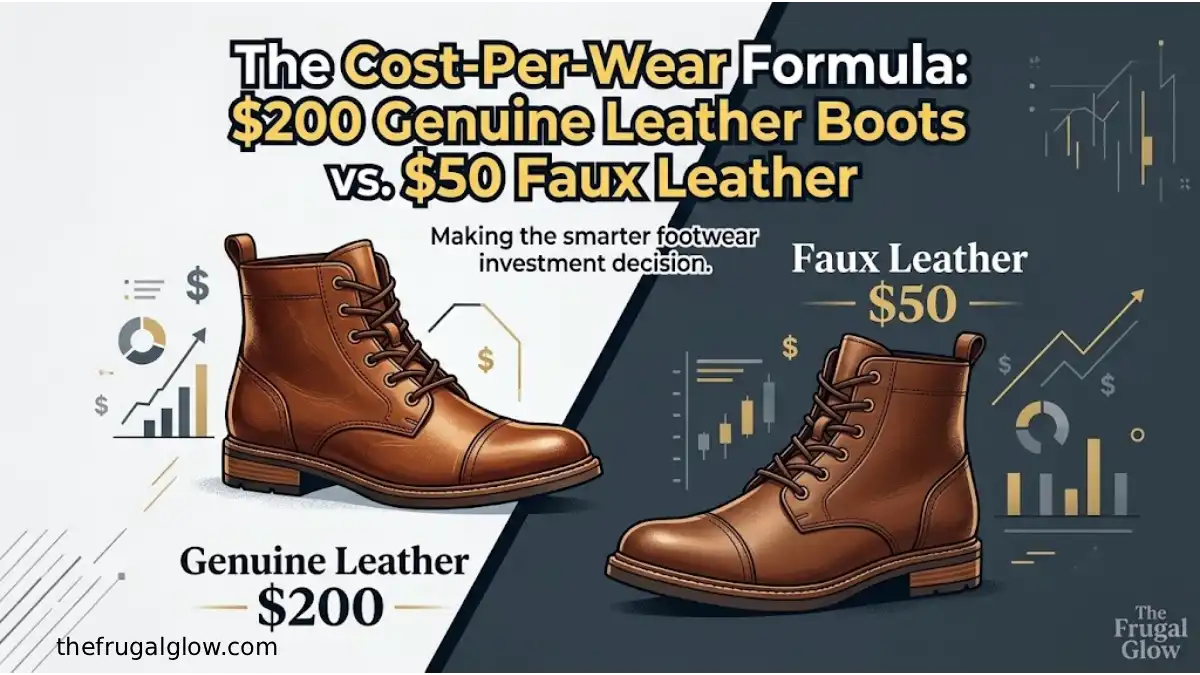
Boot season brings the same debate every single year: spend $200 on a “real” pair that’ll supposedly last forever, or grab a $50 faux leather pair that looks nearly identical in photos and frees up $150 for literally anything else? Sticker price alone makes this an easy call in favor of the cheaper option. But sticker price, on its own, is a genuinely bad way to measure value — which is exactly where the cost-per-wear formula comes in.
This breaks the whole decision down using real numbers: actual lifespan data for genuine versus faux leather, realistic wear frequency, maintenance costs, and the true cost-per-wear for both options. The winner isn’t as obvious as either “leather snob” or “budget shopper” crowds tend to assume.
Jump Links
- A Quick Refresher on the Cost-Per-Wear Formula
- How Long Each Material Actually Lasts
- Setting Realistic Wear Assumptions
- The Genuine Leather Boots: Full Cost Breakdown
- The Faux Leather Boots: Full Cost Breakdown
- Cost-Per-Wear Comparison Table
- Why Faux Leather Fails Faster: The Actual Science
- Where Genuine Leather Loses Ground
- Multi-Year Projection: 5 Years of Ownership
- When Faux Leather Is Still the Smarter Buy
- How to Maximize Cost-Per-Wear on Either Option
- FAQ
- The Bottom Line
A Quick Refresher on the Cost-Per-Wear Formula
The cost-per-wear formula is simple: take the total amount paid for an item, and divide it by the number of times you actually wear it over its usable lifespan.
Cost Per Wear = Total Price Paid ÷ Number of Times Worn
A more complete version also factors in care, repair, and resale value:
Net Cost Per Wear = (Purchase Price + Care/Repair Costs − Resale Value) ÷ Number of Times Worn
For a category like boots, where durability and lifespan vary so dramatically between materials, this formula is especially revealing — a higher price tag can absolutely produce a lower real cost, and a lower price tag can absolutely produce a higher real cost, once you actually run the numbers instead of trusting the sticker.
How Long Each Material Actually Lasts
This is the single biggest variable driving the entire comparison, so it’s worth grounding it in real data rather than guesswork.
Genuine leather (the grade most commonly used in a $200 price-point boot) typically lasts 5 to 10 years with proper care and regular conditioning, according to material comparison research. This sits below full-grain or top-grain leather (which can last 10–20+ years and is generally reserved for pricier boots), but well above faux leather across nearly every durability metric.
Faux leather (PU or PVC) typically lasts 2 to 5 years with regular use, with lower-grade PU or PVC common in fast fashion sometimes failing in as little as 1 to 2 years under regular wear. The synthetic coating is prone to cracking, peeling, or flaking over time, particularly with frequent flexing at stress points like the toe box and ankle crease, and heat or sun exposure accelerates the breakdown significantly.
Setting Realistic Wear Assumptions
To calculate an accurate Cost-Per-Wear (CPW) metric, we need to base our math on realistic consumer behavior rather than ideal conditions. The biggest flaw in most footwear comparisons is assuming boots are worn 365 days a year.
For this financial analysis, we define a moderately active footwear profile:
- Seasonal Window: In most climates, boot season spans 5 to 6 months (late autumn through early spring).
- Weekly Rotation: Wearing the exact same pair daily causes moisture build-up from sweat, accelerating leather breakdown. A realistic care schedule assumes wearing them 2 to 3 times per week, allowing rest days for the material to air out.
This baseline yields approximately 50 to 65 wears per year (using a baseline average of 55 wears per season). This middle-of-the-road estimate accounts for someone who regularly relies on their boots for work or weekend outings, without treating them as either disposable fast-fashion or delicate collectibles.
The Genuine Leather Boots: Full Cost Breakdown
Investing $200 upfront in genuine leather boots carries higher initial capital friction, but real full-grain or top-grain leather behaves as an appreciating durability asset. However, a true cost analysis must include the total cost of ownership (TCO), which factors in essential maintenance and repairs over time.
Below is the complete financial lifetime balance sheet for a $200 leather pair:
| Cost Component | Amount / Financial Detail |
|---|---|
| Purchase Price | $200 (upfront investment) |
| Annual Conditioning & Protection (leather cream, waterproofing spray) | $15 – $25 / year |
| Occasional Resoling / Cobbler Repair (roughly once per 7-year cycle) | $40 – $80 (one-time fee) |
| Estimated Lifespan | 7 Years (conservative mid-range of 5–10 years) |
| Estimated Total Wears (at 55 wears/year average) | ~385 total wears |
| Total Lifetime Cost (purchase + 7 years care + repair) | ~$305 – $375 |
| Final Cost-Per-Wear (CPW) | ~$0.79 – $0.97 |
Why the High Price Tag Yields a Sub-$1.00 CPW
The initial sticker price of $200 accounts for less than 60% of the total financial equation. The real efficiency lies in leather’s physical properties:
1. Maintenance Protects Capital Investment
Leather is organic hide. Expending $15 to $25 annually on conditioning creams prevents the material from drying out and cracking under winter elements. Over a 7-year period, preventative maintenance keeps the boot structurally intact for under $3 a month.
2. Resoling vs. Replacing
Unlike polyurethane or synthetic adhesives, quality leather footwear features stitched sole construction (such as a Goodyear welt or Blake stitch). Spending $40 to $80 at a cobbler to replace worn rubber outsoles at Year 4 resets the boot’s lifespan without forcing you to buy a new $200 pair.
3. The 385-Wear Amortization
By distributing a total lifetime outlay of ~$340 over 385 wears, the cost per use drops below one dollar ($0.79 to $0.97). Every season past Year 3 essentially operates as “free wear,” continuously driving down the amortized cost per day.
The Faux Leather Boots: Full Cost Breakdown
At first glance, synthetic leather (polyurethane/PVC) appears to be the undisputed budget winner. A $50 price tag frees up immediate cash flow and eliminates the need for specialized leather creams or cobbler visits.
However, evaluating faux leather solely on its initial price tag overlooks the repurchase cycle. Because synthetic polymers cannot self-heal or absorb conditioning oils, their structural integrity operates on a strict timer.
Below is the complete 7-year cost breakdown for reliance on synthetic footwear, matched against the same 385-wear window:
| Cost Component | Amount / Financial Detail |
|---|---|
| Initial Purchase Price | $50 (upfront cost) |
| Annual Care Products (minimal cleaning wipes/water spray) | $0 – $5 / year |
| Repair & Resoling Potential | None (glued soles & plastic coating cannot be cobbler-repaired) |
| Realistic Lifespan Per Pair | 1.5 – 2 Years (under regular 55 wears/year use) |
| Replacement Pairs Needed (to cover a 7-year period) | 3 to 4 pairs |
| Total 7-Year Spend (initial pair + 2–3 replacements + care) | ~$150 – $215 |
| Total Wears Over 7 Years (55 wears/year average) | ~385 total wears |
| True Cost-Per-Wear (CPW) | ~$0.39 – $0.56 |
Key Financial Insights on Synthetic Footwear
1. The Low-Maintenance Illusion
It is true that faux leather requires virtually zero maintenance spend ($0–$5/year). You do not need leather conditioners or expensive waterproofing oils. However, this lack of maintenance requirement is actually a structural limitation: synthetic plastic cannot be nourished. Once the polyurethane coating begins to crack or peel, no cream or wax can stop the degradation.
2. The Disposable Asset Trap
Unlike leather boots that can receive a new $50 rubber outsole from a local cobbler, faux leather boots utilize glued, injection-molded soles attached to synthetic uppers. When the sole wears down or separates, the entire boot must be discarded. You are not buying a long-term asset; you are renting short-term utility.
3. The Hidden Repurchase Multiplier
While a $0.39 to $0.56 CPW still looks lower than genuine leather on paper over a 7-year span, the true financial trade-off lies in replacement frequency. You are required to repeat the shopping, fitting, and breaking-in process 3 to 4 times over the same timeframe, generating unnecessary landfill waste and continuous micro-purchases.
Cost-Per-Wear Comparison Table
| Metric | Genuine Leather ($200) | Faux Leather ($50) |
|---|---|---|
| Upfront Cost | $200 | $50 |
| Typical Lifespan | 5–10 years (7-year estimate used) | 1.5–3 years (2-year estimate used) |
| Pairs Needed Over 7-Year Span | 1 pair | ~3–4 pairs |
| Total 7-Year Cost (incl. care/repairs) | ~$305–$375 | ~$150–$215 |
| Cost-Per-Wear Over 7 Years (385 wears) | ~$0.79–$0.97 | ~$0.39–$0.56 |
| Winner on Pure 7-Year Dollars-Per-Wear | — | Faux Leather |
The Uncomfortable Reality of the “Buy It for Life” Myth
This breakdown reveals the mathematical twist that generic “buy quality, buy once” fashion advice completely glosses over: on pure dollars-per-wear over a fixed timeframe, cheap synthetic footwear can genuinely come out ahead.
Even after buying 3 to 4 replacement pairs of $50 synthetic boots, your total out-of-pocket expenditure over 7 years (~$150 to $215) still remains lower than a single $200 leather investment plus its mandatory conditioning products and cobbler repair fees (~$305 to $375).
The raw math proves that “investing in quality” does not automatically guarantee lower financial cost per wear. Instead, deciding between genuine leather and synthetic alternative comes down to qualitative value trade-offs:
- When Pure Cash Savings Win: If your primary objective is minimizing strict dollar outflow over a 5-to-7 year horizon, faux leather holds the numerical advantage.
- The Non-Financial Capital of Leather: The premium spent on genuine leather doesn’t win on pure micro-budget metrics; it wins on qualitative metrics — breathability, foot comfort, patina aging instead of peeling, weather resistance, and reduced environmental landfill waste.
Why Faux Leather Fails Faster: The Actual Science
Understanding the material science behind synthetic leather explains why the durability ceiling is so rigid across all price points in the faux category.
Faux leather relies on a base fabric coated with polymers—typically polyurethane (PU) or polyvinyl chloride (PVC). The structural collapse of this material is governed by a chemical reaction called hydrolysis:
- Chemical Breakdown: Hydrolysis occurs when moisture in the air breaks down the chemical bonds holding the polyurethane polymer chains together. It degrades the coating from the inside out.
- Environmental Accelerators: Heat exposure, humidity, and direct sunlight accelerate this molecular decay. Even if stored in a closet without being worn, synthetic leather actively degrades over time.
- Irreversible Flaking: Once hydrolysis causes the top polymer layer to peel, crack, or flake away from its fabric backing, the damage is irreversible. Unlike natural animal hides, synthetic polymers cannot absorb conditioning oils or be patched seamlessly.
Genuine leather, by contrast, is a natural, porous matrix of collagen fibers. It absorbs moisture-restoring oils, develops a protective patina, and supports cobbler repairs like stitching and resoling—extending its operational lifespan decades beyond synthetic limits.
Where Genuine Leather Loses Ground
While genuine leather is the structural winner, a mathematical Cost-Per-Wear formula relies on disciplined, real-world usage over several years. Real-world habits often disrupt these ideal mathematical assumptions:
- Style Drift Outpaces Lifespan: A $200 leather boot may physically last 7+ years, but if fashion trends shift or your personal style evolves by Year 3, the boot sits unused in your closet. Unworn years instantly inflate your realized cost-per-wear, erasing leather’s durability advantage.
- The Maintenance Tax Requires Discipline: Leather’s longevity is not automatic; it requires consistent maintenance—cleaning, conditioning, and applying waterproofing agents. Neglecting this care routine causes genuine leather to dry out and crack, narrowing the durability gap down to faux-leather levels.
- Upfront Cash Flow Friction: Capital constraints are a real barrier. Outlaying $200 in a single transaction presents immediate budget friction compared to a quick $50 purchase, regardless of what long-term math projects.
- The Friction of Break-In Periods: Full-grain and thick genuine leathers often require a multi-week break-in phase that can cause discomfort. Synthetic alternatives offer immediate flexibility out of the box, leading to higher initial wear frequency in early weeks.
Multi-Year Projection: 5 Years of Ownership
While a 7-year timeline showcases maximum durability, 5 years represents a far more realistic ownership horizon for most shoppers. Few people plan continuous wear for nearly a decade without shifting style preferences.
The financial timeline below illustrates how cash layout and maintenance costs accumulate year-by-year over a 5-year ownership window:
| Timeline | Genuine Leather Cost ($200) | Faux Leather Cost ($50 / replaced every 2 years) |
|---|---|---|
| Year 1 | $200 initial purchase + ~$20 care = $220 | $50 initial purchase = $50 |
| Year 2 | ~$20 maintenance care = $20 | ~$5 care = $5 |
| Year 3 | ~$20 maintenance care = $20 | $50 replacement pair #1 + ~$5 care = $55 |
| Year 4 | ~$20 care + optional cobbler resoling (~$60) = $80 | ~$5 care = $5 |
| Year 5 | ~$20 maintenance care = $20 | $50 replacement pair #2 + ~$5 care = $55 |
| 5-Year Total | ~$360 (asset retains 2+ years of life) | ~$170 (asset fully depleted) |
Key Financial Takeaways at the 5-Year Mark
1. Faux Leather Holds the Cash Flow Advantage
At the 5-year snapshot, synthetic boots maintain a clear net cash advantage. Outlaying ~$170 total over five years across three separate pairs ($50 original + 2 replacements + basic care) consumes less than half the out-of-pocket capital required to buy and maintain genuine leather (~$360).
2. The Residual Asset Value Deficit
A simple 5-year cost total hides remaining utility value:
- Genuine Leather Status: At Year 5, the leather boots have been freshly resoled and maintained. They retain at least 2 to 3 years of additional usable lifespan, driving their long-term cost-per-wear down further every subsequent season.
- Faux Leather Status: At Year 5, the 3rd pair of synthetic boots is near the end of its functional life cycle. Extending to Year 6 requires buying yet another $50 replacement pair, resetting the spending cycle again.
When Faux Leather Is Still the Smarter Buy
While mathematical models favor genuine leather for long-term wearers, rational decision-making isn’t purely about theoretical maximum lifespans. In several real-world scenarios, purchasing a $50 synthetic pair is the financially optimal choice:
- Infrequent Wear Patterns (15–20 Wears/Year): If your footwear rotation only calls for boots on occasional rainy days or specific winter outings, reaching the 385-wear threshold could take 20+ years. Because synthetic leather will hydrolyze over time regardless, paying a $150 premium for durability you will never utilize is inefficient capital allocation.
- Fast-Fashion Rotation & Style Velocity: If your wardrobe relies on rotating seasonal micro-trends, silhouette shifts, or bold colors, synthetic leather aligns perfectly with a short “style lifespan.” Investing $200 in a hyper-trendy silhouette that will feel outdated in two seasons creates unnecessary depreciation loss.
- Strict Budget Allocation & Cash Flow Constraints: Financial math should never override real-world liquidity. If paying $200 upfront strains your immediate cash reserves, spending $50 keeps critical capital free for higher-priority financial obligations.
- Low-Risk Trend Testing: Faux leather serves as an ideal low-cost vehicle to test a new style (e.g., knee-high riding boots or heavy lug soles). Experiencing how a specific silhouette fits into your daily routine for $50 prevents buyer’s remorse before committing $200+ to a permanent leather pair.
- Ethical & Vegan Preferences: For consumers prioritizing animal welfare or strict vegan lifestyle choices, synthetic options provide the desired aesthetic without compromising personal values—rendering pure financial Cost-Per-Wear metrics secondary.
How to Maximize Cost-Per-Wear on Either Option
Regardless of which material aligns with your budget, practical care strategies directly protect your capital investment by delaying the repurchase cycle and driving your realized cost-per-wear down.
Maximizing Value on Genuine Leather:
- Establish a Regular Conditioning Schedule: Apply a quality leather balm every 4 to 6 weeks during active wear seasons. Hydrating the natural hide prevents drying and deep structural cracking—the primary cause of unrecoverable leather failure.
- Pre-Emptive Weatherproofing: Treat boots with a breathable waterproofing spray or beeswax protection before exposure to heavy rain, salt, or snow. Preventing deep water saturation protects both the leather matrix and internal stitching.
- Leverage Cobbler Maintenance Over Replacement: When the tread wears thin, resoling a Goodyear-welted or stitched boot at a local cobbler costs a fraction of buying a new $200 pair while resetting the outer lifespan for several additional seasons.
- Maintain Structural Integrity During Off-Seasons: Insert cedar boot trees or pad the shaft with acid-free paper during summer storage. This preserves the ankle silhouette, absorbs internal moisture, and prevents heavy creasing that weakens leather fibers.
Maximizing Value on Faux Leather:
- Mitigate Hydrolysis Through Storage: Store synthetic boots in a cool, dark, and dry environment. Keeping plastic polymers away from direct sunlight, UV rays, and radiator heat significantly slows down the chemical hydrolysis that causes peeling.
- Avoid Harsh Cleaning Chemicals: Clean synthetic uppers exclusively with a damp microfiber cloth and mild soap. Alcohol-based cleaners or harsh solvents strip the top protective coating and accelerate surface flaking.
- Minimize Severe Stress-Point Flexing: Because repeated creasing at the toe box causes polyurethane to separate from its fabric backing, avoid severe strain or prolonged crouching while wearing synthetic footwear.
- Prioritize High-Grade Polyurethane (PU) Over PVC: When purchasing, opt for high-density PU materials rather than low-cost Polyvinyl Chloride (PVC). Polyurethane offers greater breathability, superior flexibility, and a slightly longer chemical lifespan before hydrolysis sets in.
📌 YOU MIGHT ALSO LIKE:
The ‘Cost Per Wear’ Formula: Why a $100 Coat is Cheaper Than a $30 Fast-Fashion One
FAQ
Does buying $200 leather boots really save money in the long run?
Not strictly in pure cash terms. If your sole goal is minimizing absolute dollar outflow over a 5-to-7 year window, purchasing 3 to 4 pairs of $50 faux leather boots (~$150–$215 total) requires less money than buying and maintaining a single $200 leather pair (~$305–$375 total). However, genuine leather wins on value retention—at Year 7, the leather boot can still be resoled and worn for years, whereas the synthetic option is entirely depleted.
How many years do $50 faux leather boots actually last?
Under a standard wearing schedule of 55 times per year, faux leather boots typically last 1.5 to 2 years before visible cracking or sole separation occurs. Because synthetic polymers (polyurethane/PVC) suffer from irreversible chemical hydrolysis, they degrade over time regardless of how rarely they are worn.
Is it worth paying to resole $50 faux leather boots?
No. Virtually all $50 faux leather boots use glued, injection-molded construction rather than stitched welts (like a Goodyear welt). Cobblers cannot replace soles on glued synthetic uppers, and the cost of the repair would likely exceed the original price of the boot. Resoling is only cost-effective for stitched leather footwear.
What is the single biggest factor that lowers Cost-Per-Wear?
Wear frequency. The fastest way to drop your realized cost-per-wear is consistently wearing the boots across multiple seasons. A $200 leather boot worn 385 times over 7 years achieves an amortized cost under $0.97 per wear. Conversely, a $200 pair that sits in your closet and is only worn 10 times carries a disastrous cost-per-wear of $20.00.
Does faux leather require any maintenance products?
Very minimal. Unlike genuine leather, synthetic materials cannot absorb oils or creams, so spending money on leather conditioners is ineffective. Cleaning faux leather simply requires wiping the upper with a damp microfiber cloth and storing the footwear away from direct heat and UV light to delay chemical peeling.
The Bottom Line
The sticker price isn’t lying when it shows that genuine leather costs four times more than faux leather upfront—but applying a Cost-Per-Wear formula reveals a far more nuanced financial reality underneath that initial outlay.
Over a matched multi-year period, synthetic footwear’s lower replacement cost can genuinely beat genuine leather on pure dollars-per-wear metrics. However, relying solely on that raw calculation ignores fundamental value trade-offs. Genuine leather wins decisively on structural durability, repairability, comfort, and long-term sustainability.
Ultimately, the optimal purchasing decision hinges on three core factors:
- Wear Frequency: How many days per season will these boots actually be on your feet?
- Style Longevity: How long do you realistically plan to keep the same silhouette in your personal rotation?
- Value Alignment: How much weight do you place on comfort, material patina, and environmental impact versus immediate cash retention?
If you want a footwear investment that ages gracefully and retains functional utility for nearly a decade, genuine leather is worth the upfront capital. If you need seasonal style versatility or immediate budget flexibility, high-grade faux leather provides a completely logical, short-term alternative.
For more smart cost-per-wear breakdowns, sustainable wardrobe strategies, and budget-friendly style guides, check out more posts over at The Frugal Glow.