

Smart Band vs. Smartwatch: Which Is Better for Basic Health Tracking?
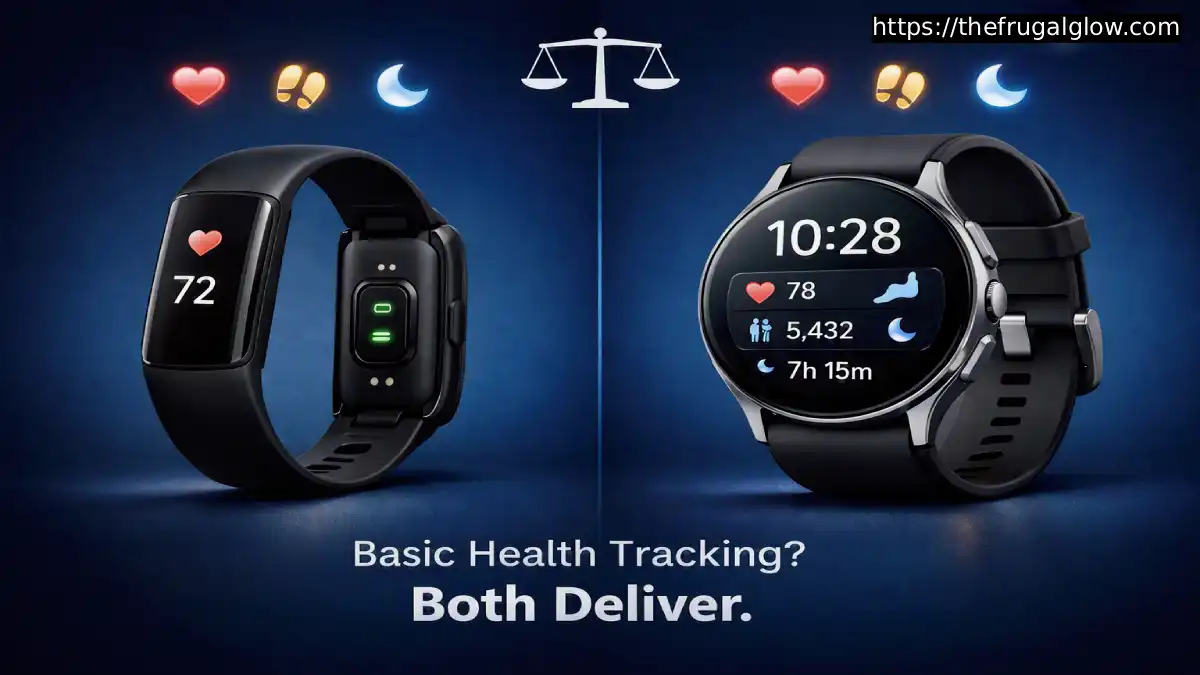
Wearable tech shopping has a way of nudging everyone toward the most expensive option on the shelf, largely because smartwatches dominate the marketing and the storefront displays. But if your actual goal is basic health tracking — steps, heart rate, sleep, general activity trends — the fanciest device on the wall isn’t necessarily the smartest purchase. A genuinely capable smart band, often costing a fraction of a smartwatch’s price, can deliver remarkably similar core health data.
This breaks down exactly where smart bands and smartwatches overlap, where they genuinely diverge, and which one makes more sense depending on what you actually want out of a wearable.
Jump Links
- What’s the Actual Difference Between the Two
- Health Tracking Accuracy: Do They Really Differ
- Battery Life: The Biggest Practical Gap
- Price Comparison
- Full Feature Comparison Table
- What You Actually Get With a Smart Band
- What You Actually Get With a Smartwatch
- Real Product Examples at Each Price Point
- When a Smartwatch Is Genuinely Worth the Extra Cost
- When a Smart Band Is the Smarter Choice
- Value-Per-Dollar Table
- FAQ
- The Bottom Line
What’s the Actual Difference Between the Two
The core distinction comes down to scope, not necessarily raw sensor quality. Smartwatches combine fitness tracking, connectivity, and advanced health features into one device, letting you manage calls, texts, and apps alongside health tools like ECG and blood oxygen monitoring. Smart bands, by contrast, stick to the fundamentals — step counting, heart rate, and sleep tracking — without smartphone app integration, calls, or a broader software ecosystem layered on top.
This isn’t a quality gap so much as a design philosophy gap. A smart band is built to be a focused, single-purpose health tool. A smartwatch is built to be a multi-purpose device that happens to include health tracking as one of several major functions, alongside notifications, payments, and a full app ecosystem.
Health Tracking Accuracy: Do They Really Differ
This is the question that actually matters most for anyone specifically prioritizing basic health tracking over extra features, and the honest answer is: less than you’d expect. Independent testing has found that a $99 fitness band can offer sleep staging and stress scores nearly identical to a $399 premium smartwatch, since both device categories generally rely on similar optical heart rate sensor technology at their core.
That similarity holds up across the fundamentals: step counting, resting heart rate, sleep duration, and general activity trends are all tracked using comparable sensor technology regardless of whether that sensor sits inside a $50 band or a $400 watch. Where meaningful accuracy differences do show up is in more advanced, specialized metrics — features like ECG readings, VO2 max estimates, and detailed workout-specific analytics, which tend to be more refined (and more exclusive to) higher-end smartwatch models.
Battery Life: The Biggest Practical Gap
If there’s one category where smart bands don’t just compete with smartwatches but genuinely outperform them, it’s battery life. Fitness bands are lighter, cheaper, and last much longer on a charge, commonly delivering 14 to 21 days of battery life on a single charge, compared to a typical smartwatch’s 1 to 2 days (or occasionally up to a week for some models specifically optimized for battery efficiency).
This gap matters more for health tracking specifically than people initially realize. Continuous, uninterrupted wear — including through sleep — is what makes metrics like sleep staging, resting heart rate trends, and overnight recovery data genuinely useful over time. A device that needs charging every day or two creates regular gaps in that data, particularly overnight, which is exactly when sleep-tracking data is being collected. A smart band’s multi-week battery life means far fewer of those data gaps.
Price Comparison
The price gap between these two categories is substantial and consistent. Smart bands are typically priced anywhere from roughly $30 to $100, with well-regarded options landing around the $50–$100 range. Full-featured smartwatches, by comparison, commonly run $250 to $450 or more for well-known mainstream brands, with premium models pushing even higher.
That price difference isn’t purely about brand markup — smartwatches genuinely pack in more hardware (larger displays, cellular or GPS chips, speakers and microphones for calls, more powerful processors), and all of that additional hardware adds real manufacturing cost. But for anyone whose priority is specifically basic health tracking rather than those additional smartphone-adjacent features, that extra cost is largely funding capabilities outside the core health-tracking use case.
Full Feature Comparison Table
| Feature | Smart Band | Smartwatch |
|---|---|---|
| Step counting | Yes, generally accurate (96–98%) | Yes, generally accurate |
| Heart rate monitoring | Yes | Yes |
| Sleep tracking | Yes (slightly less refined staging in some models) | Yes, often more detailed staging |
| SpO2 (blood oxygen) | Common on mid-range models | Common, often more refined |
| ECG | Rare, usually premium-only | Available on many higher-end models |
| GPS | Available on some mid-range models | Standard on most models |
| Smartphone app/call integration | No or very limited | Yes, full integration |
| Battery life | 14–21 days typical | 1–7 days typical |
| Typical price range | $30–$100 | $250–$450+ |
| Display size | Smaller (1.0″–1.8″) | Larger (1.3″–1.9″+) |
| Subscription required | Rarely | Occasionally, for advanced features |
What You Actually Get With a Smart Band
- Reliable core metrics. Step counting, heart rate, and sleep duration are consistently tracked with accuracy comparable to pricier devices.
- Multi-week battery life, meaning far less charging maintenance and fewer gaps in continuous data collection, especially overnight.
- A simple, focused interface that doesn’t overwhelm with notifications, apps, or unnecessary features — genuinely useful for anyone who just wants a clean read on their basic health numbers.
- Lightweight, comfortable design, generally in the 26–35 gram range, making it comfortable for genuine 24/7 wear, including sleep.
- Lower cost, freeing up budget for anything else, or simply making wearable health tracking accessible without a major financial commitment.
What You Actually Get With a Smartwatch
- Full smartphone integration, including calls, texts, app notifications, and often mobile payments.
- Larger, more vibrant displays, generally easier to read at a glance and more capable of displaying detailed data visualizations.
- More advanced health sensors on premium models, including ECG, more detailed stress and recovery scoring, and skin temperature sensing.
- Better workout-specific tracking, including built-in GPS as a more standard feature and more detailed, sport-specific training metrics.
- A broader app ecosystem, allowing third-party fitness, productivity, and lifestyle apps to run directly on the device.
Real Product Examples at Each Price Point
To ground this comparison in real numbers rather than abstractions, here’s how a few well-regarded 2026 devices stack up:
- Xiaomi Smart Band 10 (~$53): Frequently cited as the top budget tracker of 2026, this band reliably tracks steps, 24/7 heart rate, and sleep duration, includes SpO2 monitoring, and delivers roughly two weeks of battery life on a single charge — genuinely comprehensive basic health tracking at a fraction of smartwatch pricing.
- Huawei Band 9 (~$99): Positioned as a mid-tier option offering sleep staging and stress scoring described as nearly comparable to premium smartwatches costing several times more.
- Huawei Watch Fit 4 (mid-range smartwatch pricing): Blends a fitness band’s simplicity with a smartwatch’s larger, more polished display, offering accurate dual-frequency GPS and detailed sleep and heart rate tracking without requiring a subscription.
- Apple Watch Series 11 / Samsung Galaxy Watch 8 (premium smartwatch pricing): Full-featured flagship smartwatches offering the most comprehensive combination of health sensors, app ecosystem integration, and smartphone connectivity, at the highest price point in this comparison.
When a Smartwatch Is Genuinely Worth the Extra Cost
There are legitimate scenarios where the added cost of a smartwatch is worth it, even for someone primarily focused on health tracking:
- Existing cardiac monitoring needs. Users with a history of hypertension or arrhythmia genuinely benefit from ECG and irregular heart rhythm alert features, which remain more common and more refined on smartwatches.
- Frequent, serious outdoor exercise. Built-in GPS and detailed, sport-specific workout analytics provide meaningfully better training feedback for runners, cyclists, and other outdoor athletes who want granular performance data.
- Chronic condition management requiring data sharing. Deeper integration with platforms like Apple Health or Samsung Health can make it easier to share tracked data directly with healthcare providers, which matters for anyone actively managing an ongoing health condition.
- Genuine need for smartphone-adjacent features. If notifications, calls, and mobile payments on your wrist are actually useful to your daily life, that functionality is a real, tangible benefit smart bands simply don’t offer.
When a Smart Band Is the Smarter Choice
- Your priority is genuinely basic health tracking. For monitoring sleep hygiene, maintaining activity levels, or catching early signs of overtraining, a smart band delivers comparable insights to a smartwatch at a fraction of the cost.
- You value low-maintenance, long battery life. Someone who checks their health data once a day and dislikes frequent charging benefits significantly from a band’s multi-week battery advantage.
- Budget is a genuine factor. Smart bands make wearable health tracking accessible without requiring a $250–$450+ investment.
- You want a distraction-free device. Without the notification overload and app ecosystem of a smartwatch, a band tends to stay focused purely on health metrics rather than becoming another screen competing for your attention throughout the day.
📌 YOU MIGHT ALSO LIKE:
5 Refurbished Tech Sites Every Frugal Athlete Needs to Bookmark (Save 60% on Garmin)
Value-Per-Dollar Table
| Priority | Better Value Option | Why |
|---|---|---|
| Basic step/heart rate/sleep tracking | Smart band | Comparable accuracy at a much lower price |
| Multi-week battery life | Smart band | Smartwatches rarely exceed a week |
| Budget-conscious first wearable | Smart band | Lower financial commitment to try wearable tracking |
| ECG/cardiac monitoring | Smartwatch | More refined, more widely available on watches |
| Serious outdoor training (GPS-heavy) | Smartwatch | Better built-in GPS and sport-specific analytics |
| Smartphone integration (calls, apps, payments) | Smartwatch | Bands generally don’t offer this functionality |
| Data sharing with healthcare providers | Smartwatch | Deeper health app ecosystem integration |
FAQ
Is a smart band really as accurate as a smartwatch for basic health tracking?
For core metrics like step counting, heart rate, and general sleep tracking, yes, largely comparable accuracy, since both device types generally use similar underlying sensor technology. The bigger accuracy gaps show up in more advanced features like ECG and detailed workout-specific analytics.
Why do smart bands have such a big battery life advantage?
Smart bands have smaller displays, fewer onboard features, and don’t run cellular connectivity, calls, or a full app ecosystem, all of which are significant battery drains on smartwatches. This more limited feature set is exactly what allows bands to last multiple weeks per charge.
Do I need a subscription to use a smart band or smartwatch?
Not always. Several well-regarded brands, including Xiaomi and Garmin, work well without any subscription requirement, while some smartwatches reserve certain advanced features (like detailed coaching or recovery insights) behind a subscription tier.
Which is better for someone just starting to track their health for the first time?
A smart band is generally the smarter starting point for most people, offering solid core health tracking, multi-week battery life, and a much lower financial commitment, making it easier to test whether wearable tracking is genuinely useful for your habits before investing more.
Is a smartwatch worth it if I mostly just want to check my steps and sleep?
Probably not, from a pure value standpoint. If your primary use case is basic step and sleep tracking, a smart band delivers comparable data at a significantly lower price, without paying extra for smartphone integration features you may not use.
Do smartwatches offer better GPS tracking than smart bands?
Generally yes. While some mid-range smart bands do include GPS, it’s more standard and typically more refined on smartwatches, making watches the better choice for serious outdoor runners and cyclists specifically prioritizing detailed route and pace tracking.
The Bottom Line
For genuinely basic health tracking — steps, heart rate, sleep, general activity trends — a smart band consistently delivers accuracy comparable to a smartwatch costing several times more, while adding a major practical advantage in battery life. A smartwatch earns its higher price tag specifically through smartphone integration, advanced cardiac monitoring, and more detailed workout analytics — genuinely valuable additions for some, but not requirements for solid, reliable basic health tracking. Unless those specific extra features matter to you, the smarter buy is very likely the cheaper one.
For more budget-friendly wellness and tech guides, check out more posts over at The Frugal Glow.