

Why Spend $60 on Luxury Hyaluronic Acid? Try This $7 Drugstore Alternative Instead
Jump Links
- What Is Hyaluronic Acid (And Why Do You Need It)?
- The $60 Luxury Serum vs. The $7 Drugstore Alternative
- The Ingredient Breakdown: What You’re Actually Paying For
- The Science of Hyaluronic Acid: Does Price Matter?
- The Best Drugstore Hyaluronic Acid Serums Under $20
- How to Apply Hyaluronic Acid for Maximum Results
- The Math: What I Saved in One Year
- Frequently Asked Questions (FAQ)
- Final Thoughts: The Best Hyaluronic Acid Is the One You Use Consistently
The $60 hyaluronic acid serum was sitting in my Sephora cart. The packaging was gorgeous. The saleswoman promised it would “plump, firm, and hydrate” my skin. The price tag made me pause. $60 for a serum that’s mostly water and a few active ingredients.
I closed the tab and went to the drugstore. I picked up a $7 hyaluronic acid serum. Same active ingredient. Same function. The only difference? The packaging and the price.
That was the day I learned that you don’t need to spend $60 to get the benefits of hyaluronic acid. The best options are hiding at your local drugstore—and they cost under $20.
Today, I’m breaking down why luxury hyaluronic acid is rarely worth the premium. The ingredient science. The drugstore alternatives that perform just as well. And why you should never, ever spend $60 on hyaluronic acid again.
What Is Hyaluronic Acid (And Why Do You Need It)?
Hyaluronic acid (HA) is a naturally occurring sugar molecule found in your body’s connective tissue and synovial fluid. Think of it as a sponge. It attracts and holds water—up to 1,000 times its weight in moisture.
What it does in skincare: It draws water into the skin, making it look plumper, smoother, and more hydrated. Fine lines appear softer. The skin looks dewy and refreshed. It’s a humectant, which means it pulls moisture from the air and locks it into the skin .
Who needs it: Everyone. As we age, our natural HA production declines. Skin becomes drier, lines become more visible, and that “bounce” starts to fade. Adding it topically helps compensate for that loss.
The immediate effect: “Hyaluronic acid binds water in the upper layers of the skin, so fine lines look softer, and the surface looks plumper and more hydrated almost immediately,” says plastic surgeon Dr. Mike Roskies . It’s the closest thing you can get to injectable filler in a bottle.
The long-term effect: With consistent use, HA helps strengthen the skin barrier and improve moisture retention over time. The results are cumulative.
What to look for: Look for products with multiple molecular weights of hyaluronic acid—some small enough to penetrate deeply, others large enough to sit on the surface and pull moisture in. The ingredient may appear on the label as hyaluronic acid or sodium hyaluronate (a salt form that often has a lower molecular weight and penetrates more easily) .
The $60 Luxury Serum vs. The $7 Drugstore Alternative
Let me put these head to head.
The Luxury Serum:
- Price: $60
- Key ingredient: Hyaluronic acid (proprietary blend)
- Packaging: Heavy glass bottle, gold accents
- Marketing: Celebrity endorsements, “clinical studies”
- Cost per use: ~$0.60-1.00
The Drugstore Alternative:
- Price: $7-10
- Key ingredient: Hyaluronic acid 2% + B5 + ceramides
- Packaging: Simple glass bottle with dropper
- Marketing: Ingredient-focused, no celebrity endorsements
- Cost per use: ~$0.10-0.15
The functional difference: Almost none. “A basic hyaluronic acid serum designed to hydrate and plump does not fundamentally change because it arrives in heavier glass or has celebrity backing,” explains a beauty industry analysis . A straightforward HA product can deliver visible improvements without an elevated price tag.
What you’re paying for with luxury: “Marketing, packaging, and brand prestige rather than actual performance of ingredients” . When you look at the ingredient list, the hero ingredient is often buried after the preservatives, meaning it’s present at less than 1% concentration. That’s below the threshold at which most actives produce measurable effects .
What dermatologists say: “The best skincare routine is the one built around proven actives at effective concentrations, maintained consistently over time. Whether those actives come from a $12 drugstore purchase or a $120 Sephora bottle matters far less than whether they are actually there” .
The Ingredient Breakdown: What You’re Actually Paying For
Here’s the truth about ingredient labels.
The rule: Ingredients are listed in descending order of concentration. An ingredient near the top is present in a meaningful amount. An ingredient buried at position 25 of 30 is likely present at less than 1% concentration, which is below the threshold at which most actives produce measurable effects .
The problem with luxury HA: Many luxury serums bury the hyaluronic acid after the preservatives. By the time you get to it, you’re paying for water, glycerin, and marketing—not the active ingredient.
The drugstore advantage: Brands like The Ordinary disclose exact percentages on the label. You know exactly what you’re getting. “The Ordinary offers pharmaceutical-grade concentrations of actives at prices that are genuinely disruptive to the market” .
The Ordinary HA 2% + B5 contains:
- 5 molecular weights of hyaluronic acid for multi-layer hydration
- Pro-vitamin B5 to strengthen the moisture barrier
- Ceramides to support barrier function
- Vitamin E for antioxidant protection
Price: $10 for 30ml, making it one of the most value-dense serums on the market. The per-application cost is approximately ten cents .
What plastic surgeons say: “It’s the same hero ingredient at a drugstore price,” says plastic surgeon Dr. Mike Roskies, who recommends The Ordinary’s $10 HA serum to patients who want filler-adjacent results without the cost .
The Science of Hyaluronic Acid: Does Price Matter?
Price does not affect the efficacy of hyaluronic acid. The molecule is the molecule.
Molecular weight matters: Research shows that low-molecular-weight HA (50-130 kDa) penetrates the epidermis more effectively than high-molecular-weight forms, while high-MW HA (>1,000 kDa) provides superior surface film formation and immediate moisture retention . Both are available in drugstore formulas.
The Ordinary’s formula: Contains five molecular weights of HA, including a next-gen crosspolymer, to draw moisture into multiple layers of the skin for a smoother, bouncier look .
What the research says: “A study by Pavicic et al. in the Journal of Drugs in Dermatology (2011) established that low-molecular-weight HA penetrates the epidermis more effectively than high-molecular-weight forms, while high-MW HA provides superior surface film formation and immediate moisture retention” .
The barrier factor: The addition of ceramides reflects dermatological understanding that a hydrating serum should ideally support both water content and barrier integrity. “The skin barrier is composed of approximately 50% ceramides, 25% cholesterol, and 15% free fatty acids in a lamellar structure” .
What beauty editors found: In a test of five drugstore hyaluronic acid serums by a beauty writer, The Ordinary’s formula was the consistent winner. “There’s nothing ordinary about The Ordinary. This was the first hyaluronic acid I ever tried—and I’ve been obsessed with this ultra-affordable serum for years” .
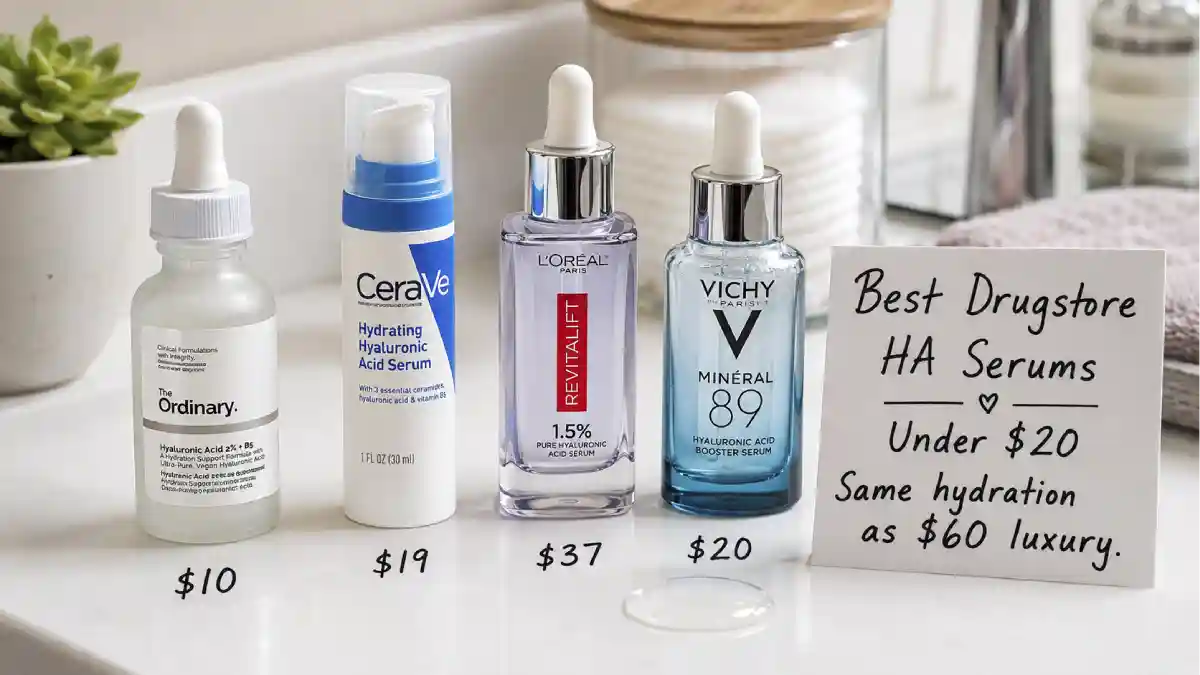
The Best Drugstore Hyaluronic Acid Serums Under $20
Here are the best drugstore HA serums, according to dermatologists, beauty editors, and thousands of reviews.
1. The Ordinary Hyaluronic Acid 2% + B5 (with Ceramides) – $10
The gold standard of affordable HA. “A little bit of this lightweight formula goes a long way, and the moment it touches my face after cleansing, my skin gets an immediate moisture boost,” says one beauty editor . It contains five types of HA, B5, and ceramides that help keep moisture locked in. The formula is fragrance-free and suitable for sensitive skin .
What reviewers say: “I’ve used dozens of bottles of The Ordinary’s hyaluronic acid over the years and have about 10 more in my cabinet at any given time. Not only is it extremely affordable at just under $10, but the simple, fragrance-free formula instantly sinks into my skin, making it appear plumper, smoother, and more hydrated within seconds” .
2. CeraVe Hydrating Hyaluronic Acid Serum – ~$19
A dermatologist favorite. “It utilizes their proprietary MVE technology, which basically means it releases moisture over time” . Contains three essential ceramides, highly concentrated hyaluronic acid, and B5. “A few pumps of this gel-cream moisturizing serum are all you need to lock in hours of hydration” .
Who it’s for: Dry, sensitive, or acne-prone skin. Fragrance-free and non-comedogenic.
3. L’Oréal Revitalift 1.5% Pure Hyaluronic Acid Serum – $25-37
The high-potency option. Eva Longoria calls it the “basis of [her] skin,” saying “You can’t lay good makeup on bad skin” . Contains 1.5% pure hyaluronic acid with micro-epidermic HA that can penetrate deeper into the skin to improve the look of wrinkles. “Count this as one celebrity-loved product that actually lives up to its claims” .
Who it’s for: Mature skin, very dry skin, anyone who wants visible results fast.
4. Vichy Mineral 89 Hyaluronic Acid Booster Serum – $20-30
The French pharmacy classic. Formulated with mineral-rich volcanic water and hyaluronic acid. Has the loveliest gel-serum texture and feels super elegant on skin . “It’s fast-absorbing and layers well with other skincare products and makeup” .
Who it’s for: All skin types, especially those who want a simple, effective formula.
5. Neutrogena Hydro Boost Hyaluronic Acid Serum – ~$20
The lightweight option. Contains a dual-weight HA system and Aquaxyl complex to increase the skin’s own hyaluronic acid levels . “Very lightweight, watery gel consistency… Absorbs rapidly into the skin without leaving any sticky or greasy residue” .
Who it’s for: Oily, combination, or acne-prone skin.
How to Apply Hyaluronic Acid for Maximum Results
Even the best HA won’t work if you apply it wrong. Here’s the correct technique.
Rule #1: Apply to damp skin.
Hyaluronic acid is a humectant. It pulls moisture from the environment into your skin. If you apply it to dry skin, it can pull moisture from deeper layers of your skin, actually making you more dehydrated. “Apply to slightly damp skin and seal with a moisturizer,” says plastic surgeon Dr. Mike Roskies .
Rule #2: Follow with a moisturizer.
Apply your moisturizer immediately after the HA. This locks in the hydration and prevents the HA from drawing moisture out of your skin.
Rule #3: Don’t use too much.
The Ordinary’s HA 2% + B5 requires only a few drops. One tiny drop covers your face and neck if applied to damp skin .
Rule #4: Wait before applying the next product.
Allow 60-90 seconds for the HA to absorb before applying the next product to minimize pilling risk .
The correct order:
- Cleanse
- Apply HA to damp skin (gentle patting, not rubbing)
- Wait 60-90 seconds
- Apply moisturizer
- Apply sunscreen (AM)
The Math: What I Saved in One Year
Let me break down the actual dollars.
If I bought the $60 luxury HA:
| Item | Cost | How Often | Annual Cost |
|---|---|---|---|
| Luxury HA serum | $60 | Every 2 months | $360 |
What I actually spend (drugstore HA):
| Item | Cost | How Often | Annual Cost |
|---|---|---|---|
| The Ordinary HA 2% + B5 | $10 | Every 2 months | $60 |
Annual savings: $300
Over 5 years: $1,500
And my skin is just as hydrated and plump as it was with the luxury version.
📌 YOU MIGHT ALSO LIKE:
5 Best ‘CVS’ Moisturizers for Sensitive Skin That Won’t Break the Bank
Frequently Asked Questions (FAQ)
1. Is expensive hyaluronic acid better than drugstore?
No. The molecule is the same. “A basic hyaluronic acid serum designed to hydrate and plump does not fundamentally change because it arrives in heavier glass or has celebrity backing” . What matters is the concentration and molecular weight, not the price tag.
2. What percentage of hyaluronic acid is effective?
Most effective HA serums contain 1-2% hyaluronic acid. The Ordinary’s formula contains 2% HA plus B5 and ceramides . L’Oréal’s Revitalift contains 1.5% pure HA . A product with 3.5% HA is also effective and offers high value .
3. Can I use hyaluronic acid every day?
Yes. Twice daily is ideal—morning and evening. Apply to damp skin before your moisturizer. The results are cumulative. “For regular daily use, this product is the way to go” .
4. What’s the best drugstore hyaluronic acid serum?
The Ordinary Hyaluronic Acid 2% + B5 (with Ceramides) is the consensus best value. Beauty editors, dermatologists, and thousands of users consistently recommend it . It contains five types of HA, B5, and ceramides for barrier support.
5. Should I use hyaluronic acid if I have dry skin?
Yes. Hyaluronic acid is especially beneficial for dry skin. One reviewer with dry skin said: “Sometimes, this was the only product I used at bedtime, and I would wake up to plumper skin” . Just make sure to apply to damp skin and follow with a moisturizer to seal in hydration.
6. What’s the difference between hyaluronic acid and sodium hyaluronate?
Sodium hyaluronate is a salt form of hyaluronic acid. It often has a lower molecular weight than raw HA molecules, meaning it can penetrate the skin’s barrier deeper than larger HA molecules . Both are effective and often appear together in good formulas.
7. Should I use hyaluronic acid with retinol?
Yes. Dermatologists recommend using HA with retinol to minimize irritation and maintain hydration while the retinol works. Apply HA to damp skin, wait 60-90 seconds, then apply retinol, followed by moisturizer.
8. Can I use hyaluronic acid on my body?
Yes. Many users add it to hand cream and foot lotion to keep skin from becoming rough or dry . The price point makes it easy to use beyond the face. One reviewer adds it to hand cream and foot lotion to prevent roughness and dryness .
Final Thoughts: The Best Hyaluronic Acid Is the One You Use Consistently
The $60 luxury HA is sitting on a Sephora shelf. My $10 The Ordinary serum is in my bathroom cabinet. My skin is hydrated, plump, and smooth. And I didn’t break the bank to get it.
The molecule is the same. The function is the same. What you’re paying for with luxury is packaging, marketing, and brand prestige—not performance .
The $10 routine:
- The Ordinary Hyaluronic Acid 2% + B5 ($10)
- Apply to damp skin morning and night
- Follow with moisturizer
- That’s it
I’ve been using The Ordinary HA for years. My skin is hydrated, my fine lines are softer, and I’ve saved hundreds of dollars.
That’s not cheap. That’s smart.
That’s the frugal glow. And it’s waiting for you at the drugstore. 💛
*For more budget beauty tips, product recommendations, and money-saving skincare strategies, visit The Frugal Glow.*