

The Ultimate Guide to Finding Your True Foundation Shade at the Drugstore
Jump Links
- Why Drugstore Foundation Matching Is So Tricky
- Step 1: Understand Your Undertone (The Game-Changer)
- Step 2: Identify Your Depth (How Light or Dark)
- Step 3: Swatch Like a Pro (Even Without Testers)
- Step 4: Check the Shade in Natural Light
- Step 5: Let It Oxidize (The Wait Test)
- The Best Drugstore Foundations for Every Undertone
- The Shade Twin Strategy: Learn from Others
- What to Do If You Buy the Wrong Shade
- The Math: What I Saved in One Year
- Frequently Asked Questions (FAQ)
- Final Thoughts: The Perfect Match Is Out There
The $50 foundation was sitting in my Sephora cart. The shade was perfect. But $50 for a bottle of pigment? That’s almost a week’s worth of groceries.
I closed the tab and went to the drugstore. I found the L’Oréal True Match foundation for $12. But finding my shade? That was a journey.
That was the day I learned that you don’t need to spend $50 to get a perfect foundation match. You just need to know how to shop.
Today, I’m sharing the ultimate guide to finding your true foundation shade at the drugstore. No testers. No fancy lighting. Just practical tips that actually work.
Why Drugstore Foundation Matching Is So Tricky
Drugstore foundation matching is notoriously difficult . Unlike Sephora or department stores, drugstores rarely have testers . You’re staring at bottles through plastic packaging, trying to guess your shade under harsh fluorescent lighting .
The challenges:
- No testers: You can’t swatch before you buy .
- Bad lighting: Store lighting is notoriously deceiving. What looks perfect under fluorescent lights might be too orange or ashy in daylight .
- Oxidation: Some foundations darken as they react with your skin’s oils .
- Packaging: The bottle color often doesn’t match the actual product.
But here’s the good news: once you understand your undertone, depth, and a few pro techniques, finding your shade becomes significantly easier.
Step 1: Understand Your Undertone (The Game-Changer)
Foundation matching fails for one core reason: people match depth without matching undertone . Depth is how light or dark your skin is—that’s the easy part. Undertone is whether your skin leans warm, cool, neutral, or olive .
Why undertone matters: Two people with identical depth can need completely different foundation shades if their undertones differ . A shade that matches your depth but clashes with your undertone will look like a mask .
The 5 undertone families:
| Undertone | Characteristics | Foundation Labels |
|---|---|---|
| Cool | Pink, rosy, blue-red | “Cool,” “Rose,” “C,” “Pink” |
| Warm | Golden, peach, yellow | “Warm,” “Golden,” “W,” “Yellow” |
| Neutral | Balanced mix of pink and yellow | “Neutral,” “N,” “Beige” |
| Olive | Greenish, grayish hue | “Olive,” “Warm Olive,” “Golden Olive” |
| Red | Rosy, flushed | Rarely labeled, often in cool category |
How to find your undertone:
The Vein Test: Look at the veins on your wrist . Blue or purple veins usually mean cool. Green veins mean warm. A mix of both suggests neutral . For olive tones, veins often appear more greenish-blue .
The Jewelry Test: Does silver jewelry flatter you more or gold? . Silver looks better on cool tones. Gold looks better on warm tones. If both look good, you’re likely neutral .
The White Paper Test: Hold a pure white piece of paper next to your bare face in natural light . Does your skin look more yellow (warm), pink (cool), or greenish/grayish (olive)?
The Sun Reaction Test: Do you tan easily or burn? . People who tan easily and rarely burn often have warm undertones. People who burn first and tan slowly often have cool undertones .
Where to look: According to L’Oréal celebrity makeup artist Sir John, your undertone is most visible in two specific areas: the space between your cheekbones and eyes, and in the middle of your forehead near your eyebrows .
Step 2: Identify Your Depth (How Light or Dark)
Once you know your undertone, you need to determine your depth—how light or dark your skin is .
Depth categories:
| Category | Description |
|---|---|
| Fair | Very light, porcelain |
| Light | Light ivory, beige |
| Medium | Tan, sand |
| Tan | Caramel, golden brown |
| Deep | Rich, dark brown |
The jawline-neck check: Your best foundation shade usually aims to unify your face with your neck . Hold the bottle up to your neck, not your face or hand . The shade that disappears at the jaw-to-neck transition is your match .
Seasonal adjustments: Most people need two foundation shades: one for winter (lighter) and one for summer (deeper) . If you get a tan in summer, your winter shade will be too light. If you lose your tan in winter, your summer shade will be too dark .
The rule: Foundation should match your neck and chest, not the temporary redness in your cheeks .
Step 3: Swatch Like a Pro (Even Without Testers)
Even without testers, there are ways to swatch accurately .
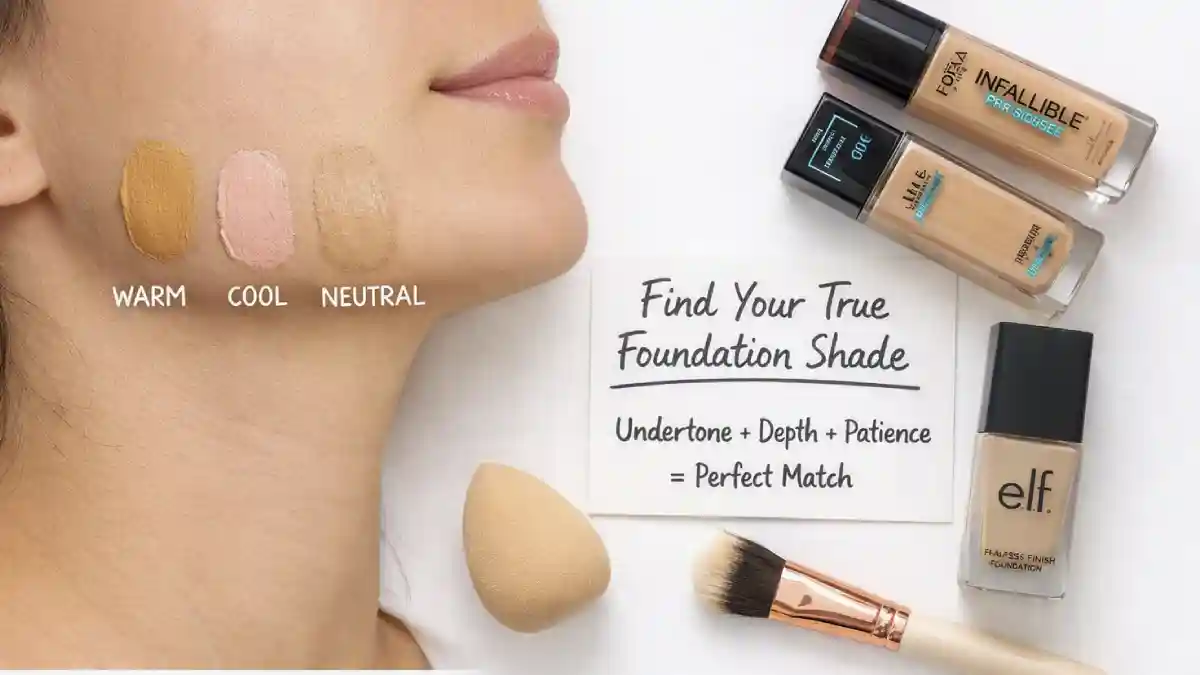
**Method 1: The jawline swatch **
If you can get a sample or have access to a tester, swatch three shades along your jawline . The correct shade disappears into your skin at the jaw-to-neck transition .
Why not your hand: The skin on your hand is often a different color than your face and neck . Swatching on your hand is misleading .
**Method 2: The bottle-to-neck test **
If you can’t swatch, hold the bottle up to your neck in natural light . This gives you a general sense of whether the shade will work.
**Method 3: Use your existing shade as reference **
Find your shade in one brand, then use an online tool to find similar shades in other brands .
Step 4: Check the Shade in Natural Light
Store lighting is notoriously deceiving . Fluorescent lights can make shades look completely different than they appear in daylight .
What to do: Step outside or near a window . Natural light is the most honest judge of foundation matches . If you can’t go outside, stand near a window with natural light .
What professional makeup artist Sir John says: “Sometimes the best lighting in the drugstore is not always the makeup aisle. Look for a place with some natural light seeping through” .
Check in three lighting conditions :
- Natural daylight (the most revealing)
- Warm indoor light (most forgiving)
- Cool office lighting (amplifies pink and can make warm shades look off)
Step 5: Let It Oxidize (The Wait Test)
Most liquid foundations shift warmer (more orange or yellow) as they react with your skin’s oils and pH over time . A shade that looks perfect in the store can turn noticeably wrong by lunchtime .
Why it happens: Oxidation occurs when the foundation reacts with air and your skin’s natural oils . Some formulas deepen or warm up significantly after application .
What to do: If you can, wear a test patch for at least two hours before committing . Check it again in natural light. If it’s shifted noticeably warmer or darker, you need to go one shade cooler or lighter than your initial match to compensate .
Who it affects most: Cool-undertone skin oxidizes foundations most dramatically . Warm-undertone skin may not notice the shift as much because the oxidation often moves toward warm/yellow tones.
The Best Drugstore Foundations for Every Undertone
Here are the best drugstore foundations for each undertone.
For Warm Undertones:
| Brand | Foundation | Shade Notes |
|---|---|---|
| L’Oréal | True Match | Labels with “W” (Warm) |
| Maybelline | Fit Me Matte + Poreless | Extensive warm shade range |
| e.l.f. | Halo Glow Filter | Shade 3.5 Medium is warm |
| Covergirl | Clean Invisible | Shade 148 Perfect Beige |
For Cool Undertones:
| Brand | Foundation | Shade Notes |
|---|---|---|
| L’Oréal | True Match | Labels with “C” (Cool) |
| Maybelline | Fit Me | Shade 222 True Beige has cool undertones |
| Revlon | ColorStay | Good cool shade range |
For Neutral Undertones:
| Brand | Foundation | Shade Notes |
|---|---|---|
| L’Oréal | True Match | Labels with “N” (Neutral) |
| e.l.f. | Camo CC Cream | Shade 425 Neutral |
| Milani | Conceal + Perfect | Shade 9 is neutral |
For Olive Undertones:
| Brand | Foundation | Shade Notes |
|---|---|---|
| L’Oréal | True Match | N7 is a great olive shade |
| Maybelline | Skin Tint | Shade 55 works for olive |
| Revlon | Illuminance | Shade 409 (may need blue mixer) |
For Deeper Skin Tones:
Brands that have stepped up their game for darker skin tones include :
- Maybelline Fit Me (huge spectrum of deeper options)
- L’Oréal True Match (categorizes by undertone)
- Milani Conceal + Perfect (solid range of deeper shades)
- e.l.f. Flawless Finish (consistently expanding shade range)
- Black Opal True Color (designed specifically for women of color)
The Shade Twin Strategy: Learn from Others
Finding your shade twin—someone with the same skin tone and undertone as you—can save you a ton of trial and error .
What is a shade twin? Someone who wears the same foundation shade as you in multiple brands. If you find a shade twin, you can ask them for recommendations in other foundations .
How to find your shade twins:
- Check beauty communities on Reddit (r/MakeupAddiction, r/DrugstoreMUA)
- Browse Lemon8 for shade twin posts
- Search for “[brand] [shade] shade twin” on TikTok or Instagram
- Use tools like Temptalia’s Foundation Matrix
- Follow creators with similar skin tones to yours
What one user said: “Finding the perfect foundation shade, especially when you have a beautiful deeper skin tone, can feel like a never-ending quest. I totally get it! Many brands, especially in the drugstore aisle, have historically overlooked the rich diversity of darker complexions, leaving us feeling frustrated” .
What to Do If You Buy the Wrong Shade
Even with the best techniques, you might still buy the wrong shade. Here’s what to do.
Option 1: Return it. Drugstores like CVS, Walgreens, and Target accept returns of opened beauty products within 30 days. Keep your receipt.
Option 2: Mix it. If it’s too dark, mix it with a lighter shade . If it’s too warm, add a drop of blue pigment mixer . If it’s too cool, add a drop of yellow pigment mixer .
Option 3: Use it differently. A too-dark foundation can be used as a bronzer or contour. A too-light foundation can be used as a highlight.
Option 4: Adjust with other products. If your foundation is too fair or cool, try adding bronzer around the frame of your face . This brings more color and warmth.
The Math: What I Saved in One Year
If I bought the $50 luxury foundation:
| Item | Cost | How Often | Annual Cost |
|---|---|---|---|
| Luxury foundation | $50 | Every 2 months | $300 |
What I actually spend (drugstore foundation):
| Item | Cost | How Often | Annual Cost |
|---|---|---|---|
| Drugstore foundation | $12 | Every 2 months | $72 |
Annual savings: $228
Over 5 years: $1,140
And my foundation match is just as perfect.
📌 YOU MIGHT ALSO LIKE:
How to Make a $5 Drugstore Foundation Look Like a $50 Luxury Finish
Frequently Asked Questions (FAQ)
1. Why does foundation look different on me than in the bottle?
Foundation often oxidizes—it reacts with your skin’s oils and the air, darkening or warming in color . Always test a shade on your jawline and wait at least two hours before committing . The color in the bottle is often lighter than the final result on your skin .
2. What’s the best way to find my foundation shade at the drugstore without testers?
Hold the bottle up to your neck in natural light . Understand your undertone (warm, cool, neutral, or olive) . If possible, use online shade matching tools or ask for samples . Or, use your existing foundation shade as a reference to find similar shades in other brands .
3. Can I use foundation that’s a little too dark or light?
If you’re between two shades, go slightly lighter for a more natural look . A too-dark foundation can look mask-like even with sheer application . You can always add bronzer or blush to add warmth, but a too-dark shade is harder to fix.
4. How do I know if I have olive undertones?
Olive skin carries green or grey-green pigment beneath the surface . A warm shade will look too yellow; a cool shade will look too pink. If many shades look too pink or too yellow on you, you may have an olive undertone . The vein test often shows greenish-blue veins .
5. Do I need different foundation shades for summer and winter?
Yes. If you get a tan in summer, your winter shade will be too light. If you lose your tan in winter, your summer shade will be too dark . Keep both shades and mix them during transition seasons .
6. Why do my veins look both blue and green? What does that mean?
If your veins look like a mix of blue and green, or if they’re hard to distinguish, you likely have a neutral undertone . Neutral skin has a balanced mix of pink and yellow pigments and can wear both warm and cool-toned foundations.
Final Thoughts: The Perfect Match Is Out There
The $50 foundation is sitting on a Sephora shelf. My $12 drugstore foundation is on my bathroom counter. My skin tone is perfectly matched, and I didn’t break the bank to get it.
Finding your true foundation shade at the drugstore takes patience. But once you understand your undertone, depth, and how to test—even without testers—the process becomes significantly easier.
The key steps:
- Understand your undertone
- Determine your depth
- Swatch on your jawline, not your hand
- Check in natural light
- Let it oxidize
That’s it. A perfect foundation match without the luxury price tag.
I’ve been using drugstore foundation for years. My skin looks flawless, my bank account is healthy, and I’ve saved over $1,000.
That’s not cheap. That’s smart.
That’s the frugal glow. And it’s waiting for you at the drugstore. 💛
*For more budget beauty tips, product recommendations, and money-saving skincare strategies, visit The Frugal Glow.*