
Is the New $16 La Roche-Posay Budget Sunscreen Stick Worth Adding to Your Bag?
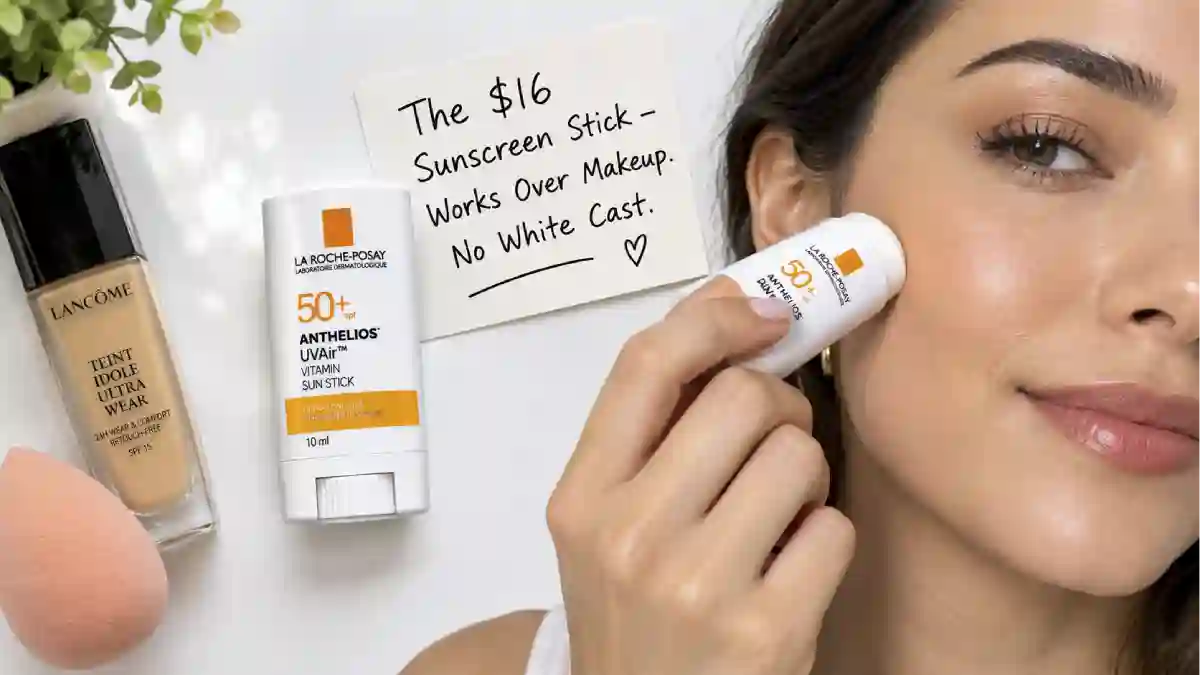
The $16 La Roche-Posay stick was sitting on the shelf at Ulta. It was tiny—barely bigger than a matchbox. The price tag said $16. I had been looking for a sunscreen stick for months. Something I could throw in my bag and use to reapply over makeup without ruining my foundation.
I had tried other sticks. The Neutrogena one was too greasy. The Supergoop one was $32. The Shiseido one was $30. All of them had the same problem: they either cost too much or felt too heavy.
The La Roche-Posay stick was $16. It promised SPF 50+, an invisible finish, and reapplication over makeup. I bought it. I tested it for two weeks. And I found out that it’s genuinely excellent—with one important catch that every review seems to skip.
Today, I’m sharing everything you need to know about the La Roche-Posay Anthelios UVAir Vitamin Sun Stick. What it does well. What it doesn’t. And whether it deserves a spot in your bag.
Jump Links
- The $16 Stick That Solves the Reapplication Problem
- What This Stick Actually Is (And What It Isn’t)
- The Filter System: Why It’s Better Than Most
- The Texture Test: How It Feels on Real Skin
- The Application Problem (The One Thing That Could Ruin It)
- How It Compares to $10 and $40 Alternatives
- Who This Stick Is Actually For
- How to Use It Without Wasting Product
- The Math: What I Saved by Switching
- Frequently Asked Questions (FAQ)
- Final Thoughts: The Best Sunscreen Is the One You Actually Reapply
The $16 Stick That Solves the Reapplication Problem
Let me start with why sunscreen sticks exist.
Dermatologists are unanimous on this point: most people apply sunscreen once in the morning and never reapply. That means afternoon protection lags far behind the SPF number on the bottle. The challenge has always been practicality. Reapplying a cream or lotion over makeup is messy, time-consuming, and ruins your foundation.
Sunscreen sticks solve that problem. A solid stick glides on over makeup without disturbing it. It’s mess-free, spill-proof, and fits in any bag . It makes reapplication realistic for people who would otherwise skip it entirely.
But there’s a catch—and it’s a big one. Sunscreen sticks are notorious for under-application. The SPF rating is tested using a generous amount of product (2 mg per square centimeter). Most people apply a fraction of that with a stick, which means the real-world SPF is far lower than the label .
So the question isn’t just “is this stick good?” It’s “does this stick make it easy enough to apply the right amount?” That’s what I tested.
What This Stick Actually Is (And What It Isn’t)
The La Roche-Posay Anthelios UVAir Vitamin Sun Stick is a 10ml solid sunscreen stick. It’s part of the Anthelios line, which is the brand’s dermatologist-recommended suncare range .
What it is:
- A SPF 50+ broad-spectrum sunscreen stick
- Formulated with a modern filter system (more on that below)
- Enriched with Vitamin E and Astaxanthin for antioxidant protection
- Sweat and water resistant
- Designed for reapplication over makeup
- Dermatologist tested and recommended
What it isn’t:
- A replacement for your primary morning sunscreen. It’s a reapplication tool, not a base layer .
- A body sunscreen. The 10ml size is too small for anything but targeted facial touch-ups .
- A lip balm. Some retailers have added stickers saying “Not Suitable For Lips,” which has confused many longtime users who used the older version as a lip balm .
The size matters. At 10ml, this stick is designed for facial reapplication—nose, cheeks, forehead, ears. It’s not meant to cover your whole body. If you’re looking for a body sunscreen, this isn’t it.
The Filter System: Why It’s Better Than Most
This is where the La Roche-Posay stick genuinely stands out—and where most reviews fail to give credit.
The formula uses a filter quad: Tinosorb S (Bis-Ethylhexyloxyphenol Methoxyphenyl Triazine), Uvinul A Plus (Diethylamino Hydroxybenzoyl Hexyl Benzoate), Uvinul T 150 (Ethylhexyl Triazone), and Uvasorb HEB (Diethylhexyl Butamido Triazone) .
Why this matters: Most American sunscreens rely on avobenzone for UVA protection. Avobenzone is photo-unstable—it degrades under UV exposure unless stabilized by other ingredients. Every filter in this stick is intrinsically photostable, meaning the protection maintains its capacity over hours of exposure without relying on a fragile component .
This is a meaningful design advantage for a product meant to be your dependable layer across a full day. The filter system is the kind of thing you’d expect in a $30+ sunscreen, not a $16 stick.
The formula also includes Vitamin E (Tocopherol) and Astaxanthin, two antioxidants that help neutralize the free radicals generated by the UV radiation that does get through. Astaxanthin is an algae-derived carotenoid with strong free-radical-quenching capacity . This isn’t label decoration—it’s a genuine backup system for the filter protection.
The Texture Test: How It Feels on Real Skin
This is where the La Roche-Posay stick shines in daily use.
I applied it over a full face of makeup: foundation, concealer, powder, blush. The stick glided on without tugging or dragging. It didn’t disturb the makeup underneath. It left a soft, satin finish that actually made my skin look better—a subtle glow rather than a greasy shine .
One beauty editor described it as making her makeup look “better after it goes on, with a soft-focus, satiny glow” . I agree. It’s not matte, but it’s not greasy either. It’s the kind of finish that works on most skin types.
The formula is fragrance-free according to the INCI list, though some regional versions list “Parfum/Fragrance” . If you’re sensitive to fragrance, check the specific product listing for your region.
The texture verdict: It’s one of the most elegant sunscreen sticks I’ve tried. It doesn’t feel like sunscreen. It doesn’t smell like sunscreen. It feels like a skincare product that happens to have SPF 50+.
The Application Problem (The One Thing That Could Ruin It)
Here’s the catch that every review seems to skip.
Sunscreen sticks require multiple deliberate passes to apply enough product to reach the labeled SPF. Dermatologists recommend four or more swipes over each area—more than you think is necessary—and then blending with your fingers to ensure even coverage .
The problem is that a stick feels like it’s applying more product than it actually is. A few quick swipes feel like “enough” when they’re actually delivering a fraction of the tested amount .
What this means in practice: If you use this stick the way most people use a stick—two or three quick swipes—you’re probably getting SPF 10-15, not SPF 50+. That’s still better than nothing, but it’s not the protection on the label.
The fix: Apply four or more passes over each area. Press gently rather than dragging. Blend with your fingertips to ensure even coverage. It takes about 30 seconds longer than a single swipe. That 30 seconds is the difference between real SPF 50+ and a false sense of security.
This isn’t a flaw specific to La Roche-Posay. It’s a flaw inherent to the stick format. But it’s important to know before you buy.
How It Compares to $10 and $40 Alternatives
| Feature | La Roche-Posay UVAir ($16) | Neutrogena Beach Defense ($10) | Supergoop! Unseen Stick ($32) | Shiseido Clear Stick ($30) |
|---|---|---|---|---|
| SPF | 50+ | 50 | 30 | 50+ |
| Filter type | Photostable quad (Tinosorb S, Uvinul A Plus, Uvinul T 150, Uvasorb HEB) | Chemical (avobenzone-based) | Chemical (avobenzone-based) | Chemical (avobenzone-based) |
| Antioxidants | Vitamin E + Astaxanthin | None listed | None listed | None listed |
| Finish | Satin, subtle glow | Greasy (too heavy for oily skin) | Velvety, matte | Clear, invisible |
| Size | 10ml | 13g | 20g | 0.7 oz |
| Price per ml | $1.60/ml | $0.77/g | $1.60/g | ~$1.50/ml |
The Neutrogena option: Cheaper per gram, but the formula is greasy and too heavy for oily skin. It’s a solid budget pick for dry skin, but not for everyone .
The Supergoop! option: Twice the price, but twice the product. The finish is more matte and velvety. If you prefer a matte finish and don’t mind spending more, it’s a good alternative .
The Shiseido option: Also twice the price. Clear and invisible, but with a smaller filter system and no antioxidant boost .
The La Roche-Posay verdict: It’s the best balance of price, protection, and finish. The photostable filter system and antioxidant pairing are genuinely superior to the cheaper alternatives. The only thing it lacks is size—10ml goes fast if you’re applying the recommended four passes.
Who This Stick Is Actually For
This stick is for you if:
- You wear makeup and want to reapply SPF without ruining it
- You have sensitive skin and need a dermatologist-tested formula
- You want a high-protection stick with a modern, photostable filter system
- You’re willing to apply multiple passes for real protection
- You want a stick that doubles as a subtle highlighter
This stick is not for you if:
- You want a single-swipe-and-go sunscreen (no stick works this way)
- You need a body sunscreen (10ml is too small)
- You prefer a completely matte finish
- You want to use it as a lip balm (some versions are labeled “Not Suitable For Lips”)
How to Use It Without Wasting Product
- Apply your primary sunscreen first. A lotion or cream as your base layer, applied generously .
- Do your makeup. Foundation, concealer, powder—whatever you normally wear.
- Use the stick for touch-ups. Swipe four or more passes over each area: nose, cheeks, forehead, ears, hairline .
- Blend with your fingers. Gently press the product into the skin to ensure even coverage .
- Reapply every two hours. Or after swimming, sweating, or toweling off .
The storage tip: Keep one in your bag, one at your desk, and one in your car. The stick format is spill-proof and won’t leak. The more places you have it, the more likely you are to actually reapply.
The Math: What I Saved by Switching
If I used a $32 Supergoop! Unseen Stick:
| Item | Cost | How Often | Annual Cost |
|---|---|---|---|
| Supergoop! Unseen Stick | $32 | Every 2 months | $192 |
What I actually spend (La Roche-Posay UVAir):
| Item | Cost | How Often | Annual Cost |
|---|---|---|---|
| La Roche-Posay UVAir Stick | $16 | Every 2 months | $96 |
Annual savings: $96
Over 5 years: $480
And the La Roche-Posay version has a better filter system and added antioxidants.
📌 YOU MIGHT ALSO LIKE:
I Tried the New $12 Drugstore Peptide Lip Treatment: Better Than High-End Brands?
Honest Review: The New $15 CeraVe Barrier Repair Balm Everyone Is Talking About
Frequently Asked Questions (FAQ)
1. Is the La Roche-Posay stick worth $16?
Yes, if you’re looking for a high-protection sunscreen stick that works over makeup. The photostable filter system and antioxidant pairing are genuinely superior to cheaper alternatives. It’s the best balance of price, protection, and elegance I’ve found .
2. Does it leave a white cast?
No. The formula is designed to be invisible on all skin tones. Multiple reviews confirm it goes on completely clear with no white residue .
3. Can I use it as my only sunscreen?
You can, but you need to be deliberate about applying enough product—four or more passes over each area. For most people, a lotion or cream as the primary morning application, with the stick for reapplication, is the better approach .
4. How long does one stick last?
The stick is 10ml. If you’re applying the recommended four passes over your face once a day, it will last roughly 3-4 weeks. If you’re using it for touch-ups only (nose, cheeks, forehead), it will last longer .
5. Is it safe for sensitive skin?
Yes. The formula is dermatologist-tested and recommended, specifically formulated for sensitive skin. La Roche-Posay’s entire brand is built around tolerance and safety .
6. Does it work over makeup?
Yes. It’s specifically designed for reapplication over makeup without disturbing it. It glides on without tugging and leaves a soft, satin finish .
7. What’s the difference between this and the La Roche-Posay UVSport stick?
The UVSport stick is designed for high-intensity outdoor activities with maximum sweat and water resistance. The UVAir stick is lighter, more elegant, and designed for daily use and reapplication over makeup. If you’re running a marathon, get the UVSport. If you’re going to work, get the UVAir .
8. Is it vegan and cruelty-free?
The DermApproved analysis flags this product as not cruelty-free and not vegan. La Roche-Posay sells in markets where animal testing is required by law, which affects their ability to claim cruelty-free status .
Final Thoughts: The Best Sunscreen Is the One You Actually Reapply
The $16 La Roche-Posay stick is sitting in my bag. It’s been there for two weeks. I’ve reapplied it every day. My makeup is intact. My skin is protected. And I didn’t spend $32 on a Supergoop! stick.
The honest verdict: This is an excellent sunscreen stick. The filter system is genuinely superior to cheaper alternatives. The texture is elegant. The finish is flattering. And the price is fair for what you get.
The one thing to remember: Apply four or more passes. A few quick swipes won’t cut it. If you’re willing to take the extra 30 seconds, this stick delivers real SPF 50+ protection. If you’re not, you’re getting a fraction of the protection on the label.
The math: You save $96 a year compared to the Supergoop! alternative. The protection is arguably better. The finish is comparable. The only trade-off is size.
I’ve been using this stick for two weeks. My makeup stays intact. My skin stays protected. And I’ve stopped skipping reapplication.
That’s not cheap. That’s smart.
That’s the frugal glow. And it fits in your bag. ☀️
*For more budget beauty reviews, product comparisons, and money-saving skincare tips, visit The Frugal Glow.*