

How to Master Bulk Bin Shopping and Save Up to 50% on Staples
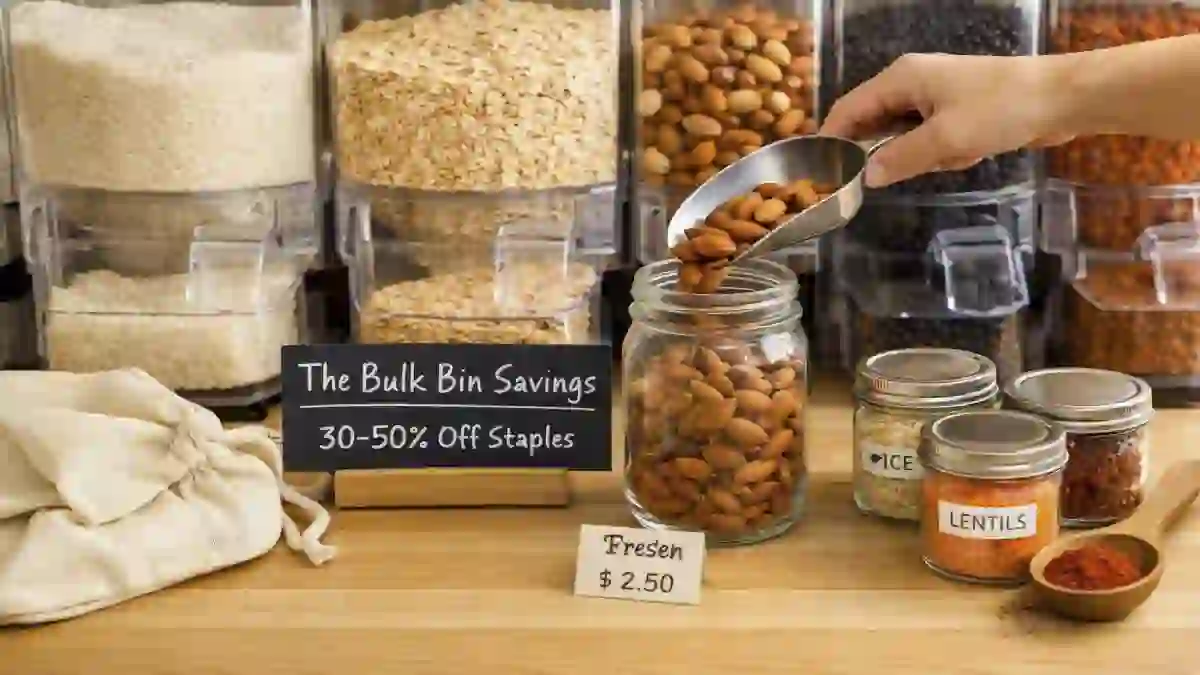
The bulk bin aisle is the least glamorous corner of the grocery store. No colorful boxes. No brand mascots. No marketing campaigns. Just clear bins, metal scoops, and the same foods sold in the middle aisles for less money.
Most shoppers walk right past it. They see the bins, assume they’re for “health food people,” and head straight to the packaged goods. That’s a mistake. The bulk bins are the single most reliable way to cut your grocery bill on pantry staples—often by 30-50%—without sacrificing quality.
I’ve been shopping the bulk bins for years. I’ve made mistakes. I’ve bought too much of things I didn’t need. I’ve forgotten to weigh my containers. But I’ve also saved hundreds of dollars on rice, oats, nuts, spices, and more.
This is the complete guide to mastering bulk bin shopping.
Jump Links
- Why the Bulk Bins Beat the Middle Aisles
- What to Buy in Bulk (And What to Skip)
- The Tare Weight Trick Nobody Teaches You
- The Best Stores for Bulk Savings (Ranked)
- How to Store Bulk Food So Nothing Wastes
- The Hygiene Problem (And How to Shop Safely)
- The Math: What I Saved in One Year
- Frequently Asked Questions (FAQ)
- Final Thoughts: Buying Smarter, Not Just More
Why the Bulk Bins Beat the Middle Aisles
The math is simple. When you buy from the bulk bins, you’re paying for food—not packaging, not branding, not marketing.
The packaging premium: A significant share of a packaged product’s price covers the box, bag, and printing, none of which a person eats. Bulk goods strip that cost away, leaving only the food itself. That’s the core reason bulk is cheaper.
The real numbers: At one store, organic black beans cost $2.99 for a 14-ounce package—that’s $3.42 per pound. The same organic black beans in the bulk bin cost $2.14 per pound. That’s a 37% savings on the same product, from the same store. This kind of price gap between packaged and bulk goods has been documented across dozens of staple categories.
At another store, white jasmine rice is $1.99 per pound in the bulk bin, compared to $2.99 per pound for the packaged version. A dollar saved per pound. Over a year of regular rice consumption, that adds up fast.
The spice savings are even bigger. Spices carry one of the steepest markups in any store, with a small jar often costing several dollars for a spoonful. The bulk bins sell the identical spices for a tiny fraction of that price. If you need a tablespoon of a spice for a recipe, you can buy a tablespoon. You don’t have to commit to a $5 jar that will sit in your cabinet for five years. Consumer savings analysts have repeatedly flagged spices as one of the highest-margin categories in the grocery store, which is exactly why buying them by the spoonful changes the economics so dramatically.
Why the price difference exists: Packaged goods carry the cost of the advertising that sold them, a premium that bulk bins simply do not charge. The rice in the bin was not marketed with a mascot or a television campaign. You’re paying for the substance, not the story.
What the data shows: An analysis of bulk buying published in 2026 found that over a year of cooking, that gap compounds into real savings. The savings aren’t dramatic on a single item. But across a full pantry of staples, they’re significant.
What to Buy in Bulk (And What to Skip)
Not everything is a good bulk buy. Here’s how to decide.
What to buy in bulk:
| Category | Why It Works | Shelf Life |
|---|---|---|
| Whole grains | Cheaper per pound, long shelf life, versatile | 6-12 months |
| Beans and lentils (dried) | Much cheaper than canned, minimal time difference | 1-2 years |
| Pasta | Non-perishable, bulk discounts | 1-2 years |
| Nuts and seeds | Lower per-pound cost, high turnover means freshness | 3-6 months |
| Dried fruit | Better value in bulk | 6-12 months |
| Spices | Fraction of the jarred price | 1-2 years |
| Oats | Cheaper per pound, versatile | 6-12 months |
| Rice | Cheaper per pound, long shelf life | 1-2 years |
What to skip:
- Perishables you won’t use quickly. Buying 5 pounds of something you eat once a month is waste, not savings.
- Items you rarely use. If you need a tablespoon of a niche spice, buy a tablespoon. Don’t buy a pound just because it’s cheaper per unit.
- Anything that will spoil before you use it. Bulk buying only saves money if you actually use what you buy.
- Items where the packaged version is genuinely cheaper. Don’t assume everything is inherently a better deal in bulk. Always crunch the numbers by looking at the unit price.
The “only buy what you’ll use” rule: Focus on buying only what you need. That way, you can ensure nothing goes to waste. That doesn’t mean that you can’t buy a large amount of something you use regularly. However, if you only eat rice once or twice a month, you don’t have to stock up on it just because you’re shopping from the bulk bin section.
The best bulk buys for most people: Everyday foundations like beans, rice, oats, and flour are cheapest in bulk, where they are sold closest to their raw commodity cost. These are the ingredients a frugal kitchen leans on daily.
The Tare Weight Trick Nobody Teaches You
This is the most important step in bulk bin shopping, and most people skip it.
What is tare weight? The tare weight is the weight of your empty container. When you bring your own jars or bags to the bulk bins, the store needs to subtract the weight of your container from the total weight so you’re only paying for the food.
Why it matters: If you don’t weigh your container first, you’ll pay for the weight of the jar or bag. A glass mason jar can weigh 8 ounces or more. If you’re buying something that costs $10 per pound, you’re paying $5 just for the jar.
How to do it: Ask an employee at the store how you can go about weighing your containers. Sometimes, you might be able to put a sticker on the container that shows the accurate pricing for the food you’re getting, or a staff member will be able to assist you as you weigh your containers. This container-weighing practice is standard at co-ops and natural grocers that encourage customers to bring their own jars.
The process:
- Bring your clean, empty containers to the store.
- Go to the customer service desk or find a scale in the bulk section.
- Weigh each empty container and write down the weight.
- The store will either give you a sticker with the tare weight or note it at checkout.
- Fill your containers. At checkout, the cashier subtracts the tare weight.
What one bulk shopper said: This is an extra step you have to think about when you’re grocery shopping at the bulk store, but it’s worth it when you consider the amount of money you’ll save, and all that plastic that you can avoid using.
The alternative: If you don’t want to bother with tare weight, use the store’s provided bags. They’re lighter and the store already knows their weight. But you’ll be using plastic, which defeats one of the benefits of bulk shopping.
The Best Stores for Bulk Savings (Ranked)
Not all bulk sections are created equal. Here’s where to find the best deals.
1. Local food co-ops and natural food stores
Local food co-ops are community-owned and focused on quality, with a robust bulk aisle. These stores often have the widest selection of bulk items, including specialty grains, flours, and spices. Prices are competitive, and the quality is often higher than conventional grocery stores.
2. Whole Foods
Whole Foods has earned a reputation for being expensive, but shopping the bulk bins can provide some serious savings. These savings can really add up, especially when layered with special members-only deals like discounts for Prime Members. The bulk section is one of the few genuinely affordable parts of the store.
3. Ethnic and international markets
Your local ethnic stores will be your best bet for the cheapest per-pound prices on staples like rice, beans, and spices. Asian and Latino markets often have bulk sections with prices that undercut conventional grocery stores, particularly on rice and dried chiles.
4. Conventional grocery stores with bulk sections
Many mainstream grocery stores have bulk sections, though they’re often smaller than co-ops or natural food stores. The savings are still real, especially on common items like oats, rice, and nuts.
5. Warehouse stores (Costco, Sam’s Club)
Warehouse stores aren’t bulk bins, but they offer bulk pricing. Hit the warehouse store for your basic staples; this is a great way to save on whole grains like oatmeal, brown rice and quinoa, legumes and beans, nuts and seeds, dried spices, meat, and dried fruit. The trade-off is the membership fee and the commitment to larger quantities.
Where NOT to buy bulk: Online bulk retailers often charge a premium. Online and delivered groceries are often overpriced, because you pay a premium for convenience.
How to Store Bulk Food So Nothing Wastes
Buying in bulk only saves money if the food stays fresh. Here’s how to store it.
The best containers:
| Container | Best For | Why |
|---|---|---|
| Glass mason jars | Grains, beans, pasta, spices | Reliable, affordable, and easy to stash just about anywhere |
| Airtight plastic containers | Flour, sugar, oats | Do a better job of keeping out air and moisture compared to plastic bags |
| Food-grade buckets | Large quantities of grains and beans | Nothing beats food-grade plastic buckets for large quantities |
| Mylar bags | Long-term storage | Will stop the intrusion of all air and moisture |
The storage rules:
- Keep it dark. Glass also works much better than plastic long-term. One thing to keep in mind is that these containers are particularly vulnerable to light, so take pains to keep them in the dark at all times. Home food storage guides consistently recommend opaque or dark-stored containers for exactly this reason.
- Keep it dry. Moisture and bugs will ruin anything you buy in bulk unless you spend money and store in the proper conditions.
- Keep it cool. A cool, dry pantry is ideal. For nuts and seeds, the freezer is even better.
- Label everything. You might also note any cooking tips. For instance, I taped the tabloid recipe on my bulgur wheat jar, so it’s always there when I need it.
- Use the oldest first. Rotate your stock so nothing expires.
Shelf life guide:
| Food | Shelf Life |
|---|---|
| Whole grains | 6-12 months |
| Dried beans | 1-2 years |
| Nuts and seeds | 3-6 months (longer in freezer) |
| Spices | 1-2 years |
| Flour | 6-12 months |
The “repackaging” trick: You can extend the shelf life of nearly any food with the right approach. Transferring bulk food from plastic bags to airtight glass jars can double its shelf life, according to long-running food storage guidance from home preservation experts.
The Hygiene Problem (And How to Shop Safely)
Bulk bins have a reputation problem. And it’s not entirely undeserved.
The risks: The biggest concern with bulk bins is hygiene. Even in a store with regular cleaning practices, customers often contaminate the scoops, especially after coughing or sneezing. They might use their bare hands to touch the food items or drop the scoop on the floor and return it to the bin without sanitizing it. Food safety researchers have flagged open bulk bins as a documented point of cross-contamination in retail settings.
Allergen cross-contamination: Shopping from bulk food containers certainly poses a risk for those with food allergies. There is a chance of cross-contact with allergens, such as peanuts or tree nuts, if the scoops for bagging are shared between bins, if the bins are not adequately cleaned between use for different foods, or if the bulk food itself has had cross-contact during the handling and distribution process.
Who should avoid bulk bins: For some people with peanut allergy who are highly sensitive, consuming as little as one milligram or less can cause an allergic reaction. Given this risk, especially for these highly sensitive individuals, many bulk food containers will carry advisory allergen labels. The safest approach for people with severe allergies is to avoid bulk bins entirely.
How to shop safely:
- Use the provided scoops. Don’t use your hands or your own scoop.
- Don’t return food to the bin. If you accidentally take too much, don’t put it back.
- Check the bin for cleanliness. If the bin looks dirty or the scoop is sticky, skip it.
- Look for gravity bins. Gravity bins dispense product without customers having to open bins and scoop out the product. Beyond discouraging the spread of pathogens, gravity bins can help reduce the release of allergens.
- Wash your hands before and after. Bring hand sanitizer.
- If you have a severe allergy, skip the bulk bins. It’s not worth the risk.
For the immunocompromised or allergy-prone: The bulk bins are a calculated risk. For most people, the risk is low. For those with severe allergies, the risk isn’t worth the savings.
The Math: What I Saved in One Year
Let me break down the actual dollars.
Before I started shopping the bulk bins:
| Item | Packaged Price | Annual Cost |
|---|---|---|
| Rice (2 lbs/month) | $2.99/lb | $71.76 |
| Oats (2 lbs/month) | $2.49/lb | $59.76 |
| Nuts (1 lb/month) | $8.99/lb | $107.88 |
| Spices (assorted) | $5/jar, 6 jars/year | $30.00 |
| Beans (2 lbs/month) | $1.99/lb | $47.76 |
| Total | $317.16 |
After switching to bulk bins:
| Item | Bulk Price | Annual Cost |
|---|---|---|
| Rice (2 lbs/month) | $1.99/lb | $47.76 |
| Oats (2 lbs/month) | $1.49/lb | $35.76 |
| Nuts (1 lb/month) | $5.99/lb | $71.88 |
| Spices (assorted) | $1.50/jar, 6 jars/year | $9.00 |
| Beans (2 lbs/month) | $1.39/lb | $33.36 |
| Total | $197.76 |
Annual savings: $119.40
The percentage: That’s a 37.6% savings on the same items.
What one shopper said: She was saving roughly $20 a week on groceries simply by buying bulk. No membership required, either. That’s over $1,000 a year. Personal finance writers who track grocery spending have reported similar figures for households that shift their staple purchases to bulk.
What I did with the savings: I put it into a separate savings account. After a year, I had enough for a weekend trip.
📌 YOU MIGHT ALSO LIKE:
Frozen vs. Canned vs. Fresh Vegetables: The Ultimate Cost-Per-Nutrient Breakdown
How to Meal Prep for 5 Days in 60 Minutes (Under $3 Per Serving)
Frequently Asked Questions (FAQ)
1. Is buying from bulk bins actually cheaper than packaged food?
Yes, for most staple items. Bulk bins strip away the cost of packaging, branding, and marketing, leaving only the cost of the food itself. One comparison found that organic black beans cost $3.42 per pound packaged versus $2.14 per pound in the bulk bin—a 37% savings. The savings vary by item and store, but for common staples like rice, oats, beans, and spices, bulk is almost always cheaper.
2. What is tare weight and why does it matter?
Tare weight is the weight of your empty container. When you bring your own jars or bags to the bulk bins, the store needs to subtract the container’s weight so you only pay for the food. If you don’t weigh your container first, you’ll pay for the weight of the jar or bag—which can be significant for glass jars. Ask a store employee to help you weigh your containers and mark them with the tare weight.
3. What are the best things to buy from bulk bins?
The best bulk buys are staples you use regularly: whole grains (rice, oats, quinoa), dried beans and lentils, pasta, nuts and seeds, dried fruit, and spices. These items have long shelf lives and are significantly cheaper per pound in bulk. Avoid buying perishables or items you rarely use, even if the per-pound price is lower.
4. How do I store bulk food so it stays fresh?
Use airtight containers. Glass mason jars work well for grains, beans, pasta, and spices. For larger quantities, food-grade buckets with gamma lids are the best option. Keep everything in a cool, dark, dry place. Moisture and bugs will ruin anything you buy in bulk unless you store it in the proper conditions. Label everything with the date and contents.
5. Are bulk bins hygienic?
There are real hygiene concerns. Customers can contaminate scoops, use their hands, or drop scoops on the floor and return them to the bin. Allergen cross-contamination is also a risk, especially for people with severe nut allergies. To shop safely, use the provided scoops, don’t return food to the bin, check the bin for cleanliness, and wash your hands before and after. If you have a severe allergy, the safest approach is to avoid bulk bins entirely.
6. Which stores have the best bulk sections?
Local food co-ops and natural food stores typically have the widest selection and best quality. Whole Foods has a solid bulk section, especially with Prime member discounts. Ethnic and international markets often have the cheapest per-pound prices on staples like rice, beans, and spices. Conventional grocery stores with bulk sections offer convenience, though selection may be smaller.
7. How much can I realistically save by shopping the bulk bins?
Savings vary by item and store, but 30-50% on staple items is common. One shopper reported saving roughly $20 per week—over $1,000 per year—by buying bulk. For a typical household, annual savings of $100-300 on pantry staples is realistic.
8. What should I bring to the bulk bins?
Bring clean, reusable containers. Glass jars, cloth bags, and clean plastic containers all work. You’ll also need a way to label your containers with the PLU number or food name. Many stores provide bags and twist ties if you don’t bring your own, but bringing your own containers is more sustainable and cost-effective.
Final Thoughts: Buying Smarter, Not Just More
The bulk bin aisle isn’t glamorous. It’s not Instagram-worthy. But it’s the single most reliable way to cut your grocery bill on the items you buy most.
The bulk bin routine:
- Bring your own containers
- Weigh them first (tare weight)
- Buy only what you’ll use
- Store in airtight containers
- Rotate your stock
- Shop safely
That’s it. A simple system that saves 30-50% on pantry staples.
I’ve been shopping the bulk bins for years. I’ve saved hundreds of dollars. My pantry is organized. My food is fresh. And I’ve stopped paying for packaging I don’t need.
That’s not cheap. That’s smart.
That’s the frugal glow. And it’s waiting for you in the bulk aisle. 🥜💛
*For more budget grocery tips, money-saving strategies, and frugal living advice, visit The Frugal Glow.*
Sources
- Bulk food buying cost comparisons and packaging markup analysis published by The Simple Dollar and NerdWallet in their grocery savings guides.
- Bulk bin usage and plastic reduction guidance from Going Zero Waste and Trash is for Tossers.
- Tare weight weighing procedures and reusable container guidance from Zero Waste Home and Litterless.
- Container and shelf life recommendations from The Kitchn and Food Storage Moms.
- Food safety and allergen cross-contact information from Food Allergy Research & Education (FARE) and the FDA’s guidance on bulk food allergen labeling.
- Savings figures reported by Southern Savers and Money Saving Mom.
- Whole Foods bulk section and Prime member discount information from Whole Foods Market.
- Warehouse store bulk buying strategy from The Krazy Coupon Lady and Clark Howard.