

How to Build Muscle at Home Using Progressive Calisthenics
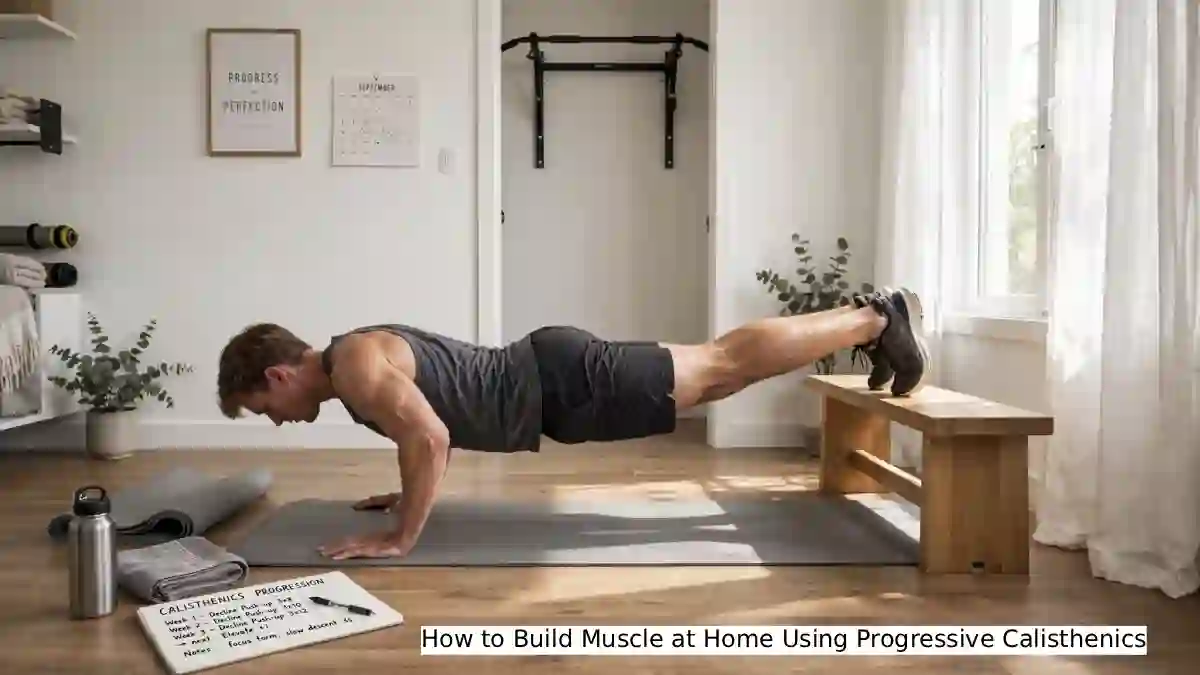
There’s a persistent myth that bodyweight training is fine for “toning” but can’t actually build serious muscle the way lifting weights can. The research says otherwise, and it’s not close. Muscle growth is driven by mechanical tension, metabolic stress, and how close you train to failure — not by whether that tension comes from a barbell or from gravity acting on your own body weight. Your muscle fibers genuinely cannot tell the difference between the two.
What actually determines whether bodyweight training builds muscle isn’t the absence of weights — it’s whether you’re applying progressive overload correctly. This is the complete system: the real science behind why this works, five distinct methods for overloading bodyweight exercises without a single dumbbell, and full progression ladders for every major muscle group.
Jump Links
- The Science: Does Bodyweight Training Really Build Muscle
- The Three Mechanisms of Muscle Growth
- The 5 Levers of Progressive Overload Without Weights
- Push Progression Ladder
- Pull Progression Ladder
- Leg Progression Ladder
- Core Progression Ladder
- Full Progression Table
- Sample Weekly Program
- Nutrition: The Part Most People Skip
- The Honest Limitation of Pure Calisthenics
- Common Mistakes That Stall Progress
- FAQ
- The Bottom Line
The Science: Does Bodyweight Training Really Build Muscle
Yes — and this isn’t a fringe claim built on wishful thinking. A 2015 study published in the International Journal of Environmental Research and Public Health confirmed that calisthenics training produces comparable strength and hypertrophy outcomes to traditional resistance training when volume and intensity are properly matched between the two approaches. Separate research comparing low-load push-ups against a traditional bench press found similar muscle hypertrophy and strength gains between the two, reinforcing that the specific tool delivering resistance matters far less than how that resistance is applied and progressed over time.
Brad Schoenfeld, a leading hypertrophy researcher, laid out the foundational framework behind this: mechanical tension is the primary driver of muscle growth, supported by metabolic stress and muscle damage as secondary contributing mechanisms. None of these three mechanisms require an external weight specifically — they require your muscles working hard enough, close enough to genuine fatigue, for your body to trigger the adaptation process that builds new muscle tissue.
The Three Mechanisms of Muscle Growth
Understanding these three mechanisms is what makes the rest of this guide actually make sense, rather than just following a list of exercises blindly.
- Mechanical tension: The force placed on a muscle as it’s stretched and contracted under load. In calisthenics, this comes from choosing sufficiently challenging exercise variations — a one-arm push-up or pistol squat generates dramatically more mechanical tension than a standard push-up or squat, even though no external weight is involved.
- Metabolic stress: The “burn” and cellular swelling that comes from higher-rep, sustained muscular effort. Research shows this contributes to hypertrophy through cell swelling and associated hormone release, and higher-rep bodyweight work is specifically excellent at generating this kind of stress.
- Muscle damage: The microscopic muscle fiber tears that occur during challenging exercise, which trigger the body’s repair process — and it’s specifically that repair process that results in muscle growth over time. Research has shown that slow negatives (the lowering portion of an exercise, like a 5-to-10-second push-up descent) maximize this specific adaptation.
The 5 Levers of Progressive Overload Without Weights
This is the core system that makes ongoing muscle growth possible without ever touching a barbell. Since you can’t simply add more plates to your own body weight, bodyweight training instead offers five distinct variables you can manipulate, often in combination, to keep making an exercise progressively harder over months and years.
1. Exercise variation (leverage): Moving to a harder version of the same movement pattern — from a standard push-up to a decline push-up to an archer push-up to eventually a one-arm push-up — changes the leverage your muscles have to work against, increasing difficulty without changing your body weight itself.
2. Range of motion: Performing a fuller, deeper range of motion (a deeper squat, a push-up with hands elevated on the way down for extra stretch) increases the mechanical tension placed on the working muscle throughout more of its length.
3. Volume (reps and sets): Simply doing more total repetitions or sets is a genuine, valid form of progression, particularly in the earlier stages of a specific exercise variation, though it eventually shifts toward improving muscular endurance rather than continuing to drive significant hypertrophy once you’re comfortably completing high rep counts.
4. Tempo and time under tension: Slowing down the eccentric (lowering) portion of a movement, as covered above, meaningfully increases the muscle damage stimulus without changing the exercise itself at all.
5. Reduced rest and increased density: Shortening rest periods between sets, or combining more work into the same total workout time, increases metabolic stress even when the exercise variation and rep count stay the same.
A sixth option, once the above five are genuinely maxed out: Adding external load specifically through a weighted vest, a loaded backpack, or resistance bands, effectively converting bodyweight training into a form of weighted calisthenics once pure bodyweight progressions on a given movement have been fully exhausted.
Push Progression Ladder
| Level | Exercise |
|---|---|
| Beginner | Wall push-up or knee push-up |
| Intermediate | Standard push-up |
| Intermediate-Advanced | Decline push-up (feet elevated) |
| Advanced | Archer push-up |
| Very Advanced | One-arm push-up |
Pull Progression Ladder
| Level | Exercise |
|---|---|
| Beginner | Doorframe row or towel row (feet close to anchor point) |
| Intermediate | Doorframe/inverted row (feet further from anchor point) |
| Intermediate-Advanced | Negative pull-ups (slow, controlled lowering only) |
| Advanced | Standard pull-up/chin-up |
| Very Advanced | One-arm assisted pull-up progressions |
Leg Progression Ladder
| Level | Exercise |
|---|---|
| Beginner | Bodyweight squat |
| Intermediate | Bulgarian split squat |
| Intermediate-Advanced | Shrimp squat (assisted) |
| Advanced | Pistol squat |
| Very Advanced | Weighted pistol squat (with a loaded backpack) |
Core Progression Ladder
| Level | Exercise |
|---|---|
| Beginner | Standard plank |
| Intermediate | Plank with shoulder taps |
| Intermediate-Advanced | Hollow body hold |
| Advanced | Hanging leg raises |
| Very Advanced | Dragon flag progressions |
Full Progression Table
| Movement Pattern | Key Progression Method | Primary Muscles |
|---|---|---|
| Push (chest/shoulders/triceps) | Leverage changes (angle, single-arm work) | Pectorals, deltoids, triceps |
| Pull (back/biceps) | Leverage changes (lean angle, negatives, one-arm) | Lats, rhomboids, biceps |
| Legs (quads/glutes/hamstrings) | Single-leg variations, added load | Quadriceps, glutes, hamstrings |
| Core | Lever length, hold duration, added instability | Rectus abdominis, obliques, deep stabilizers |
Sample Weekly Program
A genuinely balanced progressive calisthenics program built around this framework might look like the following, run across three to four sessions per week:
Day 1 — Push/Pull Focus
- Push progression exercise: 3–4 sets, 6–15 reps (depending on current level)
- Pull progression exercise (e.g., doorframe row): 3–4 sets, 6–15 reps
- Core exercise: 2–3 sets
Day 2 — Leg Focus
- Leg progression exercise (e.g., Bulgarian split squat): 3–4 sets per leg
- Calf raises: 3 sets, higher reps
- Core exercise: 2–3 sets
Day 3 — Rest or light active recovery
Day 4 — Push/Pull Focus (repeat with slight variation or added intensity)
- Same structure as Day 1, applying one of the five overload levers (slower tempo, added rep, reduced rest, or a harder variation if ready)
Day 5 — Leg Focus (repeat with progression)
Days 6–7 — Rest, or light mobility and stretching work
For muscle building specifically, training each exercise in a range of roughly 6 to 20 repetitions per set, at an intensity that brings you genuinely close to muscular fatigue, aligns with generally accepted hypertrophy training guidelines regardless of whether the resistance comes from a weight or your own body.
Nutrition: The Part Most People Skip
Progressive overload provides the training stimulus, but muscle growth also requires adequate recovery resources, most notably protein and sufficient overall calories. Without enough dietary protein specifically supporting the muscle repair process triggered by your training, even a perfectly structured progressive calisthenics program will underperform relative to its actual potential. This doesn’t require an elaborate diet plan — consistent, adequate protein intake across your daily meals, alongside enough overall calories to support recovery (rather than a significant calorie deficit that actively works against muscle building), is the core nutritional requirement running alongside any serious muscle-building training program, calisthenics or otherwise.
The Honest Limitation of Pure Calisthenics
It’s worth being genuinely honest about where pure bodyweight training does face real constraints, rather than presenting it as a flawless replacement for every form of resistance training in every scenario.
- Lower body overload gets harder at advanced levels. The lower body is harder to overload with pure bodyweight movements alone; exercises like pistol squats and shrimp squats are excellent progressions, but they can cap out in difficulty for genuinely advanced trainees without adding external load.
- Isolation work for smaller muscle groups is limited. Directly isolating smaller muscle groups like the biceps, rear deltoids, or calves is more difficult with pure calisthenics compared to targeted machine or free-weight exercises designed specifically for that purpose.
- Pure strength for very heavy, specific goals still favors external load. For a goal like a maximal one-rep deadlift or squat number specifically, research confirms that handling genuinely heavy external load remains the more direct path, even though calisthenics builds real, transferable strength for most practical purposes.
None of these limitations mean calisthenics can’t build significant, genuine muscle — the evidence clearly shows it can — but a fully honest picture acknowledges where a weighted vest, resistance bands, or eventual access to actual weights can meaningfully extend what’s achievable once pure bodyweight progressions on a given movement are genuinely exhausted.
Common Mistakes That Stall Progress
- Only adding more reps indefinitely. Once you’re comfortably completing high rep ranges (well beyond 20 reps) on a given exercise, you’re primarily building muscular endurance rather than continuing to drive meaningful hypertrophy; it’s time to progress to a harder variation instead.
- Skipping the eccentric (lowering) phase. Rushing through the lowering portion of any exercise sacrifices a significant portion of the muscle damage stimulus that research has specifically linked to hypertrophy.
- Jumping progression levels too quickly. Attempting a one-arm push-up before genuinely mastering the standard and decline versions increases injury risk and often results in poor form that reduces the actual training stimulus.
- Not tracking progress systematically. Without recording reps, sets, tempo, and which specific variation you’re performing, it’s genuinely difficult to know whether you’re actually progressing or just repeating the same stimulus indefinitely.
- Neglecting nutrition entirely. Even a perfectly structured progressive training program underperforms without adequate protein and overall calorie intake to support the muscle repair and growth process.
- Avoiding all forms of added external load. Once bodyweight progressions on a specific movement are genuinely maxed out, a resistance band, weighted vest, or loaded backpack are reasonable, evidence-supported next steps rather than something to avoid on principle.
📌 YOU MIGHT ALSO LIKE:
The 15-Minute Wall Workout: Tone Your Entire Body Using Just a Flat Wall
The $15 Adjustable Dumbbell Hack: How to Make Water-Filled Weights
FAQ
Can you really build significant muscle with calisthenics alone, or is it just for toning?
Yes, genuinely significant muscle. Multiple studies, including a 2015 IJERPH study and hypertrophy-specific research, confirm that calisthenics training can produce comparable strength and muscle growth outcomes to traditional weight training when volume and intensity are properly matched.
What’s the single most important principle for building muscle without weights?
Progressive overload — systematically making exercises harder over time using the five levers covered in this guide (exercise variation, range of motion, volume, tempo, and reduced rest), rather than performing the same exercise at the same difficulty indefinitely.
How do I know when it’s time to progress to a harder exercise variation?
Once you can comfortably complete your target rep range (typically around 15–20 reps) with good form and without reaching genuine muscular fatigue, that’s generally a sign you’re ready to progress to a more challenging variation of the same movement pattern.
Is it true that bodyweight training can’t build lower body muscle as effectively as weights?
There’s some truth to this at advanced levels specifically. Pure bodyweight lower body exercises like pistol squats can become genuinely difficult to progress beyond for very advanced trainees without adding external load, though most people have significant room to progress through single-leg variations before hitting that ceiling.
Do I need to add weights eventually, or can I stick with pure bodyweight training forever?
For most people’s goals, pure bodyweight progressions through advanced variations (archer push-ups, pistol squats, and similar movements) provide years of legitimate progression potential. Adding external load like a weighted vest becomes more relevant specifically once you’ve genuinely maxed out bodyweight-only progressions on a given movement.
How important is nutrition compared to the training itself?
Genuinely essential, not optional. Progressive overload provides the training stimulus for muscle growth, but without adequate protein and sufficient overall calorie intake to support recovery, that training stimulus won’t translate into its full potential muscle-building result.
The Bottom Line
Bodyweight training builds real, measurable muscle — the peer-reviewed research is genuinely clear on this point — but only when it’s structured around actual progressive overload rather than repeating the same push-ups and squats indefinitely. Using the five levers covered here — exercise variation, range of motion, volume, tempo, and rest manipulation — gives you years of legitimate progression potential through nothing more than gravity, your own body weight, and a doorframe or floor space to work with.
For more budget-friendly wellness and home workout guides, check out more posts over at The Frugal Glow.
Sources: