

Is a $12 Drugstore Sunscreen as Good as a French Pharmacy Brand? What Actually Differs
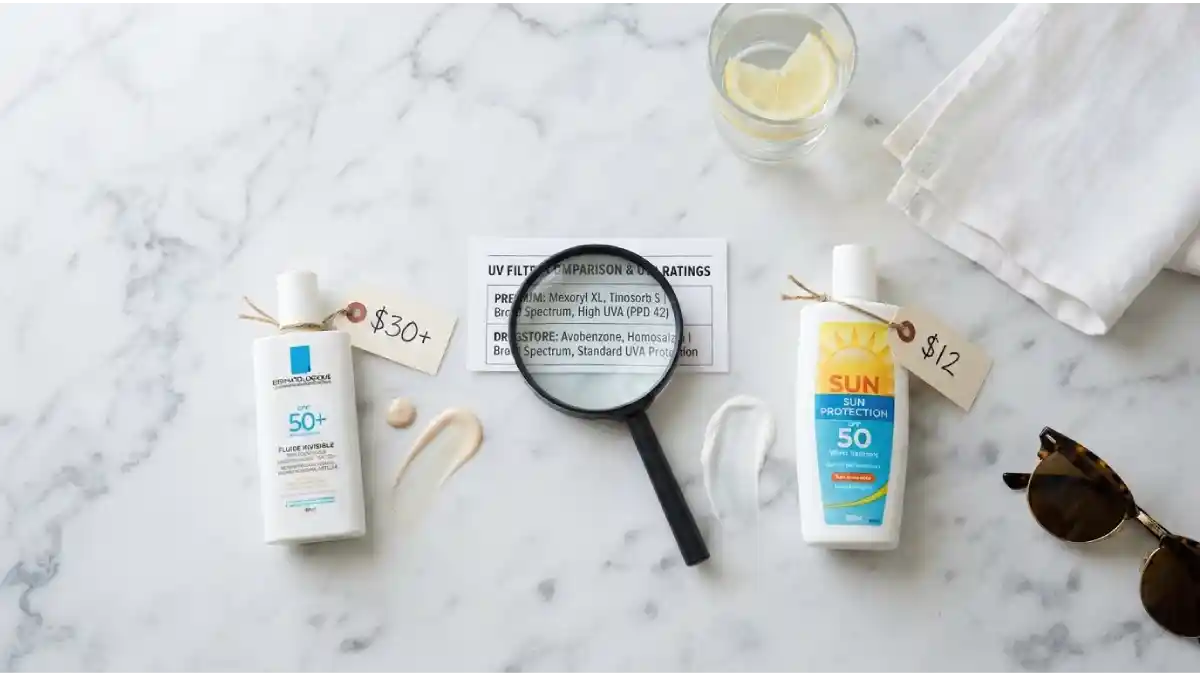
French pharmacy skincare has a reputation that borders on mythical. Pharmacists in Paris are treated like skincare consultants, brands like La Roche-Posay, Vichy, and Avène carry a medical-grade halo, and their sunscreens are widely described as the gold standard. Meanwhile, the sunscreen sitting on the shelf at your neighborhood CVS costs a fraction of the price. So the obvious question is whether paying more for the French name gets you meaningfully better protection, or whether it’s mostly branding.
The honest answer is more interesting than a simple yes or no. Some of what makes European sunscreens better is real, and it comes down to chemistry and regulation. Some of what makes premium sunscreens expensive has little to do with how well they protect you. And 2026 added a major new twist, because the FDA just approved the first new sunscreen ingredient in more than 25 years.
This guide breaks down the real differences in UV filters, UVA protection, SPF accuracy, texture, and price, so you can decide where your money is actually well spent.
Jump Links
- The Short Answer
- First, Which “French Pharmacy” Sunscreen Are We Comparing?
- UV Filters: What’s Actually in the Bottle
- UV Filter Comparison Table
- UVA Protection: Labels That Say Different Things
- UVA Labeling Comparison Table
- SPF Accuracy: Where Price Stops Mattering
- The Big 2026 Update: Bemotrizinol
- Texture and Wearability
- Price and Value
- Who Should Pay More (and Who Can Save)
- How to Pick a Budget Sunscreen Smartly
- How Much to Apply and How Often
- FAQ
- The Bottom Line
The Short Answer
It depends on what “as good” means, because sunscreen quality has at least four separate parts, and drugstore and premium brands don’t win on all of them.
SPF accuracy (how well the product delivers its labeled sunburn protection): Price is a poor predictor. Independent lab testing has found failures at every price point, and a cheap sunscreen can outperform an expensive one.
UVA protection (the longer-wavelength rays linked to skin aging and pigmentation): European-formulated sunscreens have a genuine edge, thanks to filters the US hasn’t approved. But the French-brand sunscreens sold in American drugstores are formulated to US rules, so that edge is smaller than you might think in the US aisle.
Feel and wearability: Premium brands often feel more elegant on the skin, which matters because the best sunscreen is the one you’ll actually wear every day.
Price: A $12 drugstore sunscreen costs a fraction of most premium pharmacy tubes, and if it tests well, the value gap is large.
The takeaway is that “French pharmacy” doesn’t automatically mean better protection in the US, and “drugstore” doesn’t automatically mean worse. The right move is to judge individual products by independent testing rather than by brand prestige.
First, Which “French Pharmacy” Sunscreen Are We Comparing?
This is the detail that most comparison articles skip, and it changes the whole conversation. A French pharmacy brand sold in France is formulated under European rules. The same brand sold in an American drugstore is formulated under US rules, which means it often contains a different set of UV filters.
In the US, sunscreens are regulated as over-the-counter drugs, and every active ingredient must be approved through the FDA’s monograph process. In Europe, sunscreens are regulated as cosmetics, which has allowed a wider range of modern UV filters onto the market. As a result, the European and American versions of the same brand can be meaningfully different products.
Consumer Reports’ ingredient listings illustrate this. Several La Roche-Posay Anthelios formulas sold in the US list familiar filters like avobenzone, homosalate, octisalate, and octocrylene, which are the same filter families found in many ordinary drugstore sunscreens. In other words, when you buy a French pharmacy brand at a US store, you are often buying a US-style formula with a French logo, not the European formula that earned the brand its reputation.
UV Filters: What’s Actually in the Bottle
UV filters are the active ingredients that absorb or block ultraviolet radiation, and they are the real technical difference between sunscreens around the world.
Europe has approved a much larger menu of filters. Scientific American reported that Europe has more than 30 approved UV-filtering ingredients, while the US has had only about 16, with no new addition between 1999 and 2026. Several of the filters that European formulators rely on, including Tinosorb M (bisoctrizole), Uvinul A Plus, and Mexoryl XL (also marketed as Mexoryl 400), have not been approved for US sunscreens.
One famous exception is Mexoryl SX, which exists in the US only because L’Oréal, which owns La Roche-Posay, secured its own FDA drug application for it. That’s why you’ll find it in some L’Oréal-owned brands stateside, but not in most other sunscreens.
Why does this matter? The EWG pointed out that zinc oxide and avobenzone are the main filters in US sunscreens that provide meaningful UVA protection. Avobenzone is effective, but it has a known weakness: it breaks down when exposed to sunlight unless it’s stabilized with other ingredients. Many of the newer European filters are more photostable, meaning they hold up longer under real sun exposure.
None of this means US sunscreens don’t work. They do, and zinc oxide in particular is a strong, well-established broad-spectrum filter. It means that US formulators have a smaller toolkit, and in particular have fewer options for building highly stable, high-UVA protection without a heavy or white-cast feel.
UV Filter Comparison Table
| Filter | Europe | United States | Notes |
|---|---|---|---|
| Zinc oxide | Approved | Approved | Mineral filter, broad coverage including UVA |
| Avobenzone | Approved | Approved | Main chemical UVA filter in the US, but not photostable on its own |
| Bemotrizinol (Tinosorb S) | Approved for decades | Approved June 2026, up to 6% | Photostable broad-spectrum filter |
| Bisoctrizole (Tinosorb M) | Approved | Not approved | Hybrid filter popular in European formulas |
| Uvinul A Plus | Approved | Not approved | Strong UVA filter |
| Mexoryl SX (ecamsule) | Approved | Available only via L’Oréal’s own FDA application | Water-soluble UVA filter |
| Mexoryl XL / 400 | Approved | Not approved | Photostable UVA/UVB filter |
UVA Protection: Labels That Say Different Things
There’s another big difference that has nothing to do with the ingredients themselves: how UVA protection is measured and labeled.
In the EU and UK, a sunscreen must provide UVA protection of at least one-third of its labeled SPF. For an SPF 30 product, that means a UVA protection factor (UVA-PF) of at least 10. Products that meet the standard can display the UVA-in-a-circle logo, which signals a baseline level of UVA protection to shoppers at a glance. In both Europe and the UK, products must also reach a critical wavelength of at least 370 nanometers.
In the US, the FDA uses a “broad spectrum” label that relies on a critical wavelength test, also at 370 nanometers. It’s a pass-or-fail check, and unlike the EU system, it doesn’t require a UVA-PF-to-SPF ratio, and it doesn’t display any UVA number on the label. That means two US sunscreens that both say “broad spectrum” can offer very different levels of actual UVA protection, and the label alone won’t tell you which is which.
This difference is a real advantage for the European system in terms of transparency. If you’re shopping in Europe, the UVA circle gives you a baseline guarantee. If you’re shopping in the US, you’re relying more on independent lab testing or the specific ingredients in the formula.
UVA Labeling Comparison Table
| Feature | European System | US System |
|---|---|---|
| UVA requirement | UVA-PF at least one-third of SPF | Critical wavelength of at least 370 nm |
| Label symbol | UVA-in-a-circle logo | “Broad Spectrum” statement |
| Shows a UVA number? | Not on the label, but meeting the ratio is required to use the logo | No |
| Practical result | Baseline UVA-to-UVB balance is built into the standard | Pass/fail; strength of UVA protection can vary between products |
SPF Accuracy: Where Price Stops Mattering
This is the section where the “premium is always better” assumption falls apart most clearly. Consumer Reports tests sunscreens in its lab, and its findings consistently show that the number on the front of the bottle can’t be taken at face value.
In CR’s tests of 130 sunscreens, a majority had an average tested SPF below the SPF listed on the label. Some of the shortfalls were dramatic. CR reported that one luxury moisturizer-style sunscreen priced at $55 for 1.7 ounces tested at only SPF 8, and a mineral lotion labeled SPF 30 tested at SPF 4. On the other end, the top-rated lotion in CR’s 2026 testing, Coppertone Water Babies SPF 50, earned a perfect overall score and costs less than $9.
CR’s sunscreen expert has been careful to note that falling short of the label doesn’t mean a product offers no protection. But the broader lesson is clear: the price tag and the brand prestige don’t predict how well a sunscreen performs in the lab. CR has tested several CVS Health sunscreens as well as several La Roche-Posay Anthelios formulas, so you can look up the exact product you’re considering rather than guessing based on the logo.
One caveat worth being upfront about: you may come across blog posts claiming that a specific store-brand sunscreen “drifted” far below its labeled SPF. Be cautious with claims like that unless they come from a transparent, published testing method, and check the actual lab ratings from an independent organization instead.
The Big 2026 Update: Bemotrizinol
This is the news that makes this comparison especially timely. On June 9, 2026, the FDA finalized an order adding bemotrizinol to the list of approved sunscreen ingredients, at concentrations of up to 6% for adults and children six months and older. It’s the first new UV filter added to the US sunscreen monograph since 1999.
Bemotrizinol, sold abroad as Tinosorb S and Parsol Shield, has been used across Europe, Australia, and Asia for more than two decades. Its defining advantage is photostability: unlike avobenzone, it stays stable after UV exposure. It also offers broad-spectrum coverage and, when combined with zinc oxide, can provide strong protection with less white cast, which is especially meaningful for people with darker skin tones who often find mineral sunscreens leave a visible residue.
The approval also closes part of the gap between US and European sunscreens. The EWG called it a major win for American consumers and noted it brings stronger UVA protection options to the US market. The approval came through a faster review system Congress created in 2020, which experts say may open the door for other modern filters to follow.
There are two important caveats for shoppers, though. First, the approval doesn’t instantly change what’s on the shelf. Products need time to be formulated, tested, and manufactured, and realistic estimates suggest the first US sunscreens containing bemotrizinol may take a year or two to arrive. So a drugstore sunscreen you buy today is almost certainly made with the older set of filters. Second, other European filters, like Tinosorb M, Uvinul A Plus, and Mexoryl XL, still aren’t approved in the US, so a gap remains.
What this means for the comparison: over the next couple of years, the technical gap between US drugstore sunscreens and European-formulated ones should narrow, and budget brands may eventually benefit from the same modern filter that premium European brands have used for years.
Texture and Wearability
Protection only works if you apply enough and apply it consistently, and that’s where premium sunscreens often have a real, legitimate advantage. European formulas built on modern filters tend to feel lighter and less greasy, and many premium brands invest heavily in making their products feel pleasant on the skin and sit well under makeup. That elegance is worth something, particularly for daily facial use.
Budget sunscreens can lag on feel. Even the highest-scoring lotion in CR’s testing, for example, left a noticeable sheen and greasy film according to testers. If a product feels unpleasant, you’re less likely to wear enough of it or reapply it, which can erase any price advantage. This is why the best budget strategy usually involves trying a few affordable options until you find one you genuinely like wearing.
Price and Value
Premium pharmacy sunscreens generally cost two to four times as much as a store brand, and sometimes more, particularly for small facial tubes. A typical store-brand sunscreen like those from CVS often runs around $10 to $14, while premium French pharmacy tubes commonly run from the high teens to $40 or more, depending on the product and size.
| Category | Typical price | What you’re paying for |
|---|---|---|
| Store-brand sunscreen (e.g., CVS Health) | ~$8–$14 | Basic protection, simple formula, large bottle |
| Mainstream drugstore brand | ~$9–$20 | Brand testing, improved texture |
| Premium French pharmacy brand (US-sold) | ~$20–$40+ | Brand reputation, elegant texture, sometimes proprietary filters |
Prices are approximate and may change at any time depending on the store, brand, and current sales.
The key insight is that independent testing doesn’t consistently reward higher prices. A $9 lotion earned a perfect score in the same test where a $55 product tested at SPF 8. That doesn’t mean every cheap sunscreen is great, but it does mean you can sometimes get excellent protection for very little, as long as you check the lab results.
Who Should Pay More (and Who Can Save)
You might reasonably pay more if:
- You wear sunscreen on your face every day and find budget textures too greasy, heavy, or white to wear consistently.
- You’re particularly concerned about UVA protection, for example because you’re prone to dark spots or hyperpigmentation, and you’ve found a premium formula with strong, independently tested UVA performance. If this is a medical concern, talk to a dermatologist about the best option for your skin.
- You want a specific feature, like a lightweight tint or a texture that works under makeup.
You can comfortably save if:
- You’re covering large areas of your body and need to use a generous amount, where a $9 to $12 bottle makes it much easier to apply enough.
- You’ve checked independent testing and your chosen budget sunscreen scores well on SPF accuracy and UVA protection.
- You find a drugstore formula that feels comfortable enough to wear daily.
A practical middle path for many people is using an affordable, well-tested sunscreen for the body and splurging modestly (if at all) on a facial formula they’ll love wearing.
How to Pick a Budget Sunscreen Smartly
- Look up the exact product in independent lab ratings. Consumer Reports has tested many store brands and premium brands alike, so you can compare the specific product, not just the brand.
- Choose “broad spectrum” with at least SPF 30. This is the baseline recommendation from sunscreen testers.
- Check the active ingredients. In the US, strong UVA coverage typically comes from zinc oxide or avobenzone, so look for at least one of these. As bemotrizinol products arrive over the next year or two, it will be worth looking for it on the label.
- Check water resistance if you’ll be swimming or sweating, and note that the labeled duration is typically 40 or 80 minutes.
- Pick a texture you’ll actually wear. Try small sizes first if you can.
- Don’t assume price equals protection. Some of the worst performers in lab testing were high-priced products.
How Much to Apply and How Often
Even the best sunscreen can’t protect you if you apply a thin layer. Consumer Reports notes that adults need roughly one ounce, about a shot glass full, to cover the body, and that sunscreen should be reapplied about every two hours, or more often after swimming or heavy sweating. Lotions make it easier to see how much you’re using and to get even coverage than sprays do.
If you’re using a facial sunscreen, apply it generously as the last step of your skincare routine, and don’t forget often-missed spots like the ears, neck, and the tops of the feet. Sunscreen is one part of sun protection, and shade, hats, and protective clothing add extra protection on top of it.
📌 YOU MIGHT ALSO LIKE:
The $9 Target Cleansing Balm That Melts Makeup Just Like High-End Premium Brands
Ditch the $80 Moisturizer: 5 Under-$15 Dupes for Clinique and Drunk Elephant
FAQ
Is a $12 drugstore sunscreen really as good as a French pharmacy brand?
It can be, depending on the specific products. Independent testing shows that price and brand prestige don’t reliably predict SPF accuracy, and French pharmacy brands sold in US drugstores are often formulated with US-approved filters similar to those in drugstore products. The best approach is to check lab test results for the exact products you’re comparing.
Are European sunscreens actually better?
European formulas have access to more UV filters, including several photostable ones the US hasn’t approved, and the EU requires a baseline UVA-to-SPF ratio. In that sense they can offer stronger and more stable UVA protection. However, most European-formulated sunscreens aren’t legally sold in US stores, and the French-brand sunscreens you’ll find at US pharmacies are made to US rules.
What did the FDA approve in 2026?
In June 2026, the FDA approved bemotrizinol, known in Europe as Tinosorb S, at concentrations of up to 6%. It’s the first new sunscreen ingredient approved in the US since 1999, and it offers photostable broad-spectrum protection. Products containing it may take a year or two to reach store shelves.
Why do so many sunscreens test below their labeled SPF?
In Consumer Reports’ tests, a majority of the 130 sunscreens tested had an average tested SPF lower than the number on the label. Testing variability and formulation differences are among the possible factors, and the lesson for shoppers is to rely on independent ratings rather than the label alone.
What does “broad spectrum” mean on a US sunscreen?
It means the product passed a test showing it absorbs UV light out to at least 370 nanometers. It doesn’t tell you how strong the UVA protection is, and it isn’t the same as the European requirement that UVA protection be at least one-third of the SPF.
How much sunscreen should I use?
For most adults, about one ounce, roughly a shot glass, is needed to cover the body, and sunscreen should be reapplied about every two hours. Using too little is one of the most common reasons sunscreen underperforms in real life.
The Bottom Line
A premium French pharmacy sunscreen isn’t automatically better than a $12 drugstore tube, and a drugstore sunscreen isn’t automatically a bargain either. In the lab, price has been a poor predictor of how well sunscreens actually perform, and many French pharmacy brands sold in the US use US-style filters rather than the European formulas that built their reputation. The real, technical advantage of European sunscreens, access to more photostable and effective UV filters, is real, and the FDA’s approval of bemotrizinol in 2026 is the first step toward narrowing that gap for American shoppers. Until then, the smartest move is to compare specific products using independent testing, choose broad spectrum SPF 30 or higher, apply plenty, and spend extra only when a formula’s feel or performance makes you genuinely more likely to wear it every day.
For more budget-friendly beauty and skincare guides grounded in real evidence, check out more posts over at The Frugal Glow.
This article is for general informational purposes and isn’t a substitute for medical advice. If you have a skin condition, a history of skin cancer, or concerns about sun sensitivity, please talk to a dermatologist about the best sun protection for you.
Sources: