

The Best Budget Fitness Trackers with Built-In GPS Under $100
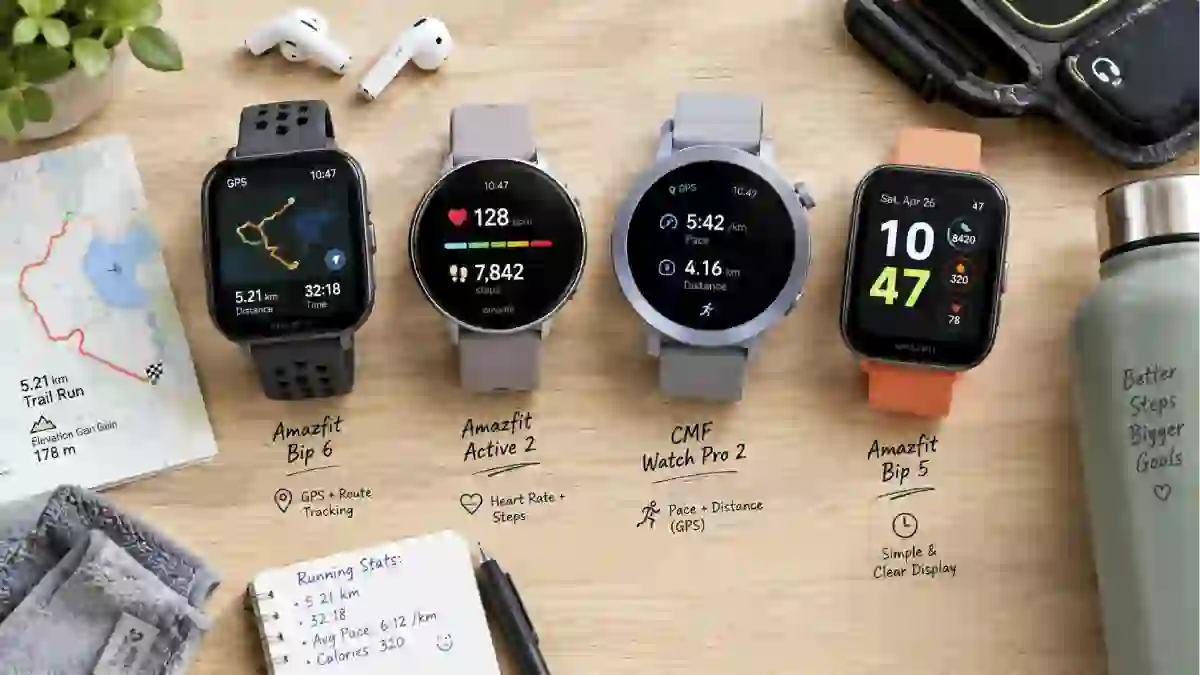
Shopping for a budget fitness tracker with GPS gets confusing fast, and that confusion is costing people money. A huge share of the “budget fitness tracker” category — including some genuinely excellent devices under $50 — doesn’t actually have GPS built into the device at all. It uses something called “connected GPS,” which means the tracker is just borrowing your phone’s GPS signal over Bluetooth, so you still need to carry your phone on every run for accurate route and distance data.
Real built-in GPS — the kind that tracks your run, hike, or bike ride with zero phone required — used to be a feature reserved for $150+ devices. That’s genuinely changed over the past couple of years. Here are the best trackers that deliver actual, standalone, built-in GPS, every single one for under $100.
Jump Links
- Built-In GPS vs. Connected GPS: The Difference That Actually Matters
- 1. Amazfit Bip 6 — Best Overall
- 2. Amazfit Active 2 — Best for Serious Fitness Tracking
- 3. CMF Watch Pro 2 — Best for Calls and Style
- 4. Amazfit Bip 5 — Best Value Pick (Previous Generation)
- Full Comparison Table
- Why Didn’t Fitbit or Garmin Make This List
- What to Check Before You Buy
- GPS Accuracy: What to Realistically Expect at This Price
- Which One Should You Actually Buy
- FAQ
- The Bottom Line
Built-In GPS vs. Connected GPS: The Difference That Actually Matters
This distinction is the single most important thing to understand before buying any fitness tracker marketed around GPS, since the marketing language on product pages doesn’t always make it obvious.
Built-in (or “onboard”) GPS means the tracker has its own GPS chip and can independently determine your location, speed, and route without any connection to your phone. You can leave your phone at home entirely and still get accurate distance, pace, and route data from a run, hike, or bike ride.
Connected GPS means the tracker itself has no GPS hardware. It relies entirely on your paired smartphone’s GPS, communicating over Bluetooth. This works fine for tracking distance and route, but only if your phone is physically with you during the activity — leave it behind, and you lose all location-based data for that session.
Both are legitimate, useful features depending on your habits, but if your specific goal is phone-free outdoor workouts (a genuinely common reason people shop for GPS in the first place), only built-in GPS actually delivers that.
1. Amazfit Bip 6 — Best Overall
Price: $79.99
The Amazfit Bip 6 has earned consistent praise across multiple independent reviewers specifically for packing genuine built-in GPS, a bright 1.97-inch AMOLED display, and up to 14 days of battery life into a sub-$80 price point. The GPS supports five satellite positioning systems (helping it lock onto a signal quickly and accurately) and includes free offline maps — a feature reviewers have specifically called rare to find at this price tier.
In hands-on testing, reviewers reported GPS locking onto a signal within about 10 seconds and logging accurate route data on real outdoor runs, with one tester specifically noting that anyone upgrading from a phone-dependent band would find the built-in GPS a significant, noticeable upgrade. With over 140 sport modes and solid health tracking (heart rate, SpO2, sleep) layered on top, it’s a genuinely well-rounded pick, not just a GPS tracker with extras bolted on.
Best for: Anyone wanting the single best overall value in this category — strong GPS, long battery life, and a genuinely nice display, all under $80.
2. Amazfit Active 2 — Best for Serious Fitness Tracking
Price: $99.99 (frequently on sale closer to $85)
The Amazfit Active 2 sits at the very top of the sub-$100 price range, and the extra few dollars compared to the Bip 6 buys a more fitness-focused feature set. It includes a BioTracker sensor supporting 24-hour heart rate, blood oxygen, stress, and sleep monitoring, plus over 160 sport modes and built-in GPS with offline map support, including a useful backtrack feature for anyone exploring unfamiliar trails.
Independent testing specifically highlighted its onboard GPS as reliable enough to track routes accurately without a phone, alongside an attractive stainless steel case design that doesn’t look or feel as obviously budget as its price suggests. The main trade-off reviewers noted is a less refined operating system compared to flagship smartwatches, and occasionally questionable elevation data — reasonable compromises at this price point.
Best for: Fitness enthusiasts who want the most comprehensive health and sport tracking feature set available under $100.
3. CMF Watch Pro 2 — Best for Calls and Style
Price: ~$99
CMF (Nothing’s budget sub-brand) has built a genuine reputation for bringing design-forward, premium-feeling hardware to budget price points, and the Watch Pro 2 follows that pattern. It features a sharp 1.96-inch AMOLED display, a sleek aluminum alloy frame, built-in GPS, and up to 13 days of battery life, alongside reliable Bluetooth calling through a built-in speaker and microphone.
Later versions in the same line (the Watch Pro 3) specifically added dual-band GPS with multi-system satellite positioning, a notable upgrade in GPS accuracy and signal reliability that’s genuinely uncommon to see at this price tier. The main noted weakness across reviews is less consistent sleep tracking and more limited third-party app integration compared to bigger-name competitors.
Best for: Anyone who wants a smartwatch that looks and feels more premium than its price tag, with solid built-in GPS and calling features.
4. Amazfit Bip 5 — Best Value Pick (Previous Generation)
Price: ~$89 (sometimes available for less as the lineup ages)
Before the Bip 6 took over as Amazfit’s headline budget pick, the Bip 5 earned genuinely glowing reviews on its own merits — one reviewer specifically called it a rival to the Apple Watch SE at a fraction of the price. It includes a four-satellite built-in GPS system, over 120 sport modes, a 1.91-inch display, and roughly 10 days of battery life.
Hands-on testing found the GPS tracking generally accurate (a tracked 10km run logged at 10.1km, a small and reasonable margin of error for this price category), alongside strong sleep tracking and a well-regarded companion app. As a now slightly older model, it’s sometimes available at a lower price than its original $89 launch point, making it a genuinely smart pick for anyone comfortable buying the previous generation to save a bit more.
Best for: Budget-conscious shoppers specifically looking for the lowest price point that still includes genuine built-in GPS.
Full Comparison Table
| Tracker | Price | GPS Type | Battery Life | Standout Feature |
|---|---|---|---|---|
| Amazfit Bip 6 | $79.99 | Built-in, 5-satellite | Up to 14 days | Best overall value |
| Amazfit Active 2 | $99.99 | Built-in, with offline maps | Up to 10 days | Most comprehensive fitness tracking |
| CMF Watch Pro 2 | ~$99 | Built-in | Up to 13 days | Premium design, Bluetooth calling |
| Amazfit Bip 5 | ~$89 | Built-in, 4-satellite | ~10 days | Lowest price with genuine GPS |
Why Didn’t Fitbit or Garmin Make This List
This is genuinely worth explaining, since both brands are extremely well-known in this space. Fitbit’s cheapest trackers with true built-in GPS, like the Charge 6, consistently retail around $150–$160 — well outside this list’s $100 ceiling — while Fitbit’s genuinely budget-priced options, like the Inspire 3 (commonly $70–$100), notably lack built-in GPS entirely, relying on connected GPS instead. Garmin follows a similar pattern: its budget-friendly Vivosmart 5 also lacks onboard GPS, with Garmin’s cheapest built-in-GPS running watches, like the Forerunner 55 or 165, generally starting well above $100.
This isn’t a knock against either brand — both make excellent devices — it’s simply that neither currently has a genuine built-in-GPS option priced under $100, which is exactly the gap Amazfit and CMF have stepped into.
What to Check Before You Buy
- Confirm “built-in GPS” explicitly in the spec sheet, not just “GPS” alone, since some product listings use the word loosely. Look specifically for phrases like “onboard GPS,” “standalone GPS,” or a description confirming the watch works for route tracking without a connected phone.
- Check satellite system support. More satellite systems (GPS, GLONASS, Galileo, BeiDou) generally mean faster lock times and more accurate positioning, particularly useful in dense urban areas or under tree cover.
- Look at GPS-specific battery drain. Many trackers’ headline battery life figures (10–14 days) drop significantly during active GPS use; checking for a separate “GPS mode” battery estimate gives a more realistic picture for frequent runners or hikers.
- Read recent reviews specifically mentioning real-world GPS accuracy, since lab specs don’t always translate perfectly to real outdoor performance, and this is an area where user experiences genuinely vary by model and even software updates.
- Consider offline map support if you hike or explore unfamiliar areas, a feature that’s become a genuine differentiator among the top picks in this list.
GPS Accuracy: What to Realistically Expect at This Price
It’s worth setting honest expectations here. Budget trackers with built-in GPS generally perform well for everyday runs, walks, and hikes, with real-world testing showing results typically within a small margin of error (a tracked 10K logging as 10.1K, for example). They’re not going to match the precision of a $300+ dedicated running watch with multi-band GPS, and occasional quirks — a slightly off elevation reading, a brief GPS drop under heavy tree cover — are reasonably common at this price tier. For the vast majority of casual-to-serious fitness tracking use cases, though, the accuracy gap between these budget picks and far pricier devices is smaller than the price gap would suggest.
Which One Should You Actually Buy
- Want the best all-around value with zero real compromises? The Amazfit Bip 6 is the clear starting point for most people.
- Serious about tracking a wide range of workouts in real depth? The Amazfit Active 2’s broader sensor suite and sport mode variety make it worth the extra few dollars.
- Prioritize how the watch looks and whether you can take calls from your wrist? The CMF Watch Pro 2 leans hardest into design and communication features.
- Want to spend as little as possible while still getting genuine built-in GPS? The Amazfit Bip 5, especially if found on sale as the lineup ages, is the most budget-friendly legitimate option.
📌 YOU MIGHT ALSO LIKE:
How to Build an Immersive Home Gym Setup Using Budget Smart Bulbs
Open-Ear Headphones vs. Bone Conduction: Best Budget Options for Outdoor Runners
FAQ
What’s the actual difference between “built-in GPS” and “connected GPS”?
Built-in GPS means the tracker has its own GPS chip and can track your location independently, with no phone required. Connected GPS means the tracker relies entirely on a paired phone’s GPS signal over Bluetooth, so you need your phone with you for any location-based data to be recorded.
Why don’t more budget trackers under $60 have built-in GPS?
GPS chips add real manufacturing cost and battery drain, and brands building devices in that lower price tier generally prioritize other features (display quality, battery life, basic health sensors) over including dedicated GPS hardware, relying on connected GPS instead to keep the price down.
Is Amazfit a reliable, trustworthy brand?
Yes, Amazfit (made by Zepp Health) has built a strong, consistent reputation across independent tech review outlets specifically for delivering genuinely capable fitness and smartwatch features at aggressively low price points, with multiple models in this list earning “best under $100” recognition from major reviewers.
Will GPS accuracy on a $79 tracker be noticeably worse than a $300 running watch?
There’s a real gap, but it’s generally smaller than the price difference suggests for everyday use. Budget trackers in this list have shown accurate results in real-world testing, with occasional minor discrepancies rather than dramatically unreliable data.
Does using GPS drain the battery faster on these trackers?
Yes, significantly. The headline battery life figures (10–14 days) apply to general smartwatch use; active GPS tracking during workouts draws meaningfully more power, so expect noticeably shorter battery life on days with GPS-tracked activities.
Can I use these trackers with an iPhone, or are they Android-only?
Most of the trackers on this list, including the Amazfit Bip 6, Active 2, and Bip 5, support both iOS and Android. It’s still worth double-checking the specific model’s compatibility listing before buying, since some budget smartwatch features (like certain music or call functions) can be Android-exclusive even when core tracking works on both platforms.
The Bottom Line
Genuine, phone-free built-in GPS used to be a feature you simply couldn’t get without spending well over $100 — that’s no longer true. The Amazfit Bip 6, Amazfit Active 2, CMF Watch Pro 2, and Amazfit Bip 5 all deliver real, standalone GPS tracking, solid health monitoring, and genuinely impressive battery life, every one of them under $100. The key is knowing the difference between “built-in” and “connected” GPS before you buy, so you’re not disappointed to find your new $45 tracker still needs your phone along for every run.
For more budget-friendly tech and wellness guides, check out more posts over at The Frugal Glow.
Sources: