

Budget Massage Guns vs. Premium Models: Is High Stall Force Really Necessary?
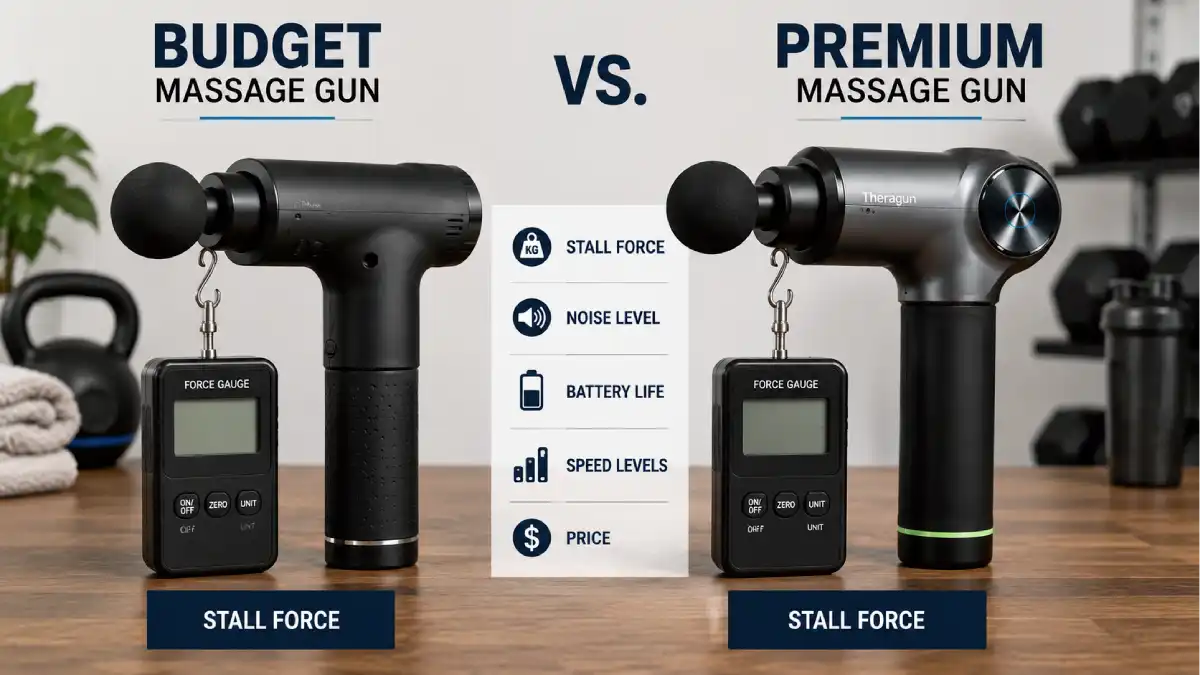
Massage gun marketing loves throwing numbers at you: amplitude in millimeters, percussions per minute, and increasingly, stall force measured in pounds. That last spec has become something of a bragging-rights arms race, with brands proudly advertising 40, 60, even 85+ pounds of stall force as though it’s the single measure of a “real” massage gun. Meanwhile, budget models a fraction of the price sometimes post stall force numbers that rival or beat their premium competition, which raises a genuinely useful question: does this spec actually matter for how a massage gun performs, or is it mostly a number designed to look impressive on a box?
This breaks down exactly what stall force is, how it compares across budget and premium models, and — most importantly — whether chasing a higher number is actually worth the extra money for how most people use these devices at home.
Jump Links
- What Stall Force Actually Means
- Stall Force Isn’t the Only Spec That Matters
- Budget vs. Premium Stall Force: Real Numbers
- Stall Force Comparison Table
- Full Feature Comparison: Budget vs. Premium
- Where Premium Models Actually Earn Their Price
- Where Budget Models Genuinely Hold Their Own
- Who Actually Needs High Stall Force
- Best Budget Massage Gun Picks
- How to Read a Massage Gun Spec Sheet Without Getting Fooled
- FAQ
- The Bottom Line
What Stall Force Actually Means
Stall force refers to the amount of pressure you can apply to the massage gun’s head before the motor slows down or stops entirely (stalls). A higher stall force number means the motor can maintain its full percussion speed even when you’re pressing firmly into dense, resistant muscle tissue, while a lower stall force means the head will bog down or stop moving once you apply enough pressure.
This matters most specifically for deep tissue work on genuinely dense muscle groups — quads, glutes, and the lower back are common examples — where firm pressure is often necessary to reach the intended depth. If a motor stalls under that pressure, the massage gun essentially stops doing its job right at the moment you’re pushing hardest to get the effect you actually want.
Stall Force Isn’t the Only Spec That Matters
Before getting into specific numbers, it’s worth understanding that stall force works alongside two other key specs, and looking at any single number in isolation can be genuinely misleading. Amplitude (how far the massage head physically travels back and forth, typically measured in millimeters) is often described as the more critical factor for actual muscle penetration, since it determines how deeply the percussion effect reaches into tissue regardless of how much pressure you apply. Percussions per minute (the speed of the head’s movement) is the third variable, affecting the overall intensity and sensation of the massage.
A massage gun with a genuinely high stall force but low amplitude can end up feeling less effective for deep tissue work than a model with more moderate stall force but stronger amplitude, since the actual depth of muscle penetration depends heavily on that second spec working in tandem with the first.
Budget vs. Premium Stall Force: Real Numbers
Here’s where the comparison gets genuinely interesting, because the numbers don’t always sort neatly by price the way marketing might suggest.
The Theragun Prime Plus — Therabody’s well-regarded, mid-premium model and a frequent “best overall” pick in 2026 testing roundups — carries a stall force of up to 40 pounds. Compare that to the Ekrin B37, a mid-tier competitor, which posts a notably higher stall force of up to 56 pounds despite generally being positioned at a similar or lower price point than premium Theragun models. Push further up the spec sheet and the Bob and Brad D6 Pro, a more affordably positioned deep-tissue model, advertises over 85 pounds of stall force — more than double what the well-regarded Theragun Prime Plus offers.
On the budget end specifically, testing from TechGearLab on a low-cost Renpho model found an interesting trade-off: the device’s amplitude was noticeably lower than premium competitors, limiting how effective it felt for genuine deep-tissue work, but its stall force was described as incredibly high, which the reviewers noted helped compensate somewhat for that lower amplitude limitation.
The takeaway here is genuinely important: high stall force numbers are not exclusive to premium, expensive massage guns. Some budget and mid-tier models post stall force specs that meet or exceed well-known premium competitors, which suggests the number alone isn’t a reliable proxy for overall quality or price.
Stall Force Comparison Table
| Massage Gun | Approx. Price Tier | Stall Force | Amplitude |
|---|---|---|---|
| Theragun Prime Plus | Premium (~$300+) | Up to 40 lbs | 16mm |
| Ekrin B37 | Mid-tier | Up to 56 lbs | 12mm |
| Bob and Brad D6 Pro | Budget/mid-tier | Over 85 lbs | 16mm |
| Renpho (budget models) | Budget | Reported as very high | Lower than premium competitors |
| Theragun Prime 6th Gen | Mid-premium | Moderate-high | 16mm |
Full Feature Comparison: Budget vs. Premium
| Feature | Typical Budget Massage Gun | Typical Premium Massage Gun |
|---|---|---|
| Price range | $50–$150 | $250–$500+ |
| Stall force | Varies widely, sometimes surprisingly high | Generally strong, but not always the highest |
| Amplitude | Often lower (10–12mm common) | Often higher (12–16mm common) |
| Battery life | 2–4 hours typical | 4–8 hours typical |
| Noise level | Varies significantly by brand | Generally quieter, more refined engineering |
| Build quality/durability | More variable | Generally more consistent and rugged |
| App connectivity | Rare | Common on flagship models |
| Attachment heads | Fewer, more basic | More varied, often including specialty heads |
| Warranty | Often shorter | Often longer, sometimes extended |
| Ergonomics/grip design | Basic, sometimes fatiguing on longer sessions | Often refined multi-grip designs |
Where Premium Models Actually Earn Their Price
Being fair to the premium end of the market, the extra cost isn’t purely brand markup — there are genuine, tangible differences beyond raw stall force numbers:
- Adaptive motor technology. Higher-end models increasingly feature motors specifically engineered to maintain consistent speed under pressure, which is a more refined engineering solution to the same problem stall force numbers are trying to solve.
- Ergonomic grip design. Premium brands like Theragun are specifically noted for multi-angle grip designs that reduce wrist and arm fatigue during use, especially valuable for reaching awkward spots like the lower back or hamstrings.
- Build durability. Premium models often undergo more rigorous drop and durability testing, with some models rated to withstand drops from significant heights without damage.
- Noise engineering. Quieter motor design, particularly at higher speed settings, tends to be more refined on premium models, though several budget options have closed this gap significantly (see the noise comparison below).
- Longer battery life. Premium devices generally offer meaningfully longer battery life per charge compared to budget counterparts.
- More extensive attachment sets and app integration. Premium models often ship with a broader range of specialty attachment heads and, in some cases, companion apps offering guided routines.
Where Budget Models Genuinely Hold Their Own
- Stall force isn’t exclusively a premium feature. As shown above, several budget and mid-tier models genuinely compete with or exceed premium stall force specs.
- Noise performance has improved significantly. Independent decibel testing found some of the quietest devices overall, including budget-friendly options, measuring around 40dB, on par with premium models specifically engineered for quiet operation.
- Added features at lower prices. Some budget models now include features once considered premium-exclusive, like integrated heating and cooling attachments, at a fraction of what premium brands charge for the same functionality.
- Simplicity as a genuine benefit. Budget models with fewer settings and no app requirement can actually be preferable for users who find extensive customization overwhelming rather than helpful.
- Massively lower cost for casual use. For anyone using a massage gun occasionally rather than as part of an intensive daily recovery routine, the performance gap simply doesn’t justify the price gap for most casual users.
Who Actually Needs High Stall Force
- Athletes and serious lifters working with genuinely dense muscle tissue. Larger, more muscular individuals or those doing heavy training loads may genuinely benefit from higher stall force, since dense muscle requires more sustained pressure to reach an effective depth.
- Physical therapists and massage professionals using devices repeatedly on a variety of client body types throughout a workday, where consistent performance under heavy pressure matters for professional reliability.
- Anyone specifically targeting deep glute, quad, or lower back tissue where firm pressure is a core part of the intended technique.
For most casual, everyday users — people using a massage gun a few times a week on general soreness, tight shoulders, or post-workout recovery — the practical difference between 40 pounds and 85 pounds of stall force is unlikely to be noticeable in day-to-day use, since most people simply don’t apply pressure anywhere near either threshold during typical home use.
Best Budget Massage Gun Picks
Renpho Power+ ThermaCool: Frequently highlighted specifically for offering heating and cooling attachment functionality standard, a feature premium brands like Theragun typically charge a significant additional cost for as an add-on. Reviewers have specifically noted it as a smart-value alternative that delivers much of the same recovery benefit at a fraction of premium pricing.
Bob and Brad Q2 Mini: Rated highly in independent testing as the best budget option in its category, offering solid power for its compact size and genuinely good value, though noted as not quite powerful enough for professional or clinical use specifically.
Bob and Brad D6 Pro: A more powerful budget/mid-tier option offering genuinely high stall force (over 85 pounds) alongside strong amplitude, positioning it as a legitimate deep-tissue option without premium pricing, though it runs somewhat heavier than more compact competitors.
How to Read a Massage Gun Spec Sheet Without Getting Fooled
- Look at amplitude alongside stall force, not stall force alone. A high stall force paired with low amplitude may not deliver the deep tissue effect the stall force number alone might suggest.
- Check independent decibel testing rather than trusting marketing noise claims. Actual measured noise levels sometimes differ meaningfully from what manufacturers advertise.
- Consider battery life relative to your actual use pattern. A shorter battery life on a budget model matters less if you’re doing brief, occasional sessions rather than long daily routines.
- Weigh attachment variety against your specific needs. More attachments aren’t automatically better if you’ll realistically only use one or two of them regularly.
- Read reviews that specifically test under real pressure, not just list spec sheet numbers, since actual performance under sustained pressure can differ from advertised maximum stall force figures.
📌 YOU MIGHT ALSO LIKE:
Smart Band vs. Smartwatch: Which Is Better for Basic Health Tracking?
FAQ
Does a higher stall force number always mean a better massage gun?
Not necessarily. Stall force works alongside amplitude and percussion speed, and a high stall force paired with low amplitude may not deliver as effective a deep-tissue result as a more balanced spec combination. It’s one factor among several, not a standalone quality indicator.
Do budget massage guns really have comparable stall force to premium models?
In several documented cases, yes. Independent testing has found some budget and mid-tier models posting stall force specs that meet or exceed well-known premium competitors, challenging the assumption that stall force is exclusively a premium feature.
Who genuinely needs a massage gun with very high stall force?
Athletes, serious lifters working with dense muscle tissue, and massage or physical therapy professionals are the groups most likely to genuinely benefit from higher stall force. Most casual, everyday users don’t apply enough pressure during typical use to notice a meaningful difference between moderate and very high stall force specs.
Is amplitude more important than stall force for most people?
Many experts consider amplitude the more consistently important spec for actual muscle penetration and effectiveness, since it determines how deeply the percussion reaches regardless of how much pressure is applied, while stall force mainly matters once you’re pushing quite firmly.
Are premium massage guns worth the extra cost if I only use one occasionally?
For occasional or casual use, the performance gap between a well-reviewed budget model and a premium one is often not noticeable enough to justify the price difference. Premium models earn their price more clearly for frequent, intensive, or professional use.
What’s a genuinely good budget massage gun to start with?
Well-reviewed budget options like the Bob and Brad Q2 Mini or Renpho’s ThermaCool line offer solid performance, reasonable stall force, and useful features like heat therapy at a fraction of premium pricing, making them a reasonable starting point for most home users.
The Bottom Line
High stall force makes for an impressive number on a spec sheet, but it’s genuinely only one piece of what makes a massage gun effective — and it’s not a spec exclusive to premium devices, as several budget and mid-tier models demonstrate. For most people using a massage gun casually at home, a well-reviewed budget model paired with reasonable amplitude will deliver a genuinely effective experience without the premium price tag. The higher stall force chase really only pays off for athletes, professionals, or anyone specifically working dense muscle tissue that demands sustained, firm pressure.
For more budget-friendly wellness and gear guides, check out more posts over at The Frugal Glow.
Sources: