

The Cost-Per-Wear Formula: How to Know If an Item Is Actually Worth Buying
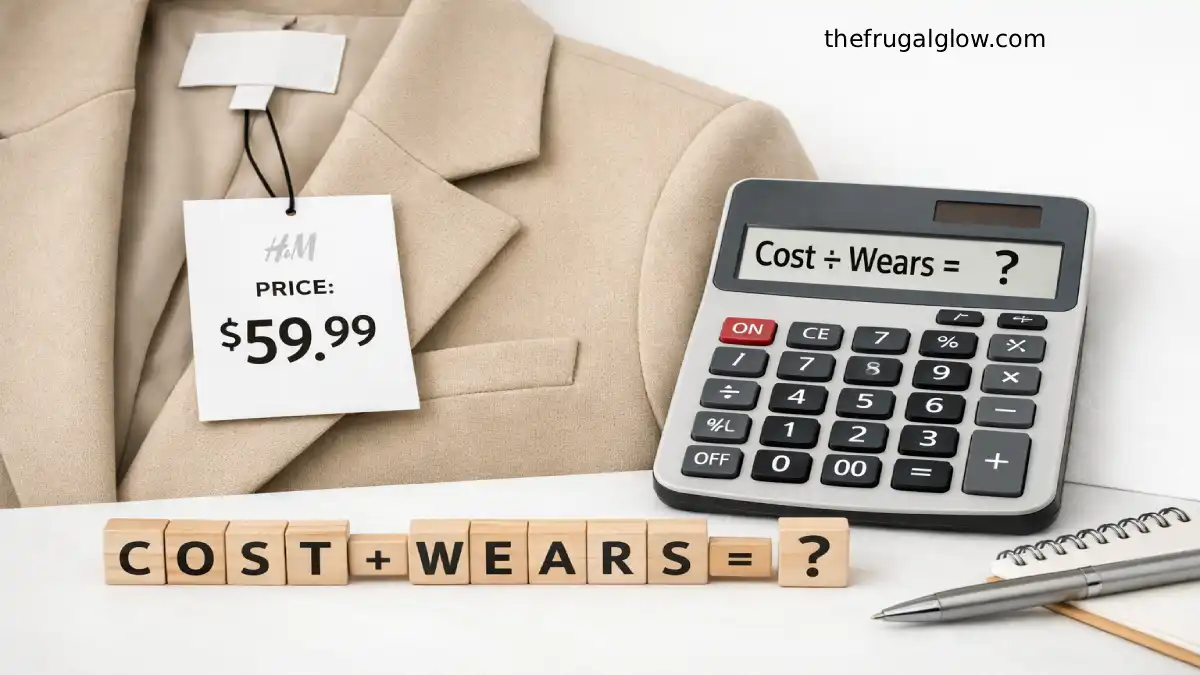
You’re standing at the checkout, or scrolling the checkout page, staring at an item that’s either “such a good deal” or “kind of a lot, but I’ll wear it forever.” Here’s the problem: your gut feeling about value is almost always wrong, because it’s reacting to the price tag alone. Price tells you what something costs to buy. It tells you nothing about what it actually costs you.
That’s exactly the gap the cost-per-wear formula fills. It’s a simple piece of math that fashion insiders, stylists, and increasingly regular budget-conscious shoppers use to cut through the “deal or not” confusion, and once you start running the numbers, you’ll never look at a price tag the same way again.
Jump Links
- What Cost-Per-Wear Actually Means
- The Formula
- Cost-Per-Wear in Action: Real Examples
- What Counts as a “Good” Cost-Per-Wear
- Good CPW Benchmark Table
- The Upgraded Formula: Factoring in Care and Resale
- How to Estimate Realistic Wear Counts
- Where This Formula Can Trick You
- How to Use This Before Every Purchase
- FAQ
- The Bottom Line
What Cost-Per-Wear Actually Means
Cost-per-wear (sometimes written CPW, or called price-per-wear) converts a sticker price into a per-use cost, which is a genuinely more accurate way to measure whether something is actually worth what you paid for it. Instead of asking “is $80 too much for this coat,” you ask “what does this coat actually cost me every single time I put it on” — and that second question is the one that actually matters for your budget.
It’s a concept that’s been floating around fashion and stylist circles for a while, but it’s become especially relevant as more people push back against fast fashion’s disposable pricing model, where a “cheap” item worn twice can genuinely cost more per use than a pricier item worn for years.
The Formula
The math couldn’t be simpler:
Cost Per Wear = Total Price Paid ÷ Number of Times Worn
That’s the whole formula. If you buy a jacket for $200 and wear it 50 times over its lifespan, the math looks like this: $200 ÷ 50 = $4 per wear. Meanwhile, a $50 dress worn only twice comes out to $25 per wear — five times more expensive per use than the jacket that cost four times as much upfront.
That’s the entire mind-shift this formula creates: sticker price and actual cost are frequently two completely different numbers, and the only way to know which is which is to run the math instead of trusting the price tag alone.
Cost-Per-Wear in Action: Real Examples
Numbers make this click faster than explanations do. Here’s a side-by-side look at how differently priced items can land at very different real costs.
| Item | Price Paid | Estimated Wears | Cost Per Wear |
|---|---|---|---|
| $12 trendy top (worn a handful of times, then discarded) | $12 | 4 | $3.00 |
| $45 basic sweater (worn weekly for two winters) | $45 | 40 | $1.13 |
| $200 winter coat (worn all season, for years) | $200 | 100 | $2.00 |
| $60 statement dress (worn once for a wedding) | $60 | 1 | $60.00 |
| $18 pair of budget flats (fall apart after a month) | $18 | 6 | $3.00 |
| $90 pair of everyday sneakers (worn constantly for a year) | $90 | 150 | $0.60 |
Notice the pattern: the most expensive item on the list (the $200 coat) actually has one of the lowest cost-per-wear numbers, while a couple of the cheapest items land at a surprisingly high real cost. This is exactly why “cheap” and “good value” aren’t the same thing, and why the formula is worth running before you assume a low price tag automatically means a smart purchase.
What Counts as a “Good” Cost-Per-Wear
There isn’t a single universal dollar amount that defines a “good” cost-per-wear because value looks completely different across wardrobe categories. Evaluating a winter coat using the same benchmark as a basic white t-shirt will distort your numbers and lead to poor buying decisions.
To determine if an item delivers strong value, you have to weigh two key factors: wear frequency and lifespan durability.
- High-Frequency Basics: Everyday staples like jeans, basic tees, and workhorse sneakers should aim for the lowest CPW possible (ideally under $1.50). Because you reach for these items multiple times a week, a low upfront price combined with heavy repetition drives their real cost down to pennies over time.
- Investment Outerwear and Layering: Heavy winter coats, structured blazers, and leather boots carry higher upfront price tags and are worn seasonally rather than daily. A coat with a $5 CPW might seem high compared to a t-shirt, but if it lasts five winter seasons and protects you from the elements every single day, it is an exceptionally smart cost-per-wear investment.
- Specialized or Trend Items: Statement pieces, eveningwear, and event dresses naturally hit higher CPW figures because their wear count is inherently capped. Understanding this benchmark before buying helps you decide whether an item is worth paying for upfront or better off rented or skipped altogether.
Good CPW Benchmark Table
Here’s a rough guide for what a solid cost-per-wear looks like across common wardrobe categories.
| Category | Excellent CPW | Reasonable CPW | Reconsider If Above |
|---|---|---|---|
| Everyday basics (tees, tanks) | Under $1 | $1–$3 | $5+ |
| Jeans | Under $1 | $1–$4 | $8+ |
| Sweaters/knitwear | Under $2 | $2–$5 | $10+ |
| Everyday shoes/sneakers | Under $1.50 | $1.50–$4 | $8+ |
| Coats/outerwear | Under $3 | $3–$8 | $15+ |
| Blazers | Under $2 | $2–$6 | $12+ |
| Special-occasion pieces | N/A (context matters) | Varies widely | Depends on the memory/event value |
Special-occasion pieces are the one category where this table gets fuzzy on purpose. A high cost-per-wear on a once-worn outfit for a major life event isn’t automatically a “bad” purchase — it just means the value being measured isn’t strictly financial, and that’s a completely reasonable trade-off to make consciously.
The $100 Target Capsule Wardrobe: 8 Essential Basics for Endless Outfits
The Upgraded Formula: Factoring in Care and Resale
While the basic formula gives you a quick snapshot, smart shoppers use the Net Cost-Per-Wear Formula to get the full financial picture. The initial sticker price is rarely the only dollar amount tied to an item over its lifetime—hidden maintenance costs can quickly inflate your real spend, while potential resale value can work in your favor.
The upgraded formula looks like this:
Net Cost Per Wear = (Purchase Price + Care/Repair Costs − Resale Value) ÷ Number of Times Worn
Understanding these extra variables changes how you evaluate value:
- Hidden Maintenance Costs (+): Dry cleaning fees, tailoring/alterations, special delicate detergents, or resoling shoes all add to the total investment. A $40 dry-clean-only sweater worn 10 times with $30 in cleaning bills actually costs $70 total—shifting the true CPW from $4 to $7 per wear.
- Resale & Recouping Value (-): Higher-quality, brand-name, or classic structured pieces (like a pre-loved designer coat or staple denim) often retain resale value on platforms like Poshmark, ThredUp, or eBay. If you buy a $150 wool blazer, wear it 30 times, and resell it for $40, your net outlay is only $110—dropping your real cost to under $3.70 per wear.
- Tailoring as a Value Multiplier: Spending $15 to tailor the waist of a $30 pair of trousers might increase the upfront cost, but if that custom fit turns a rarely worn item into an everyday favorite worn 50 times, tailoring drastically lowers your final net CPW.
How to Estimate Realistic Wear Counts
The formula only works as well as your wear-count estimate, so it’s worth being realistic rather than optimistic here. A few practical anchors:
- Everyday basics you already reach for often: estimate 30–50+ wears per year if it’s genuinely part of your regular rotation.
- Seasonal pieces (heavy sweaters, coats): estimate wears per season, then multiply by however many seasons you realistically expect to keep and still like the item.
- Statement or trend pieces: be conservative here. On average, clothing is worn only around seven to ten times before being discarded, largely because trend pieces and impulse buys fall out of favor fast — so unless a piece has serious long-term versatility, keep wear-count estimates modest.
- Special-occasion pieces: if you genuinely expect to wear it once, be honest about that going in rather than convincing yourself of a higher number to make the math feel better.
Where This Formula Can Trick You
Cost-per-wear is a genuinely useful tool, but it’s not immune to being used as a justification rather than an honest check. It’s worth watching for a few common ways the math gets bent to fit a decision that’s already been made:
- Inflating the expected wear count to make an expensive item’s math look better than it’s likely to actually be.
- Ignoring storage and closet space. A low CPW doesn’t account for the cost of owning too much — closet clutter and decision fatigue are real costs that don’t show up in the formula.
- Using it to justify impulse buys after the fact, rather than as a genuine decision-making check before purchasing.
- Treating every item like an investment piece. Not everything needs to hit an “excellent” CPW threshold — some purchases are about joy, self-expression, or a specific moment, and that’s a legitimate reason to buy something even with a higher cost-per-wear.
The formula works best as a genuine question asked before buying, not a story constructed afterward to make a purchase already made feel smarter than it was.
How to Use This Before Every Purchase
To make the cost-per-wear formula part of your routine, turn it into a 30-second mental checklist before heading to the register or clicking “place order.”
Here is how to apply it step-by-step:
- Be Brutally Honest About Wears: Estimate how many times you will realistically wear the item over its lifetime. Ignore the best-case scenario (e.g., “if I lose 10 pounds” or “if I go to fancy dinners every weekend”) and focus on your actual weekly routine.
- Run the Basic Math: Divide the sticker price by your realistic wear count to get your projected cost-per-wear.
- Check the Benchmarks: Compare your calculated CPW against the benchmark table for that category. If a basic cotton tee lands at $6 per wear, pause—that’s a signal the item is either overpriced or unlikely to get enough wear.
- Factor in the “Hidden” Care Tax: If the care tag says “dry clean only,” requires delicate hand-washing, or needs professional tailoring, add estimated care costs to your purchase price before finalizing the math.
- Evaluate the “Joy Exception”: Remember that cost-per-wear is a tool for financial clarity, not a rigid set of rules. It’s completely okay to purchase a special-occasion dress or sentimental statement piece with a high CPW—as long as you make that choice intentionally rather than by accident.
FAQ
What’s a genuinely “bad” cost-per-wear?
It depends heavily on the category, but as a rough guide, anything landing significantly above the “reconsider” thresholds in the benchmark table (like $8+ per wear for basics, or $15+ for a coat) is worth a second thought before buying.
Should I calculate cost-per-wear before or after buying something?
Ideally before, since that’s when the math can actually influence your decision. Calculating it afterward is still useful for understanding your own shopping patterns and figuring out which types of purchases tend to be worth it for you specifically.
Does cost-per-wear apply to accessories and shoes, or just clothing?
It applies to almost anything you wear repeatedly, including shoes, bags, jewelry, and accessories. Shoes in particular are a category where cost-per-wear often reveals that a pricier, more durable pair beats cheaper pairs replaced repeatedly.
Is it okay to buy something with a high projected cost-per-wear anyway?
Yes, especially for special-occasion pieces or items with genuine sentimental or emotional value. The formula is meant to inform decisions, not dictate every single purchase regardless of context.
How do I estimate wear count for something I’ve never owned before?
Look at how often you wear similar items you already own in your closet. If you reach for your current sweaters two to three times a week each winter, that’s a reasonable starting estimate for a new sweater in a similar style.
Does a lower price always mean a lower cost-per-wear?
Not necessarily, and this is actually the core insight of the whole formula. A cheap item worn only a few times before falling apart or falling out of rotation can easily have a higher real cost-per-wear than a pricier, more durable item worn for years.
The Bottom Line
The price tag only tells half the story. Cost-per-wear fills in the rest by asking the question that actually matters: what does this item really cost you, every single time you put it on? Run the simple math — price divided by realistic wears — before your next purchase, and you’ll start spotting genuine value a whole lot faster than sticker price alone could ever show you.
For more smart shopping strategies and budget-friendly style guides, check out more posts over at The Frugal Glow.