

The $2 ‘Epsom Salt’ Miracle: How to Create a Luxury Detox Bath at Home
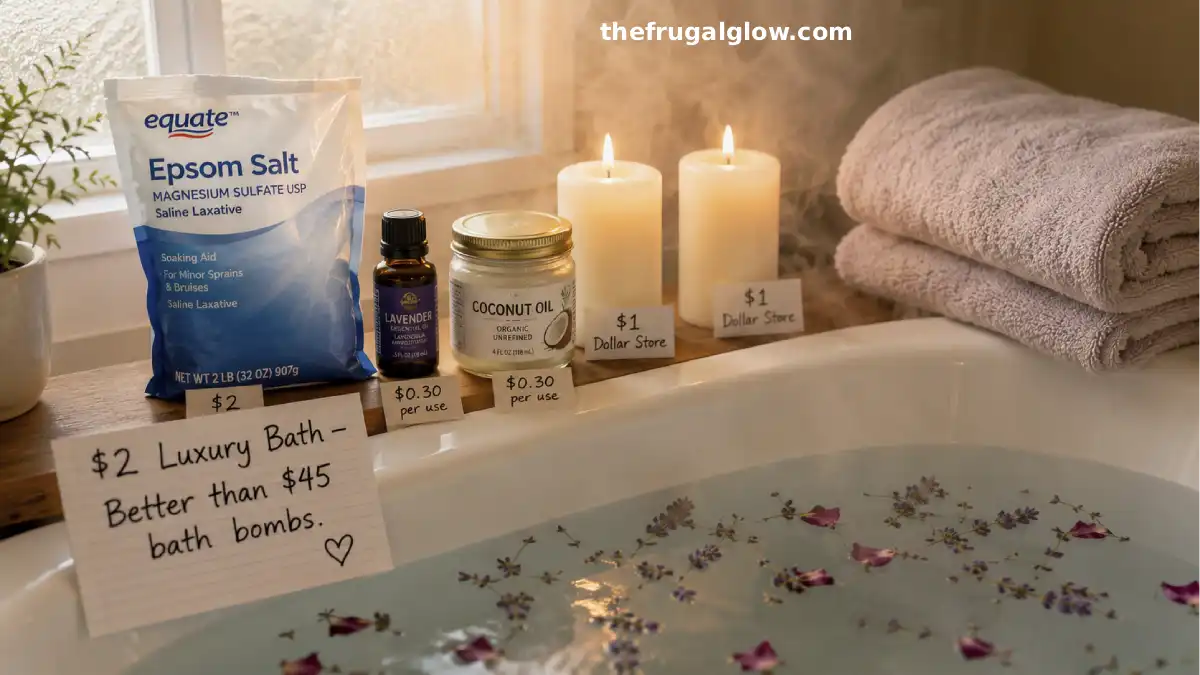
Let me tell you about the $45 bath bomb that made me question my life choices.
It was from a fancy brand. The packaging was beautiful. The scent was described as “jasmine and sandalwood with notes of bergamot and vanilla.” I dropped it in my bathtub and watched it fizz. The water turned a lovely shade of pale pink. It smelled… fine. Not amazing. Just fine.
After the bath, my skin felt okay. Not great. Not transformed. Just slightly softer.
The next week, I was sore from a workout. I had $2 in my pocket and no fancy bath bomb. I went to the grocery store and bought a 2-pound bag of Epsom salt for $1.99. I poured half of it into my bath. Added a few drops of peppermint oil I already had. Soaked for 20 minutes.
My muscle soreness was cut in half. My skin was softer than it had ever been. I felt relaxed in a way that the $45 bath bomb never achieved.
That was three years ago. I’ve taken hundreds of Epsom salt baths since. I’ve saved hundreds of dollars. And I’ve learned how to turn a $2 bag of salt into a spa-worthy experience that rivals any $50+ bath product.
Today, I’m sharing everything I’ve learned. The science of Epsom salt. The exact recipe for a luxury bath. The mistakes I made (too much salt = bad news). And why you should never, ever pay $45 for a bath bomb again.
Let’s get into it.
Jump Links
- The $45 Bath Bomb That Made Me See the Light
- What Is Epsom Salt (And Why Is It So Good for You)?
- The $2 Luxury Detox Bath Recipe
- The Add-Ons That Make It Feel Expensive (For Pennies)
- How to Set Up a Spa-Worthy Bath Environment
- The Science of Soaking: How Long and How Often?
- My Biggest Mistakes (So You Don’t Make Them)
- The $45 Product vs. $2 Epsom Salt: Ingredient Showdown
- The Math: What I Saved in One Year
- Bonus Uses: Epsom Salt for Body Scrub and Foot Soak (More Savings)
- Frequently Asked Questions (FAQ)
- Final Thoughts: Luxury Is a Feeling, Not a Price Tag
The $45 Bath Bomb That Made Me See the Light
I need to be honest about my fancy bath product obsession.
For a while, I was addicted to luxury bath products. Bath bombs from Lush ($8-12 each). Mineral soak from Aura Cacia ($15-20). Foaming bath salts from Herbivore ($45 for a small jar). I convinced myself that these products were “self-care” and that I deserved to spend money on them.
And I did deserve self-care. But I didn’t deserve to be ripped off.
The $45 bath bomb was my breaking point. It was beautiful. It smelled nice. But the ingredients? Sodium bicarbonate, citric acid, magnesium sulfate (Epsom salt), fragrance, colorant. That’s it. Epsom salt was the active ingredient. Everything else was fizz and scent.
Epsom salt costs $2 for 2 pounds. The bath bomb had maybe 1/4 cup of Epsom salt. That’s about $0.10 worth.
I was paying $44.90 for fizz, fragrance, and a pretty color.
The peppermint oil bath I made the next week changed everything. For $2, I got better muscle relief, softer skin, and a deeper sense of relaxation than any expensive bath product had ever given me.
I’ve never bought a luxury bath bomb since.
What Is Epsom Salt (And Why Is It So Good for You)?
Let me explain the science quickly.
Epsom salt isn’t actually salt. It’s magnesium sulfate. The name “salt” comes from its crystalline structure, not its composition.
What it does for your body:
Magnesium is absorbed through your skin when you soak in Epsom salt. Magnesium is essential for hundreds of bodily functions, but two are particularly relevant for baths:
- Muscle relaxation: Magnesium helps regulate muscle contractions. A warm Epsom salt bath can reduce soreness, cramping, and stiffness after workouts.
- Stress reduction: Magnesium plays a role in serotonin production. More magnesium = better mood, lower stress, and improved sleep.
What it does for your skin:
- Exfoliation: The crystals gently remove dead skin cells.
- Softening: Magnesium sulfate softens the outer layer of skin, making it smoother.
- Anti-inflammatory: Reduces redness and irritation from conditions like eczema or mild acne.
What it does NOT do:
- It does not “detox” your body in the way that wellness influencers claim. Your liver and kidneys handle detoxing. But it does help you sweat, which releases some toxins.
- It does not cure diseases.
- It does not work overnight for chronic conditions.
The benefits are real, but they’re not magic. They’re chemistry.
The $2 Luxury Detox Bath Recipe
Here’s the exact recipe I’ve used for years. It costs about $2 per bath and rivals any $30-50 spa product.
Base Recipe:
| Ingredient | Amount | Cost |
|---|---|---|
| Epsom salt (plain, unscented) | 1-2 cups | $0.50-1.00 |
| Hot water (fill the tub) | as needed | pennies |
| Total | $0.50-1.00 |
That’s it. A plain Epsom salt bath is already effective. But if you want the “luxury” experience (and who doesn’t?), here’s the full recipe.
Luxury Upgrade Recipe:
| Ingredient | Amount | Cost |
|---|---|---|
| Epsom salt | 2 cups | $1.00 |
| Baking soda | 1/2 cup | $0.15 |
| Essential oil (lavender, eucalyptus, peppermint, or tea tree) | 10-20 drops | $0.30 |
| Dried herbs (lavender buds, rose petals – optional) | 1/4 cup | $0.20 |
| Coconut oil or almond oil (for softening) | 1 tbsp | $0.30 |
| Total | $1.95 |
How to prepare:
- Run your bath water as hot as you can stand (you’ll let it cool while you soak).
- While the water is running, add the Epsom salt and baking soda. Swirl with your hand to dissolve.
- Add the coconut or almond oil. This helps moisturize your skin and helps the essential oils disperse.
- Add the essential oils last (they evaporate if you add them too early).
- If using dried herbs, sprinkle them on the surface of the water.
- Get in. Soak for 20-30 minutes.
For muscle soreness specifically:
- 2 cups Epsom salt
- 10 drops peppermint oil
- 10 drops eucalyptus oil
For stress and sleep:
- 2 cups Epsom salt
- 15 drops lavender oil
- 5 drops chamomile oil (or 2 chamomile tea bags dropped in)
For skin conditions (eczema, psoriasis):
- 1 cup Epsom salt (less is more – too much can dry out skin)
- 1/2 cup baking soda
- 5 drops tea tree oil
- No coconut oil (can clog pores for some people)
The Add-Ons That Make It Feel Expensive (For Pennies)
You don’t need these. But if you want to feel like you’re at a $200 spa, here’s how to do it for pocket change.
Candles ($1-2 each at dollar store)
Light two or three. Place them where you can see them but not near anything flammable. The flickering light instantly makes any bath feel luxurious.
Tray for across the tub ($2 at thrift store)
Use an old cutting board, a cookie sheet, or a piece of wood. Rest it across the tub. Now you have a place for your phone (watching a show), a book, or a glass of wine.
Cold drink (pennies)
Spa water with cucumber and mint. Or sparkling water with lemon. Or a glass of wine. Staying hydrated is important, and a pretty drink makes the experience feel special.
Folded towel for your neck ($0)
Roll up a hand towel and place it behind your neck. It’s the same thing spas do. It costs nothing.
Music or podcast (free)
Create a “spa” playlist on Spotify or Apple Music. Or listen to a calming podcast. Rain sounds. Ocean waves. Anything without loud commercials.
Flannel washcloth ($0)
Fold a soft washcloth and place it over your eyes. It blocks out light and forces you to relax. Spas charge $5 for this. You have washcloths at home.
Total cost for spa atmosphere: $2-4
Compare to a spa bath treatment: $50-200. You’re saving $48-196 per bath.
How to Set Up a Spa-Worthy Bath Environment
The bath itself is one thing. The environment is another. Here’s how to make your bathroom feel like a spa.
Before you start (5 minutes of prep):
- Clean the tub. Nobody relaxes in a dirty tub.
- Clear clutter off the counter. Put away toothbrushes and shampoo bottles.
- Dim the lights (or turn them off and use candles only).
- Lock the door. Put a note on it if you live with others.
- Start playing your spa music.
During the bath (20-30 minutes):
- Don’t check your phone (or put it on Do Not Disturb).
- Don’t think about work or chores.
- Focus on your breathing. In for 4 seconds. Hold for 4 seconds. Out for 4 seconds.
- Sip your cold drink.
- Close your eyes for at least 5 minutes.
After the bath (5 minutes):
- Don’t rinse off. Pat your skin dry (don’t rub) to leave the minerals on your skin.
- Apply a plain moisturizer (CeraVe, Cetaphil, or coconut oil).
- Drink a glass of water (Epsom salt baths can be dehydrating).
- Go to bed within an hour. Your body will sleep better.
The Science of Soaking: How Long and How Often?
How long:
- Minimum effective time: 15 minutes
- Optimal time: 20-30 minutes
- Maximum safe time: 45 minutes (beyond that, you risk dehydration)
The first 10 minutes are just warming up. The absorption of magnesium sulfate begins around 12-15 minutes. The peak relaxation happens around 20-30 minutes.
How often:
- For general wellness: 1-2 times per week
- For muscle soreness (after hard workouts): 1-2 times per week
- For skin conditions: 3 times per week (but use less salt – 1 cup instead of 2)
- For stress relief: as needed, but don’t exceed 4 times per week
Warning signs you’re doing it too often:
- Dry, itchy skin
- Lethargy or feeling tired all the time
- Headaches (sign of mild magnesium overdose, which is rare but possible)
- Muscle weakness
If you notice these, take a week off and reduce frequency.
My Biggest Mistakes (So You Don’t Make Them)
I made a lot of mistakes when I first started. Learn from me.
Mistake #1: Using too much salt
My first Epsom salt bath, I used the entire 2-pound bag. That’s about 4 cups. My skin felt like sandpaper afterward. I was itchy and uncomfortable. The recommended amount is 1-2 cups per bath. More is not better.
Mistake #2: Using essential oils without a carrier oil
I added peppermint oil directly to the water. It just floated on top and then stuck to my skin. The smell was overwhelming. Always mix essential oils with a carrier oil (coconut, almond, olive, or jojoba) before adding to the bath.
Mistake #3: Staying in too long
I read about the “detox” benefits and stayed in for an hour. I felt dizzy and nauseous afterward. Your body can absorb too much magnesium if you soak too long. 20-30 minutes is plenty.
Mistake #4: Using hot water instead of warm
I made the water as hot as I could stand. It felt good for 5 minutes, then I started sweating and feeling lightheaded. Warm water is better. Your body relaxes more at 98-102°F than at scalding temperatures.
Mistake #5: Not drinking water before and after
Epsom salt baths make you sweat. A lot. I didn’t drink enough water and woke up with a headache. Drink a glass before the bath and one after.
Mistake #6: Expecting miracles
I thought one Epsom salt bath would cure my chronic back pain. It didn’t. It helped. But the real benefits came from consistent use over weeks and months. Don’t expect a single bath to change your life.
The $45 Product vs. $2 Epsom Salt: Ingredient Showdown
Let me put this side by side.
$45 Luxury Bath Bomb:
- Sodium bicarbonate (baking soda)
- Citric acid (makes it fizz)
- Magnesium sulfate (Epsom salt – the active ingredient)
- Fragrance (often synthetic)
- Colorant (often synthetic)
- Dried flowers (cosmetic only, no therapeutic benefit)
$2 DIY Epsom Salt Bath:
- Magnesium sulfate (Epsom salt – the active ingredient)
- Baking soda (optional, $0.15)
- Essential oils (natural fragrance with therapeutic benefits)
- Carrier oil (for moisturizing)
Ingredient comparison:
The expensive product adds citric acid (for fizz) and colorant (for looks). That’s it. The active ingredient – the thing that actually helps your muscles and skin – is Epsom salt. Both have it.
Price per bath:
- Expensive bath bomb: $8-12 (if you buy single) or $45 per jar (if you buy a multi-pack)
- DIY Epsom salt bath: $1-2
You are paying $40+ for fizz, color, and a brand name.
The Math: What I Saved in One Year
Let me show you the actual dollar savings.
Before (using fancy bath products):
- Bath bombs (2 per week): $8-12 each = $16-24 per week
- Luxury bath salts (1 jar per month): $15-20
- Monthly total: $80-115
- Annual total: $960-1,380
After (using DIY Epsom salt baths):
- Epsom salt (2 cups per bath, 2 baths per week)
- 1 gallon bag of Epsom salt ($8 at Costco) lasts 2-3 months
- Essential oils (10-20 drops per bath, a $10 bottle lasts 30-40 baths)
- Annual total: $50-75
Annual savings: $885 to $1,330
That’s not a typo. Over a thousand dollars saved per year. By switching from fancy bath products to Epsom salt.
What I did with the savings:
- Bought a nicer bath pillow ($25)
- Upgraded my towels to soft cotton ($40)
- Took a weekend trip ($300)
- Put the rest into savings
And my baths are still relaxing, my muscles still recover, and my skin is just as soft.
Bonus Uses: Epsom Salt for Body Scrub and Foot Soak (More Savings)
Since I already have a giant bag of Epsom salt, I started using it for other things. Each of these replaces an expensive product.
Epsom Salt Body Scrub (replaces $20-30 scrubs):
Mix 1/2 cup Epsom salt with 2 tablespoons coconut oil and 5 drops of essential oil (lavender, peppermint, or grapefruit). Use in the shower. Scrub gently on damp skin. Rinse. This exfoliates better than any $20 scrub I’ve ever bought.
Epsom Salt Foot Soak (replaces $10-15 foot treatments):
Mix 1/2 cup Epsom salt in a basin of warm water. Soak feet for 15 minutes. Pat dry. Apply lotion. This softens calluses, reduces odor, and relieves tired feet after a long day.
Epsom Salt Compress (replaces $5-10 cold packs):
Dissolve 1/2 cup Epsom salt in 1 cup hot water. Soak a washcloth in the solution. Wring out. Place on sore muscles. Cover with a dry towel. Leave for 15-20 minutes. The magnesium absorbs directly into the sore area.
Annual savings from bonus uses: $50-100
That brings my total annual savings from one $8 bag of Epsom salt to nearly $1,500.
Ditch the $50 Melatonin! 5 Free Sleep Hygiene Habits for Your Deepest Rest Ever
Frequently Asked Questions (FAQ)
1. Will Epsom salt baths really “detox” my body?
The word “detox” is overused and misleading. Your liver and kidneys are your body’s detox system. They don’t need help. That said, Epsom salt baths do make you sweat, which releases small amounts of toxins through your skin. But the main benefits are muscle relaxation, stress reduction, and skin softening – not “detoxing.”
2. Can I use table salt instead of Epsom salt?
No. Table salt is sodium chloride. Epsom salt is magnesium sulfate. They are chemically different and have different effects. Table salt will dry out your skin. Do not substitute.
3. How much Epsom salt should I use for a standard bathtub?
1-2 cups for a standard tub (40-60 gallons). Start with 1 cup. If you don’t feel any muscle relief, try 2 cups next time. More than 2 cups can dry out your skin and cause irritation.
4. Is it safe to take Epsom salt baths every day?
No. Daily Epsom salt baths can dry out your skin, cause magnesium overload (rare but possible), and lead to dehydration. 2-3 times per week is plenty. Listen to your body. If your skin feels dry or you feel lethargic, take a break.
5. Can children take Epsom salt baths?
Yes, but use less salt. For children under 60 lbs, use 1/2 cup. For children 60-100 lbs, use 1 cup. For teenagers, adult amounts are fine. Always supervise young children. And don’t use essential oils on children without checking safety guidelines (some oils are not safe for young kids).
6. Why does my skin feel dry after Epsom salt baths?
You’re either using too much salt (more than 2 cups), staying in too long (over 30 minutes), or not moisturizing afterward. Epsom salt can be drying. Always apply lotion or oil after patting dry. If dryness persists, reduce to 1 cup per bath.
7. Can I add bubble bath or bath bombs to my Epsom salt bath?
Yes, but it defeats the purpose of saving money. If you want bubbles, add a small amount of unscented liquid castile soap (Dr. Bronner’s) – it’s cheaper than bubble bath and has fewer chemicals. But really, the Epsom salt is doing the work. The bubbles are just for fun.
Final Thoughts: Luxury Is a Feeling, Not a Price Tag
Here’s what I want you to take away.
The beauty and wellness industry wants you to believe that you need expensive products to feel good. They want you to think that a $45 bath bomb is “self-care” and that a $2 bag of Epsom salt is somehow lesser.
That’s marketing. It’s not truth.
Epsom salt is Epsom salt. The $45 bath bomb uses the same ingredient. The difference is fizz, color, and a pretty package.
I’m not saying you can never buy a fancy bath product again. If it brings you joy and you have the budget, enjoy it. But don’t believe that you need to spend $45 to feel relaxed, to relieve sore muscles, or to soften your skin.
You don’t. You need $2 of Epsom salt, 20 minutes of quiet, and permission to do nothing.
That’s the real luxury. And it’s available to everyone.
So this week, skip the $45 bath bomb. Go to the grocery store. Buy a bag of Epsom salt for $2. Pour it into your tub. Light a candle (dollar store). Play some quiet music. Soak for 20 minutes.
See how you feel.
I think you’ll be surprised. I know I was.
That’s the frugal glow. And it’s soaking in your bathtub for $2. 🛁💛
For more DIY wellness recipes, frugal self-care tips, and money-saving health strategies, visit The Frugal Glow.