

$300 La Mer vs. $15 Nivea Cream: Ingredient-by-Ingredient Cost Analysis
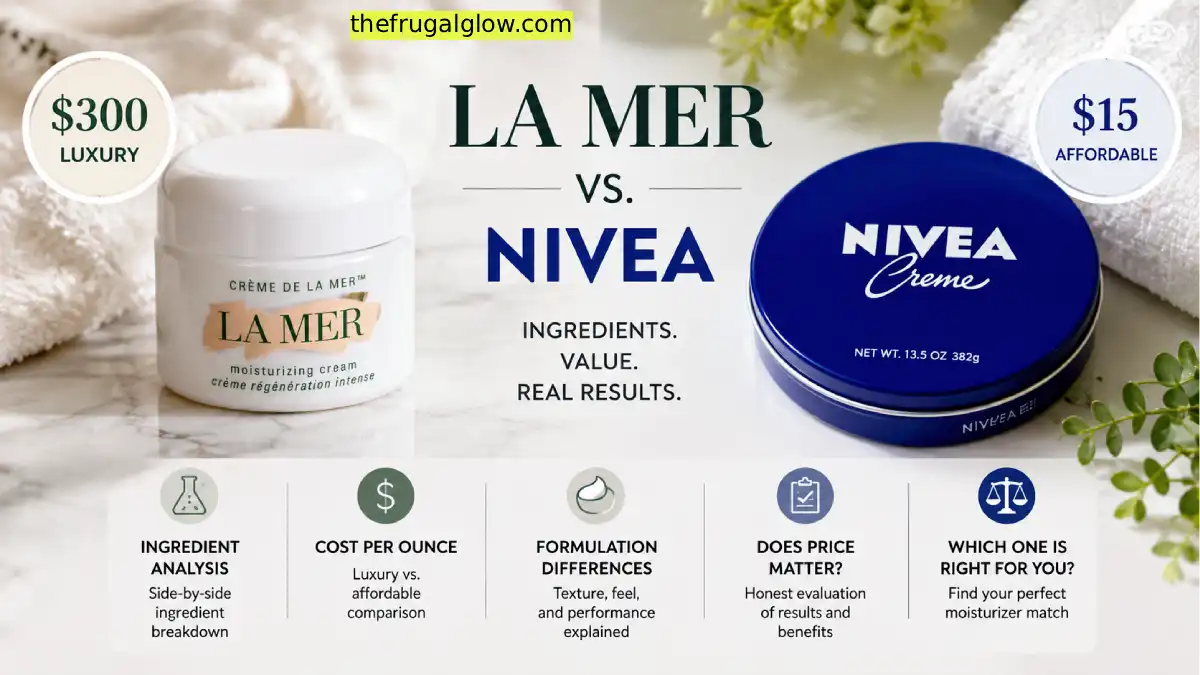
Few skincare comparisons generate as much internet debate as this one. On one side: La Mer’s Crème de la Mer, a roughly two-ounce jar that runs about $300 and has a cult following built on decades of luxury branding and a famous origin story involving a physicist and burn scars. On the other: Nivea Creme, a blue tin that’s been sitting in drugstores and medicine cabinets for over a century, priced at around $15 for a much larger jar.
The claim that gets repeated constantly online is that these two products are “basically the same thing.” That’s not quite true, and it’s not quite false either — the real answer requires actually reading both ingredient lists side by side instead of relying on a viral comparison graphic. So that’s exactly what this breaks down: ingredient by ingredient, what these two creams actually share, where they genuinely diverge, and whether the $285 price gap reflects $285 worth of real difference.
Jump Links
- The Core Claim, and Why It’s Complicated
- La Mer Crème de la Mer: Full Ingredient Breakdown
- Nivea Creme: Full Ingredient Breakdown
- Side-by-Side Ingredient Comparison Table
- What’s Genuinely Shared Between the Two
- What’s Genuinely Different
- The “Miracle Broth” Question
- Cost-Per-Ounce Breakdown
- Cost Analysis Table
- What You’re Actually Paying For at $300
- Who Each Product Actually Makes Sense For
- FAQ
- The Bottom Line
The Core Claim, and Why It’s Complicated
The internet’s favorite version of this comparison usually goes something like: “La Mer and Nivea share several of the same first few ingredients, so they’re basically identical.” That statement is technically true in the narrowest sense and misleading in the bigger picture, which is exactly why this deserves the full ingredient-by-ingredient treatment rather than a soundbite.
Ingredient lists on cosmetics are required to be listed in descending order of concentration under FDA and international labeling rules, meaning the first several ingredients on any product’s list make up the bulk of the formula, while ingredients further down the list are present in progressively smaller (often quite tiny) amounts. This is the entire key to understanding whether two products are “the same” — shared ingredients at the top of the list matter enormously; shared ingredients near the bottom mean much less, since a few drops of any additive spread across an entire batch barely moves the needle.
La Mer Crème de la Mer: Full Ingredient Breakdown
According to ingredient decoding resource INCIDecoder, Crème de la Mer’s ingredient list opens with Algae (Seaweed) Extract, followed by Mineral Oil, Petrolatum, Glycerin, Isohexadecane, Citrus Aurantifolia (Lime) Extract, Microcrystalline Wax, and Lanolin Alcohol, before moving into a long tail of nutrient- and vitamin-related ingredients including sesame seed oil, eucalyptus leaf oil, alfalfa seed powder, sunflower seedcake, sweet almond seed meal, a set of mineral gluconates (copper, calcium, magnesium, zinc), tocopheryl succinate, niacin, and beta-carotene, before finishing with preservatives, fragrance components, and coloring agents.
The headline ingredient — and the entire foundation of La Mer’s brand mythology — is what the company calls “Miracle Broth,” a proprietary fermented sea kelp extract that’s the actual “Algae Extract” sitting at the very top of the ingredient list. This fermentation process is genuinely unique to La Mer and represents real intellectual property the brand has spent decades developing and refining; it’s not something you can simply replicate by buying seaweed extract off a shelf.
Beyond that headline ingredient, though, the formula’s actual moisturizing workhorses are mineral oil and petrolatum — both extremely common, inexpensive, and effective occlusive ingredients found across a huge range of skincare products at every single price point, including plenty of drugstore staples.
Nivea Creme: Full Ingredient Breakdown
Nivea Creme’s formula has remained famously consistent since it was first developed in the early 1900s, built around a small, focused list of ingredients: water, mineral oil, glycerin, and lanolin alcohol form the backbone of the cream, alongside emulsifiers and stabilizers like decyl oleate, octyldodecanol, and aluminum stearates, with citric acid included for pH balancing, magnesium sulfate for texture, panthenol for skin conditioning, and a signature fragrance that’s become almost as iconic as the blue tin itself.
Notice immediately what’s near the top of both lists: mineral oil, glycerin, and lanolin alcohol all appear early in both formulas. That overlap is real, and it’s the entire basis of the viral “they’re the same” comparison — but it’s also only part of the story.
Side-by-Side Ingredient Comparison Table
| Ingredient | In La Mer? | In Nivea? | Position in La Mer’s List | Position in Nivea’s List |
|---|---|---|---|---|
| Algae (Miracle Broth) Extract | Yes | No | #1 (headline ingredient) | Not present |
| Mineral Oil | Yes | Yes | #2 | Early (top 5) |
| Petrolatum | Yes | No | #3 | Not present |
| Glycerin | Yes | Yes | #4 | Early (top 5) |
| Lanolin Alcohol | Yes | Yes | Mid-list | Early (top 5) |
| Microcrystalline Wax | Yes | No | Mid-list | Not present |
| Sesame Seed Oil/Powder | Yes | No | Mid-list | Not present |
| Mineral Gluconates (copper, zinc, etc.) | Yes | No | Lower-mid list | Not present |
| Panthenol | Yes | Yes | Lower-mid list | Present |
| Decyl Oleate | Yes | Yes | Lower-mid list | Present |
| Octyldodecanol | Yes | Yes | Lower-mid list | Present |
| Fragrance | Yes | Yes | Near end | Present |
What’s Genuinely Shared Between the Two
There’s real, meaningful overlap here, and it’s worth acknowledging honestly rather than dismissing the comparison entirely. Both formulas lean on mineral oil and glycerin as core moisturizing and humectant ingredients, and both include lanolin alcohol, decyl oleate, octyldodecanol, and panthenol in supporting roles. This overlap explains why both creams deliver a genuinely similar core sensation on skin — a rich, occlusive, protective barrier that locks in moisture effectively.
This shared foundation is also why the basic function of both products — providing intense, long-lasting hydration and skin barrier protection — performs similarly well in practice for a lot of users, according to both formal dermatology commentary and widespread anecdotal comparison.
What’s Genuinely Different
Where the two formulas diverge is in everything La Mer adds on top of that shared moisturizing base. Petrolatum, present in La Mer but absent from Nivea’s ingredient list, adds an additional occlusive layer beyond what mineral oil alone provides. The fermented algae extract, sesame seed components, alfalfa seed powder, sunflower seedcake, sweet almond meal, and the full suite of mineral gluconates represent an entirely separate category of ingredients simply not present in Nivea’s much shorter, more minimalist formula.
Whether these additional ingredients translate into meaningfully better real-world results is genuinely debated within dermatology circles, since many of them appear far enough down La Mer’s ingredient list that their actual concentration in the final product is likely quite small — a reasonable inference given how ingredient-order labeling rules work, even though exact percentages aren’t publicly disclosed by the brand.
The “Miracle Broth” Question
This is really the crux of the entire $300-versus-$15 debate. La Mer’s fermented algae extract is a genuinely proprietary, patent-protected process that the brand has invested heavily in refining since the 1960s, and it’s not something replicated by any other brand, drugstore or otherwise. The fermentation process itself — allegedly taking around three to four months per batch — is real, and it’s fair to acknowledge that as a legitimate point of differentiation rather than pure marketing fluff.
Where the debate gets murkier is whether that specific fermented algae extract delivers dramatically superior results compared to more common algae or seaweed extracts found in far cheaper products, or compared to well-established, heavily-researched ingredients like ceramides and hyaluronic acid that show up throughout affordable skincare. Independent formula analysis has repeatedly noted that “algae extract” as an ingredient category is extremely broad, covering thousands of possible extraction methods and species, which makes it genuinely difficult to make a definitive, universal claim about its effectiveness compared to other approaches without brand-specific clinical data being made fully public.
Cost-Per-Ounce Breakdown
This is where the mathematical reality hits hard. Regardless of how the formulation debate shakes out or which skincare philosophy you follow, the financial contrast between these two products is simply too massive to ignore. When you break the pricing down to an objective, ounce-for-ounce level, the numbers reveal a shocking gap that goes far beyond typical luxury markups.
Cost Analysis Table
| Product | Typical Size | Typical Price | Approx. Cost Per Ounce |
|---|---|---|---|
| La Mer Crème de la Mer | 2 oz (60 ml) | ~$300 | ~$150/oz |
| La Mer Crème de la Mer | 1 oz (30 ml) | ~$190 | ~$190/oz |
| Nivea Creme | 13.5 oz (400 ml) tub | ~$15 | ~$1.10/oz |
| Nivea Creme | 6.8 oz (200 ml) tin | ~$9 | ~$1.30/oz |
That works out to La Mer costing somewhere in the range of 100 to over 150 times more per ounce than Nivea Creme, depending on which size jar of each you’re comparing. Even accounting for La Mer’s genuinely unique fermented ingredient and decades of proprietary research investment, that’s an enormous multiplier for a product whose foundational moisturizing ingredients overlap meaningfully with a $15 tin.
What You’re Actually Paying For at $300
Being fair to La Mer, the price isn’t purely arbitrary. A meaningful portion covers:
- The proprietary fermentation process and R&D behind Miracle Broth, which does represent genuine, decades-long product development investment.
- Brand positioning and packaging, which carries real costs in the luxury cosmetics world, even if it doesn’t affect the cream’s actual performance on skin.
- Marketing and retail markup, standard across the prestige beauty industry, where department store and specialty retail placement adds significant cost compared to mass-market drugstore distribution.
- The additional botanical and mineral ingredients (sesame, alfalfa, sunflower, mineral gluconates) that Nivea’s formula doesn’t include, even if their concentration and individual impact are hard to verify independently.
None of that is inherently dishonest — luxury brands across every industry charge a premium for proprietary technology, brand cachet, and premium positioning. The fair question isn’t whether La Mer is “lying” about its formula; it’s whether that specific combination of factors is worth 100+ times the price for the actual skin benefit delivered, which is a genuinely personal value calculation rather than a simple yes-or-no fact.
Who Each Product Actually Makes Sense For
La Mer might make sense for:
- Someone who specifically wants access to the proprietary fermented algae technology and is willing to pay a significant premium for that exclusivity
- Someone for whom the luxury experience, packaging, and brand prestige itself add genuine value beyond pure skincare function
- Someone with disposable income where the price difference genuinely doesn’t affect their budget decisions
Nivea Creme (or a similar affordable alternative) makes more sense for:
- Anyone prioritizing core hydration and barrier protection without paying for proprietary extras that are difficult to independently verify
- Budget-conscious skincare users who want proven, effective ingredients (mineral oil, glycerin, lanolin alcohol) without the luxury markup
- Anyone comparing cost-per-use across a long-term skincare routine, where a 100x+ price multiplier is difficult to justify purely on ingredient function
📌 YOU MIGHT ALSO LIKE:
The ‘Latte Factor’ 2026: How Swapping Starbucks for At-Home Brew Saves You $2,100 a Year
FAQ
Are La Mer and Nivea really the “same product” like people say online?
Not exactly. They share a genuinely overlapping core of moisturizing ingredients (mineral oil, glycerin, lanolin alcohol), but La Mer includes additional ingredients — most notably its proprietary fermented algae extract — that aren’t present in Nivea’s much shorter formula. The comparison is more nuanced than a simple “identical” claim.
What is La Mer’s “Miracle Broth” actually made of?
It’s a proprietary fermented sea kelp (algae) extract that La Mer has developed and refined since the 1960s. The exact fermentation process and specific formulation details are closely guarded trade secrets, though it’s officially described as an algae/seaweed extract in ingredient listings.
Is petrolatum in La Mer but not in Nivea a meaningful difference?
It’s a real formulation difference, since petrolatum adds an additional occlusive layer. Whether it produces a dramatically different real-world result compared to Nivea’s mineral-oil-and-glycerin-based formula varies by individual skin type and preference.
Why is La Mer so much more expensive if some ingredients overlap?
The price reflects a combination of proprietary technology development, luxury brand positioning, premium packaging, and standard prestige retail markup, alongside the additional botanical and mineral ingredients not found in Nivea’s formula. It’s not solely explained by raw ingredient cost.
Does a higher price always mean better skincare performance?
Not necessarily. Many of the core hydrating and barrier-protecting ingredients in both products are well-studied and effective regardless of price point, though proprietary or unique ingredients (like La Mer’s fermented algae) can offer something genuinely not replicated elsewhere.
Should I switch from La Mer to Nivea to save money?
That depends on personal priorities. If your primary concern is core hydration and barrier support, Nivea’s formula covers much of that same foundational function at a fraction of the cost. If you value the specific proprietary technology or luxury experience La Mer offers, that’s a legitimate reason to stick with it, even at a significant premium.
The Bottom Line
The honest answer to the “are they the same” debate is: partially. Both creams share a real, overlapping core of proven moisturizing ingredients, which explains why both deliver genuinely rich, effective hydration. But La Mer’s proprietary fermented algae extract and additional botanical ingredients are a real point of difference, even if it’s genuinely hard to say those differences justify a 100-plus-times price multiplier for most people. The choice ultimately comes down to whether that proprietary technology and luxury experience are worth paying for, or whether a $15 tin covering the same foundational hydration needs is the smarter budget call.
For more honest ingredient breakdowns and budget beauty comparisons, check out more posts over at The Frugal Glow.