

The ‘Laundry Detergent’ Workout: How to Use Household Items for Resistance Training
Let me be real with you. Gym memberships are expensive. A decent home gym setup—weights, kettlebell, resistance bands, bench—can easily set you back $300 to $1,000. And if you’re just starting out, dropping that much cash on equipment you might not use feels like a gamble.
I’ve been there. I wanted to get stronger. But I didn’t want to spend a month’s grocery budget on a pair of dumbbells. So I got creative.
I looked around my apartment and realized something. Weight is weight. A ten-pound dumbbell is heavy. A ten-pound laundry detergent jug is also heavy. A fifteen-pound kettlebell is awkward. A fifteen-pound bag of cat litter is also awkward.
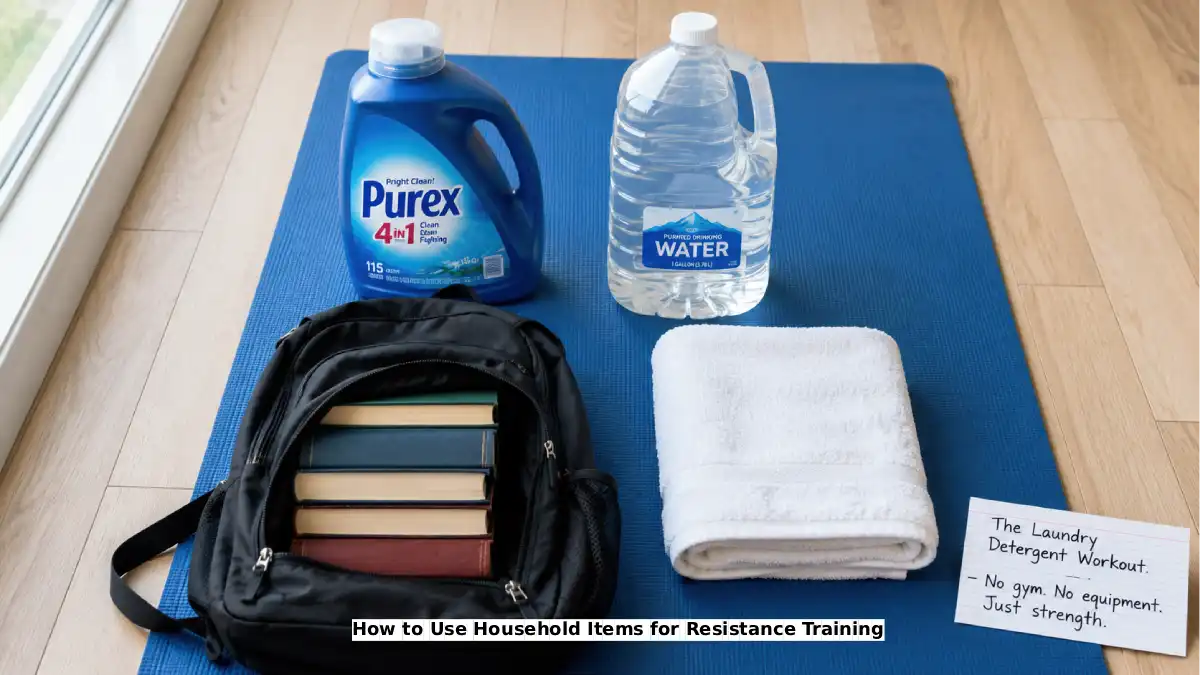
I started experimenting. Laundry jugs became dumbbells. Gallon water jugs became kettlebells. A backpack full of books became a weighted vest. Canned food became mini weights for small muscles.
That was two years ago. I’ve since bought some actual equipment. But I still use household items all the time—when I travel, when I’m too lazy to pull out my equipment, or when I just want to prove that you don’t need money to get strong.
Today, I’m sharing my full “laundry detergent workout.” No fancy gear. No gym membership. Just stuff you already have in your house.
Let’s get into it.
Jump Links
- The Day I Refused to Pay for a Gym I Hated
- Why Household Items Work Just as Well as Dumbbells
- The Equipment List (Everything You Already Own)
- Full-Body Workout: 8 Exercises Using Household Items
- Upper Body Focus (Laundry Jugs Edition)
- Lower Body Focus (Backpack Edition)
- Core & Cardio (Water Jug & Towel Edition)
- How to Progress When It Gets Too Easy
- The Safety Rules (Don’t Be Stupid)
- Frequently Asked Questions (FAQ)
- Final Thoughts: Strength Doesn’t Need a Price Tag
The Day I Refused to Pay for a Gym I Hated
I need to be honest about something.
I hate gyms. Not the idea of exercise. The actual places. The loud music. The judgmental looks. The waiting for machines. The monthly fee that comes out of my account whether I go or not. I’ve had gym memberships three times in my adult life. I’ve gone consistently for maybe two months total across all three.
The last time, I was paying $55 a month for a gym I hadn’t stepped foot in for four months. That’s $220 down the drain. For nothing.
I canceled the membership and decided I’d work out at home. But I didn’t have equipment. And I didn’t have money to buy equipment. So I looked around my tiny apartment and started picking things up.
The laundry detergent jug was right there. It had a handle. It weighed about eight pounds. I curled it like a dumbbell. It worked.
The next day, I used a gallon of water as a kettlebell. Swung it between my legs. It worked.
The week after, I filled a backpack with books and did squats. It worked.
None of it was pretty. None of it was Instagram-worthy. But I got stronger. And I didn’t spend a dime.
Now I’m not saying you’ll become a bodybuilder with laundry jugs. You won’t. But for building basic strength, improving your health, and staying active without a gym? Household items are more than enough.
Why Household Items Work Just as Well as Dumbbells
Let me explain the physics.
A dumbbell is just a weight with a handle. So is a laundry detergent jug. A kettlebell is just an awkward weight with a handle. So is a gallon water jug. A weighted vest is just weight distributed across your body. So is a backpack full of books.
Your muscles don’t know the difference. They feel resistance. They adapt. They get stronger.
The main difference is convenience and durability. Dumbbells are easier to hold and they last forever. Laundry jugs have handles that might break if you’re not careful.
But for most people, for most exercises, household items work perfectly fine.
The advantages of household items:
- They’re free (or close to free)
- You already have them
- No gym membership required
- No equipment storage needed
- You can do it anywhere (traveling? Use water bottles)
The disadvantages:
- Grip can be awkward
- Weight increments are limited (a jug is a jug)
- Some items can break if dropped
- You can’t go as heavy as a gym
Who this is for:
- Beginners who don’t want to invest in equipment yet
- Travelers who can’t bring weights
- People on a tight budget
- Anyone who wants to stay active without leaving home
Who this is NOT for:
- Advanced lifters trying to build serious muscle (you need heavier weights)
- People with specific strength goals (powerlifting, Olympic lifting)
- Anyone who just prefers real equipment (that’s fine too)
For the average person trying to be healthier, stronger, and more active? Household items are plenty.
The Equipment List (Everything You Already Own)
Here’s everything I use for my at-home workouts. Most of it is already in your house.
The Main “Weights”:
- Laundry detergent jug (with handle) – 8-12 pounds when full. Perfect for curls, rows, and overhead presses.
- Gallon water jug (milk jug style or with handle) – 8.3 pounds. Great for swings, squats, and carries.
- Backpack filled with books or cans – Adjustable weight (add or remove books). Perfect for squats, lunges, and push-ups (wear it).
- Canned food (cans of beans, tomatoes, etc.) – 1-2 pounds each. Great for small muscles and warm-ups.
- Bag of rice or flour (5-10 lbs) – Awkward to hold, which makes your stabilizer muscles work harder.
The “Accessories”:
- Towel – For gliding exercises (slide lunges, mountain climbers on hard floors)
- Chair or couch – For triceps dips, incline push-ups, step-ups
- Door frame – For pull-ups (if you have a sturdy door frame) or resistance band anchoring
- Stairs – For step-ups, calf raises, incline push-ups
- Wall – For wall sits, handstands (if you’re advanced)
Optional (but helpful):
- Resistance bands ($10-15 on Amazon) – Not “household,” but cheap and worth it
- Yoga mat ($10 at Five Below) – For floor comfort
Total cost of equipment you need to buy: $0. Use what you have.
Full-Body Workout: 8 Exercises Using Household Items
This is my standard full-body workout. Do this 2-3 times per week, resting at least one day between sessions.
Warm-up (5 minutes):
- Arm circles (30 seconds each direction)
- Leg swings (30 seconds each leg)
- Bodyweight squats (20 reps)
- Cat-cow stretch (10 reps)
The Workout (30-40 minutes):
1. Laundry Jug Curls (biceps)
- Hold a laundry jug in each hand (or one jug at a time)
- Keep elbows pinned to your sides
- Curl jugs toward your shoulders
- 3 sets of 10-15 reps
2. Gallon Jug Overhead Press (shoulders)
- Hold a gallon water jug in each hand (or one jug at a time)
- Start with jugs at shoulder height
- Press overhead until arms are straight
- 3 sets of 10-15 reps
3. Backpack Squats (legs & glutes)
- Put on a backpack filled with books (start with 10-15 lbs)
- Stand with feet shoulder-width apart
- Lower your hips as if sitting in a chair
- Push through heels to stand
- 3 sets of 12-15 reps
4. Laundry Jug Rows (back)
- Place one hand on a chair for support
- Hold a laundry jug in the other hand
- Pull the jug toward your hip, squeezing your shoulder blade
- 3 sets of 10-12 reps per arm
5. Towel Slide Lunges (legs & core)
- Stand on a hard floor (not carpet)
- Place one foot on a folded towel
- Slide the towel foot back into a lunge
- Push through front heel to return
- 3 sets of 10-12 reps per leg
6. Backpack Push-ups (chest & triceps)
- Wear the backpack (empty or with 5-10 lbs)
- Get into push-up position (on knees or toes)
- Lower chest toward floor
- Push back up
- 3 sets of as many as you can do (5-20 reps)
7. Water Jug Russian Twists (core)
- Sit on the floor, knees bent, feet hovering
- Hold a water jug with both hands
- Twist torso left and right, tapping jug to floor
- 3 sets of 20 twists (10 each side)
8. Laundry Jug Deadlift (legs & back)
- Place two laundry jugs on floor in front of you
- Hinge at hips, keeping back straight
- Grab jugs, stand up straight
- Lower with control
- 3 sets of 10-12 reps
Cool-down (5 minutes):
- Quad stretch (30 seconds per side)
- Hamstring stretch (30 seconds per side)
- Chest stretch (30 seconds)
- Child’s pose (1 minute)
Upper Body Focus (Laundry Jugs Edition)
Want to focus on arms, shoulders, chest, and back? Use this shorter workout (20-25 minutes).
The Workout:
- Laundry Jug Curls – 3 x 12 reps
- Laundry Jug Overhead Press – 3 x 12 reps
- Laundry Jug Rows – 3 x 12 reps per arm
- Laundry Jug Triceps Extension – Hold one jug with both hands behind your head, extend arms. 3 x 10 reps.
- Chair Triceps Dips – Use a sturdy chair. 3 x as many as you can do.
- Backpack Push-ups – 3 x as many as you can do.
How to make it harder:
- Use two jugs instead of one
- Do more reps (15-20 instead of 10-12)
- Slow down the movement (3 seconds up, 3 seconds down)
- Add a backpack with books during push-ups
Lower Body Focus (Backpack Edition)
Want to focus on legs and glutes? Use this shorter workout (20-25 minutes).
The Workout:
- Backpack Squats – 4 sets of 15 reps
- Backpack Lunges – 3 sets of 12 reps per leg
- Stair Step-ups – Hold a jug in each hand. 3 sets of 12 reps per leg.
- Towel Slide Hamstring Curls – Lie on back, heels on towel, slide heels toward glutes. 3 sets of 15 reps.
- Calf Raises – Stand on edge of a book or step, hold jugs. 3 sets of 20 reps.
- Backpack Glute Bridges – Lie on back, knees bent, backpack on hips. Lift hips toward ceiling. 3 sets of 15 reps.
How to make it harder:
- Add more books to your backpack
- Do more reps (20 instead of 15)
- Pause at the bottom of squats and lunges for 2 seconds
- Add a jump between reps (jump squats, jump lunges – careful with knees)
Core & Cardio (Water Jug & Towel Edition)
Want to focus on abs and get your heart rate up? Use this shorter workout (15-20 minutes).
The Circuit (do each exercise for 45 seconds, rest 15 seconds, repeat 3 times):
- Water Jug Swings – Hold a water jug with both hands, swing between legs and up to chest (like a kettlebell swing).
- Towel Mountain Climbers – Hands on towel on hard floor, slide feet back and forth quickly.
- Water Jug Russian Twists – Sit on floor, twist side to side with jug.
- Towel Plank Jacks – In plank position, feet on towel, jump feet out and in.
- Water Jug Overhead Carries – Hold jug overhead, walk across room and back. (Do for time, not reps).
- Rest
Pro tip: Go hard on this workout. It’s cardio + core. You should be breathing heavy by the third round.
How to Progress When It Gets Too Easy
Eventually, laundry jugs will feel light. That’s a good thing. It means you’re getting stronger.
Here’s how to keep progressing without buying equipment.
Method #1: Add more weight
- Laundry jug: use a bigger jug, or fill it with water (heavier than detergent)
- Backpack: add more books or canned food
- Water jug: use a 2-gallon jug (16 lbs) if you have one
Method #2: Do more reps
Instead of 10-12 reps, do 15-20. Instead of 3 sets, do 4-5 sets.
Method #3: Slow down
Take 3-4 seconds to lower the weight, 1 second to lift. Time under tension builds muscle.
Method #4: Change the leverage
Do single-leg squats instead of regular squats. Do archer push-ups instead of regular push-ups. Change the angle.
Method #5: Combine items
Wear the backpack AND hold the laundry jugs. Do squats with both.
Method #6: Upgrade to real equipment (eventually)
When you’ve maxed out household items (6+ months of consistent training), consider buying:
- A pair of adjustable dumbbells ($50-100 used on Facebook Marketplace)
- A set of resistance bands ($15 on Amazon)
- A pull-up bar ($20 on Amazon)
But don’t rush. Most people won’t outgrow laundry jugs for months or even years.
The Safety Rules (Don’t Be Stupid)
Household items aren’t designed for exercise. You need to be careful.
Rule #1: Check for leaks and cracks
Inspect your laundry jug before every use. If it’s cracked, the handle might break mid-rep. Water jugs can leak. Don’t use damaged containers.
Rule #2: Secure your backpack straps
Tighten both shoulder straps before wearing. You don’t want the backpack shifting mid-squat.
Rule #3: Don’t drop your weights
Laundry jugs can crack. Water jugs can burst. Cans can dent floors. Control the weight on the way down.
Rule #4: Use sturdy furniture
Test your chair before doing triceps dips. If it wobbles, don’t use it. Use a table or counter instead.
Rule #5: Clear your space
No breakable objects nearby. No tripping hazards. Give yourself room to fall safely (not that you’ll fall, but plan for it).
Rule #6: Listen to your body
Pain (sharp, sudden, or in joints) means stop. Soreness (dull, muscle fatigue) means keep going.
Rule #7: Start lighter than you think
Use an empty jug or a half-full water jug for your first workout. Focus on form. Add weight later.
Rule #8: Warm up
Do not skip the warm-up. Cold muscles + awkward weights = injury risk. Five minutes saves you weeks of recovery.
Why I Canceled My $150 Gym Membership for This 20-Minute Home Routine
Frequently Asked Questions (FAQ)
1. Is working out with laundry detergent jugs actually effective?
Yes, for building basic strength and muscle endurance. A 10-pound jug is still 10 pounds. If you curl it 50 times, your biceps get stronger. No, you won’t become a bodybuilder. But for general fitness, weight loss, and health? Absolutely effective. Thousands of people got strong during lockdowns using exactly this method.
2. How heavy is a typical laundry detergent jug?
A standard 100-ounce jug of liquid detergent weighs about 8-10 pounds. A 150-ounce “family size” jug weighs 12-15 pounds. A 50-ounce “compact” jug weighs 4-5 pounds. Check the label for net weight. For reference: a gallon of water weighs 8.3 pounds.
3. Can I build significant muscle with household items?
You can build beginner and intermediate muscle. You will not get “huge.” You will get toned, stronger, and more defined. If your goal is significant muscle growth (bodybuilding), you eventually need heavier weights. But most people’s goal is fitness, not bodybuilding. For that, household items are fine.
4. What’s the best household item for legs?
Backpack squats and lunges are excellent. Fill a backpack with books, canned food, or bags of rice. Start with 10-15 pounds. Work up to 30-40 pounds. Add stair step-ups while holding jugs. Your legs will feel it.
5. What if I don’t have laundry jugs? What alternatives are there?
Gallon water jugs (milk jug style) work great. A 5-pound bag of flour or sugar. A small bucket with a handle filled with water or sand. A tote bag filled with canned food. A suitcase full of books (good for rows and deadlifts). Look around. Weight is weight.
6. How often should I do these workouts?
Full-body workout: 2-3 times per week, with at least one rest day between sessions. Upper/lower split: 4 times per week (upper Monday/Thursday, lower Tuesday/Friday). Listen to your body. Rest when you’re sore.
7. Can I do cardio with household items?
Yes. Water jug swings get your heart rate up. Towel mountain climbers. Backpack walking lunges. Stair runs while holding jugs. Create a circuit (45 seconds on, 15 seconds off) and repeat 5-6 times. That’s excellent cardio.
8. Is this safe for seniors or people with injuries?
Maybe, but check with your doctor first. The movements themselves are safe (squats, lunges, presses). But household items have awkward grips and unpredictable weight distribution. For seniors or people with injuries, resistance bands or very light dumbbells might be safer. Start lighter than you think. Stop if anything hurts.
Final Thoughts: Strength Doesn’t Need a Price Tag
Here’s what I want you to take away.
You don’t need a gym membership to get strong. You don’t need expensive equipment. You don’t need a home gym setup that costs a thousand dollars.
You need motivation. You need consistency. And you need something heavy to pick up.
Laundry detergent jugs are heavy. Water jugs are heavy. A backpack full of books is heavy. And they’re all already in your house.
The “laundry detergent workout” isn’t a joke. It’s not “poor people fitness.” It’s resourceful. It’s smart. It’s proof that strength doesn’t require a price tag.
So next time you’re tempted to spend $50 on a gym membership you won’t use or $200 on dumbbells you don’t need, look around your house. Pick up a laundry jug. Do a curl.
Then do another. Then another.
That’s the frugal glow. And it’s stronger than you think. 💪
For more frugal fitness tips, at-home workout ideas, and budget wellness strategies, visit The Frugal Glow.