

Mouth Taping for Sleep: Does It Actually Improve Breathing and Night Recovery?
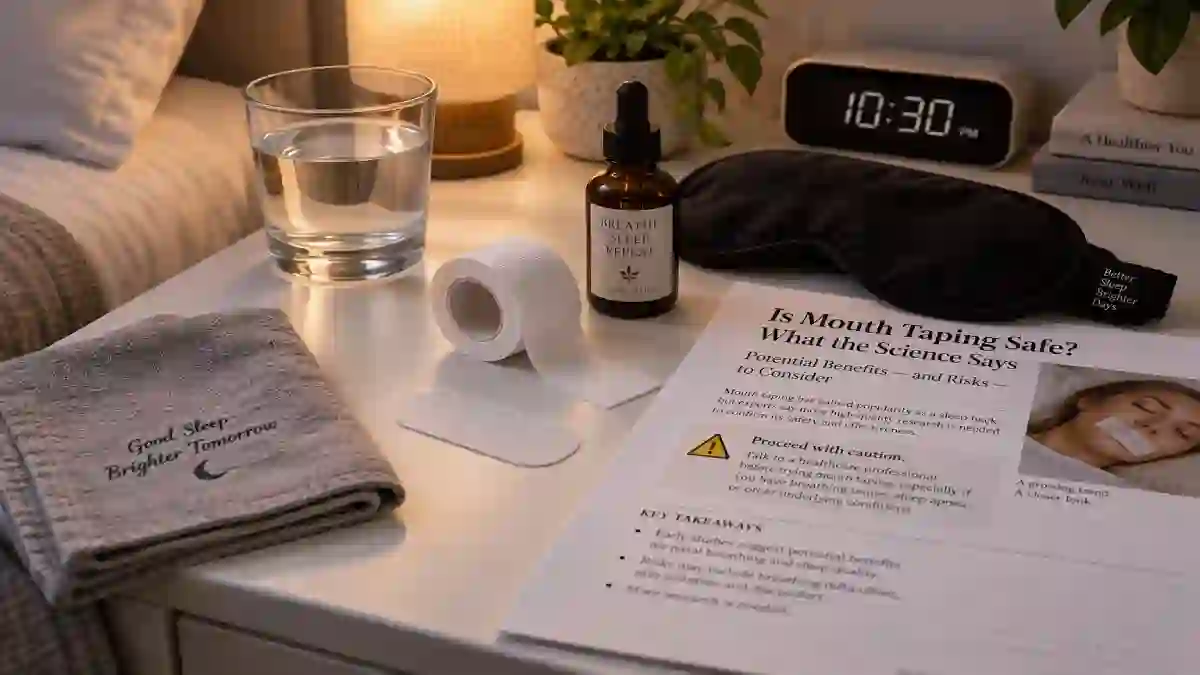
Few sleep trends have spread as fast, or generated as much genuine medical pushback, as mouth taping. The premise is simple: a strip of tape over the lips each night, forcing nasal rather than mouth breathing, promised to deliver better sleep, reduced snoring, improved recovery, even anti-aging benefits. Social media embraced it enthusiastically. The actual research — and a growing number of sleep medicine specialists speaking out directly against the trend — tells a considerably more cautious, and in some cases genuinely alarming, story.
This is the full, honest breakdown: what the available studies actually show, why doctors are specifically warning against it, and who should never attempt this practice at all.
Jump Links
- The Core Claim Behind Mouth Taping
- What the Research Actually Shows
- The 2025 Systematic Review: The Clearest Picture Yet
- Why Doctors Are Specifically Warning Against It
- The Sleep Apnea Danger, Explained
- Who Mouth Taping Might Be Low-Risk For
- Who Should Never Try This
- Research Summary Table
- Evidence-Based Alternatives Worth Trying Instead
- If You Still Want to Try It: A Safer Approach
- What to Watch for If You Snore or Suspect Sleep Apnea
- FAQ
- The Bottom Line
The Core Claim Behind Mouth Taping
The theory underlying mouth taping is genuinely grounded in real physiology: nasal breathing filters, warms, and humidifies air more effectively than mouth breathing, and chronic mouth breathing has been associated with dry mouth, bad breath, and in some research, worse sleep quality. Proponents claim taping the mouth shut forces nasal breathing throughout the night, and allege benefits ranging from better sleep quality to anti-aging properties to improvements in dry mouth, bad breath, and concentration. The physiological reasoning behind preferring nasal breathing isn’t fabricated — the problem is what happens when you forcibly prevent an alternative airway from being available at all.
What the Research Actually Shows
This is where the gap between viral claims and actual evidence becomes stark. For most people, there was “uncertain” and “minimal” evidence to support using mouth taping to treat mouth breathing, obstructive sleep apnea, or sleep disordered breathing, according to research reviewed by health reporters covering the topic. According to the American Academy of Sleep Medicine, the current evidence is insufficient to recommend mouth taping as a treatment for any sleep disorder, and no clinical guidelines endorse it — a genuinely significant statement, since AASM is the primary professional body setting sleep medicine standards in the United States.
What’s specifically missing from the evidence base is just as telling as what exists: large randomized controlled trials, long-term safety data, studies in populations with moderate-to-severe sleep apnea, and head-to-head comparisons with established treatments like CPAP or oral appliances. In other words, the foundational research that would actually support mouth taping as a legitimate intervention simply doesn’t exist yet.
The 2025 Systematic Review: The Clearest Picture Yet
A systematic review examining mouth taping’s safety and efficacy for mouth breathing, sleep disordered breathing, and obstructive sleep apnea searched the medical literature from 1999 to 2024 and found genuinely mixed results. Two studies showed statistically significant improvement in established sleep apnea markers like the apnea-hypopnea index (AHI) or oxygen desaturations, while other studies showed mouth taping offered no meaningful difference, and several specifically discussed potential risks including asphyxiation in the presence of nasal obstruction.
A separate, more recent 2025 review examined nine studies specifically and found little consensus on mouth-taping’s benefits, explicitly calling for more high-quality research rather than endorsing the practice based on existing data. The researchers behind this body of work have been direct about the implications: “Our research shows that taping the mouth shut during sleep is dangerous, especially among those who may not be aware they have sleep apnea,” according to one of the study’s lead researchers, an otolaryngologist and sleep surgeon, who added that the team’s hope is that people stop taping their mouths during sleep and recognize it is dangerous.
Why Doctors Are Specifically Warning Against It
This isn’t a fringe position among a handful of overly cautious physicians — it’s become a fairly unified message across sleep medicine specialists speaking publicly on the topic. “There is very little evidence to support mouth taping’s purported health benefits, and some clear evidence of risk and potential harm,” according to physicians interviewed on the subject, with one specifically noting that “the studies behind mouth tape are small, the benefits are modest and the potential risks are there.”
It’s also worth directly addressing the underlying premise doctors push back on: mouth breathing is not considered a major health issue for most adults, according to sleep specialists, meaning the “problem” mouth taping claims to solve isn’t necessarily a genuine medical issue requiring intervention in the first place for most people trying it.
The Sleep Apnea Danger, Explained
This is the single most important safety concern in the entire mouth-taping conversation, and it deserves a direct, clear explanation. In people with obstructive sleep apnea, the airway periodically collapses or narrows during sleep. Many people with undiagnosed or untreated sleep apnea unconsciously rely on mouth breathing as a compensatory airway — a backup route for air when the nasal passage is obstructed or the throat partially collapses. Taping the mouth shut removes that compensatory airway entirely.
Critically, adding mouth taping to existing sleep apnea doesn’t treat the underlying condition — the airway collapse responsible for sleep apnea still happens, but now without the backup breathing route the body had been unconsciously using. This is precisely the mechanism behind the asphyxiation risk specifically flagged in multiple reviews: someone who watches a mouth-taping video, recognizes themselves as a “mouth breather,” and tapes their mouth that same night may be taping over undiagnosed sleep apnea they don’t know they have, since snoring and daytime sleepiness — common but easy-to-dismiss symptoms — are signs of sleep apnea that genuinely need evaluation before any mouth taping is attempted.
Who Mouth Taping Might Be Low-Risk For
Being fair to the practice, the evidence does suggest a narrow, specific group for whom mouth taping carries comparatively low risk, though still without strong proof of benefit. For healthy adults who breathe well through the nose and only have mild snoring, mouth taping may be low risk, though it remains not a proven treatment for anything and can be unsafe if any of the risk factors below apply. Case reports suggest some people with primary snoring specifically (meaning snoring without any underlying sleep apnea) may see modest benefit, though this falls well short of the large, controlled evidence that would be needed to confidently recommend the practice.
Who Should Never Try This
- Anyone with diagnosed or suspected obstructive sleep apnea. This is the clearest, most consistently repeated warning across every source reviewed for this article — mouth taping is not considered a treatment for sleep apnea by sleep medicine specialists, and using it in place of proper evaluation and care carries real danger.
- Anyone with significant nasal congestion, allergies, or a deviated septum or other nasal obstruction, since the entire practice depends on the nose being able to handle 100% of breathing — any blockage turns a taped mouth into a genuine airway emergency risk.
- Anyone with claustrophobia or anxiety about restricted breathing, since the psychological response to a taped mouth can itself trigger panic episodes, independent of any physical breathing obstruction.
- Children, who should not use mouth taping unless under direct medical supervision.
- Anyone experiencing loud snoring combined with daytime sleepiness — a classic symptom pairing for undiagnosed sleep apnea — without first being medically evaluated.
- Anyone who hasn’t ruled out sleep apnea through proper testing, which is really the umbrella warning underlying every item on this list.
Research Summary Table
| Finding | What the Evidence Shows |
|---|---|
| Overall evidence quality | Uncertain/minimal across most studied outcomes |
| AASM official position | Insufficient evidence to recommend for any sleep disorder |
| Effect on mild sleep apnea | Some studies show modest improvement; results inconsistent |
| Effect on moderate-to-severe sleep apnea | No strong evidence of benefit; genuinely under-researched |
| Documented risks | Asphyxiation risk with nasal obstruction, masking undiagnosed sleep apnea, skin irritation, anxiety/panic episodes |
| Large randomized controlled trials | None currently exist |
| Comparison to established treatments (CPAP, oral appliances) | No head-to-head studies available |
Evidence-Based Alternatives Worth Trying Instead
For anyone dealing with snoring, mouth breathing, or general sleep quality concerns, several alternatives carry considerably stronger evidence behind them and lower risk profiles:
- Positional therapy — adjusting sleep position (side-sleeping rather than back-sleeping) can meaningfully reduce snoring and mild sleep apnea symptoms for many people.
- Nasal strips — an external adhesive strip that gently widens the nostrils, without blocking the mouth as a backup airway, carries a fundamentally lower risk profile than mouth taping.
- Saline nasal rinses — addressing nasal congestion directly, rather than forcing nasal breathing through an obstructed passage, tackles the actual underlying issue in many cases.
- Weight management — meaningfully reduces sleep apnea severity for many people, since excess tissue around the airway is a significant contributing factor to airway collapse during sleep.
- A proper sleep study and, if needed, CPAP or an oral appliance — the actual evidence-based treatments for diagnosed sleep apnea, with decades of research and clinical use behind them, unlike mouth taping’s thin evidence base.
If You Still Want to Try It: A Safer Approach
For a healthy adult specifically without diagnosed sleep apnea, significant snoring, or nasal obstruction, a staged, cautious approach is more reasonable than jumping straight to a full night taped shut:
- Get evaluated first if you snore regularly or experience daytime sleepiness, ruling out sleep apnea before considering mouth taping at all.
- Confirm your nose is genuinely clear — no active congestion, allergies, or known structural obstruction — before your first attempt.
- Start with tape specifically designed for this purpose, which typically includes a small breathing hole or porous design, rather than a fully sealed adhesive that offers zero backup airflow.
- Try it for a short nap or early part of the night first, rather than a full eight hours immediately, so you can gauge your comfort and any breathing difficulty.
- Stop immediately if you experience any breathing difficulty, panic, or significant discomfort, and don’t push through it.
- Reconsider entirely if you notice any snoring, gasping, or breathing pauses reported by a partner, or if you wake up with a headache or feel unusually unrested — these can be signs of an underlying issue mouth taping is masking rather than solving.
What to Watch for If You Snore or Suspect Sleep Apnea
Loud, habitual snoring, witnessed pauses in breathing during sleep, gasping or choking sensations upon waking, morning headaches, and excessive daytime sleepiness despite adequate time in bed are all signs worth bringing to a doctor, ideally before trying any home remedy marketed toward improving sleep breathing. Sleep apnea is a common, well-understood, and genuinely treatable condition — but it requires actual diagnosis through a sleep study, not a guess based on a viral trend.
📌 YOU MIGHT ALSO LIKE:
The ‘Dopamine Fast’ Guide: How to Reset Your Brain and Focus for $0
The $0 Sleep Hack: How Light Exposure in the Morning Fixes Insomnia
FAQ
Does mouth taping actually have scientific evidence supporting it?
The evidence is genuinely thin and mixed. The American Academy of Sleep Medicine states current evidence is insufficient to recommend mouth taping as a treatment for any sleep disorder, and no clinical guidelines endorse the practice.
Is mouth taping actually dangerous, or is that overblown?
For specific groups, the danger is real and directly stated by researchers in this field. People with undiagnosed sleep apnea or nasal obstruction face a genuine asphyxiation risk, since taping removes a compensatory airway the body may be relying on during sleep.
Can mouth taping help with sleep apnea?
No, it’s not considered a treatment for sleep apnea by sleep medicine specialists. Some small studies have shown modest improvement in mild sleep apnea markers, but there’s no strong evidence it helps moderate-to-severe cases, and it doesn’t address the underlying airway collapse that causes the condition.
Who is mouth taping relatively low-risk for?
Healthy adults with clear nasal breathing and only mild snoring, with no diagnosed or suspected sleep apnea, represent the group with the lowest risk profile in the limited available research — though even for this group, proven benefit remains unestablished.
What should I try instead of mouth taping for better sleep and less snoring?
Positional therapy, nasal strips, saline rinses, weight management, and — for anyone with diagnosed sleep apnea — established treatments like CPAP or an oral appliance all carry considerably stronger evidence and lower risk than mouth taping.
How do I know if I might have undiagnosed sleep apnea before trying something like mouth taping?
Loud habitual snoring, witnessed breathing pauses, gasping or choking upon waking, morning headaches, and excessive daytime sleepiness are all signs worth discussing with a doctor and potentially pursuing a sleep study for, before attempting any home remedy for sleep breathing.
The Bottom Line
Mouth taping’s rapid rise is a genuinely instructive example of a wellness trend outpacing the science behind it. The honest, current read of the available research is that mouth taping is a low-evidence trend riding a wave of anecdote rather than a validated sleep treatment, and for anyone with undiagnosed sleep apnea or nasal obstruction, it carries real, directly stated danger from sleep researchers and physicians. If snoring, mouth breathing, or poor sleep quality are genuine concerns, the right first step isn’t a roll of tape — it’s an actual conversation with a doctor about what’s really going on.
For more budget-friendly wellness guides grounded in real evidence, check out more posts over at The Frugal Glow.
This article is for general informational purposes and isn’t a substitute for medical advice. If you snore regularly, experience daytime sleepiness, or suspect you may have sleep apnea, please consult a doctor or sleep specialist before trying mouth taping or any other home remedy.
Sources: