

The “Project 333” Wardrobe Rule: How to Dress with Only 33 Items for 3 Months
Jump Links
- What Is Project 333 (And Why It Works)
- The Rules of Project 333 (The Complete Breakdown)
- Why 33 Items (The Number That Changes Everything)
- The First Time I Tried It (And Failed)
- The Second Time I Tried It (And Succeeded)
- How to Choose Your 33 Items
- The Capsule Categories (What Counts and What Doesn’t)
- What I Actually Wore for 3 Months
- The Unexpected Benefits of Project 333
- What I Learned After 3 Months (And Why I’m Doing It Again)
- How to Start Project 333 Yourself
- The Math: What I Saved in One Year
- Frequently Asked Questions (FAQ)
- Final Thoughts: The Best Wardrobe Is the One That Sets You Free
The closet was full. The bank account was empty. And I was standing in front of a pile of clothes, feeling like I had nothing to wear.
I had tried capsule wardrobes before. I had tried the 5×5 challenge. I had tried decluttering. But nothing stuck. I always ended up back where I started: too many clothes, too little satisfaction.
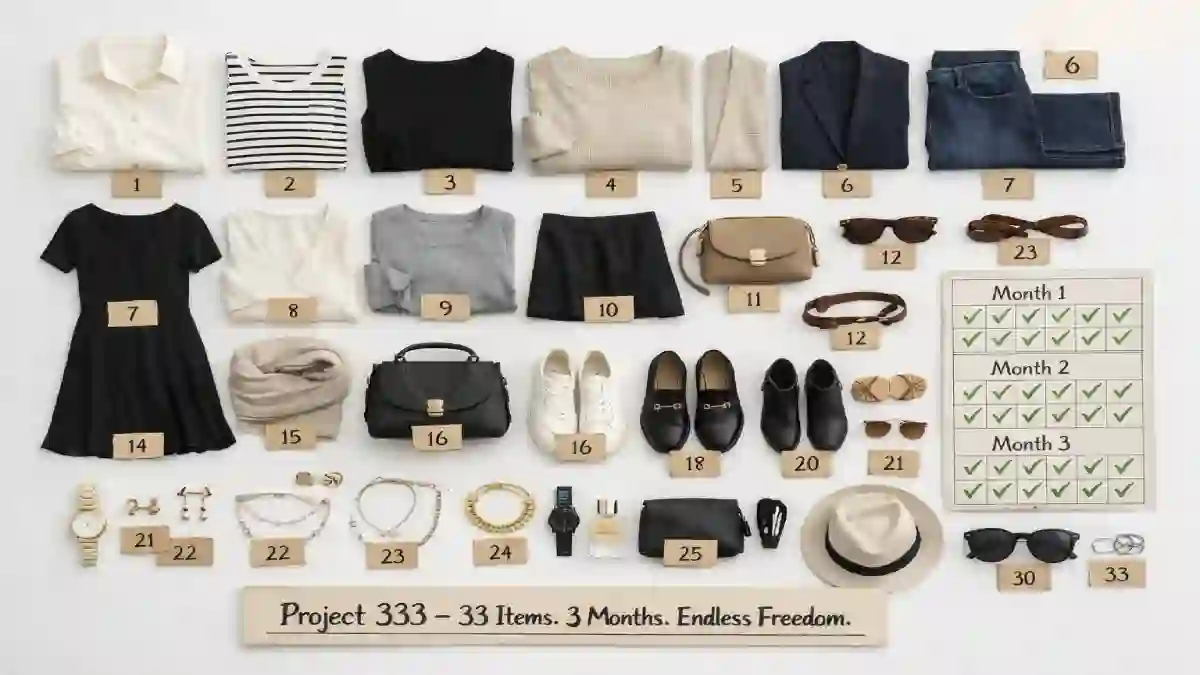
Then I found Project 333. It’s a minimalist fashion challenge created by Courtney Carver in 2010. The rule is simple: wear only 33 items of clothing for 3 months. That includes clothes, shoes, accessories, and jewelry. It doesn’t include underwear, sleepwear, workout clothes, or loungewear.
I was skeptical at first. Thirty-three items for three months? That felt impossible. But I was desperate. I was tired of the cycle of shopping, buying, and feeling unsatisfied. So I tried it.
The first time, I failed. The second time, I succeeded. And what I learned changed my relationship with clothes forever.
Today, I’m sharing the complete guide to Project 333. The rules. The strategy. The mistakes I made. And why you should try it—even if you think you can’t.
What Is Project 333 (And Why It Works)
Project 333 is a minimalist fashion challenge that asks you to dress with only 33 items for 3 months. It was created by Courtney Carver in 2010 as a personal experiment. She was dealing with debt, stress, and a closet full of clothes that didn’t make her happy. She decided to wear only 33 items for 3 months. The result was life-changing.
Why it works:
It limits decision fatigue. When you have fewer options, you make fewer decisions. You spend less time getting dressed and more time living your life.
It forces you to define your style. You can’t hide behind a closet full of “maybe” clothes. You have to choose what you actually love and what you actually wear.
It saves money. When you’re not shopping constantly, you save hundreds—sometimes thousands—of dollars.
It reduces waste. The fashion industry is one of the most polluting industries in the world. By buying less, you’re reducing your environmental impact.
It shifts your mindset. Project 333 isn’t about deprivation. It’s about discovering that you don’t need more to be happy. You need less.
What Courtney Carver says: “Project 333 is not a fashion challenge. It’s a life challenge. When you stop spending time, money, and energy on clothes, you open up space for the things that actually matter.”
The Rules of Project 333 (The Complete Breakdown)
The rules of Project 333 are simple but specific. Here’s the complete breakdown.
The 33 items include:
- Tops
- Bottoms
- Dresses
- Outerwear
- Shoes
- Accessories (scarves, belts, hats)
- Jewelry
- Bags (purses, totes, clutches)
The 33 items do NOT include:
- Underwear
- Socks
- Sleepwear
- Workout clothes
- Loungewear (worn only at home)
- Wedding rings or other sentimental jewelry that never comes off
The timeframe:
- 3 months (one season)
- You can repeat the challenge every season
- You can swap items between seasons
The rules:
- Choose 33 items (including clothing, shoes, accessories, and jewelry).
- Wear only those items for 3 months.
- Do not shop for new clothes during the 3 months.
- Store the rest of your clothes out of sight.
- At the end of the 3 months, reassess. Keep what worked. Donate what didn’t.
The philosophy: “Project 333 is about learning to live with less. It’s not about punishing yourself. It’s about discovering that less can be more.”
Why 33 Items (The Number That Changes Everything)
Why 33? Courtney Carver chose the number because it’s “just enough to be creative, but not so many that you’re overwhelmed.” It’s a specific number that forces you to be intentional.
Why 33 is the sweet spot:
- It’s not too few. You can still have variety. You can still dress for different occasions. You can still express your style.
- It’s not too many. You can’t hide behind a mountain of options. You have to choose what you actually love.
- It’s memorable. The number 33 is easy to remember. It’s a constraint that sticks with you.
- It’s flexible. You can adjust it. Some people do 33 items. Some do 25. Some do 50. The number matters less than the intention.
What the math says: With 33 items, you can create hundreds—sometimes thousands—of outfit combinations. The possibilities are endless. The limitations are only in your mind.
What I learned: I didn’t need 100 items. I needed 33. And I could have done it with 25.
The First Time I Tried It (And Failed)
Let me tell you about the first time I tried Project 333. It was a disaster.
What I did wrong:
- I chose items I thought I should wear, not items I actually loved. I included a blazer I never wore, a pair of heels that hurt my feet, and a dress that didn’t fit right. I thought I needed to be “professional.” I ended up miserable.
- I didn’t consider my actual life. I work from home. I don’t go to an office. I don’t need three blazers. I need comfortable clothes that make me feel good.
- I chose too many “special occasion” items. I included a formal dress, a cocktail dress, and a fancy clutch. I didn’t wear any of them.
- I didn’t store my other clothes properly. I kept them in my closet. Every morning, I saw them and felt tempted. I eventually gave in.
- I set unrealistic expectations. I thought it would be easy. It wasn’t. I wasn’t prepared for the emotional work of changing my habits.
What I learned: Project 333 is not just about clothes. It’s about mindset. If you’re not ready to change your mindset, you’re not ready for the challenge.
What I told my friend: “I failed. But I learned more from the failure than I would have from an easy success.”
The Second Time I Tried It (And Succeeded)
Six months later, I tried again. This time, I was better prepared.
What I did right:
- I started with a season. I didn’t try to cover all four seasons in one go. I started with spring. I chose 33 items that worked for spring weather.
- I chose items I actually loved. I didn’t include anything I didn’t wear regularly. If it didn’t fit, feel good, or make me feel confident, it was out.
- I considered my actual life. I work from home. I need comfortable, versatile clothes. I don’t need formal wear. I don’t need heels. I need clothes that make me feel good.
- I stored my other clothes out of sight. I put them in bins. I put the bins in the garage. I didn’t see them every day.
- I kept a journal. I wrote down what I wore, how I felt, and what I missed. This helped me learn what I actually needed.
- I gave myself grace. When I had a special event, I made an exception. I didn’t beat myself up about it. I just got back on track.
The result: It was hard. It was uncomfortable. But it was also liberating. I felt lighter. I felt freer. I felt more confident.
What I told my friend: “I did it. I survived. And I’m never going back.”
How to Choose Your 33 Items
Choosing your 33 items is the hardest part. Here’s how to do it.
Step 1: Consider your actual life.
What do you actually do? Do you work from home? Do you work in an office? Do you go out on weekends? Do you have special events? Your wardrobe should reflect your actual life, not your fantasy life.
Step 2: Choose your core colors.
Pick 2-3 neutral colors that work together. Black, navy, gray, white, cream, and beige are good options. These colors should be the foundation of your wardrobe.
Step 3: Choose versatile silhouettes.
Pick pieces that work for multiple occasions. A blazer can be worn to work, to dinner, or to a casual event. A t-shirt can be worn alone or layered. Choose pieces that do double duty.
Step 4: Choose items you love.
Don’t choose items because you think you “should” wear them. Choose items because you love wearing them. If you don’t love it, don’t include it.
Step 5: Consider the weather.
If you’re doing Project 333 for spring, choose items that work for spring weather. If you’re doing it for winter, choose items that work for winter. Don’t try to cover all seasons in one go.
Step 6: Be realistic.
If you work in a formal office, you need formal clothes. If you work from home, you need comfortable clothes. Don’t pretend to be someone you’re not.
Step 7: Start with 33. Adjust as needed.
If 33 feels too restrictive, start with 40 or 50. If 33 feels too easy, try 25. The number matters less than the intention.
The Capsule Categories (What Counts and What Doesn’t)
Here’s how to categorize your 33 items.
The 33 items include:
| Category | Examples | Notes |
|---|---|---|
| Tops | T-shirts, blouses, sweaters, button-downs | Count each item individually |
| Bottoms | Jeans, trousers, skirts, shorts | Count each item individually |
| Dresses | Day dresses, midi dresses, maxi dresses | Count each item individually |
| Outerwear | Blazers, jackets, cardigans, coats | Count each item individually |
| Shoes | Sneakers, boots, heels, flats, sandals | Count each item individually |
| Accessories | Scarves, belts, hats, bags | Count each item individually |
| Jewelry | Necklaces, earrings, bracelets, rings | Count each item individually |
The items that don’t count:
| Category | Examples | Notes |
|---|---|---|
| Underwear | Bras, panties, shapewear | Not counted |
| Socks | Ankle socks, crew socks, no-show socks | Not counted |
| Sleepwear | Pajamas, nightgowns, robes | Not counted |
| Workout clothes | Leggings, sports bras, athletic tops | Not counted |
| Loungewear | Sweatpants, hoodies, house clothes | Not counted if only worn at home |
| Sentimental jewelry | Wedding rings, family heirlooms | Not counted if never removed |
The gray areas:
- Hats and gloves: Count them if you wear them regularly. Don’t count them if they’re only for extreme weather.
- Bags: Count them if you use them regularly. Don’t count them if they’re special occasion only.
- Sunglasses: Count them if you wear them daily. Don’t count them if they’re just for the beach.
My approach: I counted everything I wore outside the house. I didn’t count underwear, socks, sleepwear, workout clothes, or loungewear. I counted bags, jewelry, and accessories. I was strict with myself. It was harder, but it was more rewarding.
What I Actually Wore for 3 Months
Here’s what my Project 333 wardrobe looked like for spring.
Tops (8 items):
- White button-down shirt
- Black t-shirt
- Gray t-shirt
- Cream sweater
- Striped long-sleeve tee
- Navy blouse
- Light blue oxford shirt
- Black tank top
Bottoms (5 items):
- Dark wash jeans
- Black trousers
- Olive chinos
- Black midi skirt
- Navy shorts
Dresses (2 items):
- Black midi dress
- Floral wrap dress
Outerwear (4 items):
- Navy blazer
- Denim jacket
- Gray cardigan
- Trench coat
Shoes (5 items):
- White sneakers
- Black loafers
- Brown ankle boots
- Nude flats
- Black heeled sandals
Accessories (5 items):
- Leather belt
- Silk scarf
- Neutral tote bag
- Crossbody bag
- Gold hoop earrings
Jewelry (4 items):
- Gold necklace
- Silver necklace
- Stud earrings
- Watch
Total: 33 items
What I learned: I had everything I needed. I didn’t miss anything. I didn’t feel deprived. I felt free.
The Unexpected Benefits of Project 333
Project 333 gave me benefits I didn’t expect.
Benefit 1: I saved money.
I didn’t shop for 3 months. I didn’t even want to. I saved over $400 in 3 months.
Benefit 2: I saved time.
Getting dressed took 2 minutes instead of 20. I had more time for the things that mattered.
Benefit 3: I saved mental energy.
I didn’t have to think about what to wear. I didn’t have to worry about whether my outfit was “right.” I just got dressed and moved on.
Benefit 4: I discovered my actual style.
Without a closet full of options, I had to choose what I actually loved. I discovered I love neutrals, comfortable fabrics, and classic silhouettes.
Benefit 5: I donated 80% of my wardrobe.
After the challenge, I went through my stored clothes. I donated 80% of them. I didn’t miss any of them.
Benefit 6: I felt lighter.
There’s a psychological weight to owning too much. Project 333 lifted that weight.
Benefit 7: I felt more confident.
When you know your clothes work, you feel more confident. You stop worrying about your outfit and start focusing on your life.
What I told my friend: “Project 333 didn’t just change my wardrobe. It changed my life.”
What I Learned After 3 Months (And Why I’m Doing It Again)
After 3 months, I did a full assessment.
What I learned:
- I don’t need as much as I thought. I survived with 33 items. I could have survived with fewer.
- I don’t miss what I don’t see. When I stored my other clothes out of sight, I didn’t miss them.
- I buy for a fantasy life. I buy clothes for events I never attend. I buy clothes for a body I don’t have. I buy clothes for a life I don’t live.
- I shop when I’m emotional. I shop when I’m bored, stressed, or unhappy. Project 333 showed me that shopping doesn’t fix those feelings.
- I love simplicity. I love having fewer options. I love knowing my clothes work. I love the freedom of not thinking about my wardrobe.
Why I’m doing it again:
I’m doing Project 333 again for summer. I’m choosing 33 items that work for warm weather. I’m excited to see what I learn this time. I’m excited to continue simplifying my life.
What Courtney Carver says: “Project 333 is not a one-time challenge. It’s a practice. The more you do it, the more you learn. The more you learn, the more you grow.”
How to Start Project 333 Yourself
Here’s how to start Project 333 in your own life.
Step 1: Choose your season.
Start with the current season. Don’t try to cover all four seasons in one go.
Step 2: Choose your 33 items.
Follow the steps above. Choose items you actually love. Choose items that fit your actual life. Choose items that work together.
Step 3: Store the rest.
Put your other clothes in bins. Store them out of sight. Don’t keep them in your closet.
Step 4: Wear only your 33 items for 3 months.
No exceptions (except for special events). No shopping. No cheating.
Step 5: Journal your experience.
Write down what you wear, how you feel, and what you miss. This helps you learn.
Step 6: Assess at the end.
At the end of 3 months, reassess. What worked? What didn’t? What do you want to keep? What do you want to let go of?
Step 7: Repeat.
Do it again for the next season. Each time, you’ll learn more. Each time, you’ll simplify more.
What a minimalist says: “Project 333 is a practice. It’s not about perfection. It’s about progress.”
The Math: What I Saved in One Year
Let me break down the actual dollars.
If I shopped the way I used to:
| Item | Cost | How Often | Annual Cost |
|---|---|---|---|
| New clothes (impulse buys) | $150-250 | Monthly | $1,800-3,000 |
| Total | $1,800-3,000 |
What I actually spent during Project 333:
| Item | Cost | How Often | Annual Cost |
|---|---|---|---|
| 33 items (already owned) | $0 | – | $0 |
| Replacement items (as needed) | $100-200 | Yearly | $100-200 |
| Total | $100-200 |
Annual savings: $1,600-2,800
Over 5 years: $8,000-14,000
And I have a better wardrobe than I ever did with my old shopping habits.
What I did with the savings:
- Paid off a credit card
- Put money into savings
- Took a weekend trip
📌 YOU MIGHT ALSO LIKE:
How to Build a Chic H&M Capsule Wardrobe for Under $120 Total
Frequently Asked Questions (FAQ)
1. What is Project 333?
Project 333 is a minimalist fashion challenge created by Courtney Carver in 2010. The rule is simple: wear only 33 items of clothing for 3 months. That includes clothes, shoes, accessories, and jewelry. It doesn’t include underwear, sleepwear, workout clothes, or loungewear.
2. What counts as an “item” in Project 333?
The 33 items include tops, bottoms, dresses, outerwear, shoes, accessories (scarves, belts, hats, bags), and jewelry. Underwear, socks, sleepwear, workout clothes, and loungewear (worn only at home) do not count.
3. Can I do Project 333 with fewer than 33 items?
Yes. Some people do 25 items. Some do 20. The number matters less than the intention. The goal is to simplify your wardrobe, discover what you actually wear, and save money.
4. What if I have a special event during the 3 months?
You have two options: work with what you have, or make an exception. Project 333 is meant to be a tool, not a punishment. If you have a wedding or a formal event, it’s okay to make an exception. Just make sure it’s a real exception, not an excuse.
5. What should I do with the rest of my clothes?
Store them out of sight. Don’t keep them in your closet. If you don’t see them, you won’t be tempted to wear them. At the end of the 3 months, reassess. Keep what you love. Donate what you don’t.
6. How often can I do Project 333?
You can do it every season. Many people do it four times a year. Each season, you choose 33 items that work for that season’s weather. It’s a practice, not a one-time challenge.
7. What if I fail?
Failure is part of the process. The first time I tried Project 333, I failed. The second time, I succeeded. Learn from your mistakes. Adjust your approach. Try again. The goal is progress, not perfection.
8. Does Project 333 really save money?
Yes. When you’re not shopping constantly, you save hundreds—sometimes thousands—of dollars. I saved over $400 in 3 months. Over a year, that’s $1,600 or more.
9. What are the psychological benefits of Project 333?
Project 333 reduces decision fatigue, saves time, reduces mental clutter, and increases confidence. When you have fewer options, you make fewer decisions. You spend less time getting dressed and more time living your life.
10. Can I do Project 333 with a family?
Yes. Project 333 is for individuals, but families can do it together. Each person chooses their own 33 items. It’s a great way to teach kids about minimalism, gratitude, and mindful consumption.
Final Thoughts: The Best Wardrobe Is the One That Sets You Free
Project 333 changed my life. It didn’t just change my wardrobe. It changed my mindset. It showed me that I don’t need more to be happy. I need less.
The Project 333 routine:
- Choose 33 items for 3 months
- Store the rest out of sight
- Wear only those items
- Journal your experience
- Assess and repeat
That’s it. A life-changing experience for $0.
I’ve been doing Project 333 for over a year now. My wardrobe is smaller, my mind is clearer, and my wallet is fuller. And I’ve saved over $4,000.
That’s not cheap. That’s smart.
That’s the frugal glow. And it’s waiting for you in your closet. 💛
*For more budget fashion tips, capsule wardrobe guides, and money-saving style strategies, visit The Frugal Glow.*