

How to Build a Sleep-Conducive Bedroom Environment for Under $30
Jump Links
- Why Your Bedroom Might Be Sabotaging Your Sleep
- The $0 Step: Declutter and Reset
- The $5-10 Fix: Blackout the Light Leaks
- The $10-15 Fix: Cool Down Without Cranking the AC
- The $5-10 Fix: Mask the Noise
- The $0-5 Fix: Scent and Sensory Upgrades
- The $15-20 Fix: Upgrade Your Bedding on a Dime
- The $10 Fix: Tame the Tech Glow
- Putting It All Together: A $30 Checklist
- The Math: What You Save by Sleeping Better
- Frequently Asked Questions (FAQ)
- Final Thoughts: The Cheapest Sleep Upgrade Is Free
The $150 weighted blanket was sitting in my Amazon cart. The $60 blackout curtains. The $80 sunrise alarm clock. I was about to spend over $300 on “sleep essentials” before I realized something: most of the things that actually improve sleep cost almost nothing.
Research consistently shows that the most important factors for good sleep—temperature, darkness, noise control, and a calm environment—are variables you can control for pennies on the dollar . A bedroom temperature of 65-68°F is the strongest evidence-backed factor for sleep quality. Complete darkness is right behind it. And neither requires fancy gadgets.
Today, I’m building a complete sleep-conducive bedroom environment for under $30. No weighted blankets. No sunrise lamps. Just the essentials that actually work.
Why Your Bedroom Might Be Sabotaging Your Sleep
Most people blame their insomnia on stress, caffeine, or screens. And those are real factors. But there’s a reason the “sleep sanctuary” concept exists: your bedroom environment directly affects your sleep architecture . The 7 variables that research identifies as controllable include temperature, light, sound, humidity, bedding, smell, and visual clutter .
Seven variables. And most bedrooms fail on at least four of them . The problem isn’t usually that you’re doing something wrong. It’s that you’re doing nothing—and the default bedroom environment is almost never optimized for sleep.
The good news? You don’t need a $300 budget to fix all seven. Most of the fixes cost under $5. Some cost nothing.
The $0 Step: Declutter and Reset
The cheapest sleep upgrade is completely free. It’s not sexy. It’s not Instagram-worthy. But it might be the most effective thing you can do.
The psychology of clutter: Clutter activates the prefrontal cortex and increases cognitive arousal, delaying sleep onset . When your brain sees a mess, it processes it as unfinished business. And unfinished business keeps you awake.
The 15-minute sweep: Set a timer. Clear all visible surfaces of everything that isn’t supposed to be there . Clothes go in the laundry or closet. Papers go in a drawer. Random objects get relocated to their homes . The goal isn’t perfection. It’s “the room feels lighter.”
The 70% rule: Keep your nightstand 70% clear . Lamp. Water. Book. That’s it. Every additional item is visual noise that your brain has to process.
Hide the visual noise: Use baskets or fabric bins to corral cords, books, and random stuff . This is clutter masquerading as “stored.”
The $5-10 Fix: Blackout the Light Leaks
Light is the second strongest evidence-backed factor for sleep . But full blackout curtains can run $60-120 for a standard window . That’s not happening on a $30 budget.
The budget solution: Instead of buying blackout curtains, you create them.
Cheap blackout panels ($10-15): Nicetown’s blackout curtains have a stellar reputation for their impressive results combined with refreshing affordability . One reviewer described them as an “epic price.” They can keep a room almost 15 degrees cooler without AC running .
The DIY route ($5): You can use a blackout liner sewn into existing curtains or hang a thick, dark blanket over the window at night . For renters, tension rods and a heavy fabric can create a removable shade that slides over the window .
The No-Cost Hack ($0): If you have curtains, use curtain clips or even binder clips at night to pinch the fabric tight to the wall . Sealing the window eliminates the light gaps that make curtains ineffective .
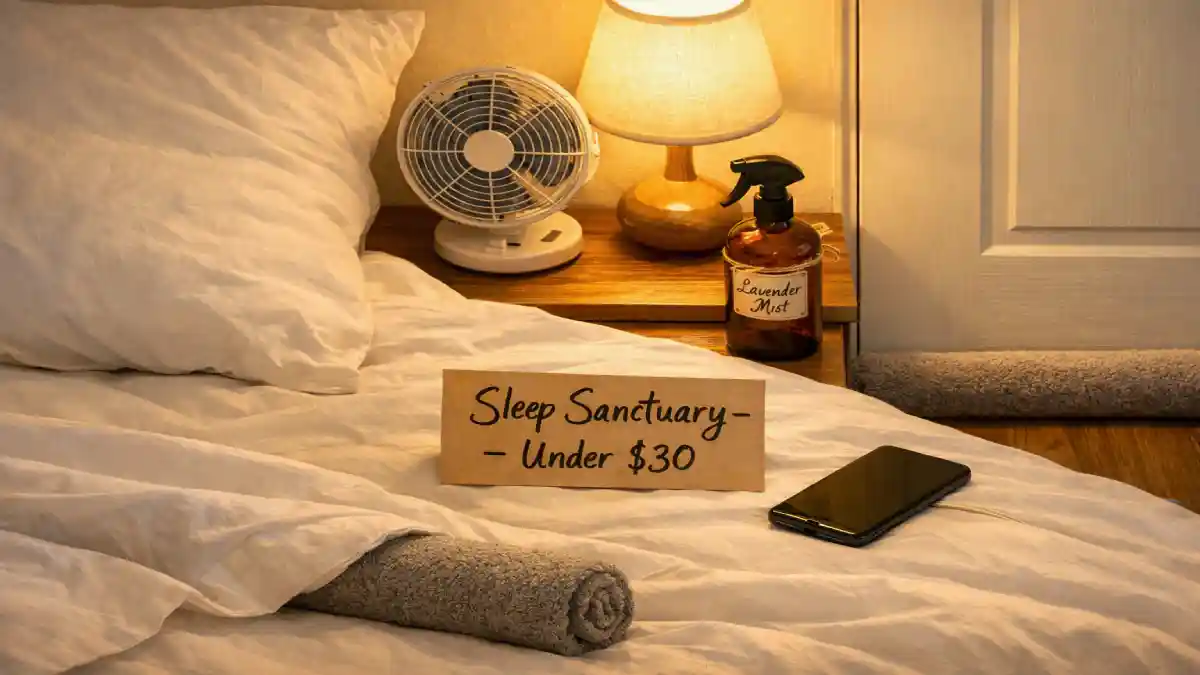
The door gap fix ($2): If hallway light is sliding under your door, grab a door sweep, draft stopper, or even a rolled-up towel to block the gap .
The electronics fix ($0): Use tiny dots of black tape, painter’s tape, or sticky notes to cover the LEDs on chargers, routers, and power strips .
The $10-15 Fix: Cool Down Without Cranking the AC
Temperature is the strongest evidence-backed factor for sleep . The optimal range is 65-68°F . But you don’t need a smart thermostat to get there.
The fan trick ($10-15): A compact, energy-efficient fan (around $15) can circulate air on hot nights . But placement matters more than power. The best move is to create a cross-breeze: point one fan to pull cooler air in from a window, and another to push warm air out . If outside air is cooler at night, crack the window and put a fan near it, facing inward at a slight angle .
The ice hack ($0): Soak a couple of flannels or face cloths in water, wring them out, and place them in the freezer roughly an hour before bedtime. Once frozen, keep them next to your bed. If you wake up roasting, lay them on the back of your neck or your stomach. It cools you down super fast and makes it much easier to get back to sleep .
The draft stopper ($5): Simple rolled-up towels or purpose-made door snakes (under $10) block cold air from entering under the door, stabilizing temperature .
The cold feet hack ($0): Put a bowl of ice in front of the fan. The air passes over the cold surface first and can drop the perceived temperature around your body . This is not magic AC, but it works.
The $5-10 Fix: Mask the Noise
Even low-level background noise can fragment sleep architecture, reducing deep-sleep stages . The solution doesn’t require soundproofing.
The white noise alternative ($0): A simple fan or a free smartphone white-noise app can mask sudden sounds . Dedicated devices produce more consistent sound than phone apps or fans, but they’re not in this budget . For a $0 fix, the app works.
The rugs fix ($5-10): A thick rug (look for second-hand options or discount stores) absorbs footfall and airborne noise, especially in apartments with hardwood or laminate floors .
The earplugs fix ($3): A bulk pack of foam earplugs (under $5) offers an immediate, zero-effort fix for occasional noisy nights .
The $0-5 Fix: Scent and Sensory Upgrades
Scent has limited but real evidence for sleep improvement . Lavender shows consistent results across multiple studies . The cheapest way to use it? DIY.
The lavender mist ($0-2): Mix water with a few drops of lavender essential oil in a spray bottle. Mist your pillow before bed . A DIY lavender mist on your pillow costs pennies .
The essential oil roller ($3): A small roller bottle with diluted lavender oil costs under $3 to make. Keep it in your nightstand drawer .
The soothing light swap ($2): Warm white bulbs (2700K-3000K) instantly soften the room . Replace any bright white bulbs in bedside lamps with “soft white” LEDs. These cost roughly $2-4 per bulb and emit far less blue light .
The “micro zen garden” ($0): Fill a shallow dish with sand or salt, add a few stones, and use a fork to “rake” patterns. It calms your brain . Cost: nothing.
The $15-20 Fix: Upgrade Your Bedding on a Dime
Your bed drives the vibe. You don’t need expensive sheets. But you do need breathability.
The sheet swap ($15): Opt for microfiber or cotton-poly blends, which are inexpensive (≈$15 for a full set) and breathable . Cotton percale is crisp, microfiber is cheap, and flannel is soft and cozy. Buy off-season for the best deals .
The pillow fix ($5): If you can’t afford new pillows, fluff them in the dryer with a tennis ball . It restores loft. If you can afford a new pillow, choose a medium-firm option .
The “bed band” fix ($12): Bed Bands—elastic straps that clip across the corners—keep sheets snug. At around $12 a set, they’re worth it .
The $10 Fix: Tame the Tech Glow
Tech is the enemy of sleep. But not all tech fixes require spending money.
The Do Not Disturb rule ($0): Set your phone to Do Not Disturb and place it face-down on your nightstand—or better yet, charge it outside the bedroom . This is free.
The night mode fix ($0): If you must keep a phone or tablet on the nightstand, enable the device’s “night mode” to reduce blue wavelengths after sunset .
The charger tuck ($0): Tuck your charger behind a plant or in a drawer to hide the light . Keep only one calming object on each surface: a candle, a framed photo, a book .
The blue-light filter ($8): If you can’t put your phone away, apply a blue-light filter screen protector (often $5-10) .
Putting It All Together: A $30 Checklist
Here’s the complete $30 sleep environment, from highest to lowest priority.
The Quick Wins (Under 1 Hour, Under $10):
- Program thermostat to 65-67°F from 30 minutes before bedtime .
- Remove all electronics with standby lights from the bedroom (or cover with electrical tape) .
- Download a white noise app or use a box fan for consistent sound masking .
- Clear the floor and all visible surfaces of non-bedroom items .
- Cover under-door light with a rolled-up towel or draft stopper .
The Core Changes (1-2 Hours, $10-20):
- Install cheap blackout panels using a tension rod (no drilling needed) .
- Replace bedside bulbs with warm white 2700K LEDs ($2-4) .
- Make a DIY lavender pillow spray ($2) .
- Set phone to Do Not Disturb or charge it outside the room .
The Upgrades (Optional, Under $30 Total):
- A compact fan for cross-breeze cooling ($15) .
- A new cotton or cotton-poly sheet set ($15) .
- Bed Bands to keep sheets from tangling ($12) .
The Math: What You Save by Sleeping Better
The $150 weighted blanket is sitting in my online cart. I’m not buying it. Instead, I’m spending $30 on the fixes that actually work.
Total spent: $30
What you get for $30:
- Blackout curtains or DIY blackout solution
- Temperature control without AC
- Noise masking without gadgets
- A decluttered, calm environment
- Better quality sleep (the “return on investment” is incalculable)
If you bought “premium” sleep solutions:
| Item | Price |
|---|---|
| Weighted blanket | $150 |
| Blackout curtains | $60 |
| Smart thermostat | $120 |
| Sunrise alarm clock | $80 |
| White noise machine | $40 |
| Total | $450 |
Savings: $420
And I’ll sleep just as well—probably better—because I’m focusing on the variables that research actually says matter.
📌 YOU MIGHT ALSO LIKE:
The $0 Sleep Hack: How Light Exposure in the Morning Fixes Insomnia
Frequently Asked Questions (FAQ)
1. What’s the single most important factor for sleep quality?
Temperature. Research consistently points to a bedroom temperature of 60-67°F as optimal for most adults . Slightly cooler skin temperature promotes the natural drop in core body temperature that precedes sleep . Light is the second strongest factor, followed by consistent sound (silence or white noise) .
2. Do I really need blackout curtains?
Yes, but you don’t need to spend $60. Research shows that even one night of ambient light can disrupt heart rate regulation and raise insulin resistance . Light at night suppresses melatonin, the hormone that helps regulate your sleep cycle . The fix doesn’t have to be costly: cheap blackout panels, tension rods with heavy fabric, or even a dark blanket pinned over the window can work .
3. Can a fan actually help me sleep better?
Yes. Fans don’t make the room colder, but they help sweat evaporate and move hot air away from your skin, so you feel cooler . Studies show that local body cooling—especially around your head and back—can seriously improve sleep quality, even in hot rooms . For best results, create a cross-breeze or place a shallow bowl of ice in front of the fan .
4. What’s the cheapest bedding upgrade that actually works?
A memory foam mattress topper (2-3 inches thick, medium density) can transform a sagging bed into something far more comfortable for under $50 . If you can’t afford that, swap your sheets for cotton percale, microfiber, or flannel—all inexpensive and breathable options . Wash your bedding weekly. It’s the cheapest luxury .
5. Does lavender actually help with sleep?
Yes. Lavender shows consistent results across multiple studies for improving sleep quality . You don’t need a diffuser. A DIY lavender spray misted on your pillow works just as well . Cost: pennies.
6. How do I keep my phone from disrupting my sleep without buying anything?
Set your phone to Do Not Disturb and place it face-down on your nightstand—or better yet, charge it outside the bedroom . Research shows that visual clutter and screen light activate the prefrontal cortex and increase cognitive arousal, delaying sleep onset . You don’t need an app or a gadget. You need discipline. It’s free.
Final Thoughts: The Cheapest Sleep Upgrade Is Free
The $150 weighted blanket is sitting in my Amazon cart. I’m not buying it. I’m not buying the $60 blackout curtains or the $80 sunrise lamp. Instead, I’m spending $30—and I’m getting better sleep than I ever did with expensive gadgets.
Sleep research is clear: temperature, darkness, and a calm environment are the non-negotiables. And all three can be achieved for pennies.
The $30 checklist:
- Clear the clutter ($0)
- Cover the light gaps ($5-10)
- Cool down with fans and ice ($10-15)
- Mask the noise with an app ($0)
- Scent the room with lavender ($0-2)
- Upgrade sheets ($15)
- Tame the tech glow ($0)
That’s it. A complete sleep-conducive bedroom for under $30.
I’ve been sleeping better for weeks. I’m not waking up in a sweat. I’m not tossing and turning. And I’ve saved $420 compared to buying “premium” sleep solutions.
That’s not cheap. That’s smart.
That’s the frugal glow. And it’s waiting for you in your bedroom. 💤
For more budget wellness tips, sleep hacks, and money-saving strategies, visit The Frugal Glow.