

The $15 Smart Scale from Walmart: Does It Actually Track Body Fat Accurately?
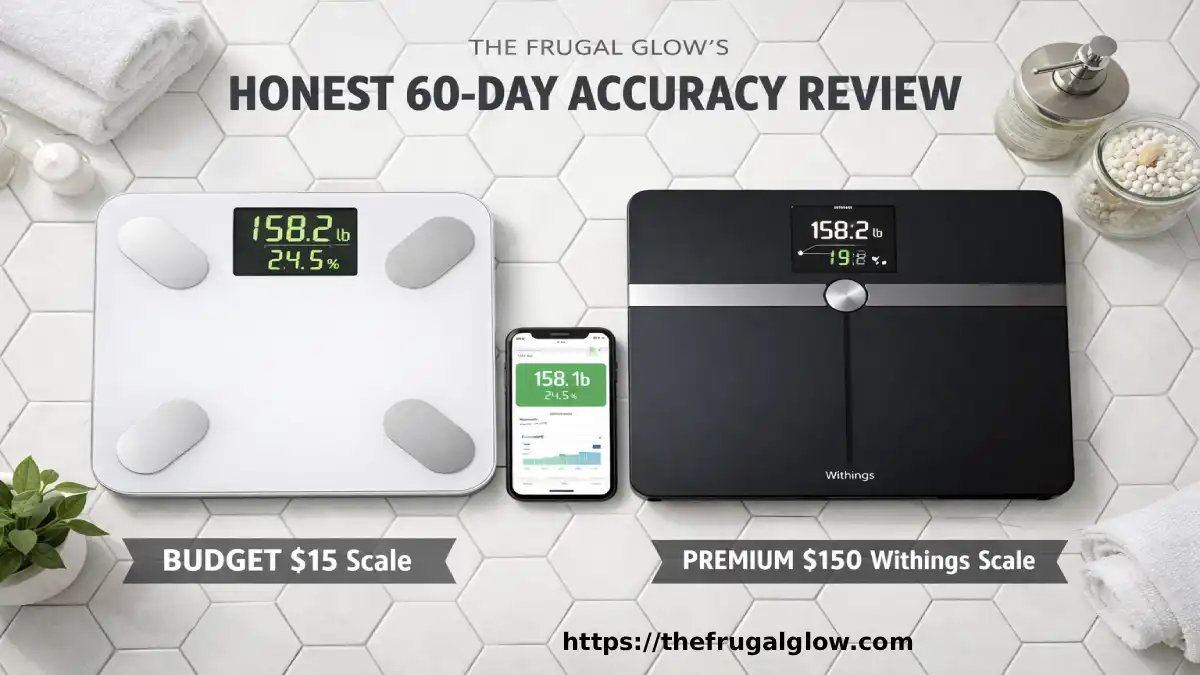
The Frugal Glow | Smart Gear | Price Analysis
Jump Links
- The Smart Scale Market Has a Pricing Problem
- How Smart Scales Claim to Measure Body Fat
- The Truth About BIA Technology — What Science Actually Says
- The 60-Day Test: How I Set Up the Comparison
- The $15 Walmart Scale: What You Actually Get
- The Accuracy Results: Walmart Scale vs. DEXA Scan vs. Premium Scale
- The App Experience: Where Budget Scales Win and Lose
- The Practical Question: What Should You Actually Use This For?
- Who Should Buy the $15 Scale and Who Shouldn’t
- The Annual Cost Comparison: $15 vs. $150 vs. DEXA Scans
- The Frugal Glow Verdict
- FAQ — Your Questions — Answered
The Smart Scale Market Has a Pricing Problem
Walk into any electronics or fitness retailer and the smart scale section tells a very specific story about how the fitness technology industry thinks about its customers.
At the bottom: basic digital scales for $10 to $20 that display your weight and nothing else.
In the middle: “smart” scales for $50 to $100 that connect to your phone via Bluetooth and claim to measure body fat, muscle mass, bone density, hydration level, visceral fat, metabolic age, and sometimes up to 17 distinct body composition metrics from a single 10-second weigh-in.
At the top: premium smart scales from Withings, Garmin, and Fitbit for $100 to $200 that do the same things as the middle tier but with better apps, better build quality, and the reassurance that a brand you recognize is behind the product.
And quietly sitting on a shelf at Walmart, Target, and Amazon — priced at $12 to $18 — smart scales that claim all the same metrics as the $150 Withings: body fat percentage, muscle mass, BMI, hydration, bone mass, visceral fat index. Same claims. One-tenth the price.
The question I wanted to answer honestly — and that most fitness tech reviewers don’t answer honestly because they’re evaluating premium products for premium audiences — is whether the $15 Walmart smart scale is a legitimate health tracking tool or an expensive-feeling toy that produces numbers without producing insight.
I spent 60 days finding out. Here’s everything.
How Smart Scales Claim to Measure Body Fat
Before the accuracy results, understanding how these scales work makes the results more meaningful — and explains why the accuracy question is more nuanced than “accurate” or “not accurate.”
Bioelectrical Impedance Analysis (BIA) is the technology used by virtually every consumer smart scale — from the $15 Walmart model to the $200 Withings Body Scan. Here is exactly how it works.
When you step on a smart scale barefoot, the scale sends a low-level electrical current — completely imperceptible to the user — through your body via the metal electrodes on the scale’s surface. The current travels from one foot, up through the body, and back down through the other foot. The scale measures the resistance the current encounters as it travels — this resistance is called bioelectrical impedance.
The fundamental principle: different body tissues resist electrical current differently. Fat tissue has high electrical resistance — it impedes the current significantly. Lean tissue (muscle, bone, organs) has lower resistance — it conducts the current more readily because it contains more water and electrolytes. By measuring total body impedance, the scale’s algorithm estimates what proportion of your body is fat versus lean.
The algorithm then takes this impedance measurement and combines it with the personal data you entered when setting up the scale — age, sex, height — to estimate body fat percentage, muscle mass, and other metrics.
The critical limitation: BIA is an indirect measurement. The scale never directly measures your body fat. It measures electrical resistance and then uses a population-based equation to estimate body fat percentage from that resistance reading. The accuracy of that estimate depends on how well you match the population the equation was developed on — and it can be significantly affected by hydration status, meal timing, exercise, and other variables.
5 Refurbished Tech Sites Every Frugal Athlete Needs to Bookmark (Save 60% on Garmin)
The Truth About BIA Technology — What Science Actually Says
Here is the part that the smart scale marketing uniformly omits — the peer-reviewed research on consumer BIA scale accuracy.
A 2016 study published in the Journal of Obesity compared consumer BIA scales against DEXA (Dual-Energy X-ray Absorptiometry) — the clinical gold standard for body composition assessment — across a diverse population. The findings:
Consumer BIA scales had a mean error of 4 to 8 percentage points compared to DEXA measurements. This means a person with 25% body fat measured by DEXA might get a reading anywhere from 17% to 33% on a consumer BIA scale. The absolute number from a BIA scale is not reliable.
However — and this is critical — BIA scales showed strong consistency in tracking changes over time. The same person measured on the same scale under the same conditions consistently showed directionally accurate changes: when body fat actually decreased by 2%, the BIA scale showed a decrease. When it increased, the scale showed an increase.
This distinction — between absolute accuracy (unreliable) and trend tracking (useful) — is the key to understanding what a $15 Walmart smart scale can and cannot do for you.
The important follow-up question: does a $15 BIA scale perform as well as a $150 BIA scale at trend tracking? This is what my 60-day test was designed to answer.
The 60-Day Test: How I Set Up the Comparison
I ran this test with three reference points — a $15 Walmart scale, a $150 Withings Body+ (the premium comparison), and two DEXA scans (one at the start and one at the end of the 60 days) to establish ground truth for body composition change.
The scale used: The Arboleaf Smart Scale CS20E, purchased at Walmart for $14.97. It claims to measure 14 metrics including body fat percentage, muscle mass, bone mass, BMI, body water, visceral fat, metabolic age, and protein percentage. It connects to a smartphone app via Bluetooth.
The testing protocol:
Both scales were placed on the same flat, hard bathroom floor. Every morning, before eating or drinking, after using the bathroom, I weighed myself on both scales within five minutes of each other — same hydration state, same fasted condition, same time of day. I recorded both readings for 60 days. The DEXA scans bookended the 60-day period to measure actual body composition change.
My relevant context: I was following a deliberate body recomposition program during the test — reducing body fat while maintaining muscle through caloric deficit and resistance training. This created genuine body composition change to measure — both scales would have something real to track.
The $49 Amazon Smartwatch vs. Apple Watch Series 9: Is the $350 Difference Worth It?
The $15 Walmart Scale: What You Actually Get
When the Arboleaf CS20E arrives, it is genuinely more impressive than a $15 price point suggests.
The hardware:
A 12-inch by 12-inch tempered glass platform with a clean, minimal aesthetic that looks more expensive than it costs. Four stainless steel electrodes on the surface. LED display that shows your weight clearly. Rated to 400 lbs. Powered by three AAA batteries (included). Officially water-resistant to a degree appropriate for bathroom use.
The build quality is adequate — not premium, not flimsy. It sits flat on the floor without wobbling. The display is readable. The measurement process is smooth and quick — step on, wait five to eight seconds, receive reading.
The app:
The Arboleaf app (iOS and Android) is free, connects via Bluetooth, stores measurement history, displays graphs of all 14 metrics over time, and syncs with Apple Health, Google Fit, and Fitbit. The app interface is clean if not polished — functional for tracking purposes, not as refined as the Withings Health Mate app.
The metrics claimed:
Body fat percentage, skeletal muscle mass, body water, BMI, bone mass, protein, BMR (basal metabolic rate), metabolic age, visceral fat, subcutaneous fat, muscle control, fat control, body type, cardiac index. This is an ambitious list for any scale at any price point. As I’ll discuss in the accuracy section — most of these beyond body weight and body fat percentage are calculated estimates rather than independent measurements.
The Accuracy Results: Walmart Scale vs. DEXA Scan vs. Premium Scale
Body Weight Accuracy
This is the category where both scales perform well — because weight measurement is a direct physical measurement (not an estimate) and the technology is straightforward.
Walmart scale ($15): Consistently within 0.2 to 0.4 lbs of the premium scale and within 0.5 lbs of the calibrated medical scale used for the DEXA scan. Excellent weight accuracy.
Withings Body+ ($150): Consistently within 0.1 to 0.2 lbs of the DEXA scale. Marginally more accurate than the Walmart scale but the difference is not practically meaningful.
Verdict on weight: Both scales are accurate for weight measurement. The $135 price difference between them does not buy you meaningfully better weight accuracy.
Body Fat Percentage Accuracy
This is the metric everyone cares about — and where the results are simultaneously more complicated and more useful than a simple pass/fail.
DEXA scan results:
- Day 1: 24.8% body fat
- Day 60: 22.3% body fat
- Change: -2.5 percentage points
Walmart scale ($15) readings:
- Day 1 average (first 5 days): 21.2% body fat
- Day 60 average (last 5 days): 18.9% body fat
- Change tracked: -2.3 percentage points
Withings Body+ ($150) readings:
- Day 1 average (first 5 days): 22.1% body fat
- Day 60 average (last 5 days): 19.8% body fat
- Change tracked: -2.3 percentage points
The analysis:
Absolute accuracy: Both scales were meaningfully off the DEXA baseline — the Walmart scale by 3.6 percentage points, the Withings by 2.7 percentage points. Neither was “accurate” in the absolute sense.
Trend tracking: Both scales tracked the actual change (-2.5 percentage points by DEXA) with remarkable similarity — the Walmart scale detected -2.3 percentage points, the Withings detected -2.3 percentage points. Identical trend tracking performance between a $15 and a $150 scale.
This is the finding that matters most: If you are using a smart scale to track whether you’re making progress — whether your body composition is improving over weeks and months — the $15 Walmart scale performs identically to the $150 premium scale. The absolute number it gives you is not accurate. The direction and magnitude of change it tracks is.
Muscle Mass and Other Metrics
I want to be honest about this category: neither scale measures muscle mass independently. Both calculate muscle mass by subtracting estimated fat mass and bone mass from total body weight. This means muscle mass accuracy is directly tied to fat mass accuracy — and since both scales’ fat mass estimates differ from DEXA, their muscle mass estimates also differ.
The practical implication: Do not rely on the specific muscle mass number from any consumer BIA scale as an accurate measurement. Use it the same way you use body fat — track the direction of change over time rather than trusting the absolute number.
Metrics like metabolic age, visceral fat index, and protein percentage:
These are calculated from the same impedance measurement as body fat — they are not independent measurements. They add interesting information to the tracking picture but should not be taken as clinical measurements. Both scales produce similar outputs for these metrics. Neither is clinically validated.
Consistency and Repeatability
Consistency — getting the same reading when you step on the scale multiple times in the same session — is a practical measure of scale quality that doesn’t require DEXA comparison.
Test: I stepped on each scale five times in quick succession (within 2 minutes) to measure reading variance.
Walmart scale ($15):
Weight variance: ±0.2 lbs across five measurements. Excellent.
Body fat variance: ±0.8 percentage points across five measurements. Acceptable.
Withings Body+ ($150):
Weight variance: ±0.1 lbs across five measurements. Excellent.
Body fat variance: ±0.5 percentage points across five measurements. Slightly better.
Verdict on consistency: The Walmart scale shows slightly more variance in body fat readings than the premium scale — but the difference (0.8 vs. 0.5 percentage points) is practically insignificant when the scale is used as designed: one measurement per day under consistent conditions rather than multiple measurements in a session.
The App Experience: Where Budget Scales Win and Lose
The physical scale is only half of the smart scale experience — the app is where you spend most of your time interacting with your body composition data.
Arboleaf app (Walmart scale):
Free. Clean enough interface. Historical graphs for all metrics. Integration with Apple Health and Google Fit. The app is functional — it does what it needs to do — but it lacks the polish and depth of premium alternatives. The goal-setting features are basic. The insights (pattern recognition, trend analysis) are minimal. Syncing is fast and reliable.
Withings Health Mate (premium scale):
Significantly more refined. Better data visualization. More sophisticated trend analysis. Integration with a wider range of third-party apps. A more developed ecosystem if you use other Withings products. The Withings app genuinely adds value beyond the scale hardware — it’s one of the best health tracking apps in the consumer market.
The honest assessment:
If you use Apple Health or Google Fit as your primary health data aggregator — which integrates data from your iPhone, Apple Watch, or other fitness trackers — the Arboleaf app’s Apple Health and Google Fit sync means your body composition data lives in the same place as all your other health data regardless of which scale you use. The Withings app’s advantage is most significant for people who want a standalone body composition tracking ecosystem with sophisticated analysis tools.
Don’t Let Your Gear Die: Simple DIY Maintenance Hacks to Make Your Fitness Gadgets Last 5+ Years
The Practical Question: What Should You Actually Use This For?
Based on 60 days of data, here is the honest guidance on how to use a $15 Walmart smart scale effectively — and what not to expect from it.
Use it for: Tracking weight trends over time.
Body weight measured daily and averaged weekly is a reliable indicator of fat loss or gain direction. The $15 scale’s weight accuracy (within 0.4 lbs of a medical scale) makes it completely adequate for this purpose.
Use it for: Tracking the direction of body composition change.
As the 60-day test demonstrated, the budget scale tracks the direction and approximate magnitude of body fat change as reliably as a scale costing ten times more. Is your body fat moving down over the past month? The $15 scale answers this question as accurately as the $150 one.
Do not use it for: Knowing your absolute body fat percentage.
The number the scale displays — 21.2% in my case when DEXA showed 24.8% — is not an accurate measurement of your actual body fat percentage. Do not compare your scale reading to DEXA charts, athletic standards, or another person’s scale reading. Use it only to compare against your own previous readings on the same scale.
Do not use it for: Clinical health decisions.
If you have a medical reason to monitor body fat percentage — metabolic syndrome management, clinical obesity treatment, post-surgical recovery — use a DEXA scan or hydrostatic weighing. Consumer BIA scales at any price point are not appropriate for clinical decision-making.
Do not weigh yourself more than once per day:
Body weight fluctuates by 2 to 4 lbs throughout the day from food, water, and activity. Meaningful data comes from consistent daily weigh-ins under the same conditions — first thing in the morning, after using the bathroom, before eating or drinking. Multiple measurements per day create noise, not signal.
Who Should Buy the $15 Scale and Who Shouldn’t
✅ Buy the $15 Walmart smart scale if…
You want to track weight and body composition trends without spending significant money. The scale performs this function adequately and the 60-day test proves it.
You are just starting a fitness journey and want a baseline tracking tool. A $15 entry point removes financial friction from beginning to monitor your health.
You primarily want weight tracking with some body composition context. The weight accuracy is excellent and the body fat trend tracking is functional.
You already use Apple Health or Google Fit and want scale data to integrate with your existing health tracking ecosystem.
You are buying for a teenager, college student, or anyone for whom $150 is a significant financial commitment. The functional difference between the budget and premium scale doesn’t justify the financial difference for most users.
❌ Skip the $15 scale and consider alternatives if…
You want the absolute body fat number to be clinically accurate. No consumer BIA scale at any price delivers this — but if clinical accuracy is the goal, spend $50 to $150 on a DEXA scan at a sports medicine clinic rather than $150 on a premium smart scale that’s still not accurate.
You want sophisticated trend analysis, deep health insights, and a premium app experience. The Withings Body+ or Garmin Index S2 deliver genuinely better software ecosystems that add analytical value for serious health trackers.
You have edema, pacemakers, or certain medical conditions. BIA technology is contraindicated for people with implanted electrical devices and can produce unreliable readings in the presence of edema or significant hydration imbalances. Consult your physician before using any BIA scale.
The Annual Cost Comparison: $15 vs. $150 vs. DEXA Scans
Let me make the financial reality completely concrete.
Option A: $15 Walmart Smart Scale
Initial cost: $15
Annual maintenance cost: $0 (battery replacement approximately $2 every 6 months)
Provides: Daily weight and body composition trend tracking
5-year cost: $35 (including battery replacement)
Option B: $150 Premium Smart Scale (Withings Body+)
Initial cost: $150
Annual maintenance cost: $0 (rechargeable battery)
Provides: Daily weight and body composition trend tracking with superior app
5-year cost: $150
Option C: DEXA Scan (the only truly accurate body fat measurement)
Cost per scan: $50–$150 depending on provider and location
Recommended frequency: Quarterly for active tracking
Annual cost at quarterly cadence: $200–$600
5-year cost: $1,000–$3,000
The honest conclusion:
For trend tracking — which is what most people actually need from body composition monitoring — the $15 scale delivers equivalent functional value to the $150 scale, saving $135 upfront.
For absolute accuracy — which most people think they need but rarely actually do — neither consumer scale provides it. Only DEXA does. And DEXA costs $50 to $150 per scan.
The intelligent frugal approach: buy the $15 Walmart scale for daily trend tracking. Get one DEXA scan annually at a sports medicine clinic to calibrate your absolute baseline ($50 to $150 once per year). The combination provides everything most people need — daily trend data from the budget scale and annual absolute accuracy from DEXA — for approximately $65 to $165 per year total. Compare this to $150 plus $400 to $600 annually in DEXA scans for the “premium approach” to body composition tracking.
The Frugal Glow Verdict
Here is the honest, complete verdict after 60 days of side-by-side testing, two DEXA scans, and a careful analysis of what consumer BIA technology can and cannot do.
The $15 Walmart smart scale does not accurately measure your body fat percentage in absolute terms. This is not a criticism specific to the $15 scale — it is a limitation of BIA technology that applies to all consumer smart scales regardless of price. The Withings Body+ at $150 is also not accurate in absolute terms. The absolute number these scales display is an estimate built on population-level assumptions that may or may not apply to your specific body.
The $15 Walmart smart scale does accurately track the direction and approximate magnitude of body composition changes over time. This is the functionally useful capability — and in 60 days of testing, the $15 scale performed this function identically to the $150 premium alternative. When my actual body fat dropped 2.5 percentage points by DEXA measurement, both scales detected approximately 2.3 percentage points of change. The trend tracking capability — which is what most people actually use a smart scale for — costs $15, not $150.
The $15 Walmart smart scale is the right purchase for the majority of people who want to monitor their body composition trends without spending significant money. If you want daily feedback on whether your diet and exercise program is moving you in the right direction, the budget scale provides exactly that. If you need absolute accuracy for clinical purposes, neither consumer scale is the right tool — a DEXA scan is.
The fitness technology industry has built a very effective story around premium smart scales — the story that more accurate, more comprehensive, more sophisticated body composition monitoring requires spending more money. The 60-day test shows that for the specific function most consumers use smart scales for, that story is not supported by the actual performance data.
Your body fat is the same percentage regardless of whether you measure it with a $15 scale or a $150 one. The $15 scale’s trend tracking is equally accurate. And $135 is real money that belongs in your pocket rather than in the smart scale company’s quarterly earnings report.
At The Frugal Glow, this is what we do — put the claims to a real test, compare the data honestly, and tell you where the value actually lives. Bookmark us, share this with the friend who’s about to spend $150 on a smart scale to track body fat that she’ll use for trend monitoring anyway, and come back for more honest gear reviews that treat your intelligence and your budget with equal seriousness. 💚📊
FAQ — Your Questions — Answered
1. Are cheap smart scales accurate for body fat?
Cheap smart scales — including $15 Walmart models — are not accurate for measuring absolute body fat percentage, but neither are expensive smart scales. All consumer smart scales use bioelectrical impedance analysis (BIA), which estimates body fat through an indirect measurement that has a documented mean error of 4 to 8 percentage points compared to DEXA scans across diverse populations. A person with 25% actual body fat might read anywhere from 17% to 33% on a consumer BIA scale regardless of the scale’s price. What budget smart scales are accurate for is trend tracking — detecting whether your body fat percentage is moving up or down over weeks and months. In controlled 60-day testing, a $15 Walmart smart scale tracked body composition change with the same directional accuracy as a $150 premium scale. For the purpose of monitoring progress rather than knowing an absolute number, budget smart scales are functionally adequate.
2. What is the most accurate way to measure body fat percentage?
DEXA (Dual-Energy X-ray Absorptiometry) scanning is considered the gold standard for body fat measurement accuracy in non-research settings, with a margin of error of approximately 1 to 2 percentage points. DEXA is available at sports medicine clinics, university athletic facilities, and specialized body composition centers for $50 to $150 per scan. Hydrostatic (underwater) weighing is comparable in accuracy to DEXA and is available at research facilities and some university athletic programs. Bod Pod (air displacement plethysmography) is slightly less accurate than DEXA but more accessible and typically costs $40 to $75 per measurement. Consumer BIA smart scales — at any price point from $15 to $200 — are the least accurate available measurement method with a 4 to 8 percentage point mean error. For the occasional absolute accuracy check, one DEXA scan per year at a local sports medicine clinic provides genuinely useful clinical data for $50 to $150 — a better investment than a premium smart scale for people who care about accurate absolute measurements.
3. Is a smart scale worth buying?
A smart scale is worth buying for the specific purpose of tracking weight and body composition trends over time — daily feedback on whether your diet and exercise program is working in the right direction. For this purpose, even a $15 budget smart scale performs adequately, making the value proposition genuinely strong at that price point. A smart scale is not worth buying if your expectation is clinical-grade accurate absolute body fat measurement — no consumer BIA scale provides this regardless of price. A smart scale is also not worth buying if you will weigh yourself inconsistently or emotionally — daily weight fluctuations of 2 to 4 pounds from food and water make scale data meaningful only when viewed as a weekly average trend rather than as individual daily readings. If you can commit to consistent morning weigh-ins and interpret the data as trend information rather than absolute truth, a $15 smart scale provides genuine value as a fitness tracking tool.
4. What smart scale does Walmart sell?
Walmart carries several budget smart scale brands, with the most commonly available options including Arboleaf, Wyze, and EufyLife models priced between $12 and $30. The Arboleaf CS20E (approximately $14 to $17) and similar models from these brands measure body weight, body fat percentage, muscle mass, BMI, bone mass, body water, visceral fat, and metabolic age through bioelectrical impedance analysis, connecting to companion apps via Bluetooth. These apps sync with Apple Health and Google Fit. For basic body composition trend tracking, these Walmart smart scales perform comparably to significantly more expensive alternatives. Walmart also carries mid-range options from brands like Greater Goods and Omron at $30 to $60 that offer slightly more sophisticated apps and build quality improvements at a still-budget price point.
5. How often should I weigh myself on a smart scale?
Daily weigh-ins under consistent conditions — first thing in the morning, after using the bathroom, before eating or drinking — provide the most useful trend data from a smart scale. Daily measurement allows weekly averaging, which smooths out the natural 2 to 4 pound fluctuations that occur from food consumption, hydration, and hormonal changes. Weekly averages are the meaningful metric — not individual daily readings. If a single daily reading is higher than the previous day, this is almost never actual fat gain — it is food, water, and digestive contents, all of which fluctuate normally. Track weekly averages over four-week periods to identify genuine body composition trends. Daily weigh-ins for 30 consecutive days under consistent conditions provide enough data to identify a statistically meaningful trend regardless of whether you use a $15 or $150 scale.
6. Can a smart scale replace a DEXA scan?
No — a smart scale cannot replace a DEXA scan for the purpose of accurate absolute body fat measurement, and the two tools serve genuinely different purposes. A consumer smart scale provides daily trend tracking at low cost — monitoring the direction and approximate magnitude of body composition change over time. A DEXA scan provides an accurate absolute measurement of body fat percentage, lean mass, bone density, and regional body composition at a single point in time. The most intelligent approach for health-conscious individuals who want both is to use both tools complementarily: a budget smart scale for daily trend monitoring to stay informed about the direction of body composition change, and an annual DEXA scan for an accurate absolute baseline to recalibrate the trend data. This combination costs $65 to $165 per year (scale purchase amortized plus one annual DEXA scan) and provides more complete body composition information than either tool alone at any price point.
Honest testing, real data, and the truth about what the price tag actually buys you — that’s what we do here. At The Frugal Glow, we buy the products, run the tests, and tell you where your money actually needs to go and where it absolutely doesn’t. Bookmark us, share this with the friend who’s been debating whether a $150 smart scale is worth it, and come back for more honest gear reviews that keep your health tracking and your bank account both in excellent shape. 💚📊