

How a Florida Mom Built a Luxury ‘Outdoor Oasis’ Using Only Thrifted Finds & Spray Paint
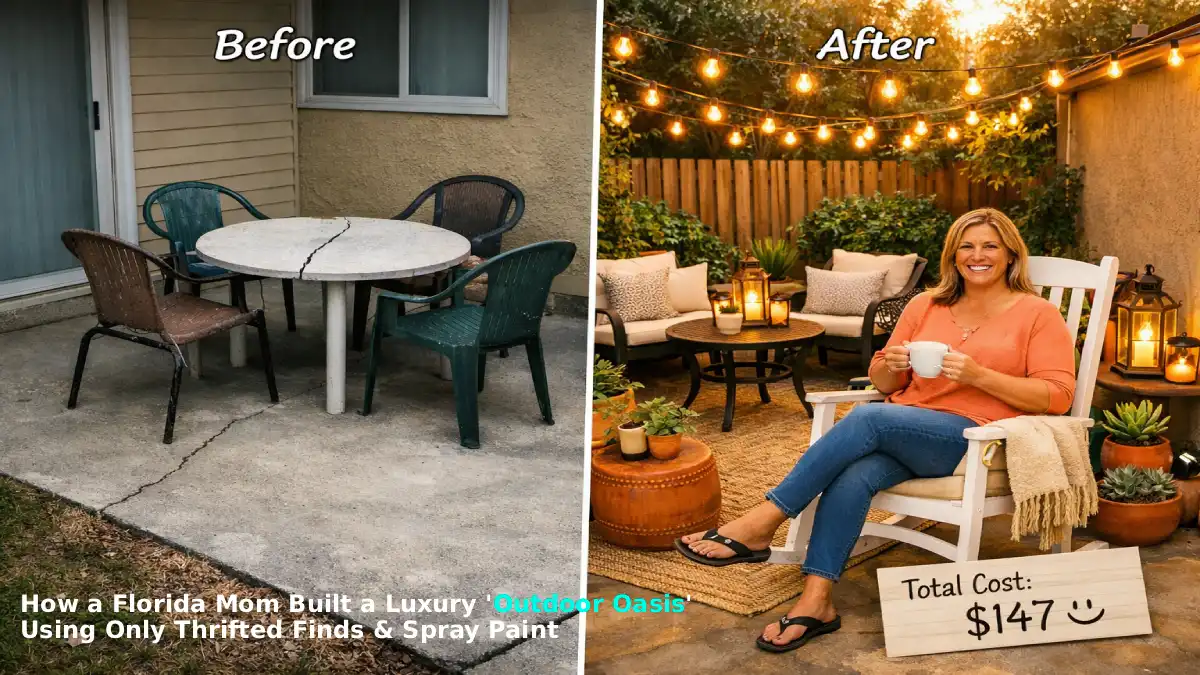
You’ve seen those backyard makeovers on Instagram. The perfectly arranged outdoor furniture. The matching cushions in neutral tones. The potted plants that look like they cost a fortune. The string lights that make everything feel magical. And then you look at your own patio – the mismatched plastic chairs, the rusty table from your college apartment, the sad dying plant in a corner – and you think: “That’s for people with money.”
Meet Jennifer Walsh, a 41-year-old mom of two from Tampa, Florida. She thought the same thing. Until she got tired of looking at her sad concrete patio and decided to do something about it. Her budget? $150. Her tools? A thrift store habit, a can of spray paint, and a stubborn refusal to pay retail prices.
Eight weeks later, she had an outdoor space that looked like it came from a magazine. Total cost: $147. The same look, bought new from HomeGoods and Wayfair? Over $2,500.
This is her story. And her exact step-by-step plan for turning junk into luxury.
Jump Links
- The Concrete Patio That Made Her Cry
- The Rules Jennifer Set for Herself
- Where She Found Everything (No, It’s Not Just Goodwill)
- The Power of Spray Paint: Her Before-and-After Favorites
- Her Exact $147 Outdoor Oasis: The Full Breakdown
- Step-by-Step: How She Transformed Each Item
- The ‘Luxury’ Finishing Touches That Cost Almost Nothing
- What She Learned From Her Mistakes
- Jennifer’s Pro Tips for First-Time Thrift Flippers
- Frequently Asked Questions (FAQ)
- Final Thoughts: Luxury Is a Feeling, Not a Price Tag
The Concrete Patio That Made Her Cry
Jennifer needs to move her three-year-old’s birthday party to their backyard because the rental venue canceled last minute. She walked outside to survey the space and just stood there. Her patio was a disaster. Gray concrete. A cracked plastic table from Target that had turned gray from sun damage. Four mismatched chairs – two metal, one wood, one plastic. A metal shelf from her college dorm that she’d been meaning to throw away for fifteen years. No plants. No lights. No nothing.
She looked at the space. She looked at her bank account. She looked back at the space. And she cried.
“I’m not a crier,” she told me over the phone, while folding laundry. “But I was so angry. Angry that we’d never had money to make our house feel like a home. Angry that every nice thing seemed to cost a thousand dollars. Angry that I’d spent years feeling like our space wasn’t good enough.”
Her husband found her sitting on the cracked plastic chair, crying. He said the thing that changed everything: “Let’s just go to Goodwill and see what happens.”
That was two years ago. Jennifer hasn’t bought a single piece of new furniture since.
The Rules Jennifer Set for Herself
Before she started thrifting, Jennifer made a list of rules. She didn’t want to end up with a bunch of random junk that didn’t go together.
Rule #1: Choose a color palette first
She picked warm neutrals: cream, beige, terracotta, and soft green. Any item she bought had to fit within that palette or be paintable to fit.
Rule #2: No buying without a plan
She made a list of exactly what she needed: seating for four, a table, a plant stand, storage, lighting, and decorative accents. No impulse buys.
Rule #3: Think about what can be transformed, not what it currently is
A rusty metal chair is not a rusty metal chair. It’s a chair that needs spray paint. A dated wooden shelf is not a dated wooden shelf. It’s a shelf that needs sanding and stain. She trained herself to see potential, not problems.
Rule #4: Set a hard budget ($150)
She withdrew the money in cash. When the cash was gone, she was done.
Rule #5: Spend time on research before spending money
She spent two weeks just browsing thrift stores, Facebook Marketplace, and Craigslist. She didn’t buy anything. She just looked at prices, quality, and what was available. By the time she started buying, she knew a good deal when she saw one.
Where She Found Everything (No, It’s Not Just Goodwill)
Jennifer didn’t find everything at one place. She had a rotation.
Goodwill & Salvation Army (60% of her finds)
Best for: Furniture with good bones, glassware, baskets, lamps, frames
Pro tip: Go on weekdays. Tuesday and Wednesday mornings are best. New donations come in over the weekend and get priced on Monday.
Facebook Marketplace (25% of her finds)
Best for: Larger items (tables, chairs, outdoor rugs)
Pro tip: Search for “free” or “curb alert.” People give away perfectly good furniture because they don’t want to haul it. Jennifer got a solid wood coffee table for free. She sanded and painted it.
Habitat for Humanity ReStore (10% of her finds)
Best for: Building materials, paint, tiles, light fixtures
Pro tip: They sell sample pots of paint for $1-2. Perfect for small projects.
Garage sales & estate sales (5% of her finds)
Best for: Unique decorative items, vintage pieces, plants
Pro tip: Go on the last day of an estate sale. Everything is 50% off.
Dumpster diving (yes, really)
“I’m not proud of this,” Jennifer said, “but I found a perfectly good wicker chair sitting next to a dumpster in my neighborhood. Someone had put a ‘free’ sign on it. I took it home, cleaned it, spray painted it, and it’s now my favorite chair.”
The Power of Spray Paint: Her Before-and-After Favorites
Spray paint was the single most important tool in Jennifer’s transformation. She spent $28 total on spray paint. Here’s what she painted and how it changed.
Item #1: A rusty metal bistro set ($15 at Goodwill → after spray paint: $0 additional)
Before: Rust spots, faded red color, chipping paint
After: Sanded rust spots, cleaned with soap and water, applied two coats of Rust-Oleum matte black spray paint ($8)
Result: Looks like a $150 bistro set from Wayfair
Item #2: A dated wooden rocking chair ($8 at Salvation Army → after spray paint: $6)
Before: 1980s oak finish with ugly floral cushions
After: Removed cushions, sanded lightly, spray painted with Rust-Oleum chalked linen white ($6)
Result: Looks like a $200 Anthropologie knockoff
Item #3: A dull brass floor lamp ($12 at Goodwill → after spray paint: $6)
Before: Yellowed brass finish, dated shape
After: Spray painted with Rust-Oleum matte bronze ($6), new beige shade ($4 at Target)
Result: Looks like a $80 lamp from West Elm
Item #4: Terracotta pots ($1-2 each at Goodwill → after spray paint: $2 for all)
Before: Mismatched colors, some chipped
After: Spray painted with leftover chalked linen white (already counted above)
Result: Looks like a set of $15 each pots from Anthropologie
Total spray paint investment: $28
Total value of items after painting (estimated): $500+
Savings: $472
“Spray paint is magic,” Jennifer said. “It covers mistakes. It unifies mismatched items. It makes old things look new. If you can only buy one tool for a home makeover, buy spray paint.”
Her Exact $147 Outdoor Oasis: The Full Breakdown
Here’s everything Jennifer bought, what she paid, and what she turned each item into.
Furniture ($62 total):
- Metal bistro table + two chairs: $15 (Goodwill) → Painted matte black
- Wicker chair: $0 (neighbor’s curb) → Cleaned and kept natural
- Wooden rocking chair: $8 (Salvation Army) → Painted linen white
- Metal side table: $6 (Goodwill) → Painted terracotta (mixed leftover paints)
- Storage bench (fits two cushions): $25 (Facebook Marketplace) → Sanded and stained
- Folding wooden tray table: $8 (estate sale) → Kept original wood, just cleaned
Textiles ($38 total):
- Outdoor cushion covers (set of 4, new but clearance): $12 (Target clearance)
- Outdoor throw pillow covers (set of 2): $8 (Goodwill, new with tags)
- Woven outdoor rug (4×6, stained but washable): $15 (Facebook Marketplace)
- Tassel throw blanket: $3 (Goodwill, washed and line-dried)
Decor & Plants ($28 total):
- Terracotta pots (mismatched, 7 total): $8 (Goodwill)
- Small succulents (4 total): $12 (Home Depot, clearance section)
- String lights (20 feet): $5 (Dollar Tree, after Christmas sale)
- Glass candle holders (assorted): $3 (Garage sale, last day 50% off)
- Candles (white, unscented, 6 total): $0 (already owned, but Dollar Tree sells for $1)
Lighting ($12 total):
- Brass floor lamp: $12 (Goodwill) → Painted bronze
- Paper lantern shade for lamp: $4 (Ikea, clearance)
Spray Paint & Supplies ($28 total):
- Rust-Oleum matte black: $8
- Rust-Oleum chalked linen white: $6
- Rust-Oleum matte bronze: $6
- Sandpaper (variety pack): $4
- Drop cloth (reused old bedsheet): $0
- Painter’s tape: $4
Grand total: $62 + $38 + $28 + $12 + $28 = $147.83
For comparison, Jennifer priced out what the same look would cost new from home decor stores:
- Similar bistro set (Wayfair): $150
- Wicker chair (Target): $120
- Rocking chair (Anthropologie): $200
- Storage bench (Crate & Barrel): $250
- Outdoor rug (West Elm): $120
- Lamps & lighting (Pottery Barn): $100
- Cushions, pots, decor (misc): $150
Estimated new price: $1,090 (on sale) to $2,500+ (full price)
Savings: At least $942. Enough to make anyone cry happy tears instead of sad ones.
Step-by-Step: How She Transformed Each Item
Jennifer walked me through her process for her biggest transformation: the metal bistro set.
Step 1: Clean everything
She scrubbed the rust spots with a wire brush. Then she washed the entire set with soap and water. Let it dry completely in the sun.
Step 2: Sand the rough spots
She used medium-grit sandpaper to smooth the rusted areas and any chipping paint. Not the whole thing – just the problem areas.
Step 3: Wipe down with rubbing alcohol
Removes any remaining dust or grease. Important for paint adhesion.
Step 4: Set up a spray painting station
Old bedsheet on the grass. Cardboard boxes to raise the table and chairs off the sheet (so paint reaches underneath).
Step 5: Apply thin coats
She did three light coats instead of one heavy coat. Waited 10 minutes between each coat. This prevented drips and ensured even coverage.
Step 6: Let cure overnight
The paint was dry to touch after an hour, but she waited 24 hours before using the set. Full cure time was 7 days before heavy use.
Step 7: Seal if needed
For outdoor furniture, she added a clear matte sealer ($6, not in her original budget because she used leftover from another project). Protects against rain and sun.
“The first time I spray painted something, I was so scared. I thought I’d ruin it,” she said. “Now I spray paint everything. Lamps. Frames. Plant pots. A metal tray that was ugly gold. It’s addictive.”
The ‘Luxury’ Finishing Touches That Cost Almost Nothing
Jennifer’s patio doesn’t look like a thrifted collection. It looks like a curated outdoor room. Here are her secrets.
Secret #1: Unifying color palette
Everything is black, white, terracotta, or natural wood. No bright colors. No patterns that clash. This makes mismatched thrift finds look intentional.
Secret #2: Varying heights
She has items at different levels: floor (rug), low (bench, chairs), medium (table, plant stands), high (hanging lights, lamp). Visual interest without spending money.
Secret #3: Odd numbers
Three plant pots on the table instead of two or four. Five candle holders across the bench. Odd numbers look more natural and curated.
Secret #4: Layering textures
Woven rug (textured) + smooth metal table (sleek) + soft cushions (plush) + rough terracotta pots (earthy). Mixing textures adds luxury without adding cost.
Secret #5: Greenery
Plants make everything look more expensive. Even $1 succulents from Home Depot’s clearance section. Even fake plants from Goodwill (just clean the dust off).
Secret #6: Lighting
String lights ($5) and a warm lamp ($12) transformed the space from “concrete slab” to “outdoor living room.” Never underestimate lighting.
Secret #7: Negative space
She didn’t fill every corner. Empty space looks intentional. Clutter looks cluttered.
What She Learned From Her Mistakes
Jennifer made plenty of mistakes. She wants you to learn from them.
Mistake #1: Painting without primer
She spray painted a laminate side table without primer. The paint peeled off within a month. She had to sand and repaint. Now she always uses primer (or buys paint with primer built in).
Mistake #2: Buying things just because they were cheap
She bought a set of five ceramic vases for $2. They’re still sitting in her garage. She never found a use for them. Now she only buys items that fill a specific need.
Mistake #3: Forgetting about outdoor durability
She used regular acrylic paint on a wooden shelf she kept outside. Rain destroyed it. Now she uses outdoor-rated paint or sealant on anything exposed to weather.
Mistake #4: Rushing the process
She tried to do her whole patio makeover in one weekend. She burned out, bought things she didn’t need, and got frustrated. The second time (the real makeover), she gave herself eight weeks. It took the stress away.
Mistake #5: Not checking Facebook Marketplace for free items first
She bought a $8 plant stand at Goodwill. Then she found a better one for free on Facebook Marketplace the next week. Now she always checks free listings before buying anything.
Jennifer’s Pro Tips for First-Time Thrift Flippers
Jennifer has done this for two years now. She’s transformed her patio, her living room, her bedroom, and half her neighbor’s house. Here’s her advice for beginners.
Tip #1: Start with one small project
Don’t try to do a whole room. Pick one item – a lamp, a side table, a picture frame – and transform it. Build confidence before tackling bigger things.
Tip #2: Join local ‘Buy Nothing’ groups on Facebook
People give away amazing furniture for free because they’re moving or upgrading. Set alerts. Check daily. Be ready to pick up quickly (same day if possible).
Tip #3: Learn basic furniture repair
Googling “how to fix wobbly chair” or “how to replace drawer pull” takes 5 minutes. Basic repair skills expand what you can buy.
Tip #4: Buy the best spray paint you can afford
Rust-Oleum costs $6-8 per can. Cheap $3 spray paint doesn’t cover well, drips, and fades. The extra few dollars matters.
Tip #5: Clean everything before you bring it inside
Jennifer learned this the hard way after bed bugs. Now she cleans thrifted items outside with disinfectant wipes or a bleach solution before they enter her house.
Tip #6: Be patient
The perfect item at the perfect price won’t appear on your first thrift trip. Or your fifth. Check regularly. The universe rewards persistence.
Tip #7: Take before photos
When you’re frustrated, look at the before photos. It reminds you how far you’ve come. Jennifer regrets not taking more before photos of her patio.
Tip #8: Ignore the haters
Some people will judge you for thrifting. “That’s gross.” “I could never.” Jennifer’s response: “Okay. I’ll keep my $900 savings. You keep your judgment.”
Spotlight: The Houston Teacher Who Replaced Her $150 Salon Visits with a $10 DIY Kit
Frequently Asked Questions (FAQ)
1. Isn’t thrifted furniture dirty or gross?
No, if you clean it. Jennifer disinfects everything with a bleach solution (1 part bleach to 10 parts water) or antibacterial wipes. Fabric items get washed immediately. Upholstered furniture gets steam cleaned. Wood items get sanded and sealed. Clean thrifted furniture is just as clean as new furniture.
2. How do I know if a thrifted item is good quality?
Check for solid wood (not particle board). Look for dovetail joints (sign of quality). Avoid items with water damage or wood rot. Test drawers and doors. Check for wobbles (most can be fixed with glue or new screws). Jennifer’s rule: “If it’s solid and not falling apart, I can fix it.”
3. What’s the best brand of spray paint for furniture?
Rust-Oleum’s “Painter’s Touch” 2X Ultra Cover line. It has primer built in, covers in 1-2 coats, and has a durable finish. For outdoor furniture, use Rust-Oleum’s “Stops Rust” line in matte (less shiny, more modern). Avoid cheap $3 spray paint from dollar stores.
4. How do I make thrifted items look intentional and not mismatched?
Choose a color palette (3-5 colors) and stick to it. Paint items to match that palette. Use spray paint to unify different materials. Group items by color or finish. The goal is cohesion, not matching.
5. Can I do this if I live in an apartment with no outdoor space?
Yes. Use a drop cloth on your floor (open windows, turn on fans). Spray paint smaller items on a balcony. Use brush-on paints (like chalk paint) for larger items – no spraying required. Facebook Marketplace is still great for finding affordable outdoor furniture for your balcony or patio.
6. What items should I never buy thrifted?
Jennifer says: mattresses, upholstered bed frames, fabric headboards (bed bugs risk). Also avoid electronics that can’t be tested, car seats, and anything with black mold. Everything else is fair game.
7. How do I price items at thrift stores? What’s a good deal?
General rule: Goodwill prices should be 70-80% off retail. Facebook Marketplace should be 50-75% off retail. If an item is more expensive than that, negotiate or walk away. Jennifer’s cheat sheet: solid wood table under $30 is good. Metal chairs under $10 each is good. Lamps under $15 is good. Rugs under $20 is good for 4×6 or smaller.
Final Thoughts: Luxury Is a Feeling, Not a Price Tag
Here’s what I want you to take away from Jennifer’s story.
Luxury isn’t about how much money you spend. It’s about how a space makes you feel. Jennifer’s patio makes her feel relaxed, proud, and happy. She made it with $147 and her own two hands. That’s not cheap. That’s creative.
The furniture industry wants you to believe that you need new things. That last season’s styles are embarrassing. That your home isn’t good enough. That’s not true. It’s marketing.
Jennifer’s patio is full of “last season” items. A 1980s rocking chair. A 1990s brass lamp. A dumpster-dived wicker chair. And it looks like a magazine. Because she took the time to make it beautiful.
So this weekend, instead of scrolling Instagram and feeling bad about your space, go to Goodwill. Walk around. See what speaks to you. Imagine what it could become. Start small. Be patient. Trust the process.
And remember: the frugal glow isn’t about having less. It’s about creating more with what you have.
Now go make something beautiful. 🪴✨
For more real-life frugal transformations, thrift flip tutorials, and budget home decor tips, visit The Frugal Glow.