

The $1 Apple Cider Vinegar Secret: How to Get ‘Expensive’ Hair Shine for Pennies
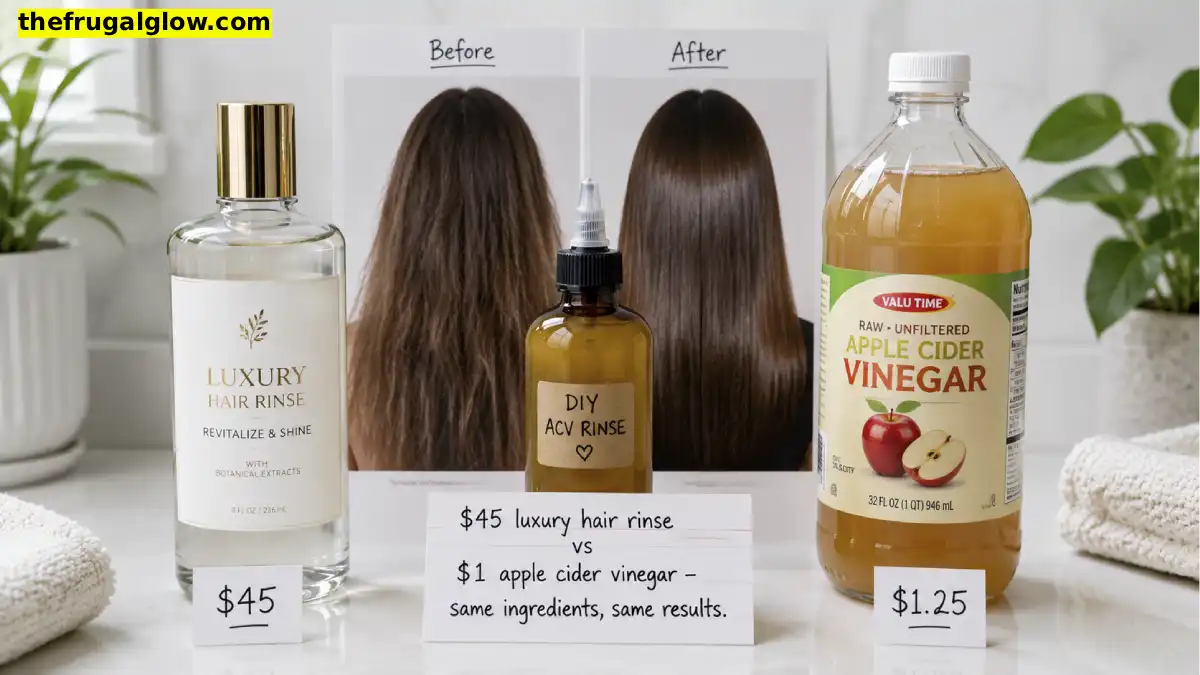
Let me tell you about the $45 hair rinse that completely changed how I shop for hair care.
I bought it hoping for shinier, healthier hair, but after finishing the bottle, I could barely tell a difference. Then I checked the ingredient list and realized the main ingredient was apple cider vinegar—the same bottle I could buy at the grocery store for about $1.
So I made my own rinse with apple cider vinegar and water. After just a few uses, my hair looked noticeably shinier, felt lighter, and people actually started asking what I was using.
Today, I’m sharing my simple apple cider vinegar hair rinse recipe, why it works, and how you can get salon-worthy shine without spending $45 on a fancy bottle.
Jump Links
- The $45 Sephora Purchase That Made Me Feel Stupid
- What Does Apple Cider Vinegar Actually Do for Hair?
- The $1 Recipe (Exact Measurements)
- How to Use It: Step-by-Step (Don’t Skip This)
- The Results: What to Expect After Your First Rinse
- My Biggest Mistakes (So You Don’t Make Them)
- The $45 Product vs. $1 ACV: Ingredient Showdown
- The Math: What I Saved in One Year
- Bonus Uses: ACV for Your Face and Body (More Savings)
- Frequently Asked Questions (FAQ)
- Final Thoughts: Shine Doesn’t Need a Price Tag
The $45 Sephora Purchase That Made Me Feel Stupid
I need to be honest about my $45 mistake.
The product was called something like “Cultured + Bright” or another two-word name that means nothing. The bottle was heavy glass. The dropper was gold-tipped. It looked like it belonged on an Instagram shelfie. I bought it because a creator I trusted said it gave her “the shiniest hair of her life.”
It didn’t work for me. Not really. My hair was maybe 10% shinier. For $45, I wanted 100% shinier. I wanted to blind people with my reflection.
After I finished the bottle (I’m not wasteful), I looked up the ingredients online. I expected a complex formula with rare extracts and cutting-edge science.
Here’s what I found: apple cider vinegar, water, aloe barbadensis leaf juice, sodium benzoate, potassium sorbate, citric acid.
That’s it. Those are the ingredients in a $45 “luxury” hair rinse.
Apple cider vinegar is the star. Water is the base. Aloe is nice but optional. The other two are preservatives. Citric acid adjusts pH.
I could buy a gallon of apple cider vinegar for $8. That’s 16 times the amount in the $45 bottle. For one-sixth the price.
I wasn’t mad at the brand. They’re allowed to charge whatever people will pay. I was mad at myself. For not reading the label. For assuming expensive meant better. For paying $45 for ingredients I could buy for $1.
That was the last time I bought a fancy hair product without checking the ingredients first.
Now I make my own ACV rinse. It costs me about $1 per month. And my hair is genuinely shinier than it ever was with the expensive stuff.
What Does Apple Cider Vinegar Actually Do for Hair?
Let me explain the science quickly.
Your hair has a natural pH of about 4.5 to 5.5. That’s slightly acidic. Most shampoos are alkaline (higher pH). They open up the hair cuticle to clean it. That’s good for cleaning. But it leaves the cuticle rough and raised, which makes hair look dull.
ACV has a pH of about 3. It’s more acidic. When you rinse your hair with diluted ACV, it does three things.
First: closes the cuticle.
The acid causes the hair cuticle (the outer layer) to flatten and smooth down. Flat cuticles reflect more light. More light reflection = more shine. This is the main benefit.
Second: removes buildup.
Shampoos, conditioners, dry shampoos, and hard water minerals leave residue on your hair. ACV gently dissolves that buildup without stripping your hair like harsh clarifying shampoos. Cleaner hair = shinier hair.
Third: balances scalp pH.
An alkaline scalp can lead to dandruff, itching, and irritation. ACV restores your scalp’s natural acidic pH. Healthier scalp = healthier hair.
What ACV does NOT do:
- It does not “detox” your hair (that’s a marketing word)
- It does not repair split ends (nothing does except scissors)
- It does not change your hair color (though it can enhance natural highlights over time)
- It does not work overnight (consistency matters)
The results are real. But they’re not magic. They’re chemistry.
The $1 Recipe (Exact Measurements)
Here’s the exact recipe I’ve used for three years. It costs about $1 per month.
Ingredients:
- 1 part raw, unfiltered apple cider vinegar (with “the mother” – the cloudy stuff)
- 2 parts water (filtered is better, tap is fine)
- Optional: 2-3 drops of essential oil (lavender, rosemary, or tea tree for scent)
For one use (fine, short, or thin hair):
- 1 tablespoon ACV
- 2 tablespoons water
- Mix in a small cup or bowl
For one use (thick, long, or curly hair):
- 2-3 tablespoons ACV
- 4-6 tablespoons water
- Mix in a squeeze bottle or an old shampoo bottle
For a batch (makes 4-6 uses):
- 1/2 cup ACV
- 1 cup water
- Store in an old glass jar or squeeze bottle in the shower
Where to buy ACV:
- Grocery store: $4-6 for 32 oz (Bragg’s is the most popular)
- Dollar store: $1.25 for 16 oz (generic brand, works the same)
- Costco: $8 for a gallon (cheapest per ounce)
I buy the dollar store brand. It works exactly the same as Bragg’s. The only requirement is “raw, unfiltered, with the mother.” That’s the good stuff. The clear, filtered ACV (like Heinz) doesn’t work as well because it lacks the beneficial enzymes and bacteria.
Total monthly cost: About $1 for the ACV. Water is free. Essential oils optional.
How to Use It: Step-by-Step (Don’t Skip This)
I messed this up the first few times. Here’s exactly how to do it.
What you need:
- Your mixed ACV rinse (in a cup or squeeze bottle)
- Your regular shampoo (no conditioner needed before the rinse – you’ll condition after)
- A timer (your phone is fine)
Step 1: Shampoo as normal
Wash your hair with your regular shampoo. Rinse thoroughly. Do NOT condition yet. Conditioner will coat your hair and block the ACV from doing its job.
Step 2: Squeeze out excess water
Your hair should be damp, not dripping wet. Excess water will dilute the ACV rinse.
Step 3: Pour the ACV rinse over your hair
Start at the roots and work toward the ends. Really saturate everything. If you have a squeeze bottle, it’s easier. If you’re using a cup, lean over the tub and pour slowly.
Step 4: Let it sit for 2-3 minutes
Set a timer. Do not skip this. The ACV needs time to close the cuticle. Two minutes is minimum. Three minutes is better. Longer than five minutes can be drying.
Step 5: Rinse with cool water
Warm or hot water opens the cuticle (opposite of what you want). Cool water seals everything. Rinse thoroughly until the vinegar smell is gone.
Step 6: Condition as normal (but only the ends)
Apply conditioner only to your mid-lengths and ends. Avoid your roots. The ACV has already balanced your scalp pH. Conditioner on roots might make it greasy.
Step 7: Style as usual
Blow dry, air dry, whatever you normally do.
How often should you do this?
- Oily hair: once per week
- Normal hair: once every 1-2 weeks
- Dry or damaged hair: once every 2-3 weeks (or less)
Overdoing ACV can dry out your hair. Start with once every two weeks. Adjust based on how your hair feels.
The Results: What to Expect After Your First Rinse
Let me set realistic expectations.
Immediately after (first use):
Your hair will feel different. Squeaky clean. Almost too clean. That’s the cuticle closing. It can feel a little rough or dry right after rinsing. That’s normal. Conditioner will fix it.
After drying (first use):
This is where you’ll see the shine. Hold your hair in natural light. Look at the reflection. It should be noticeably glossier than before. Not “Hollywood red carpet” glossy (that’s styling products), but visibly improved.
After 2-3 uses (2-6 weeks):
The shine builds. Buildup from previous products is gone. The cuticle is consistently smooth. People might start asking if you did something different to your hair.
After 2-3 months:
This is where the real magic happens. Your hair will be consistently shinier, softer, and more manageable. You might notice less frizz, especially if you live in a humid climate. Your scalp might be less itchy if that was an issue.
What NOT to expect:
- Instant “glass hair” (that requires styling products and heat)
- Repair of split ends (nothing can do that)
- Dramatic color change (highlights may look slightly brighter over time)
- Results if you don’t dilute properly (too strong = damage, too weak = no effect)
The ACV rinse is not a miracle. It’s a simple, effective, cheap treatment that delivers real results over time.
My Biggest Mistakes (So You Don’t Make Them)
I made a lot of mistakes when I first started. Learn from me.
Mistake #1: Using undiluted ACV
I thought “more is better.” I poured straight ACV on my hair. It burned my scalp. It dried out my ends. My hair looked worse, not better. Always dilute. 1 part ACV to 2 parts water is the minimum. 1:3 or 1:4 is even gentler.
Mistake #2: Using it too often
I did it every wash day (3-4 times per week). Within two weeks, my hair was dry, brittle, and breaking. ACV is acidic. Overuse strips your hair’s natural oils. Once per week maximum. Once every 2-3 weeks for dry or damaged hair.
Mistake #3: Using hot water to rinse
Hot water opens the cuticle. That’s the opposite of what you want. The whole point is to close the cuticle for shine. Use cool or cold water for the final rinse. It’s uncomfortable but worth it.
Mistake #4: Skipping conditioner
The ACV rinse leaves your hair feeling “squeaky clean” – almost too clean. That’s the cuticle closing. Conditioner is essential afterward to add back smoothness and slip. Just avoid putting conditioner on your roots.
Mistake #5: Using the wrong kind of ACV
Clear, filtered ACV (like the kind you cook with) lacks “the mother” – the beneficial enzymes and bacteria. It still works for shine, but not as well. Buy raw, unfiltered ACV with “the mother.” It’s cloudy and has sediment at the bottom. Shake before each use.
Mistake #6: Expecting instant results
The first use will give you some shine. But the real benefits come with consistent use over weeks and months. Don’t try it once, see “okay” results, and give up. Commit to 6-8 weeks before judging.
The $45 Product vs. $1 ACV: Ingredient Showdown
Let me put these side by side.
$45 “Luxury” Hair Rinse:
- Water
- Apple cider vinegar
- Aloe barbadensis leaf juice (soothing, optional)
- Sodium benzoate (preservative)
- Potassium sorbate (preservative)
- Citric acid (pH adjuster)
$1 DIY ACV Rinse:
- Apple cider vinegar (raw, unfiltered, with the mother)
- Water
Ingredient comparison:
The expensive product adds aloe (nice but not necessary) and preservatives (needed for shelf stability). The DIY version has no preservatives, which is fine because you make it fresh.
Active ingredient comparison:
Both have apple cider vinegar as the primary active ingredient. That’s what closes the cuticle and removes buildup. The expensive product doesn’t have “more” or “better” ACV. It’s the same ingredient.
Price per ounce:
- $45 product: about $9 per ounce
- DIY ACV: about $0.06 per ounce (dollar store brand)
Price per use:
- $45 product: about $1.50 per use (if the bottle lasts 30 uses)
- DIY ACV: about $0.10 per use (including water and a splash of vinegar)
You are paying $1.40 extra per use for a glass bottle and a brand name.
The Math: What I Saved in One Year
Let me show you the real dollar savings.
Before (using $45 hair rinse):
- 1 bottle lasted about 6 weeks (shorter than claimed, as always)
- That’s about 8.5 bottles per year
- 8.5 × $45 = $382.50 per year
- Plus tax (say 8%) = $413.10
After (using DIY ACV rinse):
- 32 oz bottle of raw ACV = $5 (Bragg’s) or $1.25 (dollar store)
- That bottle lasts about 6-8 months (using 1-2 oz per week)
- Let’s be generous and say 32 oz lasts 6 months
- That’s $10 per year (two bottles)
- Plus water (pennies)
Annual savings: $413 – $10 = $403
Over 5 years: $2,015
That’s not a typo. Two thousand dollars saved on hair rinse. By switching from a $45 product to a $1 ingredient.
What I did with the savings:
- Bought higher-quality shampoo (since the rinse is cheap)
- Paid for a professional haircut twice a year (instead of once)
- Put the rest into savings
The ACV rinse didn’t just save me money. It freed up money for things that actually matter.
Bonus Uses: ACV for Your Face and Body (More Savings)
Since I already have ACV in my shower, I started using it for other things. Each of these replaces an expensive product.
ACV as a face toner (replaces $15-30 toner):
Mix 1 part ACV with 3 parts water. Apply with a cotton ball after cleansing. It balances skin pH, reduces redness, and can help with acne. Start with 1:4 dilution if you have sensitive skin.
ACV as a body spray for body odor (replaces $10-20 deodorant):
Mix 1 part ACV with 3 parts water in a spray bottle. Spray on underarms after showering. The acid kills odor-causing bacteria. It doesn’t stop sweating, but it stops smell. This works shockingly well.
ACV as a foot soak (replaces $5-10 foot treatments):
Mix 1/2 cup ACV with a gallon of warm water. Soak feet for 15 minutes. It softens calluses, fights foot odor, and can help with athlete’s foot.
ACV as a scalp treatment for dandruff (replaces $15-30 dandruff shampoos):
Same as the hair rinse, but massage into your scalp and let sit for 5-10 minutes before rinsing. The acid kills the fungus associated with dandruff.
Annual savings from bonus uses: $50-100
That brings my total annual savings from one $1 bottle of ACV to over $500.
Frequently Asked Questions (FAQ)
1. Will the ACV rinse make my hair smell like vinegar?
Not if you rinse thoroughly and use conditioner. The smell dissipates as your hair dries. Some people add essential oils (lavender, rosemary, tea tree) to cover the scent. I don’t bother. The vinegar smell is gone within 30 minutes.
2. Can I use ACV rinse on color-treated hair?
Yes, but be cautious. ACV is acidic. It can strip semi-permanent color (like fashion colors) faster than permanent dye. For permanent color, ACV is generally safe and can even make color last longer by closing the cuticle. Do a strand test first. Apply the rinse to a small hidden section, rinse, dry, and see if the color changed.
3. How long does homemade ACV rinse last?
Mixed rinse (ACV + water) lasts about 1-2 weeks in a closed bottle at room temperature. After that, the water can grow bacteria. Make small batches. Or make it fresh each time (takes 30 seconds). I make fresh each wash day because it’s so easy.
4. Can I use ACV rinse if I have a sensitive scalp?
Yes, but dilute more. Start with 1 part ACV to 4 parts water (1:4). If that doesn’t irritate, try 1:3. If that burns or stings, stick with 1:4. Do not use undiluted ACV on your scalp – it will burn.
5. Will ACV rinse help with dandruff?
Yes. Dandruff is often caused by a fungus called Malassezia. ACV’s acidity creates an environment where that fungus cannot thrive. Many people report significant dandruff reduction after 2-3 weeks of weekly ACV rinses. Use 1:2 or 1:3 dilution, massage into scalp, let sit for 5 minutes, rinse.
6. Can I use ACV rinse on curly or coily hair?
Yes, but with caution. Curly hair tends to be drier and more fragile. Overuse of ACV can dry it out. Start with 1:4 dilution once every 2-3 weeks. See how your hair responds. Many curlies love ACV for clarifying without stripping, but don’t overdo it.
7. Why does my hair feel rough after the ACV rinse?
That’s the cuticle closing. A closed cuticle feels smooth when you run your finger down the hair shaft but can feel rough when you run your finger up. That’s normal. Conditioner will add back slip. Don’t panic.
8. Can I use white vinegar instead of apple cider vinegar?
Yes, but it’s not as good. White vinegar is more acidic (pH ~2.5 vs ACV’s ~3). It works for shine but lacks the enzymes and beneficial bacteria of raw ACV. It also smells stronger. ACV is better, but white vinegar works in a pinch.
Final Thoughts: Shine Doesn’t Need a Price Tag
Here’s what I want you to take away.
The beauty industry wants you to believe that expensive products are better. They want you to think that a $45 hair rinse has “special” ingredients that a $1 bottle of vinegar doesn’t.
That’s marketing. It’s not science.
Apple cider vinegar is apple cider vinegar. The $45 version uses the same ingredient as the $1 version. The expensive version adds water, aloe, and preservatives. That’s it.
I’m not saying all expensive hair products are scams. Some have genuinely unique formulations. But the ACV hair rinse? It’s one of the clearest examples of “luxury markup” I’ve ever seen.
So here’s my challenge to you.
Try the DIY ACV rinse for one month. Spend $1 on a bottle of raw, unfiltered ACV from the dollar store or grocery store. Mix it with water. Use it once a week.
See if your hair gets shinier. See if your scalp feels better. See if you notice any difference at all.
If it doesn’t work for you, you’re out $1. That’s less than the tax on a Starbucks drink.
But if it does work – and for most people, it does – you’ve just found a $400-per-year savings that takes 30 seconds to apply.
That’s not cheap. That’s smart.
That’s the frugal glow. And it’s shinier than any $45 bottle. ✨💛
For more DIY beauty recipes, frugal hair care tips, and money-saving wellness strategies, visit The Frugal Glow.