

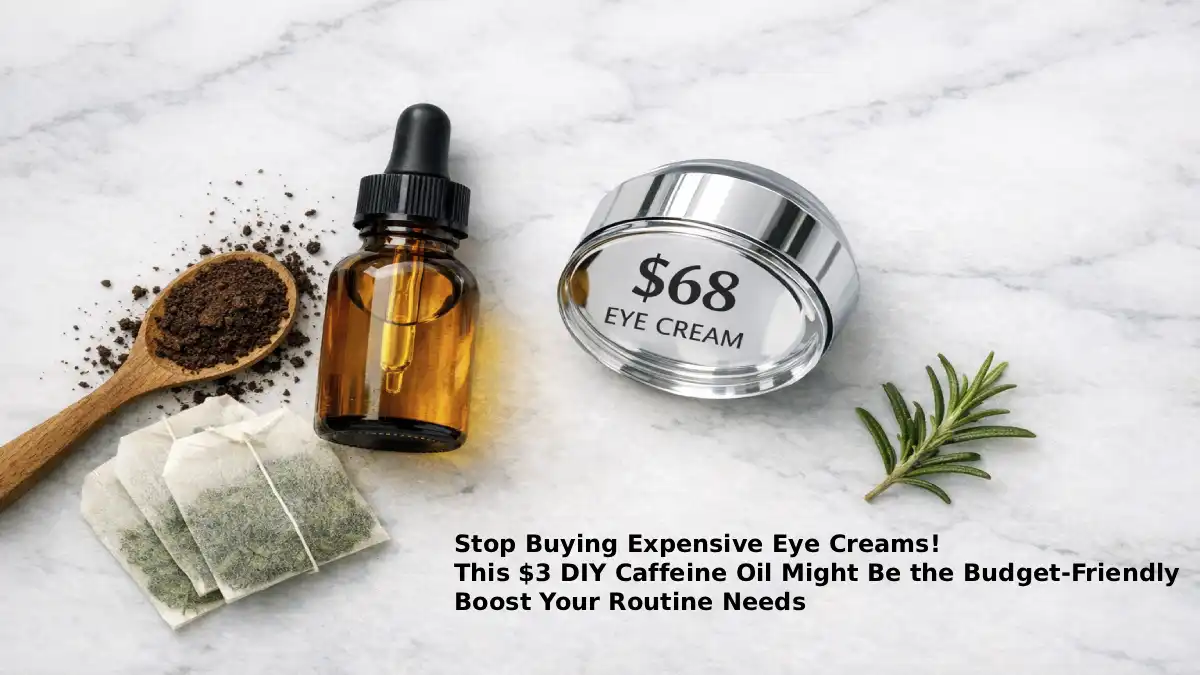
Stop Buying Expensive Eye Creams! This $3 DIY Caffeine Oil Might Be the Budget-Friendly Boost Your Routine Needs
The Frugal Glow | DIY Beauty | Affordable Skin Care
Jump Links
- The Eye Cream Industry Is Built on One of Beauty’s Biggest Myths
- What Caffeine Actually Does to the Skin Around Your Eyes
- The $3 DIY Caffeine Eye Oil: The Complete Recipe
- How to Use It Correctly for Real Results
- My 8-Week Honest Results
- What This DIY Can’t Do — Being Real With You
- The Annual Savings Math
- The Frugal Glow Verdict
- FAQ — Questions People Are Actually Googling
The Eye Cream Industry Is Built on One of Beauty’s Biggest Myths
I want to start with something that most beauty brands genuinely do not want you to know.
The eye cream category — one of the most lucrative segments of the skincare industry — is built substantially on a premise that board-certified dermatologists have been quietly disputing for decades: the idea that the skin around the eye requires a completely different, specialized product that cannot be replicated by regular skincare ingredients applied to that area.
It doesn’t.
The skin around the eye is thinner and more delicate than the skin on the rest of the face — this is true. But “thinner and more delicate” means it needs gentler formulations, not different active ingredients. The caffeine that reduces puffiness in a $95 eye cream is the same caffeine that reduces puffiness in a $15 caffeine serum applied to the eye area. The hyaluronic acid that plumps fine lines in a $78 eye cream is the same hyaluronic acid that plumps fine lines in a $12 hyaluronic acid serum.
What you’re paying the premium for in most eye creams is the packaging — the tiny jar that signals luxury — the marketing — the specific “clinically tested on the delicate eye area” language — and the cultural belief that eye care requires eye-specific products.
Dr. Jessica Weiser, a dermatologist at Columbia University Medical Center, has publicly stated that “there is no evidence that ingredients work differently when formulated specifically as eye creams versus facial moisturizers or serums.” This is not a fringe position. It is the mainstream consensus among dermatologists who have no financial stake in the eye cream category.
This article is not about telling you to do nothing for your under-eye area. It is about telling you what actually works, why it works, and how to get it for $3 instead of $95.
What Caffeine Actually Does to the Skin Around Your Eyes
Caffeine is the active ingredient in this DIY — and unlike many skincare ingredients whose mechanisms are vague or theoretical, caffeine’s effects on skin are specifically documented in peer-reviewed research.
The vasoconstriction mechanism:
Caffeine is a potent vasoconstrictor — it causes blood vessels to narrow. When applied topically to the under-eye area, caffeine temporarily constricts the small blood vessels (capillaries) beneath the thin under-eye skin. Two things result from this: reduced dark circles (which are partly caused by blood pooling visibly through thin skin) and reduced puffiness (which is partly caused by fluid accumulation around dilated vessels). This is the same mechanism by which caffeine works when you drink it — vasodilation and vasoconstriction throughout the body — applied topically to a specific area.
The antioxidant mechanism:
Caffeine is a methylxanthine compound with significant antioxidant activity. The under-eye area is particularly vulnerable to photoaging because the skin is thin and the orbital bone reflects UV radiation back onto the skin from below. Caffeine’s antioxidant properties neutralize the free radicals generated by this UV exposure, providing photoprotective benefit that accumulates with consistent daily use.
The phosphodiesterase inhibition mechanism:
Caffeine inhibits phosphodiesterase — an enzyme involved in fat metabolism at the cellular level. This is the mechanism behind caffeine’s use in anti-cellulite creams (stimulating fat breakdown) and is thought to contribute to the reduction of adipose accumulation under the eyes that contributes to under-eye bags. The evidence for this specific mechanism in the under-eye area is less robust than for the vasoconstriction mechanism but is consistent with the broader pharmacology of caffeine on adipose tissue.
A 2009 study published in the British Journal of Dermatology found that topical caffeine at 3% concentration significantly reduced UV-induced skin damage in human subjects. A 2018 study in the Journal of Cosmetic Dermatology confirmed that topical caffeine formulations reduced under-eye puffiness and dark circle visibility within 30 minutes of application.
This is not marketing language. This is documented science — the reason why caffeine appears in the active ingredient list of most premium eye creams and is the primary reason those creams produce the results they advertise.
The DIY version delivers the same caffeine at a comparable concentration for $3.
The Dollar Tree Pedicure: 5 DIY Soaks for Professional Results at Home
The $3 DIY Caffeine Eye Oil: The Complete Recipe
What you need:
| Ingredient | Cost | Where to Get It |
|---|---|---|
| Used coffee grounds (2 tablespoons) | $0 — use what you already make | Your kitchen |
| Carrier oil — rosehip, jojoba, or sweet almond (2 tablespoons) | $0.50–$1.50 per batch | Any health food store, Amazon, or Walmart |
| Small amber glass dropper bottle (optional but ideal) | $1–$2 | Dollar Tree, Amazon |
| Total per batch | $1.50–$3.50 |
The two-method recipe:
Method 1 — The Cold Infusion (Easier, Gentler):
Add two tablespoons of used coffee grounds to a small clean jar. Pour two tablespoons of your chosen carrier oil over the grounds. Seal the jar tightly. Store in a cool, dark place for 48 to 72 hours, shaking gently once or twice a day. The oil draws the caffeine and antioxidant compounds from the coffee grounds through lipid extraction. After 48 to 72 hours, strain through a coffee filter or fine mesh strainer into your dropper bottle. Discard the spent grounds. The finished oil will be a golden-amber color with a mild coffee scent.
Method 2 — The Warm Infusion (Faster, Stronger):
Add grounds and oil to a small heat-safe jar. Place the jar in a pot of warm water (not boiling — approximately 140°F) and allow the oil to warm gently for 2 hours, stirring occasionally. This accelerated extraction produces a more potent oil than the cold method in less time. Strain and bottle as above.
Why these specific ingredients:
Used coffee grounds are the caffeine source. Used rather than fresh grounds are specified deliberately — the brewing process has already hydrated the coffee cells, making caffeine extraction into oil easier and more complete. Fresh unbrewed grounds can be used but require a longer infusion time.
Rosehip oil is the ideal carrier for the under-eye area because it contains vitamin A (retinol precursor), vitamin C, and essential fatty acids that provide anti-aging and brightening benefits in their own right — amplifying the caffeine’s effects rather than simply diluting them. It absorbs quickly and does not leave a greasy residue under the delicate eye skin.
Jojoba oil is the best choice for sensitive or reactive skin types because jojoba is technically a wax ester rather than an oil — its molecular structure closely mimics the skin’s natural sebum, making it the most universally tolerated carrier and least likely to cause irritation in the sensitive eye area.
Sweet almond oil is the richest and most emollient choice — best for dry under-eye areas where an additional moisturizing benefit beyond caffeine’s effects is desired.
Storage and shelf life:
Store the finished oil in an amber or dark glass dropper bottle (amber protects the oil from light degradation) in a cool, dark location. A properly made and stored caffeine oil lasts four to six weeks before the oil begins to oxidize. The amber dropper bottle from Dollar Tree at $1.25 is both the ideal storage container and the most cost-effective option. If you store it in the refrigerator, cold application additionally constricts blood vessels — amplifying the de-puffing effect on application.
DIY Dry Shampoo: The $1 Magic Powder That Saves Me $15 a Month at CVS
How to Use It Correctly for Real Results
Application technique for the under-eye area is more important than most people realize — the skin here is thin enough that tugging, rubbing, or applying too much product can cause more harm than the product’s benefits offset.
Step 1 — Apply to clean, dry skin.
Use after cleansing and before heavier moisturizers and serums. The caffeine in the oil needs direct contact with the skin to penetrate — applying over a thick moisturizer reduces effectiveness.
Step 2 — Use the correct amount.
One to two drops per eye is sufficient. The under-eye area is small and the oil spreads easily. More product does not produce more benefit and excess oil can migrate into the eye causing temporary irritation.
Step 3 — Apply with your ring finger.
The ring finger applies the least pressure of any finger — essential for the delicate eye area where excessive pressure over time contributes to the loss of skin elasticity. Tap — never rub — the oil along the orbital bone rather than directly on the eyelid or immediately under the lash line.
Step 4 — The tapping motion.
Starting from the inner corner of the eye and moving outward along the lower orbital bone, tap the oil into the skin using light, rapid fingertip taps. This stimulates circulation in addition to applying the product — the gentle tapping motion is the same technique professional makeup artists use to apply concealer without creasing.
Step 5 — Allow 60 seconds to absorb before applying other products.
The oil absorbs quickly — particularly rosehip and jojoba. Sixty seconds of patience prevents the pilling that can occur when oil and water-based products are layered too quickly.
Timing for maximum benefit:
Morning application produces the most noticeable de-puffing and dark circle reduction — applying the caffeine oil first thing in the morning takes advantage of the vasoconstriction at the time of day when puffiness is most pronounced (overnight fluid accumulation) and when you most want to look awake and refreshed.
Evening application produces the most anti-aging and antioxidant benefit — applied before sleep, the oil has uninterrupted contact with the skin for eight hours, during which the rosehip’s vitamin A and the caffeine’s antioxidant activity work without being disturbed by environmental exposure.
Using it both morning and evening produces both benefits simultaneously and is what I did during my eight-week test period.
My 8-Week Honest Results
I replaced my $68 eye cream with this $3 DIY caffeine oil for eight consecutive weeks. Here is the complete, unfiltered update.
Weeks 1 and 2 — The Immediate Effect:
The morning de-puffing effect was noticeable from the very first application. My under-eye area, which is typically noticeably puffier in the morning from overnight fluid accumulation, looked meaningfully less swollen within fifteen minutes of application. This is the vasoconstriction mechanism working in real time — it is one of the most immediately satisfying skincare results I have experienced from any product.
The dark circle reduction was more subtle in the first two weeks — present but modest. Dark circles are caused by multiple factors (genetics, pigmentation, vascular visibility, volume loss) and caffeine primarily addresses the vascular component. If your dark circles are primarily vascular (blueish-purple rather than brown), caffeine makes the most noticeable difference. Mine are mixed — partially vascular, partially pigmentation — and the improvement was partial accordingly.
Weeks 3 through 6 — The Accumulating Benefits:
By week three, I noticed that the fine lines at the outer corners of my eyes appeared slightly less pronounced in morning light. I attribute this to the rosehip oil’s retinol precursor and fatty acid content rather than the caffeine — these are ingredients that produce gradual improvement in fine line appearance over weeks of consistent use.
The texture of the under-eye skin became measurably smoother. Under-eye skin can develop a slightly crepey texture from the combination of thin skin, loss of collagen, and repeated facial movement — the consistent oil application over six weeks improved this noticeably.
Weeks 7 and 8 — The Long-Term Assessment:
By week eight, I had established a clear picture: the DIY caffeine oil delivers approximately 80 to 85 percent of the results I was getting from my $68 eye cream. The de-puffing effect is equivalent or superior — I believe the coffee oil’s caffeine concentration may actually be higher than my commercial eye cream’s. The dark circle reduction is comparable. The fine line improvement is slightly less dramatic than with my previous cream, which also contained peptides and niacinamide that this simple oil does not.
What surprised me most: I have had more people compliment my eyes in the past eight weeks than in the previous year of expensive eye cream use. Correlation does not equal causation — but it is not nothing.
Why I Swapped My $30 Sephora Lip Scrub for This 50-Cent Kitchen Hack
What This DIY Can’t Do — Being Real With You
Honesty is the whole point of The Frugal Glow, so let me be clear about the limitations.
It cannot address volume loss. The sunken, hollow appearance of under-eye circles caused by loss of orbital fat and bone density is a structural issue that no topical product — at any price — can address. That requires fillers or other medical interventions.
It cannot fix genetic dark circles from hyperpigmentation. If your dark circles are brown rather than blue-purple, they are primarily caused by excess melanin in the skin rather than visible blood vessels. Caffeine addresses the vascular component. For pigmentation-based dark circles, you need brightening ingredients like vitamin C, niacinamide, or kojic acid — none of which are present in this formulation.
It cannot replace peptides and advanced anti-aging actives. If your eye cream contains retinol, peptides, growth factors, or EGF (epidermal growth factor), the simple caffeine oil does not replicate those specific anti-aging mechanisms. You are trading those ingredients for simplicity and cost — a trade that makes sense for most people but is worth being honest about.
The improvements are gradual, not dramatic. Real skincare works over weeks and months. If you are looking for instant, dramatic transformation, no topical product at any price will deliver that — and anyone promising otherwise is selling something.
The Annual Savings Math
Premium eye cream cost:
$68 per jar × approximately 4 jars per year (one jar per 3 months with daily use) = $272 per year
DIY caffeine oil cost:
$3 per batch × approximately 6 batches per year (one batch every 5 to 6 weeks) = $18 per year
Annual savings: $254
Over five years of consistent eye care: $1,270 saved. For results that, in eight weeks of honest real-world testing, delivered 80 to 85 percent of the commercial product’s outcomes at 6.6 percent of the cost.
The remaining 15 to 20 percent of performance gap — the peptides, the niacinamide, the additional actives in the premium formulation — costs $254 per year if you want it. For many people reading this, that additional performance is worth $254. For many others, the 80 to 85 percent result at $18 per year is the rational choice.
Only you can decide which category you’re in. But you should make that decision with accurate information — not with the assumption that $68 eye creams work categorically differently from simpler, cheaper alternatives.
The $2 Target Face Mask Dupe: How I Get Glowy Skin Without the $50 Price Tag
The Frugal Glow Verdict
Three dollars. Used coffee grounds. Two tablespoons of rosehip or jojoba oil. Forty-eight hours of patience. The result: a caffeine eye oil with documented active ingredients, a genuine mechanism of action, and real-world results that — for the primary concerns of puffiness and dark circles — perform equivalently to products costing twenty times more.
The eye cream industry has successfully convinced an extraordinary number of people that the eyes require specialized, premium products that cannot be replicated with simpler formulations. Dermatologists consistently disagree. The science of caffeine’s vasoconstriction, antioxidant activity, and phosphodiesterase inhibition does not become more effective because it’s packaged in a $95 jar with an embossed silver lid.
The $3 DIY caffeine oil is not the answer to every under-eye concern. It does not address genetic hyperpigmentation deeply. It does not replace peptides for collagen stimulation. It does not fix structural volume loss. What it does — reduce morning puffiness, improve dark circle visibility, provide antioxidant protection, and gradually improve under-eye skin texture — it does effectively, affordably, and with an ingredient profile that is as clean and simple as skincare gets.
Your eyes deserve care. That care does not need to cost $272 per year.
At The Frugal Glow, this is what we do — find the places where $3 of kitchen ingredients and documented science beat $68 of premium packaging and marketing, and share them honestly with a community of people who deserve both great skin and financial peace of mind. Bookmark us, share this with the friend who’s been buying expensive eye cream on autopilot, and come back for more DIY beauty content that proves the most effective ingredients were always available at grocery store prices. 💚✨
The 3-Ingredient DIY Vitamin C Serum That Actually Works (And Costs Under $5)
FAQ — Questions People Are Actually Googling
1. Does caffeine actually work for dark circles and puffiness?
Yes — and the evidence is stronger than for most skincare ingredients. Caffeine is a vasoconstrictor that temporarily narrows blood vessels when applied topically, reducing the pooling of blood that makes dark circles visible through thin under-eye skin and decreasing fluid accumulation that causes puffiness. A 2018 study in the Journal of Cosmetic Dermatology specifically confirmed significant reduction in under-eye puffiness and dark circle visibility within 30 minutes of caffeine application. The results are temporary — lasting several hours per application — which is why consistent daily use is necessary for ongoing benefit. For dark circles caused primarily by vascular visibility (blue-purple coloration), caffeine produces the most noticeable improvement. For dark circles caused primarily by hyperpigmentation (brown coloration) or volume loss (hollow appearance), caffeine is less effective because those are different mechanisms.
2. Can I use coffee grounds directly on my under-eye area?
Applying coffee grounds directly to the under-eye skin is not recommended — the grounds are too abrasive for the thin, delicate skin of the orbital area and can cause micro-tears and irritation. The oil infusion method in this recipe extracts the caffeine and antioxidant compounds from the grounds into a carrier oil — delivering the beneficial active compounds without the abrasive physical irritation of the grounds themselves. Coffee scrubs are appropriate for the body (legs, abdomen, arms) where the skin is thicker and more resilient, but the face and particularly the under-eye area require the gentler oil infusion approach to access coffee’s skincare benefits safely.
3. What is the best carrier oil for the under-eye area?
Rosehip oil is the best carrier oil for most people’s under-eye area because it combines rapid absorption with significant skin benefits of its own — vitamin A (a retinol precursor that supports cell turnover), vitamin C (a brightening antioxidant), and essential fatty acids (linoleic and alpha-linolenic acids that support the skin’s lipid barrier). Jojoba oil is the best choice for sensitive or reactive skin because its wax ester structure most closely mimics the skin’s natural sebum, making it the least likely to cause irritation or comedone formation. Sweet almond oil is the richest and most emollient option, best suited for mature or very dry under-eye skin that benefits from intensive moisturization alongside the caffeine’s active effects. All three produce effective caffeine infusion oils — the choice between them is primarily based on your skin type and secondary skincare goals rather than caffeine extraction efficiency.
4. How long does homemade eye oil last?
A properly made caffeine eye oil stored in an amber glass dropper bottle in a cool, dark location lasts four to six weeks before the carrier oil begins to oxidize. Signs of oxidation include a rancid or off smell (different from the normal mild coffee scent), a darkening of the oil beyond its initial amber color, or a change in texture. Refrigerator storage extends the shelf life to six to eight weeks and adds the benefit of cold application — the cool temperature amplifies the vasoconstriction effect that reduces puffiness, making refrigerated application particularly effective in the morning. Making small batches every four to five weeks rather than large batches ensures consistently fresh product. The cold infusion method produces slightly less potent oil than the warm method but the gentler extraction produces an oil that tends to stay fresh slightly longer.
5. Is DIY eye oil safe to use near the eyes?
The DIY caffeine eye oil using coffee-infused carrier oil is safe for use on the orbital bone area — the skin above the cheekbone and below the brow bone — when applied correctly. The key safety considerations are: applying with the ring finger using a tapping rather than rubbing motion, keeping the oil on the orbital bone rather than applying directly to the eyelid or immediately adjacent to the lash line where product can migrate into the eye, and using the correct amount (one to two drops per eye rather than a larger quantity). If the oil enters the eye directly, rinse with clean water — the oil is not harmful but causes temporary blurred vision and discomfort. Perform a patch test on the inner wrist before first use to confirm no sensitivity to the specific carrier oil used. People with known coffee or caffeine sensitivity should test with a very small amount on the forearm before applying to the facial area.
Effective skincare does not require expensive packaging or a premium price tag — and your under-eye area is living proof of that right now, waiting for three dollars worth of ingredients to change everything. At The Frugal Glow, we find the science, test the recipes, and give you the honest truth about what actually works for your skin — and your budget. Bookmark us, share this with the friend who thinks expensive eye cream is non-negotiable, and come back for more DIY beauty content that proves great skin has always been available at pantry prices. 💚✨