

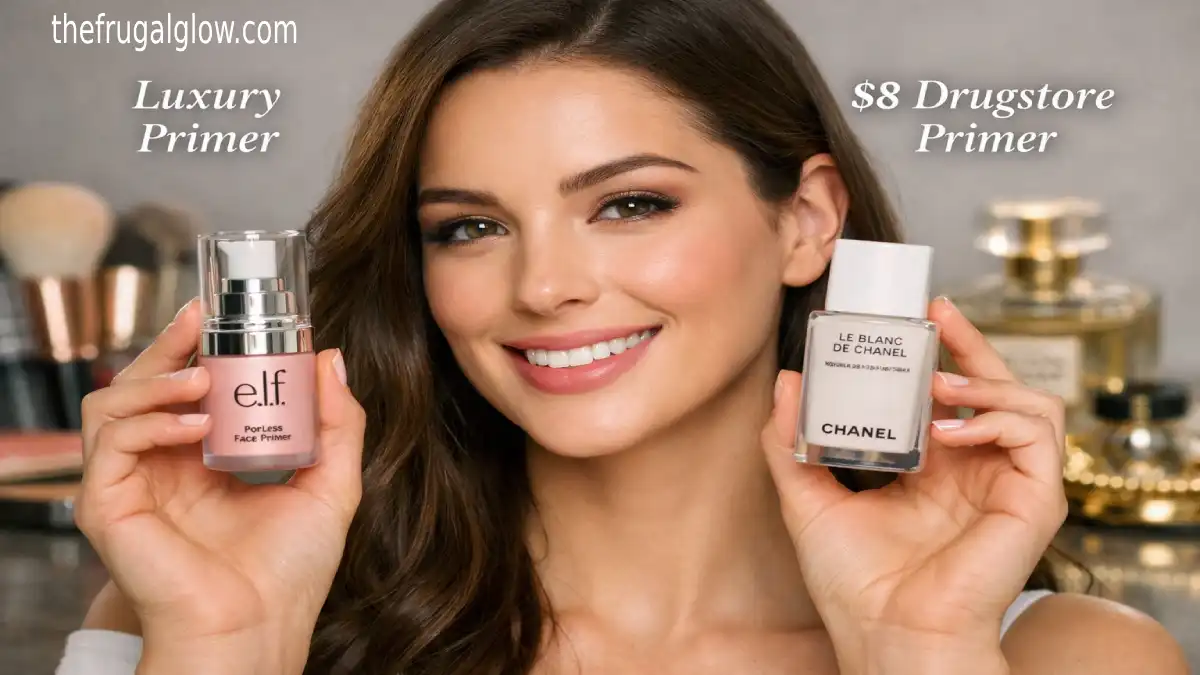
The $8 Drugstore Primers That Fill Pores Better Than High-End Brands
Jump Links
- Why I Stopped Believing Primer Price Tags
- What Experts Actually Say About Pore-Filling Primers
- The Ingredient List Is the Only Thing That Matters
- Silicone-Based vs. Water-Based Primers: Which Fills Pores Better
- What to Look for on a Drugstore Primer Label
- Common Primer Myths Worth Debunking
- How Long Does the Pore-Filling Effect Actually Last?
- How to Apply Primer for Maximum Pore-Filling Effect
- Matching Primer Type to Your Skin Type
- Common Mistakes That Make Pores Look Worse, Not Better
- Who Should Be Cautious With Silicone-Based Primers
- Cost Breakdown: Luxury Primer vs. Drugstore Primer
- The Bottom Line
- FAQ
Why I Stopped Believing Primer Price Tags
I used to think primer was one of those products where you genuinely got what you paid for. My $52 bottle of luxury pore-filling primer sat proudly on my vanity, and I assumed the smooth, blurred finish it gave me was worth every penny of that price tag. Then, purely out of curiosity one day, I actually compared its ingredient list side by side with an $8 drugstore primer sitting in my grocery store’s beauty aisle.
The first five ingredients were nearly identical. Both formulas led with the same silicone compounds doing the actual pore-filling work, listed in almost the exact same order and proportion. The luxury version had a few additional skincare-adjacent extras further down the list, things like antioxidants and a proprietary “glow complex,” but the core mechanism responsible for that smooth, poreless look was coming from the exact same category of ingredient in both bottles, in roughly the same concentration.
That comparison sent me down a genuine rabbit hole of research into how primers actually work, what dermatologists and cosmetic chemists say matters (and doesn’t) when it comes to pore-filling performance, and how to shop smart in the drugstore aisle instead of assuming a bigger price tag automatically means a better result. What I found was honestly a little validating, and also a little frustrating, since it confirmed that a meaningful chunk of what people spend on luxury makeup is going toward branding and packaging rather than functional performance. Here’s everything I found, broken down so you can actually apply it the next time you’re standing in the beauty aisle trying to decide what’s worth your money.
What Experts Actually Say About Pore-Filling Primers
This isn’t just an internet opinion, it’s backed by people who actually formulate and study these products for a living. Cosmetic chemist Krupa Koestline, who has been consulted by major outlets on primer formulation, has pointed to specific ingredient categories, including lightweight silicones, as key players in creating a smooth, calming base that reduces the appearance of shine and texture, regardless of the price tier a product falls into.
Board-certified dermatologists interviewed for consumer beauty coverage have similarly emphasized that primer performance comes down to formulation type rather than brand prestige, a point that’s easy to lose sight of surrounded by glossy packaging and celebrity endorsements on the higher end of the beauty aisle. According to reporting that consulted board-certified dermatologists, makeup artists, and cosmetic chemists together, silicone-based primers work specifically by smoothing texture and blurring the appearance of pores, which is a mechanical, ingredient-driven effect rather than something tied to a particular brand’s research budget or marketing.
This expert consensus lines up with something the beauty industry doesn’t always want to highlight: the “magic” of a great pore-filling primer isn’t proprietary technology locked behind a luxury price point. It’s a well-understood cosmetic chemistry principle available to any brand, drugstore or luxury, willing to formulate with an effective concentration of the right silicone ingredients.
The Ingredient List Is the Only Thing That Matters
Here’s the part that genuinely changed how I shop for primer. The specific silicones responsible for filling and blurring pores, most commonly dimethicone and cyclopentasiloxane, work through simple physical mechanics: they sit in and around the pore opening, creating a smooth, even surface that reflects light more uniformly than the shadowed, uneven surface a visible pore naturally creates. This is a mechanical, physical effect, not a chemical or biological one, which is exactly why it doesn’t require expensive proprietary technology to achieve.
What actually varies between primers, at any price point, is the concentration and quality of these silicone ingredients, along with the supporting formula around them (how well it spreads, how it feels on skin, whether it pills under other products). A well-formulated drugstore primer with a strong concentration of dimethicone near the top of its ingredient list will genuinely outperform a poorly formulated luxury primer that’s diluted the same silicone down with a lot of filler ingredients, regardless of what either bottle costs.
This is also why reading the actual ingredient list matters so much more than trusting packaging claims or price point alone. Ingredients on a product label are legally required to be listed in descending order of concentration, so a primer listing dimethicone or cyclopentasiloxane within the first three to five ingredients is generally going to deliver a more noticeable pore-filling effect than one where those ingredients appear further down the list, buried under water, glycerin, and fragrance. This single labeling rule is arguably the most useful piece of information in this entire guide, since it turns ingredient shopping from guesswork into something you can actually verify yourself in under thirty seconds, standing right there in the aisle.
Silicone-Based vs. Water-Based Primers: Which Fills Pores Better
| Primer Type | Best For | Pore-Filling Effect | Texture Feel |
|---|---|---|---|
| Silicone-based | Oily to combination skin, larger visible pores | Strong, mechanically fills and smooths pore openings | Silky, slightly slip-heavy finish |
| Water-based | Dry, sensitive, or acne-prone skin | Mild, mostly hydration-driven blurring rather than true filling | Lightweight, more breathable finish |
| Hybrid (silicone and water) | Combination skin, those wanting balance | Moderate, blends both mechanisms | Balanced, less heavy than pure silicone |
If pore-filling specifically is your top priority, a silicone-forward formula is generally going to outperform a water-based one, since water-based primers work more through surface hydration and light-diffusing particles than actual pore-filling mechanics. That said, silicone-heavy formulas aren’t automatically the right choice for every skin type, which is covered further down in this guide.
What to Look for on a Drugstore Primer Label
| Look For | Skip or Use Cautiously |
|---|---|
| Dimethicone listed in the first 3-5 ingredients | Primers where silicone appears far down the ingredient list |
| Cyclopentasiloxane or cyclomethicone | Heavy mineral oil or coconut oil if you’re acne-prone |
| “Silicone-based” or “pore-blurring” on the label, paired with a strong ingredient list | Primers relying mainly on marketing language like “pore perfecting” without backing it up in the ingredients |
| A price point under $15, since this range often includes solid silicone formulas | Assuming higher price automatically means higher silicone concentration |
A quick trick that works well in-store: flip the bottle over before you buy. If you don’t recognize dimethicone or a similar silicone compound within the first handful of ingredients, the pore-filling performance is likely to be underwhelming regardless of how the front label markets the product.
Stop Tossing Your ‘Dry’ Mascara! Use This $0 Hack to Make It Brand New
Common Primer Myths Worth Debunking
Beyond the price-versus-quality question, there are a handful of other primer myths worth clearing up, since they influence how people shop and apply this product just as much as price assumptions do.
| Myth | Reality |
|---|---|
| “Primer permanently shrinks pores.” | No topical product permanently shrinks pore size, since pore size is largely determined by genetics and skin structure. Primer creates a temporary, visual blurring and filling effect that lasts through wear time, not a lasting change. |
| “More expensive always means a higher silicone concentration.” | Not necessarily. Price often reflects packaging, marketing, and added extras rather than a meaningfully higher concentration of the actual active pore-filling ingredient. |
| “You need to match your primer brand to your foundation brand.” | What actually matters is matching formula type (silicone-based with silicone-based, water-based with water-based) rather than matching specific brands. |
| “Primer replaces the need for moisturizer or sunscreen.” | Primer is a makeup base product, not a skincare treatment, and shouldn’t be relied on as a substitute for proper skincare underneath. |
| “Oily skin should avoid all silicone-based primers.” | Many silicone-based primers are formulated specifically with oily and combination skin in mind, since they help control shine while providing the strongest pore-filling effect. |
Clearing up these misconceptions matters because they often drive people toward more expensive purchases or incorrect application habits that don’t actually improve results. Understanding what a primer can and can’t realistically do sets more accurate expectations and, frankly, makes it a lot easier to shop confidently in the drugstore aisle instead of assuming you need to spend more to get a genuinely good result.
The $5 ‘Elf’ Hack: How to Get a High-End Glow for the Price of a Latte
How Long Does the Pore-Filling Effect Actually Last?
Another common question worth addressing honestly: how long should you expect that smooth, blurred finish to hold up throughout the day, and does spending more on a primer actually extend that wear time?
| Factor | Impact on Wear Time |
|---|---|
| Silicone concentration | Higher concentrations generally provide a longer-lasting smoothing effect |
| Skin type | Oily skin tends to break down primer formulas faster than dry or normal skin, regardless of price |
| Climate and humidity | Hot, humid conditions can shorten wear time for any primer, luxury or drugstore |
| Application technique | Applying too much product, or skipping the setting time, tends to reduce how long the effect holds up |
| Setting powder use | A light dusting of translucent powder over primer and foundation can meaningfully extend wear time |
The honest answer is that wear time is influenced far more by these formulation and technique factors than by price point alone. A well-formulated, correctly applied $8 primer with proper setting powder on top will often outlast a poorly applied $50 primer, since technique and skin type play at least as large a role as the product itself.
Why I Swapped My $30 Concealer for This $6 ‘Walmart’ Gem (No Creasing!)
How to Apply Primer for Maximum Pore-Filling Effect
- Start with clean, moisturized skin. Apply primer to a fully prepped face, after skincare has had a few minutes to absorb. Applying primer over still-wet or unabsorbed moisturizer can cause pilling.
- Use a small amount. A pea-sized amount is typically enough for the whole face. More product doesn’t create a stronger effect, it just increases the risk of a heavy, greasy finish.
- Focus extra product on larger-pore areas. Most people notice the largest pores around the nose, cheeks, and chin (often called the T-zone and surrounding areas). A slightly heavier layer here helps target where it’s needed most.
- Apply with clean fingertips rather than a brush. The warmth from your fingers helps the silicone melt into skin more evenly, creating a smoother finish than a brush application typically achieves.
- Let it set for 2-3 minutes before applying foundation. This setting time allows the silicone to fully settle into pore openings and create the smoothest possible base, rather than getting immediately disturbed by foundation application.
- Apply foundation with light, patting motions rather than heavy swiping. Dragging a brush or sponge too aggressively across a silicone-primed face can disrupt the smooth base you just created.
Matching Primer Type to Your Skin Type
| Skin Type | Recommended Primer Formula | Why |
|---|---|---|
| Oily, large visible pores | High-concentration silicone-based | Provides the strongest mechanical pore-filling effect and helps control shine |
| Dry, flaky | Hydrating, lightweight silicone or silicone-water hybrid | Pure heavy silicone can emphasize dry patches, so a hydrating base underneath matters |
| Acne-prone, breakout-prone | Water-based or oil-free, non-comedogenic labeled | Heavy silicone concentrations can occasionally trap debris in already-compromised pores |
| Combination | Silicone-water hybrid | Balances pore-filling in oilier zones without over-drying cheeks or other drier areas |
| Mature skin, fine lines | Silicone-based, applied sparingly | Fills fine lines similarly to pores, but heavy application can occasionally settle into deeper lines, so use a light hand |
Common Mistakes That Make Pores Look Worse, Not Better
- Applying too much product. This is the single most common mistake. Excess primer doesn’t create a stronger pore-filling effect, it just increases the risk of pilling and a greasy, heavy finish.
- Skipping the setting time. Applying foundation immediately after primer, without letting it settle for a couple of minutes, can disrupt the smooth silicone layer before it’s had a chance to fully do its job.
- Mixing incompatible formulas. Layering a water-based foundation over a heavy silicone primer (or vice versa) can cause pilling, since oil-based and water-based products don’t always blend smoothly together.
- Choosing based on packaging instead of ingredients. A beautifully packaged primer with a low silicone concentration will underperform compared to a plain, unglamorous drugstore bottle with a stronger formula.
- Using a heavy silicone primer on already clogged or acne-prone skin. This can occasionally worsen breakouts for some skin types, even though it’s not universally the case.
- Rubbing foundation in too aggressively after priming. This can disturb the smooth base layer and undo some of the pore-filling effect you just created.
5 Rhode Lip Treatment Dupes You Can Find at CVS for Under $8
Who Should Be Cautious With Silicone-Based Primers
If you have active acne or are prone to frequent breakouts, dermatologists interviewed on this topic have generally advised looking for lighter formulas and avoiding heavy occlusive ingredients, since these can sometimes trap debris against compromised skin. A water-based or specifically labeled non-comedogenic primer may be a better fit, and it’s worth patch testing any new formula on a small area first before applying it across your entire face.
If you have very dry or flaky skin, a heavy silicone layer can sometimes emphasize texture and flaking rather than smoothing it, since silicone sits on top of skin rather than adding moisture underneath. Make sure your skincare routine includes adequate hydration before applying a silicone-based primer, and consider a hybrid formula instead of a pure heavy-silicone one. Layering a rich moisturizer and giving it several minutes to fully absorb before primer can also help minimize this issue significantly.
If you’ve noticed silicone-based products cause irritation or breakouts for your specific skin in the past, that’s a sign to stick with water-based alternatives regardless of how strong the pore-filling claims are, since individual skin sensitivity varies significantly from person to person. Everyone’s skin barrier responds a little differently, and no amount of expert consensus on a general ingredient category overrides what your own skin has already told you through experience.
Cost Breakdown: Luxury Primer vs. Drugstore Primer
| Primer Type | Average Cost | Core Active Ingredient | Bottle Size (approx.) | Cost Per Use |
|---|---|---|---|---|
| Luxury pore-filling primer | $40-60 | Dimethicone/cyclopentasiloxane | 1 oz | $1.00-$1.50 |
| Mid-range primer | $20-30 | Dimethicone/cyclopentasiloxane | 1 oz | $0.50-$0.75 |
| Drugstore primer (well-formulated) | $6-15 | Dimethicone/cyclopentasiloxane | 1 oz | $0.15-$0.40 |
Since the core active ingredient category is frequently the same across all three price tiers, switching from a luxury primer to a well-chosen drugstore version can save $25-50 per bottle, without necessarily sacrificing the actual pore-filling performance you’re paying for.
The Bottom Line
The pore-filling magic trick that luxury primers charge a premium for isn’t a secret formula, it’s straightforward cosmetic chemistry that’s widely accessible across price points, according to dermatologists and cosmetic chemists who study these formulations professionally. Dimethicone and similar silicones do the actual work, mechanically smoothing and filling pore openings so light reflects more evenly across skin, and that mechanism doesn’t care whether it’s sitting in a $52 bottle or an $8 one. Read the ingredient list, apply a thin layer with a couple of minutes to set, and you can absolutely get that smooth, blurred, poreless look without the luxury price tag. The next time you’re tempted to reach for the pricier bottle out of habit, flip both options over and let the actual ingredient list make the decision for you instead.
For more honest beauty breakdowns that help you spend smarter, check out The Frugal Glow for more budget-friendly product comparisons like this one.
FAQ
Do expensive primers actually work better than drugstore ones?
Not necessarily. Dermatologists and cosmetic chemists have pointed to silicone concentration and formulation quality, not brand or price, as the deciding factor in how well a primer fills and blurs pores.
What ingredient should I look for in a pore-filling primer?
Dimethicone and cyclopentasiloxane are the most common silicones responsible for the pore-filling, blurring effect. Look for these listed within the first several ingredients on the label.
Are silicone-based primers bad for acne-prone skin?
They can be for some people, since heavy silicone layers may occasionally trap debris against compromised skin. Water-based or non-comedogenic-labeled primers are often a safer choice for active breakouts.
How much primer should I actually use?
A pea-sized amount is typically enough for the whole face. Using more doesn’t improve pore-filling performance and increases the risk of a greasy, pilled finish.
Can I mix a silicone primer with any foundation?
Not always seamlessly. Pairing a silicone-based primer with a silicone-based foundation (or a water-based primer with a water-based foundation) tends to reduce the risk of pilling compared to mixing formula types.
Why did my expensive primer and my drugstore primer look almost the same on my skin?
This is common when both products contain a similar concentration of the same active silicone ingredients, since the mechanism responsible for the pore-filling effect is identical regardless of brand.