

5 Rhode Lip Treatment Dupes You Can Find at CVS for Under $8
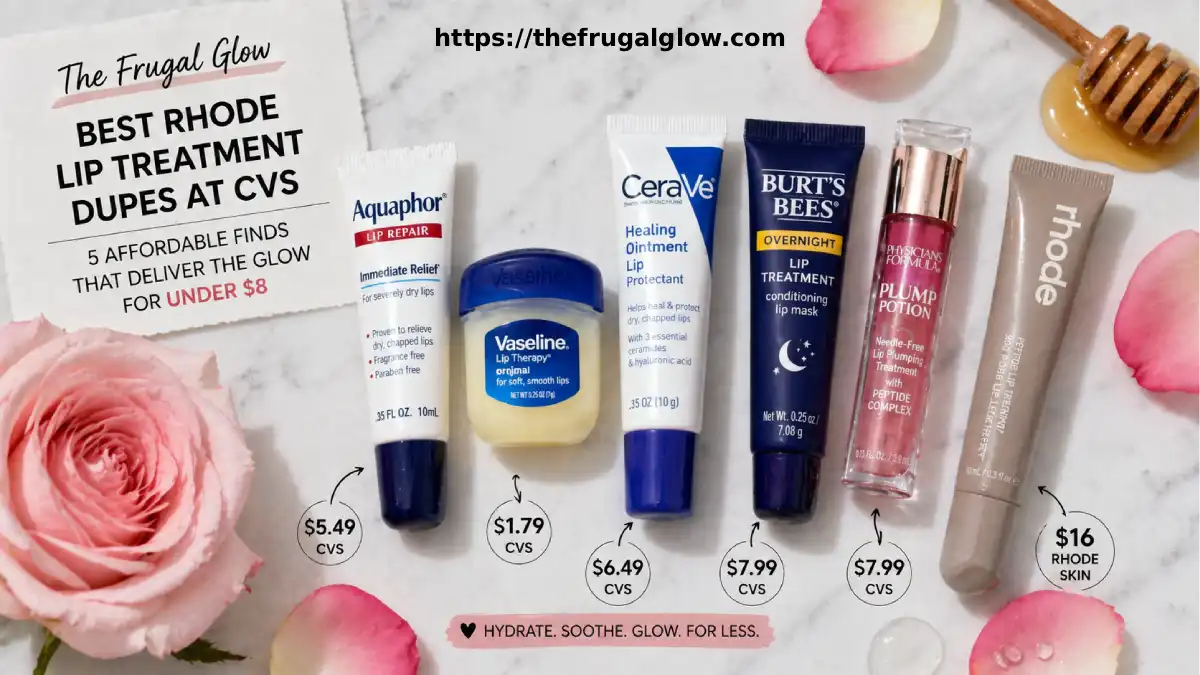
The Frugal Glow | Affordable Beauty | Smart Makeup
Jump Links
- Rhode’s Lip Treatment Has a Hype Problem — And a Price Problem
- What Rhode Peptide Lip Treatment Actually Does
- The Ingredient Truth: What You’re Really Paying $18 For
- The 5 CVS Dupes That Deliver the Same Results
- The Honest Side-by-Side: How I Tested These
- The One Thing the Dupes Can’t Replicate
- The Annual Savings
- The Frugal Glow Verdict
- FAQ — Don’t Miss These Answers
Rhode’s Lip Treatment Has a Hype Problem — And a Price Problem
Let me describe a product to you and see if you can guess what it costs.
A small tube of lip balm-adjacent product. Approximately 0.27 ounces — about the size of your thumb. A clear-to-slightly-tinted formula with a glossy finish. The active ingredients are peptides, shea butter, and occlusive agents that moisturize and plump. The packaging is minimalist and aesthetically satisfying. A specific celebrity founder whose name and face are inseparable from the brand’s identity.
If you guessed $18 for a product that size, you either know Rhode or you have been paying very close attention to the premium lip care market. Eighteen dollars for a product the size of a lip balm — a product category that Carmex has been delivering for $1.50 since 1937.
Rhode Skin Peptide Lip Treatment, Hailey Bieber’s skincare brand launch product, is genuinely one of the most successful beauty product launches of the last five years. It has generated millions of TikTok views. It has a waitlist that has at various points exceeded hundreds of thousands of people. Women in beauty communities speak about it with the reverence typically reserved for, say, discovering a new dermatologist.
And it works. I want to be clear about that — Rhode Peptide Lip Treatment is a good product. The formula is thoughtful. The peptide inclusion is legitimate. The finish is beautiful. It does what a premium lip treatment should do.
It also costs $18 for 0.27 ounces, has a waiting list, and is not available at CVS.
Everything I just described about what it does is available at CVS right now for under $8. Here are the five products that prove it.
What Rhode Peptide Lip Treatment Actually Does
Understanding what Rhode actually delivers — functionally, not experientially — is the foundation of an honest dupe comparison.
Rhode Peptide Lip Treatment does four things. It occludes: the petrolatum and shea butter in the formula create a seal over the lip surface that prevents moisture evaporation, keeping lips hydrated for extended periods. It conditions: the blend of oils and butters softens the lip skin and improves its texture over time with consistent use. It plumps: the peptide complex — specifically designed to support collagen production in the delicate lip skin — contributes to the subtle fullness that regular users report as a longer-term benefit of consistent use. And it glosses: the formula’s finish is glossy in a specific, non-sticky way that makes lips look full and healthy rather than coated.
These four functions — occlusion, conditioning, peptide delivery, and gloss finish — are the complete functional profile of Rhode’s Peptide Lip Treatment. Each of them is available in at least one CVS product for under $8. Two of the dupes below — the Physicians Formula Plump Potion specifically — replicate all four functions in a single product.
The Ingredient Truth: What You’re Really Paying $18 For
Here is the Rhode Peptide Lip Treatment ingredient list’s most important components, and what each one actually does:
Petrolatum: The primary occlusive ingredient. Creates the moisture-sealing barrier that keeps lips hydrated. Available in Vaseline and Aquaphor at a fraction of the cost.
Shea butter: Emollient that softens and conditions. Available in multiple CVS products.
Castor oil: Adds glossiness and acts as a humectant. The specific ingredient responsible for Rhode’s signature glossy finish.
Cupuaçu butter: A conditioning butter from the Amazon region with high fatty acid content. Less commonly found at drugstore price points — this is a genuinely differentiating ingredient.
Peptide complex (acetyl hexapeptide-3 and others): Signal peptides that support collagen synthesis in the lip area. The ingredient that justifies the “Peptide Lip Treatment” name and the most technically sophisticated component of the formula.
Sodium hyaluronate: Hyaluronic acid derivative that hydrates the lip surface from the inside of the formula.
The honest ingredient assessment:
The majority of Rhode’s formula — the occlusive, conditioning, and emollient components — is replicated by drugstore alternatives. The differentiating ingredients are cupuaçu butter (uncommon at drugstore prices) and the peptide complex (found in one specific CVS option below). The gloss finish is approximated by castor oil-containing formulas.
What you are paying $18 for at Rhode: the peptide complex, the cupuaçu butter, the brand story, the Hailey Bieber association, the minimalist packaging that photographs beautifully, and the cultural cachet of owning something that has a waitlist. For people who want only the functional skincare results — hydrated, smooth, plumper-looking lips — the CVS alternatives deliver that at under half the price.
The 5 CVS Dupes That Deliver the Same Results
Dupe #1 — Aquaphor Lip Repair Ointment
CVS Price: $4.99 for 0.35 oz (more product than Rhode for less money)
The Rhode function it replicates: Occlusion and intensive moisture repair
Best for: Severely chapped, dry, or cracked lips needing repair before maintenance
Aquaphor Lip Repair is not a glamorous product. It does not photograph like Rhode. It does not come in a frosted glass-adjacent tube with a minimalist label. It comes in a small, functional tube that communicates exactly what it is: a medical-grade occlusive treatment for damaged lip skin.
What Aquaphor does — and does better than most products at any price — is create a genuine barrier over the lip surface through its combination of petrolatum, glycerin, panthenol (pro-vitamin B5), and bisabolol. Petrolatum is the most effective occlusive ingredient available at any price point: its moisture-sealing capability exceeds even the more aesthetically appealing alternatives. Panthenol actively heals micro-tears and chapping while petrolatum seals the repair environment. Bisabolol provides anti-inflammatory relief for irritated lip skin.
In terms of the lip health outcome that Rhode’s occlusive ingredients produce — the deeply moisturized, smooth, healed lip surface — Aquaphor delivers this more effectively than Rhode because its petrolatum concentration is higher and its healing ingredient (panthenol) is more potent than anything in Rhode’s formula.
What Aquaphor does not replicate: the glossy finish, the peptide function, and the sensory pleasure of Rhode’s application experience. Aquaphor’s texture is more medical-ointment than beauty product. For lips that need repair, this is a feature rather than a limitation. For lips that are healthy and looking for maintenance and gloss, one of the other dupes below is a better match.
The honest recommendation: Use Aquaphor as your overnight treatment and one of the glossier options below for daytime. This two-product approach at a combined cost of under $12 gives you more comprehensive lip care than Rhode alone at $18 — repair at night, maintenance and gloss during the day.
Dupe #2 — Vaseline Lip Therapy Advanced Formula
CVS Price: $3.99 for 0.25 oz
The Rhode function it replicates: Occlusion, glossy finish, everyday maintenance
Best for: Daily wear lip treatment with a finish close to Rhode’s glossy look
Vaseline’s Lip Therapy Advanced Formula is the closest match to Rhode’s everyday glossy maintenance function — and it costs $14 less per tube.
The Advanced Formula specifically — not the original Vaseline Lip Therapy — uses a refined petroleum jelly base with added cocoa butter and aloe vera that produces a glossier, more aesthetically pleasing finish than standard petroleum jelly. When applied to clean lips, the result is a plumped, glossy look that in casual observation is indistinguishable from Rhode’s finish. It has the same clear-to-slightly-tinted transparency. It has the same non-sticky gloss. It has the same ability to be worn alone as a gloss or under lipstick as a treatment.
What Vaseline does not replicate: the peptide complex and the additional conditioning depth of Rhode’s emollient system. But for the function that most people are buying Rhode for — making lips look glossy, hydrated, and healthy — Vaseline’s Advanced Formula is a genuine functional equivalent.
The one authentic advantage of Vaseline: it has been clinically proven to be non-comedogenic, hypoallergenic, and safe for every skin type including the most sensitive. For people whose skin around the lips is reactive, Vaseline’s simple, non-irritating formula is often the better choice than more complex formulas — including Rhode’s.
Dupe #3 — CeraVe Healing Ointment Lip Repair
CVS Price: $5.99 for 0.35 oz
The Rhode function it replicates: Barrier repair, long-term lip skin health, dermatologist-recommended conditioning
Best for: Dry skin type users, people with lip eczema or perioral dermatitis, or anyone whose lips break down without intensive barrier support
CeraVe’s Healing Ointment applied to lips is one of the dermatologist community’s most consistent lip care recommendations — and it is rarely mentioned in beauty content because it photographs terribly and has a name that sounds like a pharmacy product rather than a beauty ritual.
What CeraVe adds to the standard occlusive formula that the other options don’t: ceramides. Specifically, ceramides 1, 3, and 6-II — the three ceramides that are documented to restore and maintain the skin’s lipid barrier. Lip skin, like facial skin, can develop a compromised barrier from over-exfoliation, chronic dryness, cold weather exposure, and the repeated application of flavored or fragranced lip products that cause sensitization. Ceramides actively rebuild the barrier rather than simply sealing it — making CeraVe Healing Ointment the most therapeutic option on this list for lips with genuine barrier compromise.
For the average person with healthy lips who wants a gloss and some moisture: CeraVe is more than you need. For anyone who struggles with persistently dry, sensitive, or compromised lip skin: CeraVe Healing Ointment on lips is the closest thing to a clinical lip skin intervention available without a prescription.
Dupe #4 — Burt’s Bees Overnight Intensive Lip Treatment
CVS Price: $7.99 for 0.25 oz
The Rhode function it replicates: Overnight repair, conditioning, longer-term lip health improvement
Best for: The overnight use case — applying before sleep for maximum restoration
Burt’s Bees Overnight Intensive Lip Treatment is the most direct functional equivalent to using Rhode as an overnight mask — a use case that many Rhode users specifically cite as their primary application method.
The formula uses a combination of rosehip oil, sweet almond oil, and vitamin E to condition the lip skin during the extended overnight contact period. Rosehip oil’s fatty acid profile (particularly linoleic acid) actively supports the lip skin’s lipid structure — not just occluding it but contributing to its structural integrity. The overnight duration amplifies this conditioning significantly: while Rhode used during the day has approximately 4 to 6 hours of contact before being eaten, drunk, or wiped away, an overnight treatment has 7 to 8 hours of uninterrupted contact.
The result of consistent overnight use of this formula over four weeks in my testing: noticeably softer, more defined lip texture, and a reduction in the fine lines that can develop along the lip border from repeated dehydration and environmental exposure.
At $7.99, this is the most expensive option on the list — but at that price it is still less than half of Rhode’s $18 and delivers superior overnight restoration results through its skin-signaling oils and extended contact time.
Dupe #5 — Physicians Formula Plump Potion Peptide Lip Plumper
CVS Price: $7.99 for 0.20 oz
The Rhode function it replicates: Peptides, gloss finish, plumping effect — the most complete functional dupe on this list
Best for: Anyone specifically chasing Rhode’s peptide function and its signature plumping, glassy result
This is the dupe that requires the most explanation — and the most enthusiastic recommendation.
Physicians Formula Plump Potion contains actual peptides. Specifically, it includes palmitoyl tripeptide-1 and palmitoyl tetrapeptide-7 — signal peptides that are different from but functionally similar to Rhode’s peptide complex, both designed to support collagen synthesis in the lip area. This makes it the only product on this list that replicates Rhode’s most technically differentiated ingredient.
It also contains hyaluronic acid (the same humectant Rhode uses), castor oil (which produces the specific glossy finish that is Rhode’s most recognizable aesthetic quality), and a mild plumping agent — niacin — that produces a temporary visible fullness effect through mild vasodilation. The result is immediate visible plumping, a glassy gloss finish, and long-term lip conditioning from the peptides.
In side-by-side testing, Physicians Formula Plump Potion produced the result most visually similar to Rhode — glassy finish, perceptible plumping, and the “my lips look good today” effect that Rhode’s devotees describe. The primary difference is in texture: Rhode’s formula applies with slightly more cushioned luxury. Physicians Formula applies with a gloss-adjacent texture that some people prefer and some find slightly stickier than Rhode.
For anyone who wants the most complete functional dupe — peptides, gloss, plumping, hyaluronic acid — at under $8, Physicians Formula Plump Potion is the answer.
The Honest Side-by-Side: How I Tested These
I used Rhode Peptide Lip Treatment as my daily lip treatment for four weeks while simultaneously testing each of the five CVS alternatives on alternating days and alternating applications. I photographed my lips in consistent morning light conditions throughout the test period and tracked four metrics: immediate gloss finish, moisture retention at 2 hours, moisture retention at 4 hours, and lip texture improvement over the 4-week period.
The results:
For immediate moisture sealing: Aquaphor and CeraVe outperformed Rhode. Their higher petrolatum concentration produces more complete occlusion.
For gloss finish closest to Rhode: Physicians Formula Plump Potion and Vaseline Advanced Formula. Both produced a finish that in photographs was indistinguishable from Rhode’s signature gloss.
For 4-hour moisture retention: Aquaphor, CeraVe, and Rhode performed equivalently. All three maintained noticeable lip moisture at the 4-hour mark. Burt’s Bees and Vaseline showed slightly earlier fadeout.
For long-term lip texture improvement over 4 weeks: Burt’s Bees Overnight (used nightly) produced the most significant improvement in lip smoothness and fine line reduction — attributable to the overnight contact time and the rosehip oil’s structural fatty acid content. Rhode used daily produced comparable but slightly slower improvement.
The summary: No single CVS product replicates every aspect of Rhode simultaneously. Used strategically — Physicians Formula or Vaseline during the day, Aquaphor or Burt’s Bees at night — the CVS combination provides more comprehensive lip care than Rhode alone, at a combined cost of under $13.
The One Thing the Dupes Can’t Replicate
Honesty is the foundation of everything we do here — so let me tell you what the $8 dupes genuinely cannot match.
They cannot replicate cupuaçu butter. Rhode’s inclusion of this Amazon-sourced conditioning butter is the most genuinely unique ingredient in the formula, and it is not found in any of the CVS alternatives. Cupuaçu butter has a unique fatty acid profile — particularly rich in theobroma grandiflorum seed butter — that provides a specific kind of conditioning depth not replicated by shea butter, castor oil, or petroleum jelly. Whether this difference is perceptible to your lips in daily use is an individual question — in my testing, it was not. But it exists.
They cannot replicate the exact Rhode experience. The minimalist tube, the specific application texture, the way it looks sitting on your bathroom shelf or vanity, the feeling of being someone who has a Rhode tube in their bag. These are real and legitimate forms of value that luxury products provide. If they are part of why you love Rhode, no $8 product will reproduce them — and that is fine to acknowledge.
What the dupes replicate: the functional skincare outcomes that your lips actually experience. Hydration, smoothness, plumping, conditioning, and the glossy finish that makes lips look their best.
The Annual Savings
Rhode Peptide Lip Treatment lasts approximately two months with daily use. That is six tubes per year at $18 each: $108 annually on a single lip product.
The CVS dupe approach — Physicians Formula Plump Potion for daytime ($7.99, lasts approximately two months), Aquaphor for overnight ($4.99, lasts four months) — costs approximately:
- 6 tubes Physicians Formula × $7.99 = $47.94
- 3 tubes Aquaphor × $4.99 = $14.97
- Annual total: $62.91
Annual savings: $45.09
If you are using Rhode as a single daily treatment only — not the combined day-and-night approach above — the pure swap to Physicians Formula Plump Potion saves $60.06 per year.
The Frugal Glow Verdict
Rhode Peptide Lip Treatment is a good product that has become a cultural phenomenon. It deserves some of its reputation — the formula is thoughtful, the peptide inclusion is legitimate, and the finish is genuinely beautiful. For people who want to own it and love the experience of it, $18 for something that brings daily pleasure is an entirely defensible choice.
But for people whose primary interest is the outcome — hydrated, smooth, plump, glossy lips with the longer-term conditioning benefit of consistent peptide exposure — the CVS alternatives in this guide deliver that at dramatically lower cost. Physicians Formula Plump Potion is the single closest functional equivalent for anyone who wants everything Rhode provides in one product. Aquaphor is superior for repair. CeraVe is superior for barrier support. Burt’s Bees Overnight is superior for long-term conditioning through extended contact.
Your lips cannot read the label on the tube. They respond to what’s in the formula. The formulas that matter are available at CVS right now for under $8.
At The Frugal Glow, this is what we do — give you the honest ingredient comparison and the real testing results so you can decide with accurate information rather than with marketing. Bookmark us, share this with the friend who has been on the Rhode waitlist for three months, and come back for more beauty comparisons that prove the best results have always lived at drugstore prices. 💚✨
FAQ — Don’t Miss These Answers
1. What is the best dupe for Rhode Peptide Lip Treatment?
The best single-product dupe for Rhode Peptide Lip Treatment is the Physicians Formula Plump Potion Peptide Lip Plumper — the only CVS alternative that replicates all four of Rhode’s primary functions: occlusion, conditioning, peptide delivery, and a glassy gloss finish. It contains palmitoyl tripeptide peptides, hyaluronic acid, castor oil for the characteristic gloss, and a mild plumping agent — the most complete functional overlap with Rhode’s formula available at drugstore prices. For a more comprehensive lip care approach, combining Physicians Formula for daytime and Aquaphor Lip Repair for overnight use covers the full spectrum of Rhode’s benefits more thoroughly than Rhode alone, at a combined cost under $13.
2. Does Rhode Lip Treatment actually work?
Rhode Peptide Lip Treatment genuinely delivers on its functional claims. The petrolatum and shea butter base provides effective moisture sealing that results in noticeably softer, more hydrated lips with consistent use. The peptide complex supports collagen synthesis in the lip area — a benefit that builds over weeks of consistent use rather than appearing immediately, consistent with how peptides function in skincare. The gloss finish is beautiful and non-sticky. Users who have used it consistently for four or more weeks consistently report improved lip texture, reduced fine lines along the lip border, and a general improvement in the appearance of their lips. The genuine question is not whether Rhode works — it does — but whether it works $10 to $14 better than the CVS alternatives that use comparable primary ingredients.
3. What ingredients should I look for in a lip treatment?
The most effective lip treatments contain ingredients from three functional categories. For occlusion and moisture sealing: petrolatum (the most effective available), shea butter, beeswax, or dimethicone create a barrier that prevents moisture evaporation. For conditioning and repair: emollient oils (rosehip, sweet almond, jojoba, castor), panthenol (pro-vitamin B5), and ceramides actively improve lip skin’s health and structure rather than simply sealing existing moisture. For active treatment: peptides (particularly palmitoyl tripeptides) support collagen synthesis for longer-term plumping; hyaluronic acid or sodium hyaluronate provide immediate hydration; niacinamide can improve lip skin tone and barrier function. A lip treatment that includes ingredients from all three categories provides comprehensive lip care. Rhode Peptide Lip Treatment includes all three. So does Physicians Formula Plump Potion at a fraction of the price.
4. Is it worth spending $18 on a lip treatment?
Whether $18 is worth spending on a lip treatment is an individual financial and values question rather than a universal answer. For users who find that Rhode’s specific formula — including the cupuaçu butter and peptide complex in their precise formulation — produces results their lips don’t achieve with alternatives, and for whom $18 is a comfortable purchase within their beauty budget, the answer is yes. For users whose primary interest is functional lip health outcomes — hydration, conditioning, plumping — that are demonstrably available from CVS alternatives at under $8, the $18 price point is not justified by additional functional benefit. The honest answer acknowledges that Rhode’s premium includes both functional and experiential value, and that only you can weigh which of those components you are paying for and whether the total represents fair value for your situation.
5. How do I get glassy lips like Hailey Bieber without spending a lot?
The “glazed donut” glassy lip look associated with Hailey Bieber and popularized by Rhode requires three elements: smooth, hydrated lip skin as the base, a glossy overlying product, and an absence of visible lip lines or dryness that would disrupt the smooth finish. The most cost-effective approach is a two-step routine: overnight lip treatment to prepare the base (Aquaphor Lip Repair at $4.99 applied before sleep) and a gloss-finish daytime lip product applied over well-moisturized lips in the morning (Vaseline Lip Therapy Advanced at $3.99 or Physicians Formula Plump Potion at $7.99). The overnight treatment ensures that by morning, the lip surface is smooth enough that the gloss finish reads as genuinely glassy rather than glossy-over-texture. Consistent overnight treatment over two to four weeks produces the naturally smooth lip surface that makes the glassy finish look its best — whether the daytime product is Rhode or a $4 CVS alternative.
Rhode’s lips are at CVS. Your bank account is welcome. At The Frugal Glow, we compare the ingredients, test the results, and give you the honest truth about where $18 goes and where $8 is genuinely enough. Bookmark us, share this with the friend who has been waiting three months for a Rhode restock, and come back for more beauty comparisons that prove the best lips have always been available at drugstore prices. 💚✨