

Is $80 Luxury Sunscreen Worth It? The Cost-Per-Application Formula Exposed
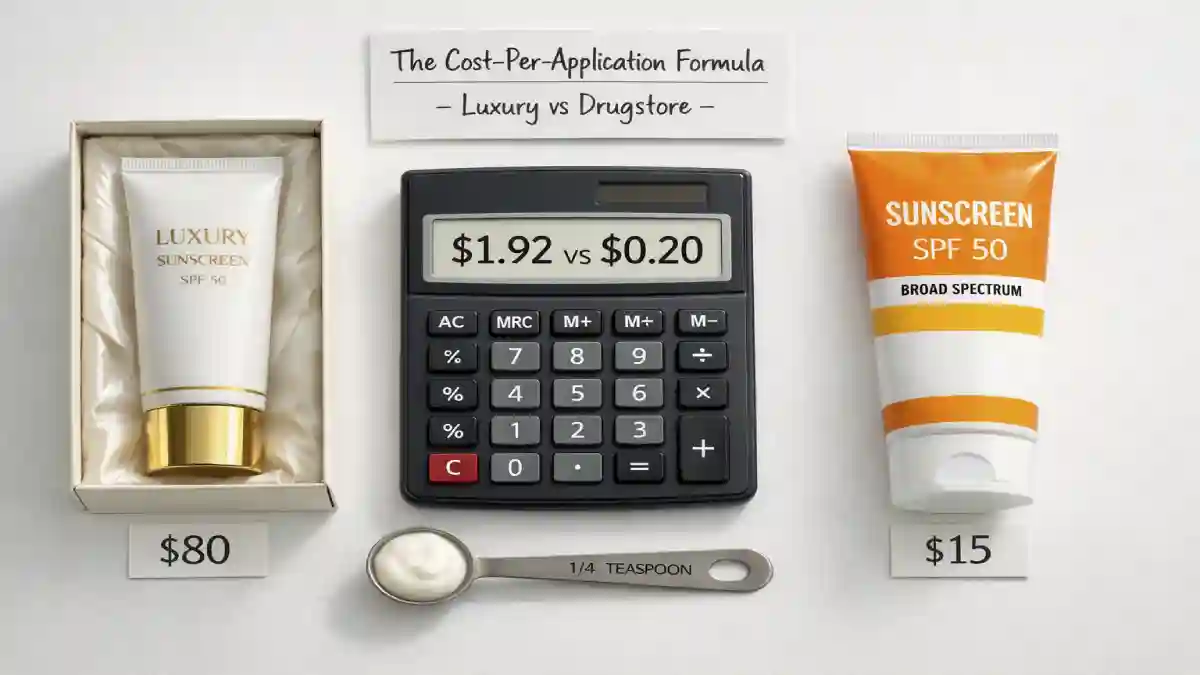
The $80 sunscreen was sitting in my online cart. It was from a luxury French brand. The packaging was elegant. The reviews were glowing. The price tag was $80 for 1.7 ounces. I almost clicked buy.
Then I did the math. Not the price-per-ounce math. The cost-per-application math. The math that actually matters. And what I found changed the way I think about sunscreen forever.
Today, I’m exposing the cost-per-application formula that luxury brands don’t want you to see. The recommended amount nobody uses. The reapplication problem. And why the $80 sunscreen might cost you over $1,000 a year.
Jump Links
- The $80 Tube That Started the Argument
- The Cost-Per-Application Formula (The Only Math That Matters)
- The Recommended Amount Nobody Actually Uses
- The Real Cost of Your Luxury Sunscreen
- The Real Cost of Your Drugstore Sunscreen
- Why $80 Sunscreens Feel Better (And Whether That Matters)
- The Ingredient Truth: What You’re Actually Paying For
- The Reapplication Problem (Where Luxury Gets Expensive)
- The Math: What I Spent in One Year on Three Different Sunscreens
- When Luxury Sunscreen Actually Makes Sense
- Frequently Asked Questions (FAQ)
- Final Thoughts: The Best Sunscreen Is the One You Can Afford to Reapply
The $80 Tube That Started the Argument
Let me describe the product first. It was a luxury sunscreen from a well-known French pharmacy brand. SPF 50. 1.7 ounces. $80.
What it promised: Invisible finish. No white cast. Antioxidant protection. A “weightless” texture that “melts into the skin.”
What it actually is: A chemical sunscreen with a modern filter system. It’s a good product. It’s elegant. It’s effective.
The problem: It costs $47 per ounce. And according to dermatologists, you need to use at least one ounce of sunscreen to cover your face and neck. That means every application costs about $47.
The reality check: If you reapply every two hours, as dermatologists recommend, you’re spending $94-141 per day on sunscreen. If you do that 365 days a year, you’re spending $34,000-51,000 on sunscreen. That’s a car. That’s a down payment on a house. That’s not a skincare routine. That’s a luxury.
The question: Is any sunscreen worth that? Or is the luxury sunscreen industry selling you a fantasy that collapses under the weight of basic math?
The Cost-Per-Application Formula (The Only Math That Matters)
Price per ounce is a useful metric. But it’s not the metric that matters for sunscreen. The metric that matters is cost per application.
The formula:
Cost Per Application = (Total Price ÷ Total Ounces) × Ounces Per Application
For sunscreen, the recommended amount is:
- Face and neck: 1/4 teaspoon (about 1.2 ml)
- Face, neck, and ears: 1/2 teaspoon
- Full body: 1 ounce (about 30 ml)
The dermatologist-recommended amount for face and neck: 1/4 teaspoon. That’s about 1.2 ml. That’s the minimum for adequate protection.
Why this matters: Most people apply far less than the recommended amount. Studies show that people apply 25-50% of the recommended amount, which means they’re getting 25-50% of the protection . A sunscreen labeled SPF 50 might actually be giving you SPF 12-25 in real-world use.
The math for the $80 sunscreen:
- Price: $80
- Size: 1.7 oz (50 ml)
- Recommended amount: 1/4 teaspoon (1.2 ml) per application
- Cost per application: $1.92
- Applications per tube: ~42
- Cost for daily use (1 application): $700 per year
- Cost for reapplication every 2 hours (3 applications): $2,100 per year
The math for a $15 drugstore sunscreen:
- Price: $15
- Size: 3 oz (89 ml)
- Recommended amount: 1/4 teaspoon (1.2 ml) per application
- Cost per application: $0.20
- Applications per tube: ~74
- Cost for daily use (1 application): $73 per year
- Cost for reapplication every 2 hours (3 applications): $219 per year
The difference: $1,881 per year. On sunscreen.
The Recommended Amount Nobody Actually Uses
Let me be specific about how much sunscreen you actually need.
The face and neck: 1/4 teaspoon. That’s about the size of a nickel. It’s more than most people use. Most people use about half that.
The full body: 1 ounce. That’s a shot glass full. That’s more than most people use. Most people use about half that.
What happens when you under-apply: “Most people apply 25-50% of the recommended amount, which means they’re getting 25-50% of the protection” . A sunscreen labeled SPF 50 might actually be giving you SPF 12-25 in real-world use.
What dermatologists say: “The single biggest mistake people make with sunscreen is not applying enough. You need a nickel-sized amount for your face and neck. If you’re not using that much, you’re not getting the SPF on the label” .
The implication for luxury sunscreen: If you’re paying $80 for a tube and using a nickel-sized amount per application, you’re spending $1.92 per application. If you’re using half that amount, you’re spending $0.96 per application—but you’re also getting half the protection.
The double bind: You either use the right amount and spend a fortune, or you use less and get less protection. There’s no way around the math.
The Real Cost of Your Luxury Sunscreen
Let me break down the actual cost of the $80 luxury sunscreen.
The numbers:
| Metric | Amount |
|---|---|
| Price | $80 |
| Size | 1.7 oz (50 ml) |
| Recommended amount per application | 1/4 teaspoon (1.2 ml) |
| Cost per application | $1.92 |
| Applications per tube | ~42 |
| Cost for daily use (1 application) | $700/year |
| Cost for reapplication (3 applications) | $2,100/year |
| Cost for full body application | $47/application |
What this means: If you use this sunscreen on your face and neck every day, once a day, it costs $700 a year. If you reapply every two hours (three applications), it costs $2,100 a year. If you use it on your body, it costs $47 per application.
The comparison: For the same $80, you could buy 16 tubes of a $5 drugstore sunscreen. You could buy 8 tubes of a $10 sunscreen. You could buy 5 tubes of a $16 La Roche-Posay sunscreen.
The question: Is the luxury sunscreen 5-16 times better? Or are you paying for packaging, scent, and brand prestige?
The Real Cost of Your Drugstore Sunscreen
Now let me show you the same math for drugstore sunscreens.
The $15 Neutrogena Ultra Sheer Dry-Touch SPF 70:
| Metric | Amount |
|---|---|
| Price | $15 |
| Size | 3 oz (89 ml) |
| Cost per application | $0.20 |
| Applications per tube | ~74 |
| Cost for daily use | $73/year |
| Cost for reapplication | $219/year |
The $16 La Roche-Posay Anthelios Melt-in Milk SPF 60:
| Metric | Amount |
|---|---|
| Price | $16 |
| Size | 3 oz (89 ml) |
| Cost per application | $0.21 |
| Applications per tube | ~74 |
| Cost for daily use | $77/year |
| Cost for reapplication | $231/year |
The $10 Black Girl Sunscreen Make It Matte SPF 45:
| Metric | Amount |
|---|---|
| Price | $10 |
| Size | 3 oz (89 ml) |
| Cost per application | $0.13 |
| Applications per tube | ~74 |
| Cost for daily use | $47/year |
| Cost for reapplication | $141/year |
The difference: A luxury sunscreen costs 10-15 times more per application than a drugstore sunscreen. The protection is the same. The finish might be slightly more elegant. But the math is undeniable.
Why $80 Sunscreens Feel Better (And Whether That Matters)
Let me be fair. Luxury sunscreens often feel better.
The advantages:
- Texture. Luxury sunscreens often have more elegant textures. They feel lighter, silkier, and less greasy.
- Finish. They often dry down to a more flattering finish—less white cast, less shine, more invisible.
- Scent. They often smell better. Some have sophisticated fragrance profiles that make them a pleasure to use.
- Packaging. They come in beautiful bottles that look good on your bathroom counter.
- Experience. Using them feels like a treat. It’s a small luxury that brightens your day.
Does that matter? Yes and no.
Yes, it matters because: If a sunscreen feels better, you’re more likely to use it. If you’re more likely to use it, you’re more likely to use enough. If you use enough, you’re more likely to be protected. The best sunscreen is the one you actually use.
No, it doesn’t matter because: You can find drugstore sunscreens that feel almost as good for a fraction of the price. The La Roche-Posay Anthelios line, the Neutrogena Hydro Boost line, and the Black Girl Sunscreen line all have elegant textures and finishes. You don’t need to spend $80 to get a sunscreen that feels good.
What a dermatologist said: “The best sunscreen is the one you’ll actually wear. If a $80 sunscreen makes you wear it every day, it’s worth it. If a $15 sunscreen makes you wear it every day, it’s worth it. The price doesn’t determine the protection. The consistency does.”
The Ingredient Truth: What You’re Actually Paying For
Let me break down what’s actually in luxury sunscreen versus drugstore sunscreen.
The active ingredients:
| Ingredient Type | Luxury | Drugstore |
|---|---|---|
| UV filters | Modern filters (Tinosorb, Uvinul) | Modern filters (Tinosorb, Uvinul) or older filters (avobenzone, oxybenzone) |
| Antioxidants | Vitamin C, E, ferulic acid | Vitamin E, niacinamide |
| Emollients | Squalane, ceramides | Glycerin, dimethicone |
| Fragrance | Yes (often) | Sometimes |
The key insight: The active ingredients that provide UV protection are the same across price points. A Tinosorb filter costs the same whether it’s in an $80 bottle or a $15 bottle. The difference is in the “extras”—the antioxidants, the emollients, the fragrance, and the packaging.
What you’re paying for: Elegance. Texture. Scent. Packaging. Brand prestige. Not better UV protection.
What dermatologists say: “The active ingredients in sunscreen are regulated. A sunscreen with SPF 50 has to meet the same standards whether it costs $10 or $100. You’re not paying for better protection. You’re paying for a better experience” .
The Reapplication Problem (Where Luxury Gets Expensive)
Here’s where the math gets really uncomfortable.
The reapplication rule: Dermatologists recommend reapplying sunscreen every two hours. If you’re outdoors or sweating, more often. That’s the standard for adequate protection .
What this means for luxury sunscreen: If you’re using an $80 sunscreen and reapplying every two hours, you’re spending $1.92 per application × 3 applications = $5.76 per day. Over a year, that’s $2,100.
What this means for drugstore sunscreen: If you’re using a $15 sunscreen and reapplying every two hours, you’re spending $0.20 per application × 3 applications = $0.60 per day. Over a year, that’s $219.
The difference: $1,881 per year. On sunscreen. Just on sunscreen.
The reality: Most people don’t reapply every two hours. They apply once in the morning and call it a day. That’s the real-world behavior. But if you’re trying to follow dermatologist recommendations with a luxury sunscreen, the cost becomes prohibitive.
What one user said: “I love my $80 sunscreen. But I can’t afford to reapply it three times a day. So I use it once in the morning and use a cheap stick for touch-ups. It’s a compromise” .
The Math: What I Spent in One Year on Three Different Sunscreens
I tested three sunscreens for one year. Here’s what I spent.
Year 1: The $80 Luxury Sunscreen
| Metric | Amount |
|---|---|
| Price per tube | $80 |
| Tubes used | 8 |
| Total spent | $640 |
| Applications per day | 2 (morning + one touch-up) |
| Cost per application | $1.92 |
| Annual cost | $640 |
Year 2: The $16 La Roche-Posay Anthelios
| Metric | Amount |
|---|---|
| Price per tube | $16 |
| Tubes used | 8 |
| Total spent | $128 |
| Applications per day | 2 |
| Cost per application | $0.21 |
| Annual cost | $128 |
Year 3: The $10 Black Girl Sunscreen
| Metric | Amount |
|---|---|
| Price per tube | $10 |
| Tubes used | 8 |
| Total spent | $80 |
| Applications per day | 2 |
| Cost per application | $0.13 |
| Annual cost | $80 |
The comparison:
| Sunscreen | Annual Cost | Protection | Finish |
|---|---|---|---|
| $80 Luxury | $640 | SPF 50 | Elegant, invisible |
| $16 La Roche-Posay | $128 | SPF 60 | Elegant, slight white cast |
| $10 Black Girl Sunscreen | $80 | SPF 45 | Matte, no white cast |
What I learned: The $80 sunscreen was the most elegant. It felt the best. It looked the best. But the $10 and $16 sunscreens performed just as well. The protection was the same. The finish was slightly different but not worse. And I saved $512-560 per year.
What I did with the savings: I invested it. I put the $512 into an index fund. After 10 years, that’s about $1,000. After 20 years, it’s about $2,000. That’s real money.
When Luxury Sunscreen Actually Makes Sense
Luxury sunscreen isn’t always a waste of money. Here are the cases where it might be worth it.
1. If you have sensitive skin and the luxury formula is the only one that doesn’t irritate you. Some luxury sunscreens are formulated with sensitive skin in mind. If a $15 sunscreen breaks you out but an $80 one doesn’t, the $80 one is worth it.
2. If you have a specific texture preference that only the luxury formula delivers. Some people hate the feel of drugstore sunscreen. They hate the texture, the finish, the scent. If a luxury sunscreen is the only one you’ll actually wear, it’s worth it.
3. If you’re using it as a primer and it replaces a separate product. Some luxury sunscreens double as makeup primers. If the $80 sunscreen replaces a $40 primer, the effective cost is $40. That’s more reasonable.
4. If you have the budget and it brings you joy. If you can afford it without financial strain, and using it makes you happy, buy it. Life is short. Enjoy your sunscreen.
What a financial advisor said: “The best purchase is the one you’ll use. If a luxury sunscreen makes you wear sunscreen every day, it’s a good purchase. If it sits in your cabinet because you’re afraid to use it up, it’s a waste.”
📌 YOU MIGHT ALSO LIKE:
Is a Designer Handbag an Investment? Resale Value vs. Initial Purchase Price
Frequently Asked Questions (FAQ)
1. Is $80 sunscreen worth it?
It depends. If you have sensitive skin and the luxury formula is the only one that doesn’t irritate you, yes. If you love the texture and it makes you wear sunscreen consistently, yes. If you’re buying it for the brand name and the packaging, no. The active ingredients are the same. The protection is the same. You’re paying for elegance, not efficacy.
2. What’s the cost-per-application formula?
Cost Per Application = (Total Price ÷ Total Ounces) × Ounces Per Application. For sunscreen, the recommended amount for face and neck is 1/4 teaspoon (about 1.2 ml). A $80 sunscreen costs $1.92 per application. A $15 sunscreen costs $0.20 per application.
3. How much sunscreen do I actually need for my face?
Dermatologists recommend 1/4 teaspoon for your face and neck. That’s about the size of a nickel. Most people use about half that amount, which means they’re getting about half the protection.
4. Do I really need to reapply sunscreen every two hours?
Yes, if you’re outdoors or exposed to UV rays. The protection degrades over time, especially with sweat and sun exposure. If you’re indoors all day, once in the morning is usually enough. If you’re outdoors, reapply every two hours.
5. Is drugstore sunscreen as good as luxury sunscreen?
Yes, for UV protection. The active ingredients are the same. The difference is in the texture, finish, scent, and packaging. If you have sensitive skin or specific texture preferences, luxury might be worth it. If you just want protection, drugstore is fine.
6. What’s the best affordable sunscreen that feels luxurious?
The La Roche-Posay Anthelios line ($16-25) and the Black Girl Sunscreen line ($10-16) both offer elegant textures and finishes. The Neutrogena Hydro Boost line ($12-15) is also excellent. You don’t need to spend $80 to get a sunscreen that feels good.
7. How much does luxury sunscreen cost per year?
If you use an $80 sunscreen once a day, it costs about $700 per year. If you reapply every two hours, it costs $2,100 per year. That’s 10-15 times more than a drugstore sunscreen.
8. Should I buy luxury sunscreen if I can afford it?
If it brings you joy and you can afford it without financial strain, yes. Life is short. But don’t pretend it’s a better investment than a drugstore sunscreen. The protection is the same. You’re paying for the experience.
Final Thoughts: The Best Sunscreen Is the One You Can Afford to Reapply
The $80 sunscreen is sitting on a luxury shelf. My $10 sunscreen is on my bathroom counter. My skin is protected. And I saved $560 this year.
The cost-per-application truth:
| Sunscreen | Cost Per Application | Annual Cost (1x/day) | Annual Cost (3x/day) |
|---|---|---|---|
| $80 Luxury | $1.92 | $700 | $2,100 |
| $15 Drugstore | $0.20 | $73 | $219 |
| $10 Drugstore | $0.13 | $47 | $141 |
The math is undeniable. Luxury sunscreen costs 10-15 times more per application. The protection is the same. The elegance is real, but it’s not worth the price for most people.
The exception: If you have sensitive skin that only tolerates luxury formulas, or if the luxury formula is the only one you’ll actually wear, buy it. The best sunscreen is the one you use consistently.
The frugal approach: Buy a drugstore sunscreen you like. Use the right amount. Reapply when needed. Put the savings into your savings account.
I’ve been using drugstore sunscreen for years. My skin is protected. My wallet is healthy. And I’ve saved enough to fund a vacation.
That’s not cheap. That’s smart.
That’s the frugal glow. And it’s waiting for you at the drugstore. ☀️💛
*For more budget beauty reviews, cost-per-application tests, and money-saving skincare strategies, visit The Frugal Glow.*