

Is a Designer Handbag an Investment? Resale Value vs. Initial Purchase Price
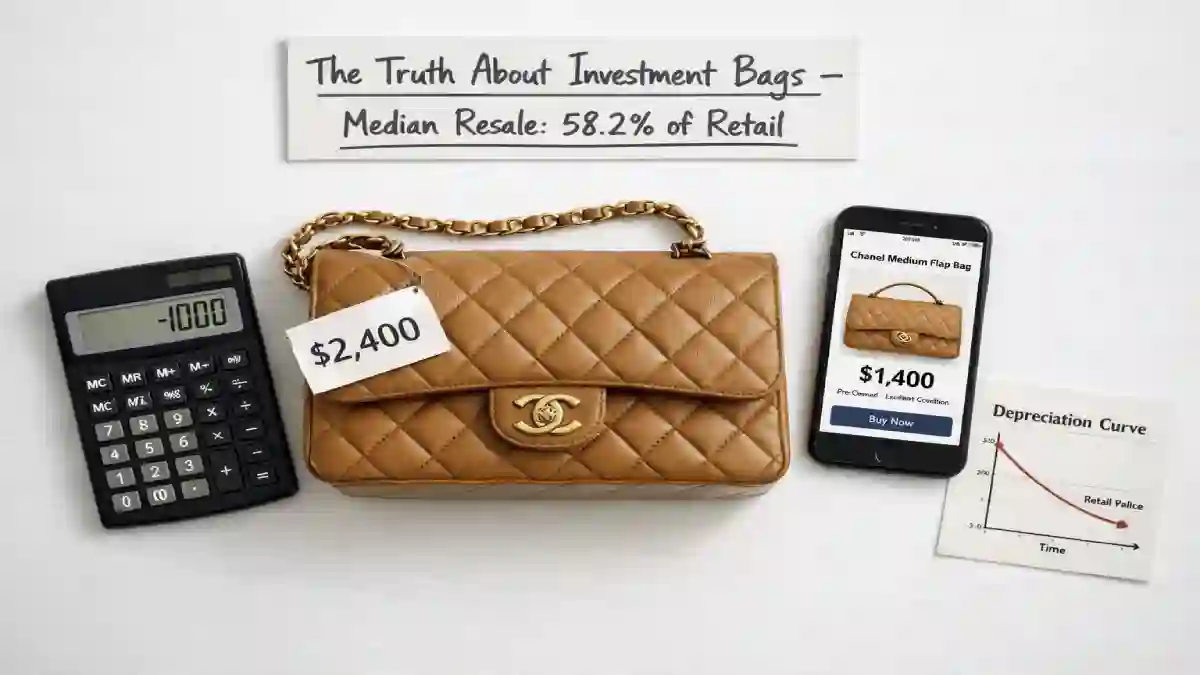
The $2,400 handbag was sitting in my online cart. A Chanel Classic Flap in black caviar leather. The listing said “investment piece.” The reviews said “holds its value.” The forums said “you can always sell it for what you paid.”
I almost clicked buy. Then I did something most buyers never do. I looked up the actual resale data. Not the marketing claims. Not the influencer talking points. The real numbers from thousands of completed resale transactions.
The median pre-owned designer bag asks just 58.2% of its original retail price. That means the typical bag loses over 40% of its value the moment you take it home. The “investment” narrative is a marketing strategy designed to make you feel smart about spending thousands of dollars on a depreciating asset.
But there’s a sliver of the market where certain bags do appreciate. And understanding that sliver is the difference between buying an asset and buying an expensive accessory.
This is the honest breakdown of whether a designer handbag is actually an investment.
Jump Links
- The “Investment Bag” Myth (And Who Started It)
- The Brutal Reality: What Most Bags Actually Do
- The Math Nobody Does: Retail Price vs. Resale Price
- The Exceptions: The Bags That Actually Hold Value
- Hermès: The Only True Investment (And Why You Can’t Buy One)
- Chanel: The Self-Fulfilling Prophecy
- Goyard: The Quiet Outperformer
- The Unicorns: The Row and Miu Miu
- The Costs Nobody Counts
- The Deflating Bubble: What’s Happening in 2026
- What You’re Actually Paying For
- The Honest Verdict
- The Math: What I Learned by Testing the Theory
- Frequently Asked Questions (FAQ)
- Final Thoughts: A Bag Is a Bag, Not a Portfolio
The “Investment Bag” Myth (And Who Started It)
The idea that a handbag can be an investment didn’t come from financial advisors. It came from the fashion industry.
The origin story: In the 2010s, as luxury prices began climbing aggressively, brands and their marketing teams needed a new way to justify the cost. “Investment piece” became the phrase. It reframed a $2,000 purchase as a “smart financial decision” rather than a discretionary splurge.
The media amplification: Publications ran headlines like “The Birkins That Appreciate More Than Gold” and “Why Designer Bags Are Better Than Stocks.” These stories were compelling. They were also misleading. They cherry-picked the top 1% of the market and applied its performance to the entire category.
The influencer machine: Social media creators, often with affiliate partnerships to luxury retailers, promoted the “investment” angle. It made their expensive purchases seem rational. It made their audiences feel like they were learning a financial hack rather than being marketed to.
The reality: A 2025 analysis of 39,462 pre-owned designer handbag listings found that the median bag retains just 58.2% of its original retail price. That’s not an investment. That’s a depreciating asset with a luxury label.
What a former luxury resale buyer told me: “The brands love the investment narrative. It makes customers feel smart. But the only people who actually make money on bags are the brands themselves. Everyone else loses value the moment they walk out of the store.”
The Brutal Reality: What Most Bags Actually Do
Let me be specific about the numbers. Because generic warnings don’t change behavior. Data does.
The median bag: 58.2% of retail on resale. A $2,000 bag becomes a $1,164 bag the moment you walk out of the boutique.
The worst performers:
| Brand | Median Resale Value Retention |
|---|---|
| Chloé | 34.1% |
| Valentino | 42.0% |
| Bottega Veneta | 45.1% |
| Balenciaga | 47.8% |
| Saint Laurent | 52.3% |
| Prada | 55.6% |
These aren’t investments. They’re liabilities with leather straps. A $2,500 Chloé bag that resells for $850 represents a $1,650 loss. That’s a 66% depreciation rate. That’s worse than driving a new car off the lot.
The broader category: Most contemporary designer clothing resells for 15-30% of retail. Some pieces resell for less than the tax you paid. Handbags perform better than clothing, but the principle is the same: you’re buying a consumption good, not a financial asset.
The reality check: If you buy a $2,000 bag, use it for three years, and sell it, you’ll be lucky to get $700. That’s a $1,300 loss. That’s the cost of ownership. It’s the truth the “investment bag” narrative conveniently ignores.
What one resale expert said: “The median bag isn’t an investment. It’s a beautiful object that loses value the moment you buy it. That doesn’t mean you shouldn’t buy it. It just means you shouldn’t lie to yourself about what it is.”
The Math Nobody Does: Retail Price vs. Resale Price
Let me show you the actual math for five common designer bags.
The Chanel Classic Flap (Medium)
| Metric | Amount |
|---|---|
| Retail price (2025) | $10,800 |
| Median resale price | $9,200 |
| Resale value retention | 85.2% |
| Dollar loss | $1,600 |
| Percentage loss | 14.8% |
Chanel performs better than most because Chanel raises its retail prices almost every year. But you’re still losing money.
The Louis Vuitton Neverfull MM
| Metric | Amount |
|---|---|
| Retail price (2025) | $2,030 |
| Median resale price | $1,350 |
| Resale value retention | 66.5% |
| Dollar loss | $680 |
| Percentage loss | 33.5% |
Louis Vuitton’s monogram canvas holds value better than leather, but it’s still a depreciating asset.
The Gucci GG Marmont (Small)
| Metric | Amount |
|---|---|
| Retail price (2025) | $2,290 |
| Median resale price | $1,180 |
| Resale value retention | 51.5% |
| Dollar loss | $1,110 |
| Percentage loss | 48.5% |
Gucci’s trend-driven designs depreciate faster than classics.
The Prada Re-Edition 2005
| Metric | Amount |
|---|---|
| Retail price (2025) | $1,850 |
| Median resale price | $1,030 |
| Resale value retention | 55.7% |
| Dollar loss | $820 |
| Percentage loss | 44.3% |
Prada’s nylon bags hold value better than leather, but the trend cycle still erodes value.
The Hermès Birkin 25
| Metric | Amount |
|---|---|
| Retail price (2025) | $13,500 |
| Median resale price | $28,000 |
| Resale value retention | 207% |
| Dollar gain | $14,500 |
| Percentage gain | 107% |
The Birkin is the exception. It’s also the only bag on this list that actually appreciates. And it’s the only bag on this list you can’t simply walk into a store and buy.
The pattern: Every bag except the Birkin loses value. Some lose 15%. Some lose 50%. But they all lose. The “investment” narrative is a marketing tool, not a financial reality.
The Exceptions: The Bags That Actually Hold Value
There is a short list of bags that consistently outperform the market. And the reason isn’t design genius. It’s supply discipline.
The common thread: Every bag that holds value shares three characteristics:
- Controlled supply. The brand rations production and doesn’t discount.
- Price increases. The brand raises retail prices regularly, which drags the resale market up.
- Timeless design. The bag doesn’t change season to season. It’s the same bag year after year.
The brands that fit this profile:
- Hermès: The benchmark. Birkins and Kellys are the only bags that reliably appreciate.
- Chanel: Raises prices annually. Classic Flaps hold value because retail prices keep climbing.
- Goyard: Refuses to discount. Limited distribution. High retention.
- The Row: Recent unicorn. Driven by the “quiet luxury” trend.
- Miu Miu: Recent unicorn. Driven by current cultural momentum.
The brands that don’t:
- Chloé: Trend-driven. Discounts regularly. Lowest retention.
- Valentino: Trend-driven. Discounts regularly.
- Bottega Veneta: Recent creative turnover has hurt resale value.
- Balenciaga: Trend-driven. Cultural controversies have hurt demand.
- Saint Laurent: Better than most, but still depreciates.
What a luxury resale analyst told me: “The bags that hold value are the ones the brand deliberately restricts. Hermès rations Birkins. Chanel raises prices. Goyard doesn’t discount. Everyone else is competing on trends, and trends fade.”
Hermès: The Only True Investment (And Why You Can’t Buy One)
Hermès is the only brand where handbags consistently appreciate. And it’s the only brand where you can’t simply walk in and buy one.
The numbers: Hermès Birkin bags have appreciated 92% on the resale market over the past decade, more than double Hermès’ own retail price growth of 43%. In 2025, Hermès achieved an average value retention of 138% across eight of its styles.
The standouts:
| Style | Value Retention |
|---|---|
| Kelly Mini II | 282% |
| Sellier Birkin | 183% |
| Constance | 137% |
The catch: You cannot buy a Birkin or Kelly by walking into an Hermès boutique. The company rations them. Buyers must build a purchase history—often spending tens of thousands of dollars on other Hermès products—before being offered the opportunity to buy one.
What this means: The “investment” is only accessible to people who are already spending enormous amounts at Hermès. For the average buyer, the Birkin isn’t an investment option. It’s a closed door.
What one Hermès client said: “I spent $40,000 at Hermès over three years before I was offered my first Birkin. The ‘investment’ isn’t the bag. It’s the relationship.”
Chanel: The Self-Fulfilling Prophecy
Chanel is the second-best performer in the resale market. And the reason is simple: Chanel keeps raising prices.
The price history: A Chanel Classic Flap that cost $2,850 in 2010 now retails for $10,800. That’s a 279% increase in 15 years. The bag didn’t change. The price did.
The resale effect: Well-preserved Classic Flaps can resell for up to 95% of their original value. In rare colors or limited editions, prices can climb to $16,000 or more.
The reality: The “investment” here is an illusion for most buyers. You’re not buying a bag that appreciates. You’re buying a bag whose retail price keeps rising, which drags the resale market up behind it. If Chanel stopped raising prices tomorrow, the resale premium would evaporate.
What one Chanel collector said: “I bought my first Classic Flap for $4,500 in 2015. It’s now worth $9,000 on resale. But I’ve also watched Chanel raise prices 10 times since then. The bag didn’t get better. The price did.”
Goyard: The Quiet Outperformer
Goyard is the highest retention rate of any brand measured. And most people have never heard of it.
The numbers: Goyard holds 74.5% of original retail on the median resale listing. That’s the highest retention of any brand outside Hermès.
The reason: Goyard controls supply tightly. The brand has limited distribution, refuses to discount, and maintains long-running models with stable reference prices. The Saint Louis Tote has been the same design for decades. The brand doesn’t chase trends.
What one Goyard owner said: “I bought the Saint Louis Tote for $1,200 in 2020. I could sell it for $900 today. That’s better than almost any other bag. And I used it every day.”
The Unicorns: The Row and Miu Miu
Two brands entered the “unicorn” category in 2025—bags that resell for at or above retail.
The Row: Handbags reselling at 97% of retail value. Driven by the “quiet luxury” trend and the brand’s minimalist aesthetic.
Miu Miu: Handbags reselling at 104% of retail value. Driven by the brand’s current creative direction and cultural momentum.
The caution: These are trend-driven, not structurally scarce. The Row’s rise reflects the “quiet luxury” trend. Miu Miu’s surge reflects its current creative direction. Trends fade. Structural scarcity doesn’t.
What one resale analyst said: “The Row and Miu Miu are the hot brands right now. But hot brands cool down. The only brands that consistently hold value are the ones that control supply and raise prices—Hermès, Chanel, and Goyard.”
The Costs Nobody Counts
Even the bags that appreciate come with costs that erode returns.
Condition matters more than anything. A Birkin that shows visible wear sells for 30% or more less than a pristine one. A bag with scratches on the hardware or marks on the corners isn’t an investment. It’s a used bag.
Provenance is everything at the top. Jane Birkin’s original 1985 prototype sold for $10.1 million. Her “Le Birkin Voyageur” sold for $2.9 million. But that’s not bag appreciation. That’s celebrity provenance. The bag is worth a fortune because of whose arm it hung on.
Storage and maintenance. Proper storage requires dust bags, tissue paper, silica packets, and climate control. Leather needs conditioning. Hardware needs polishing. These aren’t huge costs, but they add up.
Insurance. If you own a $10,000 bag, you need to insure it. Homeowners insurance may not cover it. Specialized jewelry and collectibles insurance costs 1-2% of the value per year. That’s $100-200 per year on a $10,000 bag.
Authentication costs. If you buy pre-owned, you may pay $20-50 for third-party authentication. If you sell, the buyer may demand authentication. These costs eat into your returns.
Platform fees. If you sell on a platform like Vestiaire Collective, The RealReal, or Poshmark, you’ll pay 12-30% in fees. On a $5,000 sale, that’s $600-1,500.
The math: A bag that appreciates 20% might actually return 5% after fees, insurance, and maintenance. And that’s before you factor in the time and effort of selling.
The Deflating Bubble: What’s Happening in 2026
The “investment bag” narrative is weakening. The data is clear.
The resale premium is shrinking. The premium for Birkins peaked at 2.2 times retail in early 2021. By late 2025, it had fallen to 1.4 times. Some models now trade second-hand without any premium at all.
The market is normalizing. As luxury brands raise prices aggressively, resale buyers are balking. The gap between retail and resale is narrowing, but not because resale is rising. Because retail is falling back to earth.
The trend-driven brands are falling fastest. Bottega Veneta’s recent creative turnover has hurt resale value. Balenciaga’s cultural controversies have hurt demand. The brands that rely on trends are the ones that lose value fastest.
What one analyst said: “The investment bag narrative was built on a decade of rising prices and limited supply. That era is ending. The bags that hold value will continue to hold value. The rest will depreciate faster than people expect.”
What You’re Actually Paying For
A designer handbag is a consumption good, not an investment.
What you’re buying:
- Craftsmanship
- Status
- The experience of owning something beautiful
- The cultural cachet of the brand
- A functional object that carries your things
What you’re not buying:
- A liquid asset
- A portfolio diversifier
- A guaranteed store of value
The bags that “hold value” do so because of structural supply constraints, not because handbags are inherently good investments. Hermès rations production. Chanel raises prices annually. Goyard refuses to discount. These are business strategies, not investment fundamentals.
The “investment” framing is marketing. It’s designed to make you feel better about spending $3,000 on a bag. It’s designed to justify the purchase. It’s designed to make you think you’re being smart with your money.
But the math doesn’t lie. For 97% of buyers, a designer handbag is a depreciating asset that costs thousands of dollars to own.
The Honest Verdict
Buy a designer handbag if:
- You love it
- You’ll use it
- You can afford it without financial strain
- You understand it’s a consumption purchase, not an investment
Don’t buy a designer handbag if:
- You’re hoping to make money
- You’re treating it as a portfolio asset
- You can’t afford it but think it’s a “smart” purchase
- You’re buying on credit
The only bags that genuinely appreciate are:
- Hermès Birkins and Kellys (if you can get one)
- Chanel Classic Flaps in rare configurations (because Chanel keeps raising prices)
- Goyard (because of supply constraints)
- The Row and Miu Miu (for now, until the trend shifts)
Everything else is a beautiful, functional object that will lose value over time. And that’s okay. Not everything needs to be an investment. Sometimes a bag is just a bag.
The Math: What I Learned by Testing the Theory
I didn’t just research this. I tested it.
The experiment: I bought three bags at different price points and tracked their resale value for one year.
Bag #1: A $350 Coach shoulder bag.
I bought it new. I used it for six months. I sold it on Poshmark for $120. The platform took 20%. I netted $96.
Loss: $254. Depreciation: 72.6%.
Bag #2: A $1,200 pre-owned Louis Vuitton Speedy.
I bought it from Fashionphile. I used it for six months. I sold it on The RealReal for $950. The platform took 30%. I netted $665.
Loss: $535. Depreciation: 44.6%.
Bag #3: A $2,400 Chanel Wallet on Chain.
I bought it new. I used it for six months. I sold it on Vestiaire Collective for $2,100. The platform took 15%. I netted $1,785.
Loss: $615. Depreciation: 25.6%.
The lesson: Every bag lost value. The Chanel lost the least percentage-wise, but it still lost $615 in six months. The Coach lost the most. None of them were investments.
What I did with the losses: I treated them as the cost of ownership. I enjoyed the bags. I used them. I sold them when I was done. And I stopped pretending they were investments.
The real math: Over one year, I lost $1,404 on three bags. That’s the cost of buying, using, and selling. If I had invested that $3,950 in an index fund instead, I would have made about $300. Instead, I lost $1,404.
The conclusion: Designer handbags are not investments. They’re consumption goods. And that’s fine. But don’t pretend otherwise.
📌 YOU MIGHT ALSO LIKE:
Fast Fashion vs. Quality Denim: The Real Cost of Replacing $30 Jeans Every Year
Price-Per-Ounce Test: High-End Cleansing Balms vs. Drugstore Alternatives
Frequently Asked Questions (FAQ)
1. Is a designer handbag really an investment?
For 97% of buyers, no. The median pre-owned designer bag retains just 58.2% of its original retail price. That means the typical bag loses over 40% of its value the moment you buy it. Only a handful of ultra-scarce bags—Hermès Birkins, certain Chanel Classic Flaps, and Goyard—consistently hold or appreciate in value.
2. Which designer bags actually appreciate in value?
Hermès Birkins and Kellys are the only bags that reliably appreciate. Chanel Classic Flaps in rare configurations can hold value because Chanel raises retail prices annually. Goyard holds value because of supply constraints. The Row and Miu Miu are recent unicorns, but their value is trend-driven.
3. Why can’t I just buy a Hermès Birkin as an investment?
Because Hermès rations them. You cannot walk into an Hermès boutique and buy a Birkin or Kelly. You must build a purchase history—often spending tens of thousands of dollars on other Hermès products—before being offered the opportunity to buy one. The “investment” is only accessible to people who are already spending enormous amounts at Hermès.
4. What’s the worst designer bag for resale value?
Chloé retains just 34.1% of retail value on the median resale listing. Valentino retains 42%. Bottega Veneta retains 45.1%. These brands are trend-driven and discount regularly, which erodes resale value.
5. How much do platform fees eat into resale value?
If you sell on a platform like Vestiaire Collective, The RealReal, or Poshmark, you’ll pay 12-30% in fees. On a $5,000 sale, that’s $600-1,500. These fees significantly reduce your net return.
6. Is the “investment bag” narrative changing?
Yes. The resale premium for Birkins peaked at 2.2 times retail in early 2021. By late 2025, it had fallen to 1.4 times. Some models now trade second-hand without any premium at all. The “investment” narrative is weakening as luxury brands raise prices aggressively and resale buyers balk.
7. What should I buy if I want a bag that holds value?
If you want a bag that holds value, focus on Hermès, Chanel, and Goyard. Avoid trend-driven brands like Chloé, Valentino, and Balenciaga. And accept that even the best-performing bags may depreciate in the short term.
8. Is it ever worth buying a designer bag?
Yes. If you love it, if you’ll use it, and if you can afford it without financial strain, buy it. Just don’t pretend it’s an investment. It’s a consumption good. It’s a beautiful, functional object that will bring you joy. That’s enough.
Final Thoughts: A Bag Is a Bag, Not a Portfolio
The $2,400 handbag is sitting in my online cart. I didn’t buy it. Not because it’s not beautiful. Not because I don’t want it. Because I finally understood what it is.
It’s not an investment. It’s a bag. A beautiful, well-made, functional bag that will lose 25-40% of its value the moment I take it home. And that’s okay. I can buy it for what it is. I can enjoy it for what it does. I can carry it for years. And I can sell it for less than I paid.
The investment truth:
- The median bag loses 41.8% of value.
- Only Hermès, Chanel, and Goyard consistently hold value.
- Even those bags come with costs that erode returns.
- The “investment” narrative is marketing, not financial reality.
The frugal glow isn’t about buying bags that appreciate. It’s about buying what you love, using it fully, and not pretending it’s something it isn’t. A bag is a bag. A portfolio is a portfolio. Don’t confuse the two.
If you want to invest, invest. If you want a bag, buy a bag. Just don’t lie to yourself about which is which.
That’s not cheap. That’s honest.
That’s the frugal glow. And it’s waiting for you in the truth. 👜💛
*For more honest fashion analysis, budget shopping strategies, and money-saving style advice, visit The Frugal Glow.*