

How Accurately Do Cheap Wearables Track Sleep Stages?
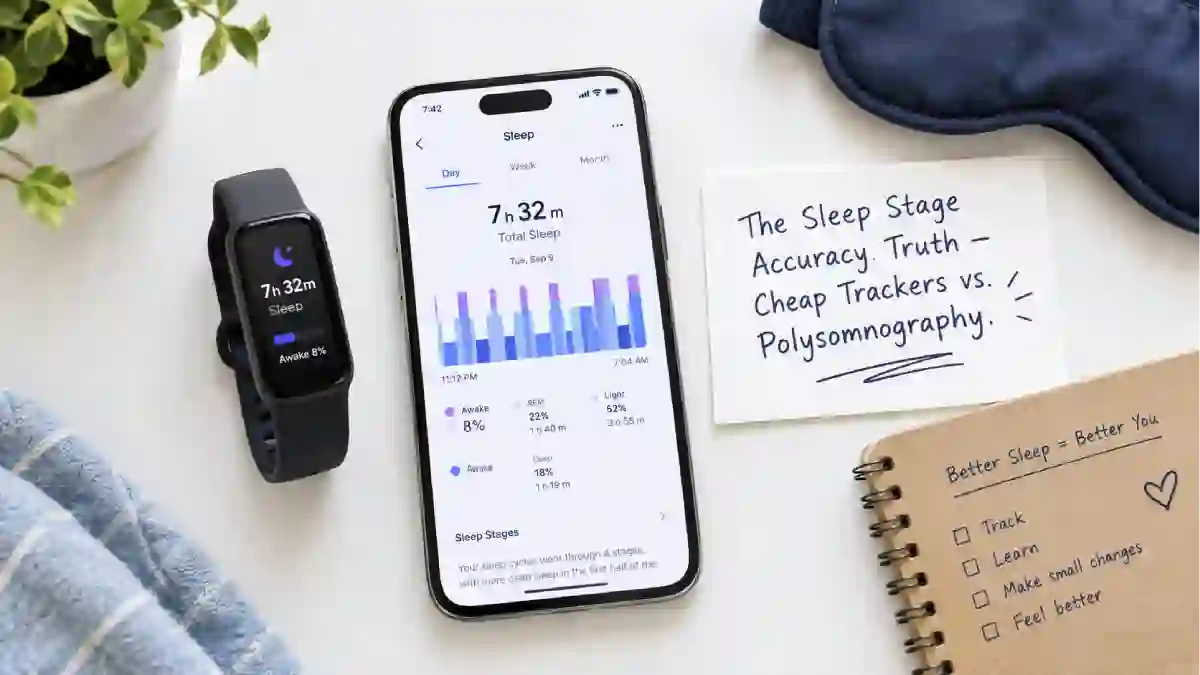
The $40 fitness band was sitting in my online cart. It promised to track my sleep stages—light, deep, and REM. It promised to tell me how well I slept. It promised to give me a “sleep score” that would somehow quantify the quality of my night.
I bought it. I wore it for a month. And I watched the numbers fluctuate wildly—deep sleep ranging from 45 minutes to 2 hours and 15 minutes, REM sleep from 30 minutes to 90 minutes, all with no obvious correlation to how I actually felt in the morning.
That was the day I started researching how sleep trackers actually work. What I found was both fascinating and sobering. Cheap wearables can track sleep versus wakefulness reasonably well. But when it comes to sleep stages—the deep, restorative sleep that actually matters—they’re often guessing.
This is the honest breakdown of how accurately cheap wearables track sleep stages. The science. The limitations. And what you should actually do with the data.
Jump Links
- The Sleep Tracking Boom (And the Budget Reality)
- How Sleep Trackers Actually Work (The Sensors Inside)
- Sleep vs. Wake: Where Cheap Trackers Actually Shine
- Sleep Stages: Where Budget Trackers Fall Apart
- The Deep Sleep Problem (And Why It Matters)
- The REM Sleep Problem (The Hardest Stage to Track)
- What the Research Actually Shows
- Why Cheap Trackers Struggle (The Algorithm Problem)
- The Accuracy Numbers You Should Actually Care About
- The Orthosomnia Problem (When Tracking Hurts Sleep)
- How to Use a Cheap Tracker Without Being Misled
- Frequently Asked Questions (FAQ)
- Final Thoughts: Trends Over Numbers, Feelings Over Scores
The Sleep Tracking Boom (And the Budget Reality)
Sleep tracking has become a massive industry. Fitbit, Xiaomi, Amazfit, Huawei, Whoop, Oura, and dozens of other brands now sell wearables that promise to analyze your sleep. The appeal is obvious: sleep is fundamental to health, and most people don’t get enough of it.
The budget segment is growing fastest. Devices like the Xiaomi Smart Band 9, Amazfit Band 7, and Fitbit Inspire 3 cost under $60 and offer sleep tracking as a core feature. These budget trackers can deliver surprisingly reliable readings for basic metrics like heart rate, step count, and sleep tracking.
But there’s a catch. Sleep tracking on cheap bands tends to be less detailed. Cheaper bands often miss short wake-ups or fail to distinguish between light and REM sleep accurately.
The price paradox. Premium devices like the Oura Ring, Apple Watch, and Whoop cost $200-400. Do they track sleep stages better? Yes, in some cases. But the gap isn’t as large as the price difference suggests. And even the premium devices have limitations that most marketing materials don’t acknowledge.
How Sleep Trackers Actually Work (The Sensors Inside)
To understand why cheap wearables struggle with sleep stages, you need to understand how they work. Most consumer sleep trackers rely on two sensors: an accelerometer and a photoplethysmography (PPG) heart rate sensor.
The accelerometer measures movement. When you’re still, the device assumes you’re sleeping. When you move, it assumes you’re awake or in a lighter sleep stage. This is the same principle behind research-grade actigraphy, which has been used in sleep studies for decades.
The PPG sensor measures heart rate by shining light through the skin and detecting changes in blood flow. Heart rate drops during deep sleep and fluctuates during REM sleep. By combining heart rate data with movement data, the device attempts to estimate sleep stages.
What’s missing: The gold standard for sleep staging is polysomnography (PSG), which measures brain waves (EEG), eye movements (EOG), and muscle activity (EMG). These signals are the only definitive way to know what stage of sleep you’re in.
Polysomnography tests are the most accurate because they track a person’s brain waves, heart rate, breathing, blood oxygen levels, and body and eye movements during sleep through electrodes attached to the skin and scalp. Analyzing brain wave patterns is the only definitive way of knowing whether someone is awake or asleep, and to know what stage of sleep they’re in.
What wearables have instead: Movement and heart rate. As we move frequently during all stages of sleep, movement provides few clues about what sleep stage we’re in. Many sleep devices also fail to differentiate one stage of sleep from another based on motion alone.
This is the fundamental limitation. Cheap wearables are making educated guesses about sleep stages based on indirect signals. Sometimes those guesses are right. Often, they’re not.
Sleep vs. Wake: Where Cheap Trackers Actually Shine
Here’s the good news: cheap wearables are actually quite good at detecting whether you’re asleep or awake. This is the most basic sleep metric, and it’s where the technology has matured.
The accuracy numbers. A 2025 study found that the performance of smart watches in sleep/wake detection is comparable to that of research-grade sleep wearables such as actigraphy. For two-stage classification (sleep vs. wake), all devices showed around 86-89% agreement with PSG.
What this means in practice. If you want to know roughly how long you slept, a cheap tracker will give you a reasonably accurate answer. It might overestimate by 15-30 minutes, especially if you spent time lying still but awake. But it won’t be wildly off.
The caveat. Even sleep/wake detection has limitations. Most wrist-worn devices overestimate sleep time and underestimate wake after sleep onset. In other words, your tracker might tell you that you slept 8 hours when you actually slept 7. The error is usually in the direction of overestimating sleep.
For people with normal sleep, this is fine. For people with insomnia, it’s a problem. People with insomnia tend to remain very still in bed in an attempt to fall asleep. But as sleep trackers only measure movement, one study found watches were unable to differentiate sleep from wakefulness in people with insomnia.
The bottom line: Cheap trackers can tell you roughly how long you slept. They can’t tell you how well you slept.
Sleep Stages: Where Budget Trackers Fall Apart
This is where the story gets less encouraging. Sleep staging—distinguishing between light sleep, deep sleep, and REM sleep—is where cheap wearables struggle most.
The accuracy drop. While sleep/wake detection achieves 86-89% agreement with PSG, for multi-state sleep stage classification, agreement dropped to 50-65%. That’s a massive drop. It means that for every two sleep stage classifications a cheap tracker makes, one is wrong.
The research is consistent. A 2024 study in Sleep Health evaluated six wearable sleep trackers across four device classes. The findings were stark: the low-cost consumer trackers had poorest overall performance, with kappa values below 0.31 for two-stage classification and below 0.33 for four-stage classification. For context, a kappa of 0.31 means “fair” agreement. A kappa of 0.33 for four-stage classification is barely better than chance.
What this means for you. If your cheap tracker says you got 1 hour and 45 minutes of deep sleep, that number could be off by 30-60 minutes in either direction. If it says you got 90 minutes of REM sleep, that number could be off by 40-50 minutes.
The specific problem with cheap trackers. The Sleep Health study found that low-cost trackers, despite poor wake detection, could have some utility for logging time in bed. That’s damning with faint praise. It means the best you can say about cheap trackers is that they know when you got into bed and when you got out. Everything else is unreliable.
What a Chinese tech reviewer found after 30 days of testing: Deep sleep detection is the weak point for all bands. Low-priced bands tend to overestimate deep sleep duration. Bands mainly use body movement and heart rate to judge sleep stages, but true deep sleep requires EEG to accurately determine. So the band’s “deep sleep” is more of an estimate.
The reviewer’s data was telling. The Xiaomi Mi Band 8 reported 2.1 hours of deep sleep when PSG showed 1.2 hours—an overestimate of 75%. The Huawei Band 8 reported 1.5 hours—a 25% overestimate. Only the Apple Watch (a premium device) came close, reporting 1.3 hours against a PSG measurement of 1.2 hours.
The Deep Sleep Problem (And Why It Matters)
Deep sleep—also called slow-wave sleep or N3—is the most restorative stage of sleep. It’s when your body repairs tissue, consolidates memories, and releases growth hormone. Getting enough deep sleep is linked to better immune function, better mood, and better cognitive performance.
Why cheap trackers struggle with deep sleep. Deep sleep is characterized by slow brain waves, low muscle tone, and steady heart rate and breathing. Wearables can detect the steady heart rate and lack of movement. But so can other sleep stages. Light sleep (N2) also involves low movement. REM sleep involves low muscle tone but a more active heart rate.
The result is confusion. The device shows limited precision in classifying sleep stages, often misclassifying deep and REM sleep as light sleep. If your tracker is misclassifying deep sleep as light sleep, your deep sleep numbers will be artificially low. If it’s misclassifying light sleep as deep sleep, your numbers will be artificially high.
The practical implication. Don’t obsess over your deep sleep numbers from a cheap tracker. They’re not accurate enough to be actionable. If your tracker consistently shows very low deep sleep and you feel exhausted, that’s worth investigating—but investigate it with a doctor, not with your tracker.
What the research shows. A 2017 study found that the intraclass correlation coefficient (a measure of consistency) for deep sleep duration across different wearables was only 0.27, indicating poor consistency. In plain English: different cheap trackers give wildly different deep sleep numbers for the same night.
The REM Sleep Problem (The Hardest Stage to Track)
REM sleep is where dreaming happens. It’s important for emotional processing and memory consolidation. And it’s the hardest sleep stage for wearables to detect accurately.
Why REM is hard. REM sleep involves rapid eye movements, which wearables can’t detect. It also involves changes in heart rate and breathing that overlap with other sleep stages. Without EEG and EOG, distinguishing REM from light sleep is extremely difficult.
The accuracy numbers. In a 2024 study of three devices (Oura Ring Gen3, Fitbit Sense 2, and Apple Watch Series 8), Fitbit sensitivity for REM was 61.7-78.0% and precision was 72.8-73.2%. That means the Fitbit missed 22-38% of actual REM sleep and mislabeled 27-28% of what it called REM.
For cheap trackers, it’s worse. The Sleep Health study found that low-cost consumer trackers had the poorest overall performance for four-stage classification, which includes REM.
What this means. Your cheap tracker’s REM sleep numbers are unreliable. They might be in the right ballpark on some nights. On other nights, they could be completely wrong. Don’t use them to make decisions about your health.
What the Research Actually Shows
Let me synthesize the research into the numbers that matter.
Sleep vs. wake detection (2-stage):
- Agreement with PSG: 86-89%
- Kappa for high-end trackers: 0.58-0.76
- Kappa for low-cost trackers: below 0.31
Four-stage sleep classification (wake/light/deep/REM):
- Agreement with PSG: 50-65%
- Kappa for high-end trackers: 0.45-0.86
- Kappa for low-cost trackers: below 0.33
Specific parameter errors:
- Fitbit overestimated light sleep by 57.7 minutes on average
- Fitbit underestimated deep sleep by 15 minutes
- Most devices overestimate total sleep time
- Devices overestimate sleep efficiency by an average of 14.5%
The clinical bottom line. A 2024 meta-analysis in the Journal of Clinical Sleep Medicine concluded that wrist-worn sleep tracking devices, although popular, are not as reliable as polysomnography in measuring key sleep parameters such as total sleep time, sleep efficiency, and sleep latency. Physicians and consumers should be aware of their limitations and interpret results carefully.
The expert view. The Nuffield Department of Clinical Neurosciences puts it plainly: Sleep trackers are only accurate 78% of the time when identifying sleep versus wakefulness. This accuracy drops to around 38% when estimating how long it took participants to fall asleep.
Why Cheap Trackers Struggle (The Algorithm Problem)
There’s another layer to this problem: the algorithms. And it’s a layer that neither you nor researchers can fully see.
The black box problem. The algorithms which companies use to make predictions about sleep are unknown, making it difficult for scientists to identify whether the assumptions made by the sleep devices are valid. When a cheap tracker says you had 90 minutes of deep sleep, you have no way of knowing what calculation produced that number.
Frequent algorithm changes. Even if a device was validated in a study, that validation might be obsolete. The exact algorithm used in the device is unknown. Iterative generations and products with updated algorithms demand new validations, whereas validated products have become old-fashioned.
The machine learning problem. Modern trackers use machine learning algorithms trained on large datasets. These algorithms can improve over time as more data is collected. But they can also fail in unexpected ways. Novel machine learning algorithms were developed to recognize sleep sessions and sleep stages using accelerometer sensors and inter-beat intervals. The complexity of these algorithms makes them harder to validate and easier to mislead.
What this means for you. You can’t assume that a tracker that was accurate last year is accurate today. You can’t assume that two trackers using the same sensors will produce the same results. And you can’t assume that the “deep sleep” your tracker reports means what you think it means.
The Accuracy Numbers You Should Actually Care About
If you’re going to use a cheap tracker, here’s what you should and shouldn’t trust.
Trust (with caveats):
- Sleep duration (total sleep time): Reasonably accurate, though tends to overestimate by 15-30 minutes.
- Time in bed: Very accurate. Trackers know when you got into bed and when you got out.
- Sleep/wake patterns: Good enough to see general trends. If you consistently get 6 hours of sleep, your tracker will show that.
Don’t trust (at all):
- Deep sleep duration: Unreliable. Off by 30-60 minutes or more.
- REM sleep duration: Unreliable. Off by 30-50 minutes or more.
- Sleep onset latency (how long it took to fall asleep): Very unreliable. Only 38% accuracy.
- Sleep score: A made-up number that doesn’t correlate reliably with how you actually feel.
Trust with caution:
- Sleep efficiency: Tends to be overestimated by about 14.5%. If your tracker says 90%, it might actually be 75%.
- Wake after sleep onset (WASO): Tends to be underestimated. If you remember waking up three times but your tracker shows one, trust your memory.
The most important metric: How you feel. If you slept 8 hours according to your tracker but feel exhausted, believe your body. If you slept 6 hours according to your tracker but feel great, believe your body.
The Orthosomnia Problem (When Tracking Hurts Sleep)
There’s a psychological risk to sleep tracking that rarely gets discussed: orthosomnia.
What is orthosomnia? A condition where people become so focused on achieving “perfect” sleep numbers that they develop anxiety about sleep, which paradoxically makes it harder to sleep.
The research. The Nuffield Department of Clinical Neurosciences conducted a study where participants were given sleep watches and told they had either good or poor sleep—even though the actual sleep was the same. The study found that those who were told they had a poor night’s sleep showed lower mood, difficulties with daytime thinking processes and increased sleepiness. Those who were told they had a great night’s sleep showed the opposite.
The clinical concern. One report highlighted more patients are seeking treatment for perceived sleep difficulties as a result of feedback from sleep trackers. Even when such complaints are refuted by a polysomnography test, watches continue to provide a source of sleep-related anxiety.
Who’s at risk. People with existing sleep problems are most vulnerable. Given people who experience poor sleep may be more likely to use sleep tracking devices, this could be a concern as it may potentially worsen mental health issues.
What to do. If you find yourself anxious about your sleep numbers, stop looking at them. The tracker is supposed to help you, not hurt you. If it’s causing stress, it’s not worth using.
How to Use a Cheap Tracker Without Being Misled
If you’re going to use a budget sleep tracker, here’s how to use it wisely.
1. Focus on trends, not nightly numbers. One night of “bad” deep sleep doesn’t mean anything. A month of consistently low deep sleep might be worth discussing with a doctor. Relative accuracy highlights the importance of tracking long-term trends over single-night scores.
2. Ignore the sleep score. Sleep scores are proprietary algorithms that don’t correlate reliably with how you feel. They’re designed to be engaging, not accurate.
3. Use the tracker for sleep/wake patterns. If your tracker shows you’re going to bed at 2 AM and waking at 7 AM, that’s useful information. If it shows you’re waking up multiple times per night, that’s worth paying attention to.
4. Don’t make health decisions based on stage data. If your tracker says you have low deep sleep, don’t panic. If you’re concerned about your sleep quality, see a doctor. A cheap tracker is not a diagnostic tool.
5. Cross-reference with how you feel. The best measure of sleep quality is how you feel during the day. Are you tired? Are you irritable? Are you struggling to focus? Those are the signals that matter.
6. Wear it consistently. Consistency and form factor are more important than chasing perfect accuracy. If the tracker is comfortable and you wear it every night, you’ll get useful data. If it’s uncomfortable and you take it off, you won’t.
7. Avoid becoming obsessive. If you’re checking your sleep score first thing every morning and feeling anxious about it, stop. Orthosomnia is real, and it’s counterproductive.
📌 YOU MIGHT ALSO LIKE:
The Best Budget Fitness Trackers with Built-In GPS Under $100
Why I Stopped Buying $200 ‘Beats’ and Switched to These $30 ‘Anker’ Earbuds
Frequently Asked Questions (FAQ)
1. How accurate are cheap sleep trackers compared to expensive ones?
Cheap trackers are reasonably accurate for sleep/wake detection (86-89% agreement with PSG) but poor for sleep stage classification. A 2024 study found that low-cost consumer trackers had poorest overall performance with kappa values below 0.33 for four-stage classification, compared to 0.45-0.86 for high-end trackers. The gap is significant, but even high-end trackers struggle with sleep stages.
2. Can cheap trackers accurately measure deep sleep?
No. Deep sleep is the weakest point for budget trackers. One reviewer found that the Xiaomi Mi Band 8 reported 2.1 hours of deep sleep when PSG showed only 1.2 hours—a 75% overestimate. Research shows that low-cost trackers have poor consistency for deep sleep duration, with intraclass correlation coefficients as low as 0.27.
3. How accurate is REM sleep tracking on a budget device?
REM sleep is the hardest stage for wearables to detect. Even premium devices like the Fitbit Sense 2 have REM sensitivity of only 61.7-78.0%. For cheap trackers, the accuracy is even lower. The Sleep Health study found that low-cost trackers had kappa values below 0.33 for four-stage classification, which includes REM.
4. Why do cheap sleep trackers struggle with sleep stages?
They rely on accelerometers (movement) and PPG sensors (heart rate) to estimate sleep stages. They don’t measure brain waves (EEG) or eye movements (EOG), which are the gold standard for sleep staging. As we move frequently during all stages of sleep, movement provides few clues about what sleep stage we’re in. Without EEG, distinguishing deep sleep from light sleep or REM from light sleep is extremely difficult.
5. Should I trust my sleep tracker’s sleep score?
No. Sleep scores are proprietary algorithms designed to be engaging, not accurate. They don’t correlate reliably with how you actually feel. The Nuffield Department of Clinical Neurosciences warns that data from sleep trackers could change your emotional state and concentration levels during the day, even if the readings are accurate.
6. What can cheap sleep trackers actually do well?
They’re good at tracking sleep duration and sleep/wake patterns. A 2025 study found that the performance of smart watch in sleep/wake detection is comparable to that of research-grade sleep wearables such as actigraphy. They can tell you roughly how long you slept and when you went to bed. That’s useful for tracking general trends.
7. Can sleep trackers cause harm?
Yes. Orthosomnia—an obsession with achieving perfect sleep numbers—can develop in people who use sleep trackers. Research shows that one report highlighted more patients are seeking treatment for perceived sleep difficulties as a result of feedback from sleep trackers. If tracking causes anxiety, it’s counterproductive.
8. What’s the best way to use a cheap sleep tracker?
Focus on trends, not nightly numbers. Ignore the sleep score. Use it for sleep/wake patterns. Don’t make health decisions based on stage data. Cross-reference with how you feel. Wear it consistently. And if it causes anxiety, stop using it.
Final Thoughts: Trends Over Numbers, Feelings Over Scores
The $40 fitness band is still on my wrist. I still check the sleep data. But I’ve stopped taking it seriously.
The sleep duration is roughly accurate. The sleep/wake patterns are useful. The deep sleep and REM numbers are guesses—sometimes good guesses, sometimes bad ones. The sleep score is a marketing tool.
What I learned:
- Cheap trackers are good at sleep/wake detection (86-89% agreement with PSG).
- Cheap trackers are poor at sleep stage classification (50-65% agreement, or worse).
- Deep sleep and REM sleep numbers are unreliable on budget devices.
- Sleep scores are not meaningful.
- The best measure of sleep quality is how you feel.
The frugal approach: If you want a sleep tracker, buy a cheap one. Use it for trends. Ignore the stage data. Don’t let it make you anxious. And remember that the most accurate sleep tracker is your own body.
That’s not cheap. That’s smart.
That’s the frugal glow. And it’s waiting for you in the morning, when you open your eyes and feel how you feel. 😴💛
*For more budget wellness reviews, honest product tests, and money-saving health strategies, visit The Frugal Glow.*