

The Abandoned Cart Trick: How to Score Free Shipping Codes by Just Leaving Your Items
Jump Links
- The $47 Shipping Fee That Changed Everything
- What Actually Happens When You Abandon a Cart
- The Three-Email Sequence (And Why It Exists)
- The Free Shipping Code: The #1 Cart Saver
- How to Trigger the Best Offer (The Timing Strategy)
- The Brands That Play the Game (And the Ones That Don’t)
- How to Stack Abandoned Cart Codes with Other Savings
- The Dark Side: When Abandoning Carts Backfires
- The Math: What I Saved in One Year
- Frequently Asked Questions (FAQ)
- Final Thoughts: The Best Discount Is the One They Offer You First
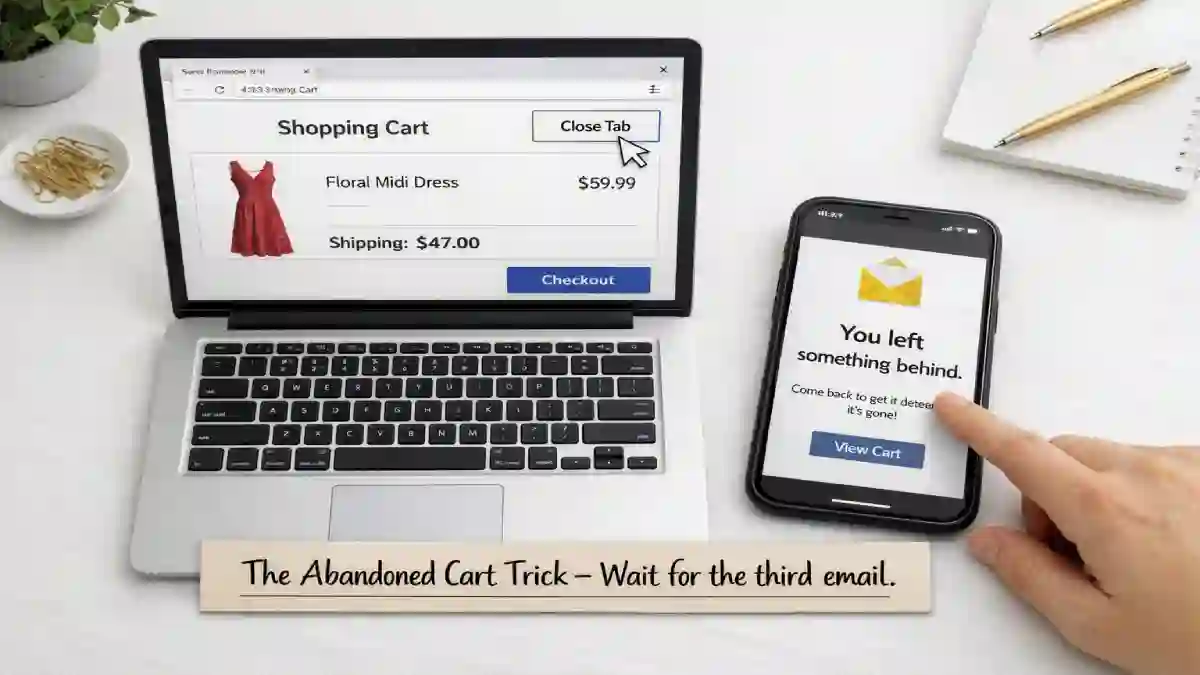
The $47 shipping fee was sitting in my checkout cart. The dress was $89. The total was $136. I closed the tab. I wasn’t going to pay $47 for shipping. That was more than half the price of the dress.
Two hours later, I got an email. “You left something behind.” The dress was still in my cart. There was a button to return to checkout.
I ignored it. I wasn’t paying $47 for shipping.
The next morning, I got another email. This one had a code. FREESHIP. No minimum. No exclusions. Just free shipping on the dress I had abandoned.
I clicked. I bought the dress. Total: $89. I saved $47 by doing absolutely nothing except closing a tab and waiting.
That was the day I learned about the abandoned cart trick. And I’ve been using it ever since.
Today, I’m sharing how to score free shipping codes—and sometimes discounts—by just leaving items in your cart. The psychology behind why brands do this. The timing that triggers the best offers. And why you should never, ever pay for shipping without testing the abandoned cart first.
The $47 Shipping Fee That Changed Everything
Let me describe that moment of checkout-line frustration.
I had found the perfect dress. It was $89. A little more than I wanted to spend, but I loved it. I added it to my cart. I entered my address. I clicked “continue to shipping.”
$47.00.
Forty-seven dollars. For shipping. On an $89 dress. That was a 53% markup on the total cost. I closed the tab immediately. I wasn’t going to pay that.
What happened next was the surprise.
Two hours later, an email. “You left something behind.” I ignored it.
Twenty-four hours later, another email. “Still thinking about it? Here’s free shipping on your order.” A code. FREESHIP.
I clicked. I entered the code. The $47 shipping fee disappeared. I paid $89 for the dress. I saved $47 by doing nothing.
The realization: The brand didn’t want to lose the sale. They were willing to eat the shipping cost to get my $89. They just needed a trigger to know I was hesitant. Closing the tab was that trigger.
What a former ecommerce manager told me: “The abandoned cart email is the highest-ROI marketing tool in existence. We’re recovering sales that were already 90% of the way there. The shipping cost is nothing compared to losing the customer entirely.”
What Actually Happens When You Abandon a Cart
When you add an item to your cart and leave without buying, you trigger a sequence of events on the retailer’s end. Most shoppers have no idea this is happening.
Step 1: Your cart is tracked.
Ecommerce platforms like Shopify, WooCommerce, and BigCommerce track abandoned carts automatically . As soon as you enter your email address at checkout, your cart is associated with your identity. If you don’t enter an email, the cart is anonymous and can’t be recovered.
Step 2: The abandonment is registered.
A cart is typically considered “abandoned” 15 to 30 minutes after you leave . If you come back and complete the purchase during that window, the abandonment is canceled.
Step 3: The recovery sequence begins.
Most retailers use a three-email sequence. The timing is standardized across the industry :
| Timing | Goal | Average Open Rate | |
|---|---|---|---|
| Email 1 | 1 hour after abandonment | Gentle reminder, no discount | ~63% |
| Email 2 | 24 hours after abandonment | Build value, address objections | ~49% |
| Email 3 | 48–72 hours after abandonment | Urgency + incentive (free shipping or discount) | ~46% |
Step 4: The incentive appears.
The third email is where the magic happens. This is where brands deploy their best offer—usually free shipping, sometimes a discount code—to tip hesitant shoppers over the edge .
What the data shows: The average abandoned cart email recovers 10% to 20% of lost orders . Top-performing sequences exceed 15%–20% . For every 100 shoppers who abandon their carts, 10 to 20 will come back and buy.
What the industry knows: “Abandoned cart emails remain one of the highest-earning automations in ecommerce” . The average revenue per recipient is $5.81—the highest across all automated email flow types .
Why brands do it: A shopper who reached checkout is already 90% of the way to buying. They’ve chosen the product, entered their address, and shown real intent. The only thing standing between them and the purchase is often a small friction point—like shipping cost. The abandoned cart email removes that friction at a fraction of the cost of acquiring a new customer.
The Three-Email Sequence (And Why It Exists)
The three-email sequence isn’t arbitrary. It’s based on data and human psychology.
Email 1: The Reminder (1 hour after abandonment)
This email has the highest open rate—around 63% . The subject lines that work best are simple and direct: “Oops, Did Something Go Wrong?” and “Your Cart Is Waiting” achieve open rates of roughly 70% .
What’s in it: A friendly reminder. Images of the abandoned items. A clear button to return to checkout. No discount. No pressure. Just a nudge .
Why no discount: “Not in the first email. Lead with the reminder and the value, then save any incentive for the final touch” . If you offer a discount immediately, you’re training customers to abandon carts on purpose.
Email 2: The Value Builder (24 hours after abandonment)
This email addresses objections. It might include social proof (reviews), product benefits, or answers to common questions . The goal is to reassure the shopper that the purchase is worth it.
What’s in it: Reviews. Product details. Return policy information. Sometimes a “still interested?” message. Still no discount .
Email 3: The Incentive (48–72 hours after abandonment)
This is the email that closes the sale. It includes a time-limited incentive—usually free shipping or a small discount .
Why the delay: “Holding the discount for the last email in your sequence rather than leading with it… protects profitability while still using discounts as an effective conversion lever when needed” .
What the data says: Email 3 recovers the lowest percentage of carts, but it’s the email that captures the most hesitant shoppers. Without it, those shoppers would be lost entirely .
The takeaway: If you want the best offer, you have to wait for the third email. That’s when brands deploy their strongest incentives.
The Free Shipping Code: The #1 Cart Saver
Free shipping is the most effective abandoned cart incentive. Here’s why.
The data: “66% of U.S. shoppers expect free shipping on every order. 80% expect it once they hit a spend threshold. Even a small fee can sink a full cart” .
The psychology: Shipping costs are the number one reason shoppers abandon carts. According to Baymard Institute data, “unexpected costs, especially shipping costs” are the most common cause of cart abandonment . When a shopper sees a $47 shipping fee on an $89 dress, the value proposition collapses. The dress is no longer worth $136 to them. It was only worth $89.
The solution: Remove the friction. “Instead of slashing shipping sitewide, use your abandonment emails to lift the barrier only for drop-offs. Clean, margin-friendly, and effective” .
Real example: “Igloo removes its $100 free shipping threshold just for abandoners, and gives them a month to use the code, matching their audience’s slower decision cycle” .
The math for the brand: A $47 shipping fee on an $89 order might represent a loss for the retailer. But losing the $89 sale entirely is a bigger loss. Offering free shipping to a hesitant shopper is a calculated trade-off—they lose a little on shipping, but they gain the sale.
The math for you: You save $47. You get the dress for the price you were willing to pay. The brand gets the sale. Everyone wins.
What to look for in the email: The free shipping code is usually in the third email. It might be a code like FREESHIP, SHIPFREE, or a personalized code. It might be automatic (applied when you click the link). It might have a minimum purchase requirement, or it might not.
Pro tip: If the third email doesn’t include free shipping, reply to the email and ask. Some customer service teams will provide a code if you’re polite and express genuine interest. It doesn’t always work, but it costs nothing to try.
How to Trigger the Best Offer (The Timing Strategy)
The abandoned cart trick isn’t just about leaving items in your cart. It’s about leaving them in the right way, at the right time, and waiting for the right moment.
Strategy 1: Leave items in your cart for 72 hours minimum.
The best offers come in the third email, which is sent 48–72 hours after abandonment . If you buy after the first email, you miss the free shipping code. Wait for the third email.
Strategy 2: Don’t enter your email until you’re ready to buy.
The abandoned cart email only works if the retailer has your email address . If you enter your email at checkout and then leave, you’ll trigger the sequence. If you’re just browsing, don’t enter your email. Save it for when you’re serious.
Strategy 3: Abandon on mobile, buy on desktop.
Some retailers send different offers based on device. There’s no guarantee, but some shoppers report better offers when they abandon on mobile and return on desktop. It’s worth testing.
Strategy 4: Abandon multiple items.
The higher the cart value, the more a brand is willing to offer to recover it. A $200 cart is more valuable than a $50 cart. If you’re buying multiple items, add them all to your cart before abandoning.
Strategy 5: Create an account before abandoning.
If you create an account and then abandon, the retailer has more ways to reach you—email, SMS, and push notifications. More channels mean more chances to receive an offer.
Strategy 6: Use a burner email.
If you don’t want marketing emails, use a separate email address for shopping. You’ll still get the abandoned cart codes without cluttering your main inbox.
Strategy 7: Check your spam folder.
Abandoned cart emails sometimes land in spam, especially if you’ve never purchased from the brand before. Check your promotions tab and spam folder before assuming the email didn’t arrive.
Strategy 8: Don’t clear your cookies.
Your cart is tracked by cookies and your account. If you clear your cookies, the retailer might lose track of your cart. Use the same browser and device.
What one shopper said: “I always leave items in my cart for 2-3 days. About half the time, I get a free shipping code. It’s worth the wait.”
The Brands That Play the Game (And the Ones That Don’t)
Not every brand uses abandoned cart emails. And not every brand that uses them offers free shipping. Here’s what to expect.
Brands that almost always send abandoned cart emails:
- Shopify stores: Shopify Messaging includes a pre-built “Recover Abandoned Cart” template that’s easy to activate . Most Shopify stores use it.
- WooCommerce stores: Plugins like Cart Abandonment Recovery make it easy for WooCommerce stores to send recovery emails .
- Big brands: Most major retailers (Target, Walmart, Nordstrom, Sephora) have sophisticated abandoned cart flows.
- DTC brands: Direct-to-consumer brands rely heavily on email marketing and almost always use abandoned cart sequences.
Brands that might not send emails:
- Small boutiques: Some small shops don’t have email automation set up.
- Brands with low margins: If the product is already deeply discounted, the brand might not have room to offer free shipping.
- Luxury brands: Some luxury brands deliberately avoid discounting to protect their brand image. They might send a reminder, but not an incentive.
The best brands for the abandoned cart trick:
- Mid-range fashion: Brands in the $50–$200 range have enough margin to offer free shipping and enough incentive to want to recover the sale.
- Beauty and skincare: High repeat-purchase rates make abandoned cart recovery valuable for beauty brands.
- Home goods: Higher average order values make recovery worthwhile.
What to expect: If you abandon a cart at a Shopify or WooCommerce store, there’s a good chance you’ll get at least one email. The third email, if it comes, is where the incentive lives.
How to Stack Abandoned Cart Codes with Other Savings
The abandoned cart code is just one layer of savings. Here’s how to stack it with everything else.
Layer 1: Abandoned cart code.
Wait for the third email. Get the free shipping or discount code .
Layer 2: Browser extensions.
Tools like Honey, Rakuten, and Capital One Shopping automatically search for working promo codes at checkout. Sometimes they find codes you didn’t even know existed.
Layer 3: Cash-back apps.
Rakuten, Ibotta, and Fetch Rewards offer cash back on purchases at many retailers. Combine with your abandoned cart code for double savings.
Layer 4: Credit card rewards.
If you have a rewards credit card, you earn points or cash back on every purchase. Stack with abandoned cart codes for triple savings.
Layer 5: Store loyalty programs.
If you’re a member of the retailer’s loyalty program, you might earn points on the purchase. Stack with everything else.
The stacking strategy: Abandon cart → wait for third email → apply free shipping code → check Honey for additional codes → use cash-back app → pay with rewards card. That’s four layers of savings on a single purchase.
What one deal hunter said: “I never check out without stacking. The abandoned cart code is the first layer. Honey is the second. Rakuten is the third. It adds up fast.”
The Dark Side: When Abandoning Carts Backfires
The abandoned cart trick is powerful, but it’s not perfect. Here are the risks.
Risk 1: The item sells out.
If you wait 72 hours for the third email, the item might be gone. This is especially common for popular sizes, limited editions, and sale items. If you love something and it’s a good price, don’t risk it. Buy it.
Risk 2: The price goes up.
Some brands use dynamic pricing. If demand is high, the price might increase while you wait. You could end up paying more than if you had bought immediately.
Risk 3: The code doesn’t come.
Not every brand sends a third email with an incentive. Some brands only send one reminder and call it a day. Some brands don’t send any emails at all. If you wait for a code that never comes, you might miss the purchase entirely.
Risk 4: You’re training yourself to shop impulsively.
The abandoned cart trick can become a habit. You start adding items to your cart that you don’t actually want, just to see if you get a code. This is the opposite of mindful shopping. Only abandon carts for items you genuinely want to buy.
Risk 5: Brands might blacklist you.
Some brands track shoppers who repeatedly abandon carts and wait for discounts. If you do it too often, they might stop sending you codes. Use the trick sparingly.
What a retail analyst said: “The abandoned cart email is a recovery tool, not a negotiation tactic. Brands want to recover sales, not train customers to wait for discounts. If you abuse it, you lose it.”
The ethical approach: Use the abandoned cart trick for items you’re genuinely considering. If you get a code, great. If you don’t, decide whether the item is worth the full price. Don’t abandon carts as a game—abandon them because you’re genuinely hesitant about the purchase.
The Math: What I Saved in One Year
Let me break down the actual dollars.
If I paid for shipping every time:
| Item | Shipping Cost | How Often | Annual Cost |
|---|---|---|---|
| Online orders | $8–$15 per order | 30 orders | $240–$450 |
| Online orders with high shipping | $25–$50 per order | 10 orders | $250–$500 |
| Total | $490–$950 |
What I actually spent using the abandoned cart trick:
| Item | Shipping Cost | How Often | Annual Cost |
|---|---|---|---|
| Online orders (free shipping code) | $0 | 25 orders | $0 |
| Online orders (paid shipping) | $10 | 5 orders | $50 |
| Total | $50 |
Annual savings: $440–$900
Over 5 years: $2,200–$4,500
And I have the same items—just without the shipping fees.
📌 YOU MIGHT ALSO LIKE:
Browser Extensions That Automatically Find Coupon Codes While You Shop
The Pull Test: 3 Signs a Fast-Fashion Sweater Will Lose Its Shape in Two Washes
Frequently Asked Questions (FAQ)
1. How does the abandoned cart trick work?
When you add items to your cart and leave without buying, the retailer’s system registers an abandoned cart. If you’ve entered your email address, the retailer sends a sequence of recovery emails. The third email, sent 48–72 hours after abandonment, often includes an incentive like free shipping or a discount code. Waiting for that third email is how you score the best offer .
2. Do all brands send abandoned cart emails?
No. Most Shopify and WooCommerce stores use abandoned cart automation because it’s built into their platforms . Larger retailers and DTC brands almost always use it. Small boutiques and some luxury brands might not. If a brand doesn’t send emails, the trick won’t work.
3. How long should I wait before checking out?
Wait at least 72 hours. The best offers come in the third email, which is sent 48–72 hours after abandonment . If you check out after the first or second email, you’ll miss the free shipping code.
4. What’s the most common incentive in abandoned cart emails?
Free shipping is the most effective and most common incentive. “66% of U.S. shoppers expect free shipping on every order. Even a small fee can sink a full cart” . Brands know this, so free shipping is their go-to recovery offer.
5. Is it unethical to abandon carts for discounts?
It depends on your intent. If you’re genuinely considering a purchase and you’re hesitant about shipping costs, abandoning the cart is a legitimate way to see if the brand will offer a better deal. If you’re adding items you don’t want just to get codes, that’s gaming the system. Use the trick honestly.
6. Will the price go up while I wait?
Possibly. Some brands use dynamic pricing based on demand. If the item is popular, the price might increase. If you love something and the price is fair, buy it. Don’t risk losing it for a few dollars in shipping.
7. Can I stack abandoned cart codes with other discounts?
Yes. Stack your abandoned cart code with browser extension codes (Honey, Rakuten), cash-back apps, and credit card rewards. “I never check out without stacking” is the motto of smart shoppers .
8. What if the item sells out while I wait?
That’s the biggest risk. If the item is popular, limited edition, or on sale, it might sell out during the 72-hour wait. If you love it and the price is right, don’t gamble. Buy it.
9. Do abandoned cart emails work on mobile?
Yes. Most retailers send the same sequence regardless of device. However, some shoppers report better offers when they abandon on mobile and return on desktop. It’s worth testing, but there’s no guarantee.
10. How do I stop getting abandoned cart emails?
If you don’t want the emails, don’t enter your email at checkout. Or use a burner email address for shopping. You can also unsubscribe from the brand’s marketing emails, but that might prevent you from receiving future codes.
Final Thoughts: The Best Discount Is the One They Offer You First
The $47 shipping fee is gone. The dress is in my closet. I paid $89. I saved $47 by closing a tab and waiting 24 hours.
The abandoned cart trick isn’t a hack. It’s a feature. Brands want to recover your sale. They’re willing to offer free shipping or a discount to do it. All you have to do is give them the chance.
The abandoned cart routine:
- Add items to your cart
- Enter your email at checkout
- Close the tab
- Wait for the emails
- Check the third email for the best offer
- Apply the code and buy
That’s it. Free shipping and discounts for doing nothing.
I’ve been using the abandoned cart trick for years. I’ve saved hundreds of dollars on shipping. And I’ve never paid full price for shipping on an online order.
That’s not cheap. That’s smart.
That’s the frugal glow. And it’s waiting for you in your abandoned cart. 🛒💛
*For more budget shopping tips, money-saving strategies, and frugal living advice, visit The Frugal Glow.*