

5 ‘Amazon’ Fitness Gems Under $15 That Actually Replace Heavy Gym Machines
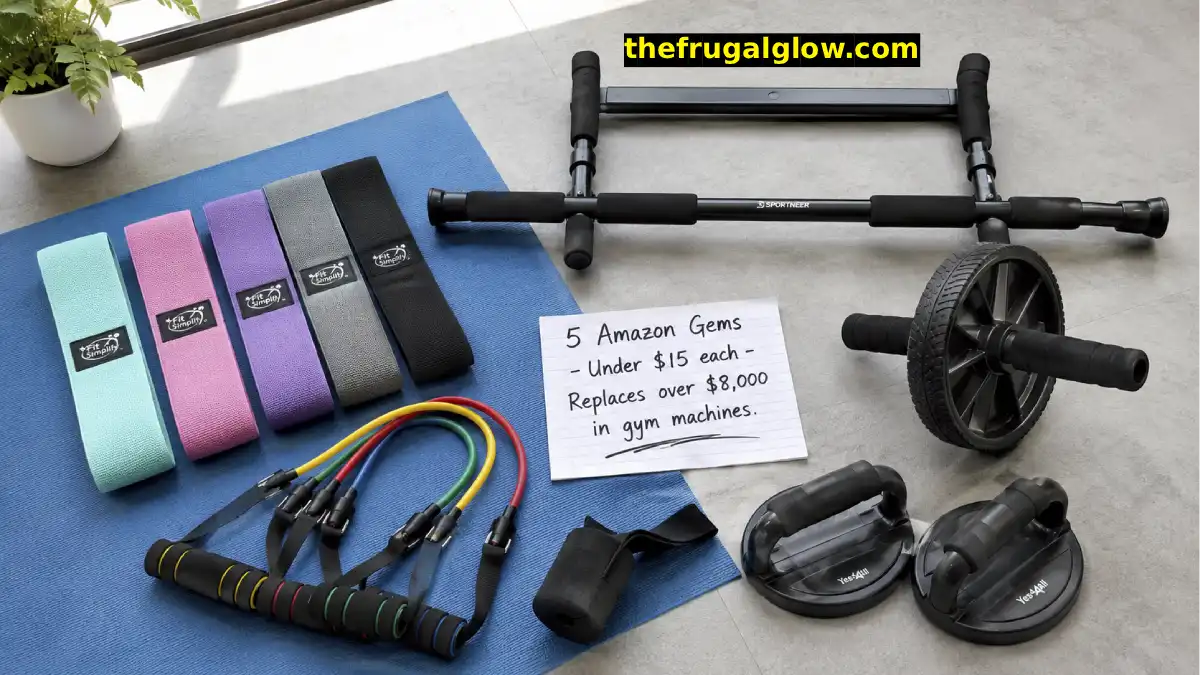
Let me be real with you. I used to believe that you couldn’t get a good workout without a gym full of machines. The leg press. The cable crossover. The lat pulldown. The hip abductor. All that shiny, expensive metal that costs thousands of dollars.
Then the pandemic hit. Gyms closed. And I was stuck in my apartment with nothing but a yoga mat and a lot of anxiety about losing all my gains.
I started researching. I went down a rabbit hole of calisthenics, resistance bands, and “unconventional” training. And I discovered something that made me feel genuinely stupid. You can mimic almost any gym machine with a $10-15 piece of equipment from Amazon. Not “kind of” mimic. Actually mimic. Same movement patterns. Same muscle activation. Same results.
The leg press machine? Replaceable with a $12 resistance band loop. The lat pulldown machine? Replaceable with a $10 door anchor and some bands. The hip abductor machine? Replaceable with a $13 mini band. The cable crossover? Replaceable with bands and a door anchor.
I’ve been using these five Amazon gems for over two years now. I’ve saved thousands of dollars in gym memberships. I’ve built muscle, lost fat, and gotten stronger. And I’ve spent less than $75 total on equipment.
Today, I’m sharing the five best fitness products on Amazon under $15. Each one replaces a bulky, expensive gym machine. Each one fits in a drawer. Each one actually works.
Let’s get into it.
Jump Links
- The Day I Quit the Gym (And Why I Never Went Back)
- Why Resistance Training Doesn’t Require Heavy Metal
- Gem #1: Resistance Band Loops ($12) – Replaces Leg Press & Hip Adductor
- Gem #2: Door Anchor Resistance Bands ($15) – Replaces Lat Pulldown & Cable Crossover
- Gem #3: Pull-Up Bar ($15) – Replaces Lat Pulldown & Assisted Pull-Up Machine
- Gem #4: Ab Wheel ($10) – Replaces Captain’s Chair & Roman Chair
- Gem #5: Push-Up Handles ($12) – Replaces Chest Press Machine & Triceps Dip Station
- Sample Full-Body Workout Using Only These 5 Gems
- How to Progress When It Gets Too Easy
- The Math: What I Saved in Two Years
- Frequently Asked Questions (FAQ)
- Final Thoughts: Strength Is Strength, No Matter the Tool
The Day I Quit the Gym (And Why I Never Went Back)
I need to tell you about my last gym membership.
I was paying $65 a month for a “premium” gym. It had everything. Leg press machines, cable towers, pec decks, hack squats. All the shiny toys. I went three times a week. I used maybe four machines total. The rest just sat there, staring at me, making me feel guilty for not using them.
One day, I was doing lat pulldowns. The cable snapped. The machine was out of order for two weeks. Two weeks. For a basic cable repair.
That’s when it hit me. I was paying $65 a month for access to machines that break, that I have to wait for, that I share with strangers who don’t wipe them down. And I could do almost every single exercise at home with equipment that costs less than one month’s membership.
I canceled the next day.
I spent $75 on Amazon. Five products. All under $15. They arrived in two days. I set up my “home gym” in a corner of my living room. It took ten minutes.
That was two years ago. I haven’t been back to a commercial gym since. Not because I’m anti-gym. Because I don’t need one. My $75 setup does everything I need.
Why Resistance Training Doesn’t Require Heavy Metal
Let me explain the science quickly.
Your muscles don’t know what a leg press machine is. They don’t care about brand names or shiny metal. They only understand tension and resistance.
When you push against a machine, your muscles contract. When you pull against a resistance band, your muscles contract. When you lift your own body weight, your muscles contract.
The machine is just a tool. The band is just a tool. Your body weight is just a tool.
Resistance bands are particularly effective because they provide variable resistance. The further you stretch them, the harder they pull. That’s actually more similar to how muscles naturally strengthen than the constant resistance of a weight stack.
A $12 resistance band loop can provide 10-50 pounds of resistance. That’s plenty for most people for most exercises. Leg press? Loop band around your feet and press. Hip adduction? Loop band around your thighs and squeeze. Lat pulldown? Anchor a band to a door and pull.
The only real difference is convenience and ego. Machines are easier to load heavy. Bands require more stabilization. But stabilization is good. It works your core and smaller supporting muscles.
So no, you won’t be powerlifting with bands. But for general fitness, muscle building, and fat loss? Bands and body weight are more than enough.
Gem #1: Resistance Band Loops ($12) – Replaces Leg Press & Hip Adductor
Product: Set of 5-8 fabric resistance band loops (different resistance levels)
Price: $10-15 on Amazon
Replaces: Leg press machine ($2,000+), hip adductor machine ($1,500+), hip abductor machine ($1,500+)
Why it’s a gem:
These are the cloth-covered bands, not the skinny rubber ones that roll up and snap. Fabric bands lie flat against your skin. They don’t pinch. They don’t roll. They come in different colors for different resistance levels (light to heavy).
What gym machines it replaces:
- Leg press: Place the band around your feet, lie on your back, and press your legs away from your body. Same movement pattern as a leg press. Same muscle activation (quads, glutes, hamstrings).
- Hip adduction (inner thigh machine): Loop band around your thighs, lie on your back with knees bent, and press your knees together against the band.
- Hip abduction (outer thigh machine): Same setup, but push your knees apart instead of together.
Best exercises:
- Banded glute bridges (activate glutes before squats)
- Banded squats (band around thighs, push knees out against band)
- Banded lateral walks (band around ankles, walk sideways)
- Lying leg press (as described above)
Pro tip: Get the fabric bands, not the rubber tubing bands. Fabric is more durable, more comfortable, and less likely to snap. The “Booty Band” style is what you want.
Estimated cost of gym machines replaced: $5,000+
Cost of this gem: $12
Gem #2: Door Anchor Resistance Bands ($15) – Replaces Lat Pulldown & Cable Crossover
Product: Set of 4-5 tube resistance bands with door anchor and handles
Price: $12-18 on Amazon
Replaces: Lat pulldown machine ($1,000+), cable crossover machine ($2,000+), seated row machine ($800+)
Why it’s a gem:
This is the classic tube resistance band set. They come with a foam handle, a door anchor (a foam ball thing that you close in a door), and multiple bands that you can stack for more resistance. The door anchor is the game-changer. It lets you attach bands at different heights on a door.
What gym machines it replaces:
- Lat pulldown: Put the door anchor at the top of a door. Attach bands. Pull the handles down toward your shoulders. Same movement as the lat pulldown machine. Same back activation.
- Cable crossover: Anchor bands at high, middle, and low positions on a door. Do flyes, presses, rows, and raises from different angles. Same as a cable machine.
- Seated row: Anchor bands at chest height. Sit on the floor with legs extended. Pull handles toward your ribs.
Best exercises:
- Banded lat pulldowns (wide grip and close grip)
- Banded chest flyes (anchor at chest height)
- Banded rows (anchor at chest height)
- Banded overhead triceps extensions (anchor low)
- Banded bicep curls (stand on band, curl up)
Pro tip: Close the door with the anchor on the opposite side from where you’re pulling. The door should close toward you, not away from you. Test it before you pull hard.
Estimated cost of gym machines replaced: $4,000+
Cost of this gem: $15
Gem #3: Pull-Up Bar ($15) – Replaces Lat Pulldown & Assisted Pull-Up Machine
Product: Door frame pull-up bar (no-screw, tension-mounted)
Price: $13-20 on Amazon
Replaces: Lat pulldown machine ($1,000+), assisted pull-up machine ($1,500+)
Why it’s a gem:
This is the most basic piece of fitness equipment ever invented. It’s a metal bar that hooks onto your door frame. It doesn’t require screws or tools. It holds 250-300 pounds. And it gives you one of the best back and bicep exercises in existence: the pull-up.
What gym machines it replaces:
- Lat pulldown machine: Pull-ups are a harder, more functional version of lat pulldowns. You’re pulling your body weight instead of a weight stack. Same back muscles. Better core engagement.
- Assisted pull-up machine: Can’t do a full pull-up? Use a resistance band looped over the bar and under your knee. The band assists you. Same concept as the machine, costs $1,500 less.
Best exercises:
- Pull-ups (overhand grip, wide grip, close grip, chin-ups)
- Hanging knee raises (core exercise, hang from bar and raise knees)
- Active hangs (just hang for time – great for shoulder health)
- Rows (low bar – put the bar low and do inverted rows)
Pro tip: If you can’t do a pull-up yet, start with negative pull-ups. Jump up to the top position, hold for 2 seconds, then lower yourself as slowly as possible (5-10 seconds). Do 3-5 sets of 3-5 negatives. You’ll get your first pull-up in weeks, not months.
Estimated cost of gym machines replaced: $2,500+
Cost of this gem: $15
Gem #4: Ab Wheel ($10) – Replaces Captain’s Chair & Roman Chair
Product: Ab wheel roller (single wheel or double wheel)
Price: $8-12 on Amazon
Replaces: Captain’s chair ($1,000+), Roman chair ($500+), various ab machines
Why it’s a gem:
The ab wheel is deceptively hard. It looks like a toy. It costs less than a pizza. And it absolutely destroys your core in ways that expensive ab machines can’t touch. It works your rectus abdominis (six-pack muscles), obliques (side muscles), and transverse abdominis (deep core) all at once.
What gym machines it replaces:
- Captain’s chair (leg raise station): Ab wheel rollouts work your lower abs just as hard as hanging leg raises, but without the equipment.
- Roman chair (back extension station): Ab wheel rollouts in reverse (starting from knees, rolling out and back) works your lower back similarly.
- Any “ab crunch” machine: Ab wheel is harder and more functional.
Best exercises:
- Kneeling ab rollouts: Start on knees, roll out as far as you can, roll back. Beginner version.
- Standing ab rollouts: Start standing, roll down to the floor, roll back up. Advanced version. Extremely hard.
- Ab rollouts with band resistance: Loop a band around your feet and the wheel. Makes it harder on the way back.
- Pike rollouts: Like a pike push-up with the ab wheel. Advanced.
Pro tip: Start slow. Your first ab wheel workout will leave you sore for days. Do 3 sets of 5-8 rollouts your first time. Add reps slowly. And keep your back straight – don’t let your lower back sag.
Estimated cost of gym machines replaced: $1,500+
Cost of this gem: $10
Gem #5: Push-Up Handles ($12) – Replaces Chest Press Machine & Triceps Dip Station
Product: Push-up handles or parallel bars (floor version)
Price: $10-15 on Amazon
Replaces: Chest press machine ($800+), triceps dip station ($200+), floor press
Why it’s a gem:
Push-up handles do two things. First, they let you go deeper than floor push-ups (range of motion increases). Second, they rotate, which is easier on your wrists. The parallel bar style (two separate bars) also allows for dip movements.
What gym machines it replaces:
- Chest press machine: Weighted push-ups (put a backpack with books on your back) with handles for deeper range of motion. Same chest activation as the machine.
- Triceps dip station: Place two push-up handles shoulder-width apart. Dip between them. Triceps dips at home.
- Floor press (if you have dumbbells): Use handles with dumbbells for a floor press.
Best exercises:
- Weighted push-ups (backpack with books or water bottles)
- Triceps dips (between two handles)
- Archer push-ups (one hand on handle, one on floor, shift weight)
- Push-up holds (hold the bottom position for time)
Pro tip: Put a backpack with books or water bottles on your back for weighted push-ups. Start with 5-10 pounds. Work up to 30-40 pounds. Weighted push-ups are a fantastic chest and triceps builder.
Estimated cost of gym machines replaced: $1,000+
Cost of this gem: $12
Sample Full-Body Workout Using Only These 5 Gems
Here’s a complete workout you can do with just the equipment above. Do this 2-3 times per week.
Warm-up (5 minutes):
- Arm circles, leg swings, torso twists
- Banded lateral walks (light band, 10 steps each direction)
- 10 bodyweight squats
Workout (30-40 minutes):
Circuit 1 (Push exercises):
- Weighted push-ups (with backpack) – 3 sets of 8-12 reps
- Triceps dips (between push-up handles) – 3 sets of 8-12 reps
- Banded chest flyes (door anchor at chest height) – 3 sets of 12-15 reps
- Rest 60 seconds, repeat circuit 3 times total
Circuit 2 (Pull exercises):
- Pull-ups (or negative pull-ups) – 3 sets of as many as you can do (3-10 reps)
- Banded rows (door anchor at chest height) – 3 sets of 10-15 reps
- Banded lat pulldowns (door anchor high) – 3 sets of 10-15 reps
- Rest 60 seconds, repeat circuit 3 times total
Circuit 3 (Legs & core):
- Banded squats (loop band around thighs) – 3 sets of 15 reps
- Lying banded leg press (loop band around feet) – 3 sets of 15 reps
- Banded glute bridges (loop band around thighs) – 3 sets of 20 reps
- Ab wheel rollouts – 3 sets of 5-10 reps
- Rest 60 seconds, repeat circuit 3 times total
Cool-down (5 minutes):
- Quad stretch, hamstring stretch, chest stretch, lat stretch
How to Progress When It Gets Too Easy
Eventually, this workout will feel easy. Here’s how to make it harder without buying more equipment.
Progression #1: Add more band resistance
Stack multiple bands together. Use the heavy band plus the medium band. The door anchor bands usually come in a set of 4-5. Use them all if you need to.
Progression #2: Add weight to push-ups and pull-ups
Wear a backpack with books. Add 5-10 pounds. Work up to 30-40 pounds. For pull-ups, loop a band under your foot to assist you if you can’t do many, or wear a backpack to add weight if you can do 10+.
Progression #3: Do harder variations
- Pull-ups: wide grip, close grip, chin-ups, archer pull-ups (advanced)
- Push-ups: decline push-ups (feet on chair), diamond push-ups, archer push-ups
- Squats: Bulgarian split squats (rear foot on chair), pistol squats (advanced)
- Ab wheel: from knees to standing (much harder)
Progression #4: Slow down
Take 3-4 seconds on the eccentric (lowering) phase of each rep. Time under tension builds muscle.
Progression #5: Do more reps and sets
Instead of 3 sets of 10, do 4 sets of 15. Volume is a valid progression method.
The Math: What I Saved in Two Years
Let me show you why this setup is a financial no-brainer.
Cost of gym membership (typical):
- Monthly fee: $50-80 (I’ll use $65)
- Annual fee: $780
- Two-year cost: $1,560
- Plus gas to drive there: maybe $50/year
- Plus overpriced smoothies or water bottles: up to you
Cost of my home setup (one-time):
- Resistance band loops (fabric): $12
- Door anchor resistance band set: $15
- Pull-up bar: $15
- Ab wheel: $10
- Push-up handles: $12
- Total one-time cost: $64
Two-year savings: $1,560 – $64 = $1,496
That’s not a typo. Nearly fifteen hundred dollars saved. In two years. And the equipment doesn’t expire. I’ll save another $780 next year. And the year after that.
What I did with the savings:
- Bought a nice pair of adjustable dumbbells ($200 used – optional)
- Took a vacation ($800)
- Put the rest into savings
And I still spent less than I would have on gym memberships.
The ‘Laundry Detergent’ Workout: How to Use Household Items for Resistance Training
Frequently Asked Questions (FAQ)
1. Can you really build muscle with resistance bands and body weight?
Yes. Research shows that resistance bands can build muscle as effectively as traditional weights, especially for beginners and intermediates. The key is progressive overload – making the exercise harder over time by adding resistance, reps, or volume. Bands provide variable resistance (harder at the top of the movement), which is actually excellent for muscle growth.
2. Are cheap Amazon resistance bands safe? Won’t they snap?
Look for bands with good reviews (4.5+ stars, 10,000+ reviews). Avoid the very cheapest unbranded bands. The fabric “booty bands” are very durable and rarely snap. Tube bands can snap if they’re old or damaged, but quality ones last years. Inspect them before each use. If you see cracks or thinning, replace them. A $15 band set is cheaper than a doctor visit.
3. How do I know how much resistance I’m using? Bands don’t have numbers.
Most band sets come with a resistance chart (e.g., yellow = 5-10 lbs, green = 10-20 lbs, blue = 20-30 lbs, etc.). It’s not exact, but it doesn’t need to be. Focus on perceived exertion. Can you do 12 reps with good form? Too light. Can you only do 5 reps with shaky form? Too heavy. Find the band that lets you do 8-12 challenging reps.
4. What if I live in an apartment and can’t install a pull-up bar?
Most pull-up bars are tension-mounted – they don’t require screws or drilling. They work by pressing against the door frame. They’re safe and removable. That said, some apartment doors are not sturdy enough, or the frame is too shallow. Alternatives: use a doorway “pull-up handles” that clip onto the trim (less stable), do lat pulldowns with bands instead, or find a playground with a bar.
5. Can I do legs effectively without heavy weights?
Yes. Banded squats, banded lunges, banded leg presses, and body weight Bulgarian split squats are very effective. The resistance band loop adds 20-50 pounds of tension at the top of the squat. That’s plenty for most people. If you need more, do single-leg variations (pistol squats, single-leg deadlifts with a band). Advanced lifters may eventually want dumbbells or a barbell, but most people won’t outgrow bands.
6. How long will these cheap Amazon products last?
Resistance bands (fabric) last 2-4 years with regular use. Tube bands last 1-3 years before the rubber degrades. Ab wheel and push-up handles last essentially forever – they’re just plastic and metal. Pull-up bar lasts forever if not abused. Even if you replace the bands every 2-3 years, you’re spending $10-15. Compare that to a $780 annual gym membership. It’s not even close.
Final Thoughts: Strength Is Strength, No Matter the Tool
Here’s what I want you to take away.
Gym machines are nice. They’re convenient. They have pin-stack weights and shiny metal and cushioned seats. But they are not necessary.
For the price of one month of a premium gym membership, you can buy all five of these Amazon gems. For less than the cost of a year’s membership, you can equip a home gym that will last you a decade.
I’m not saying everyone should cancel their gym membership. Some people love the gym. Some people need the accountability. Some people enjoy the community. That’s valid.
But if you’re on a budget. If you hate waiting for machines. If you want to work out at home without spending thousands. This setup works. It works really well.
Five products. Under $15 each. Under $75 total. Replacing thousands of dollars worth of gym equipment.
That’s not cheap. That’s smart.
That’s the frugal glow. And it’s stronger than any machine. 💪💛
For more frugal fitness tips, budget home gym setups, and money-saving wellness strategies, visit The Frugal Glow.