

Box Breathing and Vagus Nerve Stimulation: Free Tools to Instantly Stop Overwhelm
The email came in at 4:47 PM on a Thursday. It was a client asking for a “quick revision” to a project I had already delivered. My chest tightened. My jaw clenched. My thoughts started spiraling. They hate it. I’m going to lose this client. I’m terrible at my job. I should just quit.
My body was in full fight-or-flight mode. My heart was racing. My breathing had gone shallow. And I was about to do what I always did: spiral into panic, snap at someone, or shut down entirely.
But this time, I did something different. I closed my laptop. I sat up straight. I inhaled for four counts, held for four, exhaled for four, held for four. I did it three more times.
Ninety seconds later, my heart rate had slowed. My jaw had unclenched. The email was still there, but the panic was gone. I responded calmly, professionally, and the client was happy.
Box breathing. Free. Available anywhere. And backed by decades of research on the nervous system.
This is the guide to the free tools that can stop overwhelm in its tracks. Box breathing. Vagus nerve stimulation. The physiological sigh. Cold water. Humming. None of them require a subscription, an app, or a prescription. And they all work on the same principle: you can use your breath and your body to tell your brain that you are safe.
Jump Links
- Why Your Body Hijacks You (And Why It’s Not Your Fault)
- Box Breathing: The 4-4-4-4 Technique That Resets Your Nervous System
- The Vagus Nerve: Your Body’s Built-In Brake System
- The Physiological Sigh: The Fastest Reset You’re Not Using
- Cold Water Face Immersion: The 30-Second Vagal Reset
- Humming: The Free Vagus Nerve Hack You Can Do Anywhere
- The 5-4-3-2-1 Grounding Technique: When Breathing Isn’t Enough
- How to Build a Free Nervous System Reset Toolkit
- What the Research Actually Shows
- Frequently Asked Questions (FAQ)
- Final Thoughts: The Reset Is Already Inside You
Why Your Body Hijacks You (And Why It’s Not Your Fault)
Before we get to the techniques, let me explain what’s actually happening when you feel overwhelmed.
Your autonomic nervous system has two main branches: the sympathetic nervous system (fight-or-flight) and the parasympathetic nervous system (rest-and-digest). When you perceive a threat—a stressful email, a difficult conversation, a deadline—your sympathetic nervous system activates. Your heart rate increases. Your breathing becomes shallow. Your muscles tense. Your digestion slows. Blood flows to your limbs so you can fight or run .
This is a brilliant system for surviving a physical threat. It’s a terrible system for surviving a passive-aggressive email. Because there’s nothing to fight and nowhere to run. The threat is internal. And the stress response just keeps building.
The key insight is this: your body doesn’t distinguish between a real threat and a perceived threat. A difficult email feels the same to your nervous system as a bear in the woods. And your body responds accordingly.
The solution isn’t to suppress the response. It’s to activate the other branch—the parasympathetic nervous system—to counterbalance it. And the fastest way to do that is through your breath.
Box Breathing: The 4-4-4-4 Technique That Resets Your Nervous System
Box breathing is the most accessible nervous system reset tool in existence. It’s simple, free, and can be done anywhere—at your desk, in your car, in a bathroom stall before a difficult meeting.
What It Is
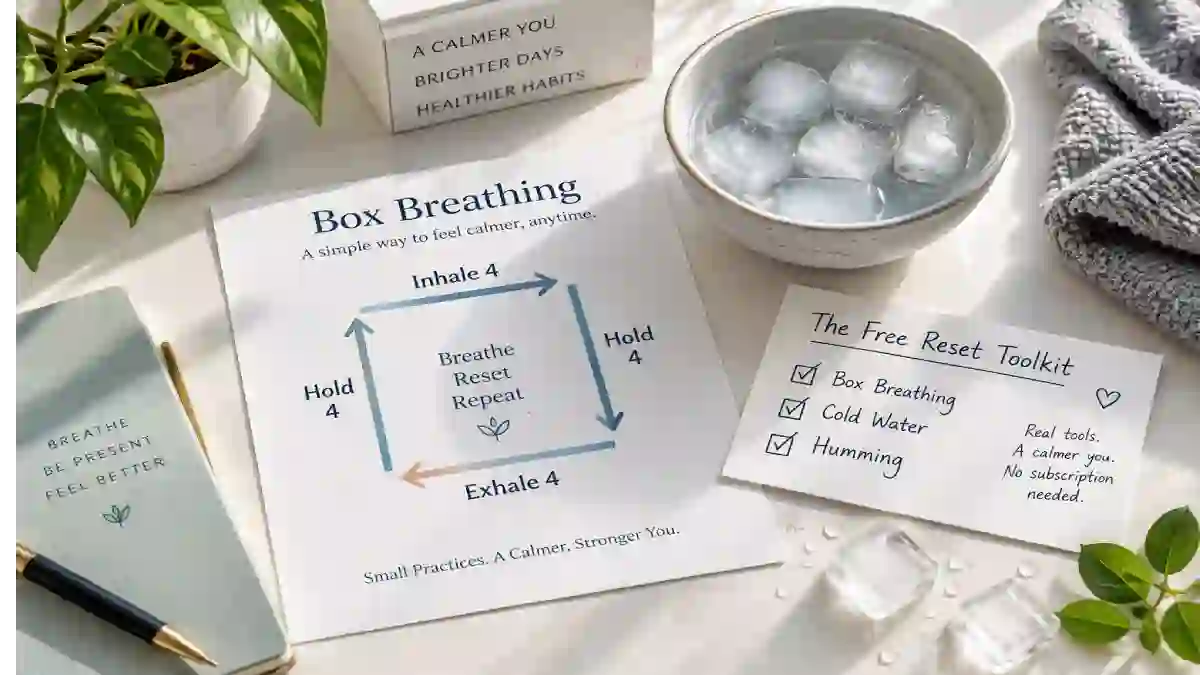
Box breathing is a form of yogic deep breathing also known as sama vritti pranayama. The technique is used by Navy SEALs, first responders, and stressed-out people everywhere. Its common name comes from the visual of a box: four sides, four counts, four phases of breath .
The pattern is:
- Inhale for 4 counts
- Hold for 4 counts
- Exhale for 4 counts
- Hold for 4 counts
Repeat for three to four rounds.
Why It Works
When you’re anxious, you breathe shallowly and quickly. This shallow breathing actually creates more anxiety within your body. It’s a feedback loop: stress causes shallow breathing, shallow breathing causes more stress .
Box breathing interrupts that loop. The slow, steady counting forces your breath into a longer, more even rhythm. This activates the parasympathetic nervous system, the branch responsible for rest and digestion. The result is a lower heart rate, reduced cortisol levels, and a calmer mind .
Harvard Health describes it as a technique that “can damp down the body’s sympathetic nervous system” while “engaging the parasympathetic nervous system, which controls the body’s ability to relax” .
How to Do It
- Sit comfortably. You can do this anywhere—at your desk, on a bus, in a waiting room .
- Exhale completely, releasing all the air from your lungs.
- Inhale through your nose for a count of four. Be conscious of how the air fills your lungs and stomach.
- Hold your breath for a count of four.
- Exhale through your mouth for a count of four.
- Hold your breath again for a count of four.
- Repeat for three to four rounds.
Dr. Melissa Young, an integrative medicine specialist, emphasizes the importance of not straining. “You don’t want to go too slowly or too quickly,” she says. “Stay at your comfort level, making sure you’re breathing very gently and not straining” .
When to Use It
Dr. Young recommends practicing box breathing one or two times a day, regardless of how you’re feeling. Try it first thing in the morning or after a stressful day of work. The more you practice when you’re calm, the easier it becomes to use when you’re not .
The Vagus Nerve: Your Body’s Built-In Brake System
To understand why these techniques work, you need to understand the vagus nerve.
What Is the Vagus Nerve?
The vagus nerve is the longest cranial nerve in your body, running from your brainstem through your neck, chest, and abdomen. It’s the main component of the parasympathetic nervous system—the “rest and digest” branch of your nervous system .
Think of it as your body’s built-in brake system. When activated, it slows your heart rate, lowers blood pressure, promotes digestion, and calms your mind. When underactive, you stay stuck in fight-or-flight .
Why Stimulating It Matters
Polyvagal theory, developed by Dr. Stephen Porges, describes the vagus nerve as the conductor of your emotional state. When it’s working well, you feel calm, connected, and safe. When it’s not, you feel anxious, overwhelmed, and disconnected .
The good news: you can consciously stimulate your vagus nerve through simple physical techniques. And you don’t need any equipment to do it.
The Physiological Sigh: The Fastest Reset You’re Not Using
If box breathing is the reliable tool, the physiological sigh is the emergency brake.
What It Is
A physiological sigh is a double inhale followed by a long exhale. You breathe in through your nose, take a second short inhale to fully inflate your lungs, then exhale slowly through your mouth until your lungs are empty.
Why It Works
Sighing isn’t just an emotional expression—it’s a physiological reset mechanism. Research published in Biological Psychology and ScienceDirect shows that sighs serve as “psychophysiological resetters,” restoring homeostasis when the respiratory system has been compromised .
A study published in ScienceDirect found that “self-reported relief following an instructed deep breath was higher than before” and that “physiological tension decreased following a spontaneous sigh” . The sigh isn’t just a sign of relief—it actually creates relief.
How to Do It
- Inhale through your nose.
- Before exhaling, take a second short inhale to fully inflate your lungs.
- Exhale slowly through your mouth until your lungs feel empty.
- Repeat two to three times.
When to Use It
The physiological sigh is best for acute, in-the-moment overwhelm. When you feel the stress response surging—chest tight, thoughts racing, panic rising—one or two physiological sighs can interrupt the spiral before it takes hold.
Cold Water Face Immersion: The 30-Second Vagal Reset
This one sounds uncomfortable. It is. And it works faster than almost anything else.
What It Is
Splashing cold water on your face—or immersing your face in a bowl of cold water—triggers what’s called the mammalian dive reflex. This reflex slows your heart rate and activates the parasympathetic nervous system .
Why It Works
A study published in Circulation Journal found that “bradycardia associated with cold-water face immersion is mainly attributed to cardiac vagal activity” . In plain English: cold water on your face directly stimulates the vagus nerve, producing a powerful parasympathetic response.
A study on ice water application to the face found that it “induces powerful vagal stimulation and bradycardia similar to, or even greater than, facial immersion in cold water” .
How to Do It
- Fill a bowl with cold water (add ice if you want a stronger effect).
- Take a breath and hold it.
- Immerse your face in the water for 15-30 seconds.
- Come up, breathe normally, and notice the shift.
If you don’t want to immerse your face, splashing cold water on your face several times works too. So does holding an ice pack or a cold, damp cloth against your cheeks and forehead.
When to Use It
Cold water immersion is best for high-intensity overwhelm—panic attacks, intense anxiety, or moments when you feel completely hijacked. It’s also a well-known technique used in trauma therapy to help regulate the nervous system .
Humming: The Free Vagus Nerve Hack You Can Do Anywhere
This is the most underrated technique on this list. And it’s probably the easiest.
What It Is
Humming—or singing, chanting, or even buzzing—stimulates the vagus nerve through vibration.
Why It Works
The vagus nerve runs through your vocal cords. When you hum, you create vibrations that directly stimulate the nerve. This triggers a parasympathetic response, calming your nervous system .
A study on Bhramari pranayama (humming bee breath) found that the practice “produces sound of humming bee” and that “practicing pranayama reduces the effects of stress on different systems by increasing the vagal tone” .
Courtney Lavadia, a behavioral health expert at Swedish, explains: “Because the vagus nerve touches our vocal cords, humming, singing, chanting or even buzzing can help stimulate relaxation during stressful moments” .
How to Do It
- Take a normal breath in through your nose.
- Exhale slowly while humming a low, steady tone.
- Feel the vibration in your lips, face, and chest.
- Continue for 30 seconds to a minute.
You don’t need to be a good singer. You don’t need to know a song. You just need to hum.
When to Use It
Humming is perfect for low-grade, chronic stress—the kind that builds up over a long day. It’s also easy to do discreetly. You can hum while walking, while doing dishes, or while sitting at your desk.
The 5-4-3-2-1 Grounding Technique: When Breathing Isn’t Enough
Sometimes, the overwhelm is so intense that focusing on your breath feels impossible. That’s where grounding techniques come in.
What It Is
The 5-4-3-2-1 grounding technique engages all five senses to pull your attention out of your anxious thoughts and into the present moment .
Why It Works
Anxiety is usually about the future—what might happen—or the past—what did happen. Grounding techniques bring you back to what’s happening right now. Dr. Melissa Young explains: “Grounding techniques like 5-4-3-2-1 bring you into the present moment” .
How to Do It
- 5 things you can see: Look around and name five things. Notice details—color, shape, texture.
- 4 things you can feel: Notice four physical sensations. The texture of your shirt, the pressure of your feet on the floor, the temperature of the air.
- 3 things you can hear: Identify three sounds. Traffic, birds, the hum of a refrigerator.
- 2 things you can smell: Notice two scents. Coffee, soap, fresh air.
- 1 thing you can taste: Notice one taste. Toothpaste, tea, the lingering flavor of lunch.
When to Use It
Use 5-4-3-2-1 when your thoughts are racing so fast that you can’t focus on your breath. It’s also helpful for anxiety that feels “stuck” in your head.
How to Build a Free Nervous System Reset Toolkit
The beauty of these techniques is that they’re all free, and they all work on the same principle: activating the parasympathetic nervous system through breath and body.
Here’s how to build your toolkit:
For Acute Overwhelm (Panic, Spiral, Hijack)
- Physiological sigh (2-3 reps) — fastest interruption
- Cold water face immersion (15-30 seconds) — strongest vagal activation
- Box breathing (3-4 rounds) — stabilizes after the initial surge
For Building Resilience (Daily Practice)
- Box breathing (1-2 times daily) — trains your nervous system to return to calm more easily
- Humming (30 seconds, a few times a day) — gentle, consistent vagal stimulation
- 5-4-3-2-1 grounding (when needed) — builds mindfulness and present-moment awareness
The Key Principle
The nervous system is not fixed. It’s plastic. You can change it by learning how to activate the parasympathetic response . Every time you practice one of these techniques, you’re strengthening the neural pathways that lead to calm. Over time, it becomes easier to return to a regulated state.
What the Research Actually Shows
The science behind these techniques is solid.
Box breathing: Studies show that regulating your breath can lower cortisol levels and blood pressure. It activates the parasympathetic nervous system, moving you out of fight-or-flight . Harvard Health confirms it can “damp down the body’s sympathetic nervous system” and “engage the parasympathetic nervous system” .
Physiological sigh: Research shows that sighs serve as “psychophysiological resetters,” restoring homeostasis and reducing muscle tension. Self-reported relief increases following a deep breath .
Cold water immersion: Studies confirm that cold water on the face “induces powerful vagal stimulation and bradycardia” . It’s a direct, powerful way to activate the parasympathetic nervous system .
Humming: Research on Bhramari pranayama shows it increases vagal tone and improves autonomic balance . The vibration of humming directly stimulates the vagus nerve .
Grounding: The 5-4-3-2-1 technique is a well-established mindfulness practice that interrupts anxious thought patterns by engaging the senses .
📌 YOU MIGHT ALSO LIKE:
How to Build a Sleep-Conducive Bedroom Environment for Under $30
DIY Body Dry Brushing: How a $5 Brush Boosts Circulation and Skin Glow
Frequently Asked Questions (FAQ)
1. How long does box breathing take to work?
Most people notice a shift within 60-90 seconds. The first round of 4-4-4-4 breathing starts the parasympathetic activation. By the third or fourth round, the effect is more pronounced.
2. Can I do box breathing in public without anyone noticing?
Yes. You can do it while sitting at your desk, on a bus, or in a meeting. The counting is silent. The breathing is gentle. No one will know you’re doing it.
3. What’s the difference between box breathing and the physiological sigh?
Box breathing is a structured, rhythmic practice that’s best for building calm over time. The physiological sigh is a quick reset that’s best for acute overwhelm. Use the sigh for emergencies, box breathing for daily practice.
4. Is cold water immersion safe for everyone?
Generally, yes. But if you have a heart condition, high blood pressure, or are pregnant, check with your doctor first. Cold water triggers a strong physiological response, and it’s not appropriate for everyone.
5. How often should I practice these techniques?
For box breathing, once or twice a day is ideal. For humming, whenever you think of it. For grounding and physiological sighs, use them as needed. The more you practice when you’re calm, the easier they are to access when you’re not.
6. What if none of these techniques work for me?
Different techniques work for different people. Try all of them and see which one resonates. If you’re dealing with chronic anxiety or trauma, these techniques are complementary tools, not replacements for professional support. A therapist can help you build a more personalized toolkit.
7. Can these techniques replace medication or therapy?
No. These are free, accessible tools that can help you manage moments of overwhelm. They are not a substitute for professional mental health care. If you’re struggling with persistent anxiety, depression, or trauma, please talk to a healthcare provider.
8. Why does humming work when I’m stressed?
Humming stimulates the vagus nerve through vibration. The vagus nerve runs through your vocal cords, so humming directly activates the parasympathetic nervous system. It also forces a longer exhale, which is itself a calming signal to your body .
Final Thoughts: The Reset Is Already Inside You
The email is still there. The client still asked for the revision. But the panic is gone. And it didn’t cost me anything to get there.
The toolkit:
- Box breathing: 4 counts in, 4 hold, 4 out, 4 hold. Repeat.
- Physiological sigh: Double inhale, long exhale. Repeat.
- Cold water: Splash your face. 30 seconds.
- Humming: 30 seconds. Any song.
- Grounding: 5-4-3-2-1. Use your senses.
None of these require an app. None require a subscription. None require a prescription.
They require you. And you’re already enough.
The nervous system is plastic. It can change. And you can change it—one breath at a time.
That’s not cheap. That’s free.
That’s the frugal glow. And it’s already inside you. 🧘💛
*For more free wellness tools, budget mental health strategies, and frugal living advice, visit The Frugal Glow.*