

Fast Fashion vs. Quality Denim: The Real Cost of Replacing $30 Jeans Every Year
Jump Links
- Why $30 Jeans Are a Trap (Not a Bargain)
- The Hidden Costs of Cheap Denim (Beyond the Price Tag)
- What You’re Actually Getting for $30 vs. $100: The Breakdown
- The Cost-Per-Wear Math: $30 Jeans vs. $100 Jeans
- Why $30 Jeans Fail: Fabric Weight, Elastane, and Construction
- The Environmental Cost of Cheap Denim (It’s Not Just Your Wallet)
- How to Spot Quality Denim Without Spending a Fortune
- The Sweet Spot: Where to Get the Best Value
- The Math: What I Saved in One Year
- Frequently Asked Questions (FAQ)
- Final Thoughts: The Cheapest Jeans Are the Ones You Only Buy Once
The $30 pair of jeans was sitting in my cart. Again. I had bought the same brand three times in two years. Each pair looked great for a few months. Then the knees bagged out, the color faded, and the inner thigh seams started to fray. I replaced them. And replaced them again.
That was the day I realized I wasn’t saving money. I was just paying for jeans in installments.
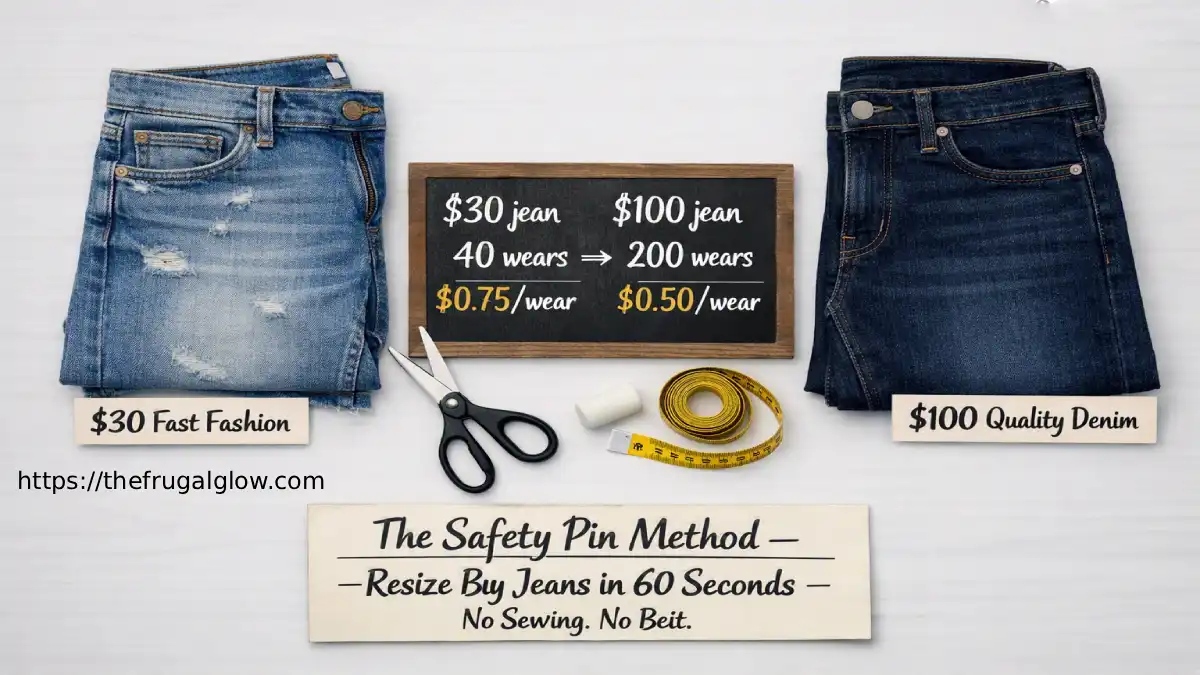
I decided to run the numbers. That $30 pair lasted about 40 wears before it started looking sad . A $100 pair of quality denim, on the other hand, can easily last 200 wears or more . That meant the $30 jeans cost me $0.75 per wear. The $100 jeans cost me $0.50 per wear. The “expensive” pair was actually cheaper.
Today, I’m breaking down the real cost of replacing $30 jeans every year. The math. The materials. The hidden environmental and social costs. And why the cheapest jeans are the ones you only buy once.
Why $30 Jeans Are a Trap (Not a Bargain)
Fast fashion jeans are designed to look good in the store, not to last in your closet. The business model relies on you replacing them frequently . A $30 price tag is seductive, but it hides the fact that you’re buying the same pair of jeans over and over again.
Here’s the reality: a typical pair of fast fashion jeans ($30-40) delivers about 25-40 wears before visible quality decline sets in . The fabric stretches out at the knees and seat. The color fades unevenly. The seams start to fail. By month six, they look worn out. By month twelve, they’re in the donation pile or the trash.
Meanwhile, a $100 pair of mid-range denim consistently delivers 180-200 wears before it shows significant wear . That’s five times the lifespan for three times the price. The math isn’t complicated.
A fashion educator explains the difference in simple terms: fast fashion jeans are made with lighter fabrics, looser construction, and less attention to detail because the manufacturer has to hit a price point that leaves room for profit . They cut corners on materials and construction time.
The Hidden Costs of Cheap Denim (Beyond the Price Tag)
The upfront cost is only the beginning. Here’s what you’re really paying for when you buy $30 jeans.
The “replacement tax”: You buy a pair. It lasts a year. You buy another. And another. Over five years, you’ve spent $150 on five pairs of jeans that are always in the “falling apart” phase of their lifecycle . A $100 pair of quality jeans, worn for five years, costs you $100 total. You save $50 and you always have jeans that look good.
The time cost: Every time your $30 jeans fail, you have to go shopping again. You have to find a new pair that fits. You have to break them in. You have to deal with the frustration of clothes that don’t fit right. Time is money, and cheap jeans cost you both.
The confidence cost: Wearing jeans that are stretched out, faded, or fraying doesn’t make you feel good. Cheap denim loses its shape quickly, which means it stops flattering your body . Quality denim molds to your body over time, becoming more comfortable and better-fitting with every wear .
The environmental cost: The fashion industry produces 100 billion garments annually, and 92 million tons end up in landfills every year . When you buy cheap jeans that fail quickly, you’re contributing to that waste. Quality denim reduces the number of pairs you buy and discard.
What You’re Actually Getting for $30 vs. $100: The Breakdown
Let’s compare what your money buys at each price point .
Under $40 (Fast Fashion):
- Fabric weight: 8-10 oz (thin, loses structure quickly)
- Elastane content: 4-8% (stretches out, doesn’t recover)
- Seam construction: Single-needle stitching on most seams
- Hardware: Lightweight zinc or aluminum
- Pattern grading: Proportional scaling (fits one body type, everyone else awkwardly)
- Lifespan: 3-6 months of regular wear
- Cost per wear: ~$0.75-1.00
$60-120 (Mid-Range):
- Fabric weight: 11-13 oz (substantial, holds shape)
- Elastane content: 1-2% (comfortable but holds its shape)
- Seam construction: Double-needle stitching throughout
- Hardware: Heavier copper-toned or branded hardware
- Pattern grading: Multiple fits within a silhouette
- Lifespan: 2-4 years of regular wear
- Cost per wear: ~$0.50-0.60
$150+ (Premium):
- Fabric weight: 14 oz and above (durable, ages beautifully)
- Elastane content: 0-1% (rigid or minimal stretch)
- Seam construction: Chain stitch on select seams, bar tacks at stress points
- Hardware: Donut buttons, custom-stamped, YKK zippers
- Pattern grading: Cut-and-sew pattern work, hidden rivets
- Lifespan: 5+ years to decades
- Cost per wear: ~$0.50
The real divide isn’t between mid-range and premium. It’s between fast fashion and everything above it . Once you cross the $75 threshold, you’re getting genuine quality.
The Cost-Per-Wear Math: $30 Jeans vs. $100 Jeans
Cost per wear is the most honest way to evaluate clothing value: divide the purchase price by the number of times you wear the item .
| Pair of Jeans | Price | Expected Wears | Cost Per Wear | 5-Year Total |
|---|---|---|---|---|
| Fast fashion | $30 | 40 | $0.75 | $150 (5 pairs) |
| Mid-range | $95 | 180 | $0.53 | $190 (2 pairs) |
| Premium | $175 | 350 | $0.50 | $175 (1 pair) |
The fast fashion × 5 years math: five pairs × $30 = $150 total spent. And after five years, you’ve worn jeans that were mostly in the “falling apart” phase. The mid-range pair costs $95 total and stays in good condition for years .
A fashion expert explains the numbers: a €50 pair of jeans that lasts one year costs €50 per year. A €150 pair that lasts five years costs €30 per year. The cost per wear is always lower for quality denim .
Why $30 Jeans Fail: Fabric Weight, Elastane, and Construction
There are three technical reasons cheap jeans fall apart.
Fabric Weight: Fabric weight is the most reliable single indicator of denim quality. Fast fashion jeans typically run 8-10 oz, which produces a soft, pliable fabric that drapes nicely in the fitting room but loses its structure quickly . Mid-range jeans run 11-13 oz. Premium denim runs 14 oz and above. The heavier the weave, the more structure the fabric holds over time. You can feel this difference immediately when you handle the fabric.
Elastane Content: High elastane content (4-8%) causes jeans to bag at the knees and seat after a few hours of wear because the fiber snaps back unevenly when the garment heats up on the body . Quality denim typically has 1-2% elastane, which produces a comfortable fit without compromising durability.
Seam Construction: Fast fashion jeans use single-needle stitching on most seams, which pulls out faster under stress . Mid-range and premium denim use double-needle stitching throughout and bar tacks at stress points like pocket corners and fly base.
A denim expert explains that a well-made pair of jeans can last at least 10 years. The construction details—bar tacks, reinforced hardware, and precise pocket placement—ensure longevity .
The Environmental Cost of Cheap Denim (It’s Not Just Your Wallet)
The environmental impact of fast fashion denim is staggering.
- Water use: It takes 2,700 liters of water to make ONE t-shirt . Denim production is even more water-intensive.
- Carbon emissions: The fashion industry is responsible for roughly 10% of global carbon emissions, more than all international flights and maritime shipping combined .
- Textile waste: 92 million tons of clothing end up in landfills annually. By 2030, fast fashion waste is expected to increase to 134 million tons .
- Microplastics: 35% of all microplastics found in the ocean come from the laundering of synthetic textiles like polyester, which are common in cheap denim blends .
A textile expert notes that global fiber production is projected to rise from 132 million tons to 169 million tons between 2025 and 2030, with only about 1% of textile waste getting recycled into new textiles . The problem is growing, not shrinking.
Quality denim brands use organic cotton, natural indigo, and water-saving dyeing processes. Many offer repair programs to extend the life of their jeans instead of encouraging disposal . When you choose quality denim, you’re not just saving money. You’re voting for a more sustainable fashion future.
How to Spot Quality Denim Without Spending a Fortune
Here’s how to identify quality denim at any price point .
1. Check the elastane on the tag.
Target: 2% or under for longevity. Over 4% is a red flag .
2. Handle the fabric.
Does it have weight and substance, or is it thin and flimsy even before trying on? Heavier denim feels substantial in your hands .
3. Check the pocket corners.
Bar tacks present? Pocket bag fabric substantial? Fast fashion jeans often skip bar tacks, which is why pocket corners are the first place they fail .
4. Sit down in the fitting room.
Does the waistband gap at the back? Does the rise feel right when seated? A $30 pair that fails the sit test is not a bargain. Quality denim should stay in place when you move .
5. Look at the waistband edge.
Is it interfaced and lying flat, or already starting to roll? Fast fashion jeans often have single-layer waistbands that roll and curl after several washes .
6. Check the hardware.
Solid rivets and sturdy zippers instead of flimsy plastic. Quality brands use branded or custom hardware that holds finish through repeated washing .
7. Turn them inside out.
Does the inside look as clean as the outside? Quality construction shows on the inside of the garment .
The Sweet Spot: Where to Get the Best Value
The honest sweet spot for most buyers is $75-120 . At this price point, you consistently get 11-12 oz denim, 1-2% elastane content, double-stitched seams, interfaced waistbands, and better pattern grading. You’re getting real quality for the money, not a label premium.
Brands that reliably deliver at this tier :
- Madewell: Consistent fabric weight, good sizing range
- Everlane: Transparent about manufacturing costs and fabric specs
- Uniqlo’s selvedge line: Genuinely heavy-weight Japanese denim at a mid-range price
- Levi’s Made in the USA line: Distinct from their mainline, which is largely mid-tier
For sizing variety and body-type-specific fits, brands like Good American and Universal Standard invest in genuine multi-fit grading rather than proportional scaling .
A fashion expert notes that premium denim often uses Japanese or American-made fabric with heavier weights and tighter weave standards. Brands that manufacture in Japan for their premium lines are typically transparent about it .
The Math: What I Saved in One Year
Here’s what happens when you stop replacing $30 jeans every year.
Before (fast fashion cycle):
| Year | Pairs Bought | Cost | Cost Per Wear |
|---|---|---|---|
| Year 1 | 2 pairs ($30 each) | $60 | ~$0.75 |
| Year 2 | 2 pairs | $60 | ~$0.75 |
| Year 3 | 2 pairs | $60 | ~$0.75 |
| 3-Year Total | 6 pairs | $180 | — |
After (one quality pair):
| Year | Pairs Bought | Cost | Cost Per Wear |
|---|---|---|---|
| Year 1 | 1 pair ($95) | $95 | ~$0.53 |
| Year 2 | 0 pairs | $0 | ~$0.53 |
| Year 3 | 0 pairs | $0 | ~$0.53 |
| 3-Year Total | 1 pair | $95 | — |
Annual savings after switching: $85
Over 5 years: $425
And I never have to deal with baggy knees, faded color, or fraying seams again.
📌 YOU MIGHT ALSO LIKE:
Home Gym vs. ‘Planet Fitness’ Membership: The 12-Month ROI Breakdown
Frequently Asked Questions (FAQ)
1. Why do cheap jeans lose their shape so fast?
Cheap jeans use lightweight fabrics (8-10 oz) and high elastane content (4-8%). The lightweight fabric doesn’t hold structure, and the high elastane stretches out and doesn’t recover. The result is baggy knees and a sagging seat after just a few hours of wear .
2. Is it really cheaper to buy expensive jeans?
Yes. A $95 pair of mid-range jeans worn 180 times costs $0.53 per wear. A $30 pair of fast fashion jeans worn 40 times costs $0.75 per wear. The “expensive” pair is cheaper .
3. How many wears should I expect from different price tiers?
Fast fashion denim typically delivers 25-40 wears before visible quality decline. Mid-tier denim reaches 80-150 wears with proper care. Premium denim can deliver 200-300+ wears .
4. What’s the single most important thing to check before buying jeans?
Check the elastane content on the tag. 2% or under is ideal for longevity. Over 4% is a red flag—those jeans will stretch out and lose their shape quickly .
5. Can I make cheap jeans last longer?
Yes, but only up to a point. Wash them inside out in cold water, air dry, and avoid the dryer. But even with perfect care, lightweight fabrics and high elastane content will eventually fail. Quality denim is a better investment .
6. How can I tell if a pair of jeans is well-made?
Turn them inside out. Check the stitching—tight, straight, double-stitched seams indicate quality. Look for bar tacks at pocket corners. Feel the fabric weight. Check the hardware. Sit down in the fitting room—does the waistband gap? If it does, the pattern grading is poor .
7. What’s the best price point for quality denim?
The sweet spot is $75-120. At this price point, you consistently get 11-12 oz denim, 1-2% elastane, double-stitched seams, and better pattern grading. You’re getting real quality for the money, not just a label premium .
8. Is sustainable denim worth the extra cost?
Yes. Sustainable denim uses organic cotton, natural indigo, and water-saving dyeing processes. It reduces environmental impact and often lasts longer because it’s made with higher-quality materials. The cost per wear is lower than fast fashion denim .
Final Thoughts: The Cheapest Jeans Are the Ones You Only Buy Once
The $30 pair of jeans is sitting in my closet. I bought it last year. I’ve worn it maybe 15 times. It already looks stretched out. I’m not going to replace it.
The $95 pair I bought three years ago is still going strong. It’s faded perfectly. It fits like a second skin. It’s been with me through hundreds of days. And I haven’t spent another dime on jeans since I bought it.
The math is simple: the cheapest jeans are the ones you only buy once.
Quality denim costs more upfront. But it lasts years longer, looks better, and costs less per wear. You’re not just buying jeans. You’re buying years of wear, better fits, and fewer trips to the store.
Next time you’re tempted by a $30 pair of jeans, do the math. Divide the price by how many times you’ll wear them. Then compare that to a $100 pair. You’ll see that the “expensive” pair is actually cheaper.
That’s not cheap. That’s smart.
That’s the frugal glow. And it’s waiting for you in a pair of jeans that actually lasts. 💛
For more budget fashion tips, quality guides, and money-saving style strategies, visit The Frugal Glow.