

Home Gym vs. ‘Planet Fitness’ Membership: The 12-Month ROI Breakdown
Let me tell you about the $40 I wasted on a gym membership I never used.
I signed up for Planet Fitness in January. $15 a month. $40 annual fee. I was motivated. I was going to go three times a week. I was going to get in the best shape of my life.
I went twice.
Then life happened. Work got busy. The weather was bad. The gym was crowded. I kept telling myself I’d go tomorrow. Tomorrow never came.
By December, I had spent $220 on a gym membership I barely used. That’s $110 per workout. That’s more expensive than a personal trainer. That’s more expensive than a massage. That’s more expensive than almost anything I could have done at home.
I canceled my membership. I spent $200 on a set of adjustable dumbbells, a yoga mat, and some resistance bands. I’ve been working out at home ever since. I go three times a week, every week. No excuses. No waiting for machines. No commuting.
That was three years ago. I’ve saved over $1,000 since then. And I’m in better shape than I ever was with a gym membership.
Today, I’m breaking down the 12-month ROI of a Planet Fitness membership vs. building a home gym. The exact costs. The hidden fees. The break-even point. And why one option is a much better investment for most people.
Let’s get into it.
Jump Links
- The $40 I’ll Never Get Back
- Planet Fitness: The Real Cost of a ‘Cheap’ Membership
- Home Gym: The Upfront Investment (And Why It Pays Off)
- The 12-Month Comparison: Side by Side
- The Break-Even Point: When Home Gym Becomes Cheaper
- The Hidden Costs of Both Options (What Nobody Tells You)
- The Convenience Factor: How Much Is Your Time Worth?
- The Motivation Factor: Why Home Works for Some and Not Others
- How to Build a Home Gym on a Budget (Under $300)
- The Hybrid Approach: Best of Both Worlds
- The Math: What I Saved in Three Years
- Frequently Asked Questions (FAQ)
- Final Thoughts: The Best Gym Is the One You Actually Use
The $40 I’ll Never Get Back
I need to describe the moment I realized I had wasted my money.
I was looking at my bank statement. I saw the $15 charge from Planet Fitness. Then the $40 annual fee. Then another $15. Then another. I had been paying for six months. I had been to the gym twice.
I did the math. $15 × 6 = $90. Plus $40 annual fee = $130. Divided by 2 workouts = $65 per workout.
I could have hired a personal trainer for that. I could have bought a massage. I could have gone out for a nice dinner. Instead, I paid for a gym I never used.
The worst part? I knew I wasn’t going to go. I knew it on day one. The gym was 15 minutes away. By the time I drove there, worked out, showered, and drove back, I had used up 90 minutes. I didn’t have 90 minutes. I had 30 minutes. I needed something I could do at home.
I canceled my membership. I bought a set of adjustable dumbbells for $150. I bought a yoga mat for $20. I bought resistance bands for $15. Total investment: $185.
I’ve been working out at home for three years. I go three times a week. That’s over 450 workouts. My cost per workout? $0.41.
The gym was $65 per workout. The home gym is $0.41 per workout. The home gym is 150 times cheaper.
That’s not a small difference. That’s life-changing.
Planet Fitness: The Real Cost of a ‘Cheap’ Membership
Planet Fitness advertises $15 a month. But that’s not the real cost.
The advertised price: $15/month
The real cost over 12 months:
| Fee | Amount |
|---|---|
| Monthly fee ($15 × 12) | $180 |
| Annual fee (charged once per year) | $49 |
| Join fee (one-time, often waived) | $1-49 |
| Taxes | ~$20 |
| Total 12-month cost | $250-$300 |
What you get for that price:
- Access to one club (Classic membership) or any club (Black Card)
- Free fitness training with a certified trainer
- Access to the PF App with on-demand workouts
- 24-hour access at most locations
The Black Card upgrade:
- $24.99/month
- Access to any Planet Fitness location
- Bring a guest every time
- Black Card Spa (tanning, massage chairs)
- Total 12-month cost: ~$350
The hidden cost:
The annual fee is a surprise for most people. You think you’re paying $15/month. Then you get hit with a $49 charge. That’s $49 you weren’t expecting. That’s $49 that makes your “cheap” membership cost $250/year.
The other hidden cost:
If you want to cancel before 12 months, you may have to pay an early termination fee (for some membership types). Read the fine print.
The break-even point for Planet Fitness:
If you go 3 times per week (156 workouts per year), your cost per workout is $250/156 = $1.60.
If you go 1 time per week (52 workouts), your cost per workout is $4.80.
If you go 10 times per year (like me), your cost per workout is $25.
The more you go, the cheaper it gets. But only if you actually go.
Home Gym: The Upfront Investment (And Why It Pays Off)
A home gym has a higher upfront cost. But it pays off over time.
The average cost to build a home gym:
According to CNET’s analysis, the average home gym costs $1,098. This includes:
- 2 kettlebells ($42-47 each)
- A treadmill or cardio machine ($400)
- Weights and accessories
According to Xcelerate Gyms, most people spend between $1,500 and $3,000 for a solid setup.
According to Realtor.com, the average cost is $7,750, but budget setups can cost $2,150 to $3,600.
What you need for a basic home gym ($300):
| Item | Cost |
|---|---|
| Adjustable dumbbells (one pair) | $150 |
| Yoga mat | $20 |
| Resistance bands (set of 3-5) | $15 |
| Exercise ball | $15 |
| Jump rope | $10 |
| Total | $210 |
Add a bench: $80. Total: $290.
What you need for a mid-range home gym ($1,500):
| Item | Cost |
|---|---|
| Adjustable dumbbells (up to 50 lbs) | $300 |
| Adjustable bench | $200 |
| Power rack | $400 |
| Barbell and plates | $300 |
| Rubber flooring | $200 |
| Resistance bands and accessories | $100 |
| Total | $1,500 |
What you need for a premium home gym ($3,000+):
- Commercial-grade rack
- Full dumbbell set
- Cardio machine (treadmill or bike)
- Full flooring
- Mirrors and accessories
The used market advantage:
You can often find bumper plates and equipment at half price on Facebook Marketplace, OfferUp, and Craigslist. Many people buy equipment and never use it. Their loss is your gain.
My advice: Start with a basic setup. Use it for 3-6 months. If you’re consistent, upgrade piece by piece. Don’t spend $1,500 on equipment you might not use.
The 12-Month Comparison: Side by Side
Let me put these head-to-head.
Planet Fitness (Classic) – 12 months:
| Cost | Amount |
|---|---|
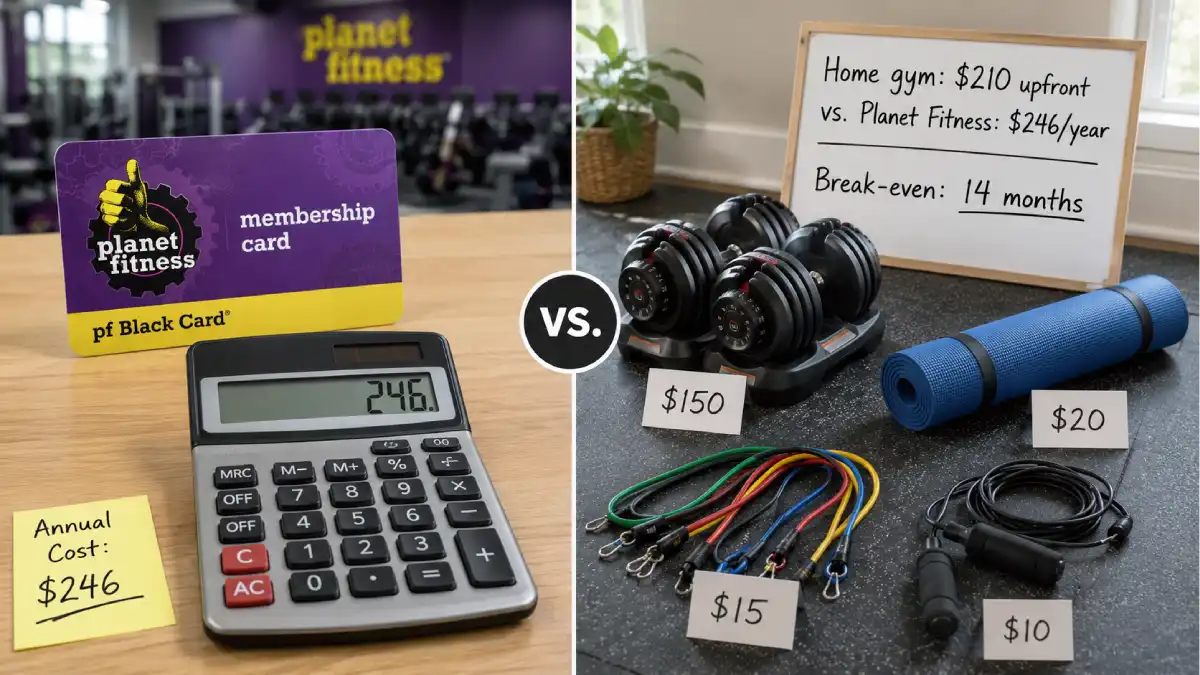
| Monthly fees ($15 × 12) | $180 |
| Annual fee | $49 |
| Join fee (waived with promotion) | $1 |
| Taxes (~7%) | $16 |
| Total 12-month cost | $246 |
Planet Fitness (Black Card) – 12 months:
| Cost | Amount |
|---|---|
| Monthly fees ($24.99 × 12) | $300 |
| Annual fee | $49 |
| Join fee (waived) | $1 |
| Taxes (~7%) | $25 |
| Total 12-month cost | $375 |
Basic Home Gym ($300 setup) – 12 months:
| Cost | Amount |
|---|---|
| Equipment purchase | $300 |
| Maintenance/upgrades | $0 |
| Total 12-month cost | $300 |
But wait. The home gym costs more in year 1. But it costs almost nothing in years 2, 3, 4, and beyond.
After 3 years:
| Option | Year 1 | Year 2 | Year 3 | Total |
|---|---|---|---|---|
| Planet Fitness | $246 | $246 | $246 | $738 |
| Basic Home Gym | $300 | $0 | $0 | $300 |
After 5 years:
| Option | Year 1 | Year 2 | Year 3 | Year 4 | Year 5 | Total |
|---|---|---|---|---|---|---|
| Planet Fitness | $246 | $246 | $246 | $246 | $246 | $1,230 |
| Basic Home Gym | $300 | $0 | $0 | $0 | $0 | $300 |
The home gym saves you over $900 in 5 years.
The Break-Even Point: When Home Gym Becomes Cheaper
The break-even point depends on your setup and the gym membership you’re comparing.
Scenario 1: Basic Home Gym ($300) vs. Planet Fitness ($246/year)
- Year 1: Gym is cheaper ($246 vs. $300) – difference of $54
- Year 2: Home gym becomes cheaper ($300 vs. $492) – you save $192
- Break-even point: 13-14 months
Scenario 2: Mid-Range Home Gym ($1,500) vs. Planet Fitness ($246/year)
- Year 1: Gym is cheaper ($246 vs. $1,500)
- Year 2: Gym is still cheaper ($492 vs. $1,500)
- Year 3: Gym is still cheaper ($738 vs. $1,500)
- Year 4: Home gym becomes cheaper ($984 vs. $1,500)
- Break-even point: 6-7 years
Scenario 3: Mid-Range Home Gym ($1,500) vs. Premium Gym ($100/month)
- Year 1: Home gym is cheaper ($1,500 vs. $1,200? Actually, gym is cheaper in year 1)
- Year 2: Home gym becomes cheaper ($1,500 vs. $2,400) – you save $900
- Break-even point: 15 months
The key takeaway:
If you’re comparing to a premium gym ($100+/month), a mid-range home gym pays for itself in 15-18 months.
If you’re comparing to Planet Fitness ($15/month), a basic home gym pays for itself in 13-14 months, but a mid-range setup takes 6-7 years.
The CNET calculation: Based on Gold’s Gym ($25/month) vs. a $1,098 home gym, the break-even point is about 4 years.
My calculation: Based on Planet Fitness ($246/year) vs. a $300 basic home gym, the break-even point is about 14 months.
The Hidden Costs of Both Options (What Nobody Tells You)
Neither option is perfect. Both have hidden costs.
Planet Fitness hidden costs:
| Hidden Cost | Amount | Frequency |
|---|---|---|
| Annual fee | $49 | Once per year |
| Join fee (if no promotion) | $1-49 | One time |
| Transportation (gas, mileage) | $50-200/year | Ongoing |
| Time commuting | 30-60 minutes per visit | Each visit |
| Waiting for equipment | 5-20 minutes per visit | Each visit |
| Cancelation fee (if applicable) | $99+ | If you cancel early |
Home gym hidden costs:
| Hidden Cost | Amount | Frequency |
|---|---|---|
| Space (lost square footage) | Varies (could be $50-200/year) | Ongoing |
| Maintenance/repairs | $50-200/year | As needed |
| Upgrades | $100-500 | Every few years |
| Electricity (if using cardio machines) | $20-50/year | Ongoing |
| Insurance (if worried about liability) | Varies | Optional |
The space cost:
A home gym takes up space. If you live in a small apartment, that space is valuable. If you live in a house with a spare bedroom, the space cost is less significant.
According to Realtor.com, home gyms “take up valuable square footage and can carry a real cost in many housing markets”.
My experience:
I converted a corner of my bedroom into a gym. It takes up about 15 square feet. In my city, that’s about $100/year in rent. I’m fine with that.
The Convenience Factor: How Much Is Your Time Worth?
Time is money. Let’s put a dollar value on it.
Planet Fitness time cost (per workout):
| Activity | Time |
|---|---|
| Getting ready/packing bag | 10 minutes |
| Driving to gym | 15 minutes |
| Parking/walking in | 5 minutes |
| Workout | 45 minutes |
| Showering/changing | 15 minutes |
| Driving home | 15 minutes |
| Total | 105 minutes |
Home gym time cost (per workout):
| Activity | Time |
|---|---|
| Walking to gym area | 1 minute |
| Workout | 45 minutes |
| Showering/changing | 10 minutes |
| Total | 56 minutes |
Time saved per workout: 49 minutes
Over a year (3 workouts per week):
- Time saved per week: 147 minutes (2.45 hours)
- Time saved per year: 7,644 minutes (127 hours)
- That’s 5 full days of your life. Saved.
The dollar value of that time:
Let’s say you value your time at $25/hour (roughly $50k/year salary).
- 127 hours × $25/hour = $3,175
- That’s the time value of a home gym.
Yes, the upfront cost is higher. But the time savings are massive. CNET noted that “at-home workouts are a clear winner when factoring in your time” because “preparing and commuting to the gym can be time-consuming”.
The Motivation Factor: Why Home Works for Some and Not Others
This is the most important factor. The best gym is the one you actually use.
Why a gym membership works for some people:
- Community: “The most common reason why my former riders took group fitness classes instead of working out at home was the community and camaraderie of exercising with someone”.
- Accountability: When you pay for a membership, you feel obligated to use it.
- Change of scenery: Some people need to leave their house to get in the right mindset.
- Equipment variety: Gyms have everything. You don’t need to buy it.
Why a home gym works for some people:
- Convenience: No commute. No parking. No waiting for equipment.
- Flexibility: You can work out anytime, in your pajamas, without worrying about judgment.
- Privacy: No one watches you. No judgment. Just you and your workout.
- Consistency: “Those who remove as many barriers to use as possible and create habits surrounding their home gym will generate the most benefits from it”.
The judgment-free zone:
Planet Fitness is known for its “Judgement Free Zone”. But for some people, any gym is intimidating. A home gym eliminates that entirely.
The hybrid approach:
Start with a gym membership while you build your home gym. Many people do this. You get the benefits of both. And you can cancel the membership once you’re consistent at home.
My experience:
I was never going to be a gym person. I tried. I failed. The commute was too long. The crowds were too much. I needed something I could do in 30 minutes without leaving my house.
The home gym works for me. It might work for you. It might not. The important thing is to know yourself.
How to Build a Home Gym on a Budget (Under $300)
You don’t need to spend $1,000+ to get started. Here’s how to do it cheaply.
Phase 1: The essentials ($100-300)
According to Planner 5D, the goal of this phase is to “remove every excuse not to train by spending as little as possible on highly versatile gear”.
The essentials:
- A set of resistance bands ($15-60)
- A good utility mat ($20)
- One pair of adjustable dumbbells or a single kettlebell ($150)
Phase 2: The strength foundation ($500-1,500)
Once you’re training consistently (3-4 days per week), you can upgrade:
- A power rack or squat stand ($250-400)
- An Olympic barbell ($150-300)
- A set of bumper plates ($200-400)
- An adjustable bench ($150-200)
Phase 3: Specialty and recovery gear ($500-1,000)
After 6-12 months of consistent training:
- Cardio machine (rowing machine or stationary bike – $200-500)
- Cable machine ($300-500)
Money-saving tips:
- Buy used: “Check OfferUp, Facebook Marketplace or your local community for more affordable, gently used equipment without paying full price”. Also, “you can often find bumper plates at half price”.
- Buy versatile equipment: “Prioritize gear that enables at least five different exercises. For example, a bench can be used for presses, rows, step-ups, and dips, whereas a leg extension machine only does one thing”.
- Start small: Buy the essentials first. Use them. If you’re consistent, add more equipment later. “You can add to your gym over time and shop sales”.
- Consider your space: Know your ceiling height, floor space, and how much room equipment will take up.
My budget setup ($210):
- Adjustable dumbbells: $150
- Yoga mat: $20
- Resistance bands: $15
- Exercise ball: $15
- Jump rope: $10
Total: $210. Enough to do full-body workouts 3-4 times per week.
The Hybrid Approach: Best of Both Worlds
You don’t have to choose one or the other. You can do both.
Option 1: Gym membership + basic home equipment
- Keep a cheap gym membership ($15-25/month)
- Buy a few pieces of home equipment (resistance bands, a mat, dumbbells)
- Use the gym for heavy lifting and variety
- Use the home equipment for quick workouts and days when you can’t get to the gym
Option 2: Home gym + occasional gym visits
- Build a basic home gym ($300)
- Keep a gym membership for the first 6 months
- Once you’re consistent at home, cancel the gym membership
- Buy day passes or class packs when you want to use specialized equipment
The hybrid math:
Let’s say you keep a Planet Fitness membership ($246/year) while you slowly build your home gym. You spend $300 on equipment in year 1. Total year 1 cost: $546. That’s $300 more than just the gym membership.
But in year 2, you cancel the membership. Your cost is $0. Total over 2 years: $546. A gym membership alone over 2 years: $492. The hybrid is $54 more over 2 years. Not a big difference.
By year 3: The hybrid is $546 total. The gym membership is $738. The hybrid saves $192.
The hybrid is a smart approach if you want to test the waters before committing to a full home gym.
The Math: What I Saved in Three Years
Let me break down my actual savings.
Before (Planet Fitness membership):
| Year | Monthly Fee | Annual Fee | Total |
|---|---|---|---|
| Year 1 | $15 × 12 = $180 | $49 | $229 |
| Year 2 | $15 × 12 = $180 | $49 | $229 |
| Year 3 | $15 × 12 = $180 | $49 | $229 |
| Total | $687 |
After (home gym):
| Year | Equipment | Maintenance | Total |
|---|---|---|---|
| Year 1 | $210 | $0 | $210 |
| Year 2 | $0 | $0 | $0 |
| Year 3 | $0 | $0 | $0 |
| Total | $210 |
Total savings over 3 years: $477
But wait. The cost per workout is where it gets crazy.
Gym membership cost per workout:
- Total gym visits over 3 years: 24 (I went 8 times per year)
- Cost per workout: $687/24 = $28.63
Home gym cost per workout:
- Total home workouts over 3 years: 468 (3 times per week, 52 weeks per year)
- Cost per workout: $210/468 = $0.45
The home gym is 63 times cheaper per workout.
That’s not a small difference. That’s the difference between “I can’t afford to work out” and “I can’t afford not to work out.”
The ‘Cost Per Wear’ Formula: Why a $100 Coat is Cheaper Than a $30 Fast-Fashion One
Frequently Asked Questions (FAQ)
1. Is a home gym really cheaper than a Planet Fitness membership?
Yes, over the long term. Planet Fitness costs about $246 per year. A basic home gym costs about $300 upfront. After 14 months, the home gym becomes cheaper. Over 5 years, a home gym saves you over $900 compared to a Planet Fitness membership.
2. How long does it take for a home gym to pay for itself?
For a basic home gym ($300) compared to Planet Fitness ($246/year), the break-even point is about 14 months. For a mid-range home gym ($1,500) compared to Planet Fitness, it takes about 6-7 years. For a mid-range home gym compared to a premium gym ($100/month), it takes 15-18 months.
3. What’s the cheapest way to start a home gym?
Start with resistance bands ($15-60), a yoga mat ($20), and a pair of adjustable dumbbells ($150). Total cost: $185-230. You can do full-body workouts with just these. Add equipment gradually as you get consistent.
4. Can I build a home gym for under $500?
Yes. A basic setup costs $300-500. You can get adjustable dumbbells ($150), a bench ($100), resistance bands ($30), a mat ($20), and a jump rope ($10). Total: $310. For $500, you can add a barbell and plates or a cardio machine.
5. Where can I buy used home gym equipment?
Facebook Marketplace, OfferUp, Craigslist, and neighborhood Buy Nothing groups. “You can often find bumper plates at half price”. Many people buy equipment and never use it. Their loss is your gain.
6. What are the hidden costs of a home gym?
Space (lost square footage), maintenance/repairs, upgrades, and electricity (if using cardio machines). A home gym takes up space that could be used for something else. But for most people, these costs are minimal compared to ongoing gym membership fees.
7. What if I don’t have space for a home gym?
You don’t need much space. A corner of a bedroom, a garage, or a basement is enough. If you’re really tight on space, use collapsible equipment (folding bench, adjustable dumbbells, resistance bands). These can be stored in a closet when not in use.
8. How do I stay motivated to work out at home?
Start with the essentials and build a habit. Once you’re training 3-4 days per week, upgrade your equipment. Use a training app (many free ones exist). Set specific goals. Track your progress. And remember: the most expensive gym is the one you don’t use.
Final Thoughts: The Best Gym Is the One You Actually Use
Here’s what I want you to take away.
I spent $40 on a gym membership I never used. I felt guilty. I felt like a failure. I felt like I had wasted my money.
Then I built a home gym for $210. I’ve been using it for three years. I’ve saved over $470. And I’m in the best shape of my life.
The math is clear. A home gym is cheaper in the long run. It saves you time. It gives you convenience. It removes all the excuses.
But the math doesn’t matter if you don’t use it. The best gym is the one you actually go to. If you love the energy of a gym and the community of group classes, a gym membership is worth every penny. If you hate commuting, waiting for equipment, and exercising in front of others, a home gym is the answer.
The key is knowing yourself. Be honest about your habits. Be honest about your motivation. Be honest about your space and your budget.
Then make a choice. Not a “cheaper” choice. A choice that works for you.
Because the most expensive gym is the one you don’t use.
That’s the frugal glow. And it’s waiting for you in your home gym. 💪💛
For more home gym advice, fitness budgeting tips, and money-saving health strategies, visit The Frugal Glow.