

Polycotton vs. 100% Cotton: Which Cheap Fabric Actually Holds Its Shape in the Wash?
Jump Links
- The $15 T-Shirt That Lost Its Shape in One Wash
- What Polycotton and 100% Cotton Actually Are
- The Shrinkage Test: How Much Does Each Fabric Actually Shrink?
- The Shape Retention Test: Which One Holds Its Silhouette?
- The Comfort Factor: Breathability vs. Durability
- The Verdict by Category (T-Shirts, Sheets, Workwear)
- How to Check the Label (The Ratio Matters)
- The Math: What I Saved by Choosing the Right Fabric
- Frequently Asked Questions (FAQ)
- Final Thoughts: The Best Fabric Is the One That Lasts
The $15 t-shirt was sitting in my drawer. I had bought it three months ago. It fit perfectly on day one. By month two, the neckline had stretched out. By month three, it looked like a nightgown. It was 100% cotton.
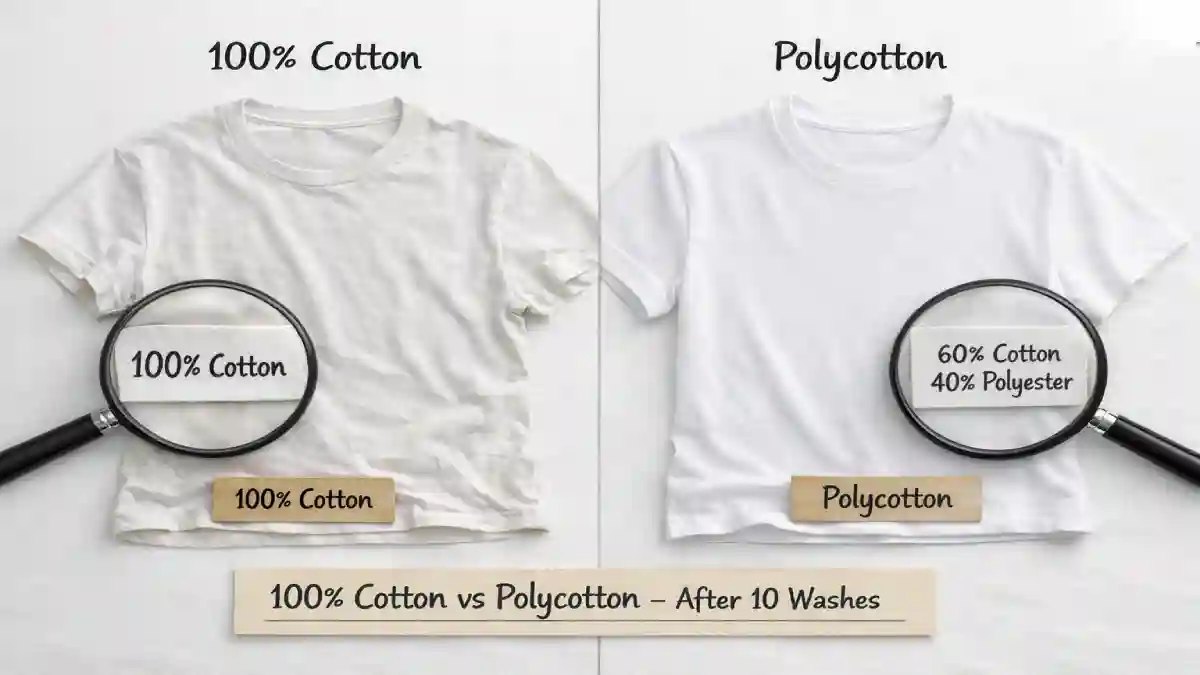
Next to it was a $12 polycotton t-shirt I had bought around the same time. Same number of washes. Same care routine. It still looked almost new. The neckline was intact. The shape was unchanged.
That was the day I started paying attention to fabric composition. Not just the price tag. Not just the brand. The actual fibers.
Today, I’m breaking down the polycotton vs. 100% cotton debate. The shrinkage numbers. The shape retention. The comfort trade-offs. And why the cheapest fabric isn’t always the one with the lowest price tag.
The $15 T-Shirt That Lost Its Shape in One Wash
Let me describe what happened to that $15 cotton t-shirt.
The first wash: I washed it in cold water and dried it on low heat, just like the label said. When it came out, it was noticeably shorter. The sleeves were tighter. The body had shrunk about half an inch in length.
The second wash: It shrank a little more. The neckline started to lose its structure. It felt looser, less crisp.
The third wash: The neckline was visibly stretched. The shirt looked tired. It wasn’t ruined, but it wasn’t the same shirt I had bought.
By the fifth wash: It was a sleep shirt. I couldn’t wear it outside anymore.
The polycotton t-shirt: I washed it the same way. Cold water, low heat. After five washes, it looked almost identical to the day I bought it. The neckline was still structured. The shape was intact. The color had barely faded.
The realization: I had been paying for the “premium” feel of 100% cotton, but I was replacing those shirts every few months. The polycotton shirt, which cost less, was lasting longer and looking better.
What a textile expert would tell you: The difference isn’t magic. It’s fiber science. Cotton shrinks. Polyester doesn’t. When you blend them, you get the best of both worlds—or at least a compromise that works for your wallet.
What Polycotton and 100% Cotton Actually Are
Before we get into the numbers, let’s clarify what these fabrics actually are.
100% Cotton: Cotton is a natural fiber harvested from the cotton plant. It’s soft, breathable, and moisture-absorbing. It feels premium against the skin. It also shrinks, wrinkles, and can lose its shape over time, especially with repeated washing and drying .
Polycotton (Polyester-Cotton Blend): Polycotton is a blend of cotton and polyester fibers. The ratio varies—common blends are 50/50, 65/35, and 80/20 (cotton/polyester). The polyester adds strength, durability, and shape retention. The cotton adds softness and breathability .
Why the blend exists: Manufacturers blend polyester with cotton for one primary reason: dimensional stability . Polyester fibers don’t absorb water or respond to heat the way cotton does. When blended, they stabilize the fabric, reducing shrinkage and helping the garment hold its shape .
What the industry says: “Polycotton fleece is a blended fabric combining cotton’s softness with polyester’s durability and shape retention” . That’s the core value proposition. You get the comfort of cotton and the performance of polyester.
The Shrinkage Test: How Much Does Each Fabric Actually Shrink?
This is where the numbers get interesting. Let’s look at the actual shrinkage rates.
100% Cotton:
- Untreated cotton: 3–5% shrinkage in the first wash
- Pre-shrunk cotton (labeled “Sanforized”): 1–3% shrinkage
- Some sources report up to 5–10% in a hot dryer
- In extreme cases (hot water, high heat), cotton can shrink up to 20%
Polycotton (50/50 blend):
- Typical shrinkage: 3–6% in a hot dryer
- In normal conditions (cold wash, low heat): 1–3%
Polycotton (65/35 polyester/cotton blend):
- Typically shrinks less than 2% because the higher polyester content resists heat and water-induced contraction
The takeaway: Polycotton shrinks significantly less than 100% cotton. The more polyester in the blend, the less it shrinks. A 65/35 polycotton blend is one of the most dimensionally stable cotton blends available .
What one manufacturer says: “Reduced shrinkage (1–3% vs. 4–6% for pure cotton) means more consistent sizing across production runs” . That’s why polycotton is the standard for uniforms and promotional merchandise.
The Shape Retention Test: Which One Holds Its Silhouette?
Shrinkage is one thing. Shape retention is another. A garment can shrink and still hold its silhouette, or it can keep its size but lose its structure.
100% Cotton Shape Retention:
- Cotton is prone to creasing and wrinkles
- It tends to lose structure over time with frequent laundering
- Necklines stretch. Shoulders sag. The garment “relaxes” with wear.
- “Natural fibers are more prone to shrinking and creasing, and cotton polos may require more careful washing to maintain their shape”
Polycotton Shape Retention:
- Polyester provides “durability and prevents garments from warping or losing color over time”
- Polycotton “holds its shape better over time and tends to dry faster”
- It “resists creasing, shrinking, and general wear”
- For workwear and tailored pieces, polycotton “keeps the silhouette crisp”
The verdict: Polycotton wins on shape retention. The polyester fibers act like a skeleton for the fabric, preventing it from sagging, stretching, or losing its structure. This is why polycotton is the fabric of choice for uniforms, workwear, and anything that needs to look sharp after repeated washing.
What a designer says: “For smart separates where wrinkle-resistance matters, polycotton pieces keep the silhouette crisp” .
The Comfort Factor: Breathability vs. Durability
Here’s the trade-off. Polycotton wins on durability and shape retention. But 100% cotton wins on comfort.
100% Cotton Comfort:
- “Breathes, it’s soft against skin, and it gets better (and softer) with washing”
- Superior moisture absorption
- Feels cooler in warm conditions
- Ideal for anything worn close to the skin
Polycotton Comfort:
- “It doesn’t breathe nearly as well” as pure cotton
- “Because polyester fibres do not absorb moisture in the same way as cotton, polycotton can feel slightly warmer, especially in hot environments”
- The trade-off is that it “maintains a pleasant texture against the skin” while being more durable
What the experts recommend: “For anything worn close to the skin, cotton is almost always the superior choice. Think T-shirts, shirts and blouses, underwear, summer dresses” . “Use polycotton strategically for structure-led pieces or workwear where crease-resistance is useful” .
The rule of thumb: If it touches your skin directly and you’ll be wearing it in warm conditions, choose cotton. If it’s a structured piece that needs to look sharp after washing, choose polycotton.
The Verdict by Category (T-Shirts, Sheets, Workwear)
Not all garments are the same. Here’s how to choose based on what you’re buying.
T-Shirts and Everyday Wear:
- Winner: 100% cotton for comfort, polycotton for longevity.
- If you want softness and breathability, choose cotton. If you want a shirt that survives 50 washes without losing its shape, choose polycotton.
- My pick: Polycotton for basic tees you wear often. Cotton for premium tees you wear occasionally.
Bed Sheets:
- Winner: Polycotton for easy care. Cotton for luxury.
- Polycotton sheets “dry faster than pure cotton and often require little or no ironing” . They’re “durable and long-lasting” because the polyester strengthens the fabric .
- Cotton sheets are more breathable and feel more premium, but they wrinkle and need ironing.
- My pick: Polycotton for everyday sheets. Cotton for guest rooms or if you love the feel.
Workwear and Uniforms:
- Winner: Polycotton, without question.
- “Polycotton polos are often chosen for workwear, uniforms, and roles where garments are washed frequently. They hold their shape better over time” .
- “The tighter weave and added durability mean they handle embroidery well, particularly for logos that need to stay crisp after repeated use” .
- My pick: Polycotton for anything that needs to look professional after washing.
Activewear:
- Winner: High-polyester blends or 100% polyester.
- Polyester wicks moisture and dries quickly. Cotton absorbs sweat and stays wet.
- My pick: Avoid 100% cotton for activewear. Choose polycotton or 100% polyester.
Underwear and Sleepwear:
- Winner: 100% cotton.
- “Synthetic fibres near intimate areas are a recipe for irritation” .
- My pick: 100% cotton for anything that touches sensitive areas.
How to Check the Label (The Ratio Matters)
The label tells you everything. Here’s how to read it.
The ratio rule:
- 80% cotton or above: This is essentially a cotton garment with a small amount of polyester to reduce creasing. Good for comfort and moderate durability .
- 50/50 blend: You’re in polycotton territory. Fine for workwear and structured pieces, but avoid for anything worn directly against the skin on warm days .
- Below 50% cotton: You’re essentially buying a synthetic garment. Be aware, especially if you have sensitive skin .
What to look for:
- The label will list the fiber content by percentage. “60% Cotton, 40% Polyester” means it’s a 60/40 polycotton blend.
- “100% Cotton” means it’s pure cotton.
- If the label doesn’t specify the ratio, be cautious. Transparency matters .
The “pre-shrunk” label: If cotton is labeled “pre-shrunk” or “Sanforized,” it will shrink less (1–3% instead of 3–5%) . But it will still shrink more than polycotton.
The Math: What I Saved by Choosing the Right Fabric
Let me break down the actual dollars.
If I kept buying 100% cotton t-shirts:
| Item | Cost | How Often | Annual Cost |
|---|---|---|---|
| 100% cotton t-shirt | $15 | Every 3 months | $60 |
| Total | $60 |
If I switched to polycotton t-shirts:
| Item | Cost | How Often | Annual Cost |
|---|---|---|---|
| Polycotton t-shirt | $12 | Every 12 months | $12 |
| Total | $12 |
Annual savings: $48
Over 5 years: $240
And that’s just t-shirts. When you apply the same logic to sheets, workwear, and uniforms, the savings multiply.
The hidden savings: I also saved time and frustration. No more replacing stretched-out shirts. No more ironing wrinkled cotton. The polycotton shirts looked good with minimal effort.
📌 YOU MIGHT ALSO LIKE:
The Cost-Per-Wear Formula: How to Know If an Item Is Actually Worth Buying
The Ultimate TJ Maxx & Marshalls Shopping Guide for Budget Capsule Wardrobes
The 5×5 Wardrobe Challenge: How to Survive a Month with Just 5 Clothes and 5 Shoes
Frequently Asked Questions (FAQ)
1. Does polycotton shrink less than 100% cotton?
Yes. Polycotton typically shrinks 1–3%, while 100% cotton shrinks 3–5% (and up to 20% in hot water and high heat) . The more polyester in the blend, the less it shrinks. A 65/35 polycotton blend is one of the most dimensionally stable cotton blends available .
2. Which fabric holds its shape better after washing?
Polycotton holds its shape better than 100% cotton. The polyester fibers provide structure and prevent the garment from sagging, stretching, or losing its silhouette . This is why polycotton is the standard for workwear and uniforms .
3. Is polycotton less comfortable than cotton?
Yes, slightly. Polycotton doesn’t breathe as well as pure cotton and can feel warmer in hot conditions . However, it’s still softer and more breathable than 100% polyester. For anything worn directly against the skin in warm weather, cotton is the better choice .
4. What’s the best polycotton ratio for durability?
A 65/35 polyester/cotton blend is the most durable and dimensionally stable . It shrinks less than 2% and holds its shape very well . A 50/50 blend is a good balance of comfort and durability .
5. Should I choose cotton or polycotton for bed sheets?
It depends on your priorities. Polycotton sheets are easier to care for, dry faster, and require less ironing . Cotton sheets are more breathable and feel more premium, but they wrinkle and need more maintenance. For everyday use, polycotton is the practical choice.
6. How can I tell if a garment is 100% cotton or polycotton?
Check the label. It will list the fiber content by percentage. “100% Cotton” means pure cotton. “60% Cotton, 40% Polyester” means it’s a polycotton blend. If the ratio isn’t listed, be cautious .
7. Does 100% cotton always shrink?
Yes, 100% cotton will always shrink to some degree. “When manufacturers spin cotton into thread, they stretch the raw fibers to make the weave. This creates tension. When you launder cotton fabric, the heat reduces this tension, resulting in shrinkage” . Pre-shrunk cotton shrinks less, but it still shrinks.
8. What’s the best fabric for activewear?
High-polyester blends or 100% polyester. Polyester wicks moisture and dries quickly, while cotton absorbs sweat and stays wet. Avoid 100% cotton for activewear .
Final Thoughts: The Best Fabric Is the One That Lasts
The $15 cotton t-shirt is in my sleepwear drawer. The $12 polycotton t-shirt is in my regular rotation. It’s been washed 20 times. It still looks new.
The cheapest fabric isn’t the one with the lowest price tag. It’s the one that lasts the longest, holds its shape, and doesn’t need to be replaced every few months. For most everyday garments, polycotton wins that calculation.
The fabric cheat sheet:
- T-shirts you wear often: Polycotton for longevity
- Sheets for everyday use: Polycotton for easy care
- Workwear and uniforms: Polycotton for shape retention
- Underwear and sleepwear: 100% cotton for comfort
- Activewear: High-polyester blends for moisture-wicking
I’ve been choosing polycotton for my everyday basics for over a year now. My clothes last longer, my laundry routine is simpler, and I’ve saved money by replacing items less often.
That’s not cheap. That’s smart.
That’s the frugal glow. And it’s waiting for you on the label. 🧵💛
*For more budget fashion tips, fabric guides, and money-saving style strategies, visit The Frugal Glow.*