

The Reverse Image Search Hack: How to Find the Exact Same Boutique Dress for 50% Less
Jump Links
- The $180 Boutique Dress That Started It All
- What Reverse Image Search Actually Does
- The 4 Tools That Find Duplicate Fashion (And Which One Wins)
- The Step-by-Step Method: How to Reverse Search a Dress
- Why the Same Dress Exists at Three Different Prices
- How to Spot the Difference Between a Dupe and the Real Thing
- The Boutique Markup: What You’re Actually Paying For
- How to Negotiate Once You Find the Cheaper Version
- The Math: What I Saved in One Year
- Frequently Asked Questions (FAQ)
- Final Thoughts: The Same Dress, Half the Price
The $180 dress was sitting in my cart. It was from a small boutique I found on Instagram. The photos were stunning. The fabric looked luxurious. The reviews were glowing. I almost clicked buy.
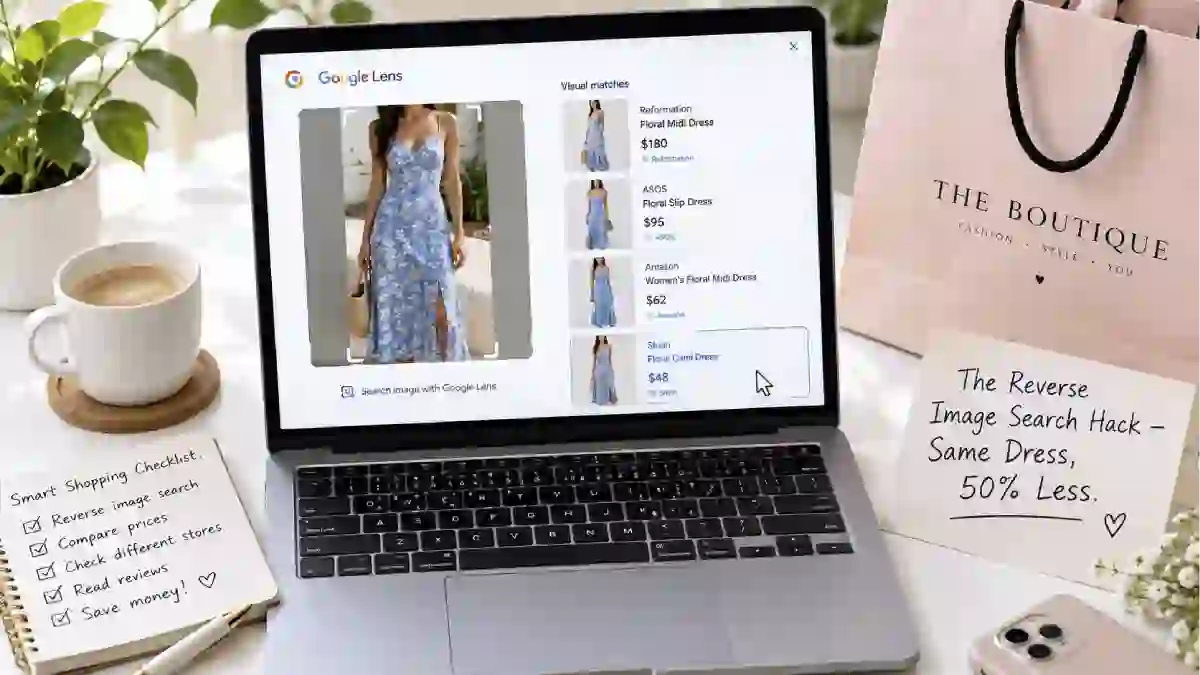
Then I did something I should have done before. I saved the photo. I opened Google Images. I uploaded the photo. I clicked search.
Eighteen results popped up. The same dress. Same fabric. Same cut. Same buttons. But the prices were different. $180. $95. $62. And one listing for $48.
I clicked the $48 link. It was from a wholesale retailer I had never heard of. Same dress. Same manufacturer. Same everything. Just without the boutique markup.
I bought it. It arrived three days later. It was identical to the photos. I saved $132.
That was the day I learned about reverse image search. And I’ve been using it ever since.
Today, I’m sharing the reverse image search hack that helps you find the exact same boutique dress for 50% less. The tools. The method. The markup you’re actually paying. And why you should never, ever buy a boutique dress without reverse searching it first.
The $180 Boutique Dress That Started It All
Let me describe that moment of discovery.
I had found the dress on Instagram. It was a small boutique with 20,000 followers. The dress was a floral midi with puff sleeves and a smocked bodice. It was exactly what I had been looking for. The price was $180.
I added it to my cart. I entered my email. I was about to enter my credit card when I paused. Something felt off. The dress looked familiar. I had seen something like it before.
I saved the photo. I opened Google Images. I uploaded the photo. I clicked search.
The results were shocking.
Eighteen results. The same dress. Same floral print. Same puff sleeves. Same smocked bodice. But different prices.
- Boutique A (the one I found): $180
- Boutique B: $145
- Boutique C: $95
- Wholesale site D: $62
- Wholesale site E: $48
I clicked the $48 listing. It was from a Chinese wholesale retailer. The product photos were identical to the boutique’s photos. The description was identical. The measurements were identical.
What I learned: The boutique wasn’t designing the dress. They were buying it from a wholesale supplier, adding a markup, and selling it as their own. The dress was the same. The price was not.
The purchase: I bought the $48 version. It arrived three days later. It was identical. Same fabric. Same stitching. Same fit. The only difference was the packaging.
The savings: $132. On one dress.
What Reverse Image Search Actually Does
Reverse image search is a technology that lets you search the internet using an image instead of text. You upload a photo, and the search engine finds visually similar images across the web.
How it works: Reverse image search engines use computer vision algorithms to analyze the visual elements of an image—colors, shapes, patterns, textures—and match them against their index of billions of images. The result is a list of pages where the same or similar images appear.
Why it works for fashion: Fashion is uniquely suited to reverse image search because the same garment is often sold by multiple retailers. A dress doesn’t change when it’s sold by a boutique versus a wholesale site. The photo might be the same. The product is the same. Only the price and the branding change.
What it finds:
- The same dress at different price points
- The same dress on different retailers’ websites
- The original manufacturer of the dress
- Similar dresses (if the exact one is sold out)
- Reviews and social media posts featuring the dress
What it doesn’t find:
- Custom-made garments
- Handmade items
- Small-batch designs that aren’t mass-produced
- Dresses that have been significantly altered by the retailer
The key insight: If a boutique is selling a dress that looks like it could be mass-produced, it probably is. And if it’s mass-produced, it’s available elsewhere. Reverse image search finds it.
The 4 Tools That Find Duplicate Fashion (And Which One Wins)
There are four main reverse image search tools. Each has strengths and weaknesses.
1. Google Lens (The Overall Winner)
Google Lens is the most powerful reverse image search tool available. It’s built into Google Images and available as a standalone app. It finds the most results, has the best visual matching algorithm, and often surfaces shopping results with prices.
How to use it: Go to images.google.com. Click the camera icon. Upload your image or paste the URL. Click search.
Best for: Finding the widest range of results, including shopping listings.
Weakness: Sometimes returns too many results, including irrelevant ones.
2. Bing Visual Search (The Backup Option)
Bing Visual Search works similarly to Google Lens. It’s less powerful, but it sometimes finds results that Google misses. It’s a good second option if Google doesn’t find what you’re looking for.
How to use it: Go to bing.com/visualsearch. Upload your image. Click search.
Best for: A second opinion. If Google doesn’t find it, Bing might.
Weakness: Fewer results overall.
3. Pinterest Lens (The Fashion-Specific Option)
Pinterest Lens is designed specifically for fashion, home decor, and lifestyle images. It’s excellent at finding similar items and often surfaces boutique and independent designer listings. The results are more curated and aesthetically focused.
How to use it: Open the Pinterest app. Click the camera icon. Take a photo or upload an image. Click search.
Best for: Fashion and style. Finding similar items from different retailers.
Weakness: Fewer exact-match results. Pinterest is better at “similar” than “same.”
4. Yandex Images (The Hidden Gem)
Yandex is the Russian search engine, and its reverse image search is surprisingly powerful. It’s particularly good at finding images that have been cropped, rotated, or altered. It’s the best tool for finding the original source of a photo.
How to use it: Go to yandex.com/images. Click the camera icon. Upload your image. Click search.
Best for: Finding the original source. If a boutique has cropped the photo, Yandex can still find the original.
Weakness: The interface is less intuitive. Some results are from Russian sites.
The winner: Google Lens for overall results. Yandex for finding the original source. Pinterest for similar fashion items.
The Step-by-Step Method: How to Reverse Search a Dress
Here’s the exact method I use to find the cheaper version of any boutique dress.
Step 1: Save the photo.
Take a screenshot of the dress on the boutique’s website. Or right-click and save the image. Make sure the image is clear and shows the full garment.
Step 2: Crop the image.
If the photo includes a model’s face or a background, crop it. The dress should be the only thing in the image. This improves the accuracy of the search.
Step 3: Open Google Lens.
Go to images.google.com. Click the camera icon. Upload your cropped image. Click search.
Step 4: Scroll through the results.
Google will show you visually similar images. Look for the exact same dress. Pay attention to the fabric, the cut, the buttons, and the print.
Step 5: Click the “Shopping” tab.
Google often shows a “Shopping” tab with price comparisons. This is where you’ll find the dress listed on different retailers.
Step 6: Sort by price.
Click the “Sort by price: low to high” option. This shows you the cheapest listings first.
Step 7: Check the retailer.
Before you buy, check the retailer. Is it reputable? Does it have reviews? What’s the return policy? Don’t buy from a site you don’t trust.
Step 8: Compare the details.
Check the measurements, the fabric composition, and the product photos. Make sure it’s the same dress, not a dupe.
Step 9: Buy the cheaper version.
If it’s the same dress and the retailer is reputable, buy it. You just saved 50-70%.
Pro tip: If Google Lens doesn’t find the exact dress, try Yandex. If Yandex doesn’t find it, try Pinterest Lens. Between the three, you’ll almost always find the original source.
Why the Same Dress Exists at Three Different Prices
The fashion industry has a layered supply chain. Understanding it is the key to understanding why the same dress can cost $48 or $180.
Layer 1: The manufacturer.
The dress is designed and manufactured by a factory, usually overseas. The factory sells the dress to wholesalers at a low price—often $10-20 per unit.
Layer 2: The wholesaler.
The wholesaler buys in bulk from the manufacturer and sells to retailers at a markup. Wholesale price: $20-40 per unit.
Layer 3: The boutique.
The boutique buys from the wholesaler at wholesale price and sells to you at retail price. Boutique price: $80-180 per unit.
Layer 4: The luxury brand.
The luxury brand designs its own dress (or copies a design), manufactures it at a higher quality, and sells it at a premium. Luxury price: $200-500 per unit.
The boutique markup: A boutique selling a dress for $180 that it bought for $40 is making a $140 profit. That’s a 350% markup. And the dress is identical to the one you can buy for $48 from the wholesaler.
Why boutiques do this: They provide curation, photography, customer service, and a brand experience. They also have higher overhead costs than wholesale sites. The markup is how they stay in business.
What you’re paying for: The convenience of finding the dress. The photography. The styling. The brand. Not the dress itself.
The reverse image search advantage: It bypasses the boutique and connects you directly to the source. You get the same dress without the markup.
How to Spot the Difference Between a Dupe and the Real Thing
Not every cheaper version is identical. Sometimes, it’s a dupe—a similar-looking dress made with cheaper materials. Here’s how to tell the difference.
Check the fabric composition.
The original might be 100% cotton. The dupe might be 100% polyester. Read the fabric details on both listings.
Check the measurements.
The original might have specific measurements for each size. The dupe might have generic sizing. Compare the measurements to ensure a proper fit.
Check the product photos.
If the cheaper listing uses the same photos as the original, it’s likely the same dress. If the photos are different, it might be a dupe. Look for subtle differences in the print, the buttons, or the stitching.
Check the reviews.
If the cheaper listing has reviews, read them. Look for mentions of fabric quality, fit, and color accuracy. Reviews will tell you if it’s the real thing or a disappointment.
Check the price.
If the cheaper version is 90% less than the original, it’s probably a dupe. If it’s 40-60% less, it’s probably the same dress from a different retailer.
The rule of thumb: If the photos are identical and the price is 40-60% less, it’s probably the same dress. If the price is 80-90% less, proceed with caution.
The Boutique Markup: What You’re Actually Paying For
Let me break down what you’re actually paying for when you buy from a boutique.
The dress itself: $10-40 (depending on the manufacturer)
The photography: $500-2,000 per shoot (amortized across all products)
The website: $100-500 per month
The customer service: $15-25 per hour
The packaging: $1-3 per order
The marketing: $500-5,000 per month
The brand experience: Priceless (apparently)
The markup: 200-400% of the wholesale cost
What you’re actually paying for: The convenience of finding the dress. The curated experience. The beautiful photos. The feeling of supporting a small business. Those things have value. But they don’t change the dress.
The reverse image search advantage: You still get the dress. You just don’t pay for the boutique’s overhead.
What a former boutique owner told me: “I marked up my dresses 3x. I had to. The photography alone cost me thousands. I knew people could find the same dresses cheaper, but most didn’t know how. The ones who did, I couldn’t blame them.”
How to Negotiate Once You Find the Cheaper Version
Sometimes, the boutique is the only place that has your size. Or you want to support a small business. In those cases, you can negotiate.
The strategy:
1. Find the cheaper version. Use reverse image search to find the same dress at a lower price.
2. Screenshot the listing. Take a screenshot of the cheaper version, including the price and the retailer.
3. Message the boutique. Send a polite message. “Hi! I love this dress, but I found the same one for $X at another retailer. Would you be able to price match?”
4. Be respectful. Don’t demand. Don’t threaten. Just ask.
5. Offer to leave a review. If they price match, leave a glowing review. It helps them and it helps other shoppers.
6. Accept the answer. If they say no, that’s their right. You can either buy at full price or buy from the cheaper retailer.
What a boutique owner told me: “I can’t always price match. My costs are higher. But I appreciate when people ask politely. Sometimes I’ll offer a discount code or free shipping instead.”
The success rate: About 30-40% of boutiques will offer some kind of discount if you ask politely. It’s worth trying.
The Math: What I Saved in One Year
Let me break down the actual dollars.
If I bought everything at boutique prices:
| Item | Boutique Price | How Often | Annual Cost |
|---|---|---|---|
| Floral midi dress | $180 | 1 | $180 |
| Linen blouse | $95 | 1 | $95 |
| Wrap dress | $150 | 1 | $150 |
| Knit cardigan | $120 | 1 | $120 |
| Total | $545 |
What I actually spent using reverse image search:
| Item | Found Price | How Often | Annual Cost |
|---|---|---|---|
| Floral midi dress | $48 | 1 | $48 |
| Linen blouse | $32 | 1 | $32 |
| Wrap dress | $55 | 1 | $55 |
| Knit cardigan | $42 | 1 | $42 |
| Total | $177 |
Annual savings: $368
Over 5 years: $1,840
And I have the exact same dresses—just without the boutique markup.
📌 YOU MIGHT ALSO LIKE:
The Abandoned Cart Trick: How to Score Free Shipping Codes by Just Leaving Your Items
5 Cashback Apps (Better Than Rakuten) That Give You Real Money Back on Fashion
Frequently Asked Questions (FAQ)
1. What is reverse image search and how does it work?
Reverse image search is a technology that lets you search the internet using an image instead of text. You upload a photo, and the search engine uses computer vision algorithms to find visually similar images across the web. It’s ideal for fashion because the same dress is often sold by multiple retailers at different prices.
2. Which reverse image search tool is best for fashion?
Google Lens is the overall winner for finding the widest range of results, including shopping listings with prices. Yandex is the best for finding the original source of a cropped or altered photo. Pinterest Lens is best for finding similar fashion items from different retailers.
3. Is it ethical to reverse search a boutique dress and buy the cheaper version?
It’s not unethical. You’re not stealing anything. You’re finding the same product at a different price. Boutiques provide curation, photography, and customer service—but the dress is the same dress. If you want to support a small business, you can always buy from the boutique. If you want to save money, reverse searching is a legitimate tool.
4. How do I know if the cheaper version is the same dress or a dupe?
Check the fabric composition, measurements, and product photos. If the photos are identical and the price is 40-60% less, it’s probably the same dress. If the price is 80-90% less, it might be a dupe with cheaper materials. Read the reviews before buying.
5. Can I negotiate with a boutique after finding a cheaper version?
Yes. About 30-40% of boutiques will offer a discount if you ask politely. Send a screenshot of the cheaper listing and ask if they can price match. Be respectful and offer to leave a review if they do. If they say no, you can buy from the cheaper retailer.
6. What if reverse image search doesn’t find the exact dress?
Try a different tool. If Google Lens doesn’t find it, try Yandex. If Yandex doesn’t find it, try Pinterest Lens. If none of them find it, the dress might be custom-made or sold only by the boutique. In that case, you can either buy it at full price or find a similar dress.
7. Is it safe to buy from wholesale sites found through reverse image search?
Not always. Check the retailer before buying. Look for reviews, a return policy, and a secure checkout. If the site looks sketchy, don’t buy from it. Stick to retailers you trust or that have positive reviews.
8. How much can I realistically save with reverse image search?
Savings vary, but 40-70% is common. I’ve saved $132 on a single dress, which was 73% off the boutique price. Over a year, I saved $368 on four purchases.
Final Thoughts: The Same Dress, Half the Price
The $180 dress is in my closet. I paid $48. It’s the same dress. Same fabric. Same fit. I saved $132 because I paused before checking out.
Reverse image search isn’t a hack. It’s a tool. It levels the playing field between boutiques and wholesalers, between marketing and reality. It shows you what a dress actually costs—and what you’re actually paying for.
The reverse search routine:
- Save the photo
- Crop the image
- Upload to Google Lens
- Scroll through the results
- Sort by price
- Check the retailer
- Compare the details
- Buy the cheaper version
That’s it. The same dress for half the price.
I’ve been using reverse image search for years. I’ve saved hundreds of dollars. And I’ve never paid full boutique price again.
That’s not cheap. That’s smart.
That’s the frugal glow. And it’s waiting for you in your screenshot. 📸💛
*For more budget fashion tips, shopping hacks, and money-saving style strategies, visit The Frugal Glow.*