

The $5 ‘Rit Dye’ Challenge: How to Give Your Faded Black Jeans a Luxury Makeover
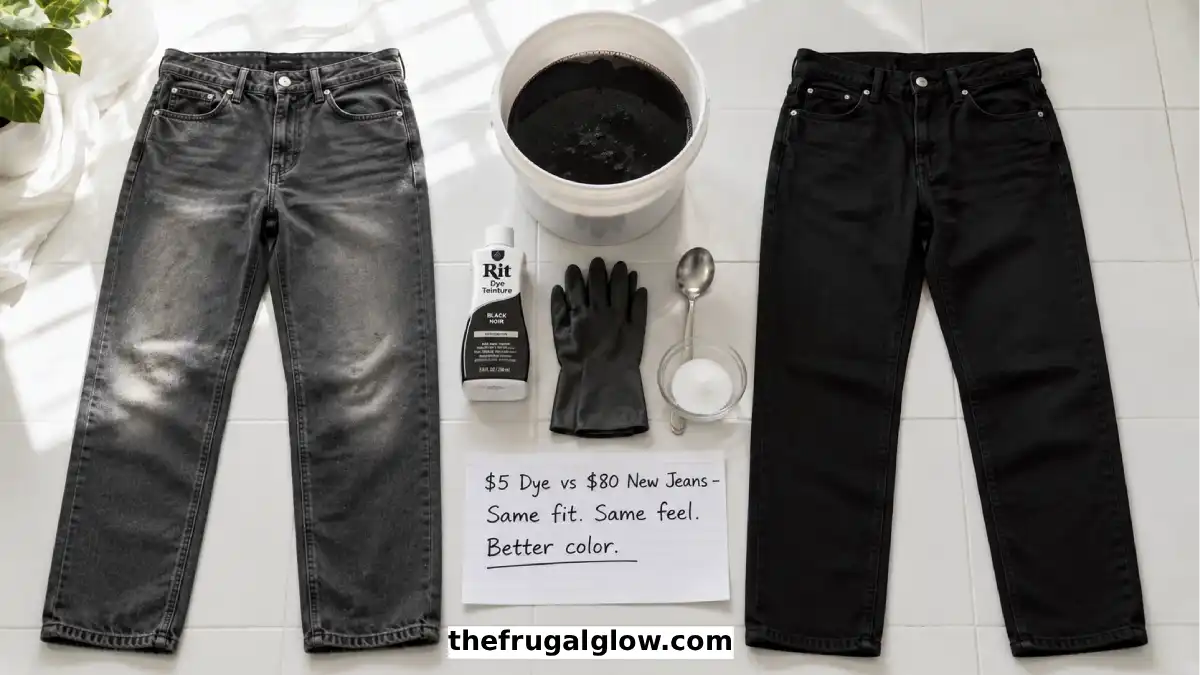
Let me tell you about the pair of black jeans that broke my heart.
They were perfect. The fit was ideal. The fabric was soft. They had taken months to break in just right. But after two years of washing and wearing, they weren’t black anymore. They were gray. Faded. Sad. The kind of gray that looks like you’ve owned them since college (which I had).
I almost threw them away. I had them in a “donate” pile. I was ready to spend $80 on a new pair of black jeans. The same brand. The same fit. The same style.
Then a friend said something that stopped me. “Why don’t you just dye them?”
I thought she was joking. Dyeing clothes at home sounded messy, complicated, and destined to fail. I imagined uneven splotches, stained washing machines, and jeans that turned out purple instead of black.
But she showed me her own jeans. She had taken a faded pair of black jeans and turned them into a deep, rich, expensive-looking black. She used a $5 bottle of Rit Dye. That’s it.
I went to the grocery store. I bought the dye. I followed the instructions. Forty-five minutes later, I pulled my jeans out of the dye bath. They were black. Deep, even, luxurious black. Like the first day I bought them. Like a $200 pair from a designer brand.
That was three years ago. I’ve dyed those jeans four times now. They still look amazing. I’ve also dyed other faded black clothes, white shirts that got stained, and even a pair of beige pants that I turned into olive green.
Total cost per project: $5-10. Total savings compared to buying new: hundreds of dollars.
Today, I’m sharing my exact process. The mistakes I made. The secrets to getting an even, professional-looking dye job. And why you should never throw away faded black jeans again.
Let’s get into it.
Jump Links
- The Donation Pile That Almost Cost Me $80
- Why Black Jeans Fade (And Why Dye Works)
- The $5 Rit Dye Shopping List
- Step-by-Step: How to Dye Your Jeans (Without Ruining Them)
- My Biggest Mistakes (So You Don’t Make Them)
- Before and After: What to Expect
- How to Make Black Jeans Stay Black Longer
- What Else Can You Dye? (More Savings)
- The Math: What I Saved in Three Years
- Frequently Asked Questions (FAQ)
- Final Thoughts: Don’t Throw Away Your Favorite Jeans
The Donation Pile That Almost Cost Me $80
I need to describe the moment I almost gave up on my favorite jeans.
They were hanging in my closet, but I hadn’t worn them in months. Every time I looked at them, I saw the faded gray knees, the washed-out thighs, the overall tired appearance. They didn’t look like “nice” jeans anymore. They looked like jeans I wore to do yard work.
I pulled them out. I tried them on. The fit was still perfect. The fabric was still soft. But the color was wrong. Black jeans that aren’t black anymore don’t look vintage or cool. They look old.
I put them in the donation pile. I opened my laptop. I went to the brand’s website. The same jeans, same fit, same style: $78 plus shipping. I was about to click “add to cart” when I texted my friend a photo of the faded jeans and the new ones in my cart.
Her response changed everything: “Dye them. I’ll show you how.”
I thought she was crazy. I had never dyed clothes before. I remembered a childhood disaster where my mom turned a white shirt tie-dye purple. I didn’t want that.
But she sent me a photo of her own jeans. They looked brand new. Deep, rich, even black. She told me she used Rit Dye. $5. The grocery store. Forty-five minutes.
I put my laptop away. I went to the store. I bought the dye. I followed her instructions. And when I pulled those jeans out of the dye bath, I almost cried. They were perfect. Blacker than when I bought them. Richer than any new pair I could have ordered.
I cancelled my online cart. I put the jeans back in my closet. I’ve worn them hundreds of times since.
That donation pile cost me $0. The new jeans would have cost me $80. I saved the jeans and the money.
Why Black Jeans Fade (And Why Dye Works)
Let me explain the science quickly. Understanding this will help you get better results.
Black dye is unstable.
Black clothing is dyed with a combination of dyes that bond to fabric differently. Over time, washing, UV light, and friction break those bonds. The dye molecules wash out. The black becomes gray.
Cotton fades faster than synthetic blends.
100% cotton jeans absorb dye well but also release it faster. Polyester blends hold dye longer but are harder to re-dye (requires different dye). Most jeans are cotton or cotton-poly blends.
Rit Dye is a “all-purpose” dye.
It works on cotton, linen, wool, silk, nylon, and rayon. It does NOT work well on polyester (less than 35% polyester is fine). Check your jeans’ fabric tag. If they’re 100% cotton or a cotton-poly blend with less than 35% polyester, Rit Dye will work.
The dyeing process replaces faded dye.
You’re not “painting” your jeans. You’re submerging them in a dye bath where new dye molecules bond to the fabric. The result is a fresh, even color that looks like new.
Important: Dye will not make stains or discoloration disappear. It will color over them, but if you have bleach spots or oil stains, they may still show through. Pre-treat or accept them.
The $5 Rit Dye Shopping List
Here’s exactly what you need. Most of this you already own.
Essential items (cost: $5-10):
| Item | Cost | Where to find |
|---|---|---|
| Rit Dye (liquid or powder) – Black | $4-6 | Grocery store, Walmart, Amazon, craft store |
| Large pot or bucket (at least 2-3 gallons) | $0 (use what you have) | Your kitchen |
| Long spoon or tongs (for stirring) | $0 | Your kitchen |
| Rubber gloves | $0 (or $2 for a pack) | Your cleaning supplies |
| Salt (for cotton) or vinegar (for nylon/wool) | $0 | Your pantry |
| Dish soap (a drop) | $0 | Your kitchen |
Optional but helpful:
- Rit Color Stay Dye Fixative ($4) – helps the color last longer
- 5-gallon bucket from hardware store ($5) – easier than a pot
- Plastic tablecloth ($2) – protects your surfaces
Total out-of-pocket cost if you need everything: $15-20 for first project. After that, dye only costs $5.
What you do NOT need:
- Fancy equipment
- A special “dyeing machine”
- Professional training
- Expensive fabric treatments
This is a $5 project. Don’t overcomplicate it.
Step-by-Step: How to Dye Your Jeans (Without Ruining Them)
Here’s the exact process I’ve used on dozens of items. Follow these steps and you will get even, professional-looking results.
Step 1: Prepare your jeans (15 minutes)
- Wash your jeans. Do not use fabric softener (it coats the fabric and repels dye).
- Leave them damp. Damp fabric absorbs dye more evenly than dry fabric.
- If your jeans have stains, pre-treat them. Dye will not cover oil or bleach stains.
Step 2: Protect your space (5 minutes)
- Cover your counter or table with a plastic tablecloth or trash bags.
- Wear rubber gloves. Dye will stain your hands for days.
- Wear old clothes. Dye will stain your clothes.
- Put down newspaper or paper towels around your workspace.
Step 3: Prepare the dye bath (10 minutes)
- Fill your pot or bucket with 3 gallons of very hot water (140-160°F, almost boiling).
- Add 1 teaspoon of dish soap (helps dye spread evenly).
- For cotton jeans: add 1 cup of salt (helps dye bond to cotton).
- For nylon/wool/rayon: add 1 cup of white vinegar instead of salt.
- Shake the Rit Dye bottle well. Pour the entire bottle into the water.
- Stir thoroughly until the dye is completely dissolved.
Step 4: Dye the jeans (30-60 minutes)
- Submerge your damp jeans completely. Push out air bubbles.
- Stir continuously for the first 10 minutes (prevents uneven spots).
- For the next 20-50 minutes, stir every 5 minutes. The longer you leave them, the darker they get.
- For faded jeans that are still mostly black: 30 minutes.
- For jeans that are light gray: 45-60 minutes.
Step 5: Rinse and wash (15 minutes)
- Remove jeans from dye bath. Rinse under cool running water until the water runs clear.
- Wash jeans alone in your washing machine on a normal cycle with cold water and a small amount of detergent.
- Run an empty rinse cycle afterward to clean your machine.
Step 6: Dry (time varies)
- Dry jeans in the dryer on low heat or hang dry.
- Your jeans are now black. Deep, even, rich black.
Pro tip: If you want the color to last longer, use Rit Color Stay Dye Fixative after dyeing. It costs $4 and takes 20 minutes. Worth it for jeans you wear weekly.
My Biggest Mistakes (So You Don’t Make Them)
I messed up several times. Learn from me.
Mistake #1: Not wearing gloves
My hands were black for three days. I went to work looking like I had a bizarre skin condition. Wear gloves. Every time.
Mistake #2: Using too small of a pot
I tried to dye jeans in a stockpot. They were too crowded. The dye didn’t reach all areas evenly. I ended up with splotches. Use a bucket or a very large pot. The jeans need room to move.
Mistake #3: Forgetting to stir
I left the jeans soaking without stirring. The dye settled at the bottom. One side of the jeans was darker than the other. Stir continuously for the first 10 minutes, then every 5 minutes after.
Mistake #4: Using fabric softener before dyeing
Fabric softener coats the fibers and repels dye. I learned this the hard way. Wash your jeans with detergent only, no softener, before dyeing.
Mistake #5: Dyeing jeans that were too wet
I submerged soaking wet jeans. The water diluted the dye. The color came out light gray instead of black. Damp is good. Dripping wet is bad.
Mistake #6: Not protecting my kitchen
I didn’t cover my counters. Dye splashed. My white counter had black spots for months. Cover everything with plastic or old towels.
Mistake #7: Using hot water to rinse
I rinsed with hot water. Hot water opens the fabric fibers and releases dye. Rinse with cool water until it runs clear. Cool water seals the dye in.
Before and After: What to Expect
Let me set realistic expectations.
Before (faded jeans):
- Color: washed-out gray, especially on knees, thighs, and seat
- Texture: still soft (if you’ve worn them in)
- Fit: perfect (that’s why you’re keeping them)
- Overall vibe: “I’ve had these since college”
After (freshly dyed jeans):
- Color: deep, rich, even black (darker than when you bought them)
- Texture: slightly stiffer (this softens after 1-2 washes)
- Fit: unchanged (dyeing does not shrink or stretch fabric if you use cool water)
- Overall vibe: “Are those new? They look expensive”
What you will NOT get:
- A “professional” dye job from a denim specialist (but close enough for most people)
- Uniform color if you had bleach stains or oil spots (those may still show)
- Permanent color (all black jeans fade over time – you’ll need to re-dye every 6-12 months)
What one user reported:
They had a pair of expensive jeans that they “felt had died.” After using Rit Dye, they “came back to life” and the user wrote a “very satisfied, positive review” .
Another user with “black jeans that had seen better days” reported that after dyeing, “the transformation was amazing. They look brand new.”
This works. Millions of people do it every year.
How to Make Black Jeans Stay Black Longer
You’ve dyed your jeans. Now keep them black.
Wash less.
Black jeans don’t need to be washed after every wear. Wash them every 5-10 wears unless they’re visibly dirty or smell. This is the single most important tip.
Wash inside out.
Turn your jeans inside out before putting them in the washing machine. This protects the outer surface from friction.
Use cold water.
Hot water opens fabric fibers and releases dye. Cold water keeps the dye locked in.
Use detergent for dark clothes.
Specialty detergents (like Woolite Darks or The Laundress Darks) have less optical brightener and are gentler on black dye. They cost a few dollars more. Worth it.
Hang dry.
Dryer heat fades black dye. Hang your jeans to dry. They’ll last twice as long.
Re-dye every 6-12 months.
Even with perfect care, black jeans fade. Plan to re-dye them once or twice a year. It’s a $5, 45-minute project. Worth it to keep your favorite jeans alive.
What Else Can You Dye? (More Savings)
Once you have the dye and the bucket, you can dye almost anything. Here’s what I’ve dyed.
Faded black t-shirts:
Same process as jeans. Works perfectly. A $5 dye job saved me from buying $20 worth of new t-shirts.
White shirts with stains:
I had a white button-down with a yellow underarm stain. Nothing removed it. I dyed the shirt black. The stain disappeared. The shirt looks new. Cost: $5 instead of $40 for a new shirt.
Beige pants to olive green:
I had beige chinos that I never wore. The color washed me out. I dyed them olive green using Rit Dye in “Dark Green.” Now I wear them weekly.
Canvas sneakers:
White Converse that were yellowed and dirty. I dyed them black. They look like new sneakers. Cost: $5 instead of $55 for new ones.
Curtains:
I found beige curtains at a thrift store for $5. I dyed them charcoal gray. They look like $50 curtains from West Elm.
Annual savings from dyeing other items: $100-200
That brings my total annual savings from one $5 bottle of Rit Dye to over $200.
The Math: What I Saved in Three Years
Let me break down the actual dollars.
Before (buying new jeans every 18 months):
- New black jeans: $80
- Every 18 months = $53 per year
- Over 3 years = $160
After (dyeing existing jeans every 6-12 months):
- Rit Dye (once per year): $5
- Salt, water, bucket: $0 (already owned)
- Over 3 years = $15
Savings over 3 years: $145
Add other items I dyed instead of replacing:
- 3 faded t-shirts ($15 each new) → dyed for $5
- 1 stained white shirt ($40 new) → dyed for $5
- 1 pair of beige pants ($30 new) → dyed for $5
- 1 pair of canvas sneakers ($55 new) → dyed for $5
- Thrifted curtains ($50 new) → dyed for $5
Total savings on other items: $145
Total savings over 3 years: $290
That’s not counting the environmental impact (keeping clothes out of landfills) or the emotional value (keeping jeans that fit perfectly).
Don’t Buy New Curtains! How to Upcycle Vintage Bed Sheets Into ‘Boho-Chic’ Window Treatments
Frequently Asked Questions (FAQ)
1. Will Rit Dye ruin my washing machine?
No, if you clean it afterward. After dyeing and washing your jeans, run an empty wash cycle with hot water and a cup of bleach. This will remove any residual dye. Some people prefer to rinse and wash the jeans in a bucket or bathtub to avoid any risk to their machine. I’ve used my washing machine for dozens of dye projects and never had an issue.
2. Can I dye jeans that are mostly polyester?
Rit Dye works best on natural fibers (cotton, linen, wool, silk, rayon). It does NOT work well on polyester. If your jeans are 50% cotton and 50% polyester, the cotton will dye black, but the polyester will remain light. The result will be a dark gray, not true black. Check your fabric tag. If polyester is more than 35%, use Rit DyeMore (synthetic formula) instead of regular Rit Dye.
3. How long does the black color last?
With proper care (washing inside out, cold water, hang drying), the color lasts 6-12 months. I dye my jeans every 6-8 months to keep them looking fresh. Some people dye once a year. The good news is that re-dyeing is cheap and easy.
4. Will the dye stain my skin if I wear the jeans?
No. Once the jeans are rinsed and washed, the excess dye is gone. They won’t stain your skin or your furniture. Some people notice a small amount of dye transfer on the first wear, especially if they didn’t rinse thoroughly. Wash them twice before wearing if you’re concerned.
5. Can I dye jeans that are not 100% cotton?
Yes, but check the blend. 100% cotton is ideal. Cotton-poly blends with less than 35% polyester work well. Over 35% polyester, use Rit DyeMore (synthetic formula) instead. Nylon and rayon dye beautifully. Spandex/elastane (2-5%) is fine – it adds stretch and won’t affect the dye.
6. My jeans have white stitching. Will that dye?
No. The thread used in most jeans is polyester, which does not absorb Rit Dye. Your white stitching will stay white. This looks great – it creates a contrast that makes the jeans look more expensive. Embrace the white stitching. It’s a feature, not a flaw.
7. Can I use the same dye bath for multiple items?
Yes. You can dye multiple pairs of jeans or other items in the same dye bath. Add them one at a time, stir continuously, and leave them in for the same amount of time. The dye bath will get weaker with each item, so your first item will be darkest and your last item will be lightest. For best results, dye similar items together.
Final Thoughts: Don’t Throw Away Your Favorite Jeans
Here’s what I want you to take away.
The fashion industry wants you to believe that clothes are disposable. That when your jeans fade, you should throw them away and buy new ones. That’s how they make money.
But your favorite jeans – the ones that fit perfectly, that are soft and broken in, that make you feel good – those are irreplaceable. A new pair might have the same style number, but it won’t have the same feel. It won’t have the memories.
Dyeing your jeans isn’t just about saving money. It’s about keeping something you love. It’s about rejecting the “throw it away and buy new” mentality. It’s about being resourceful.
The process takes less than an hour. It costs $5. And when you pull those jeans out of the dye bath and see them transformed back to their former glory, you’ll feel something. Pride. Satisfaction. A small rebellion against a system that wants you to consume and discard.
So this weekend, dig through your closet. Find those faded black jeans. Go to the grocery store. Buy a $5 bottle of Rit Dye.
Give them a second life.
That’s the frugal glow. And it looks great in black. 👖💛
For more clothing care tips, DIY fashion projects, and money-saving style advice, visit The Frugal Glow.