

Smart Rings vs. Fitness Tracker Wristbands: Features Per Dollar Comparison
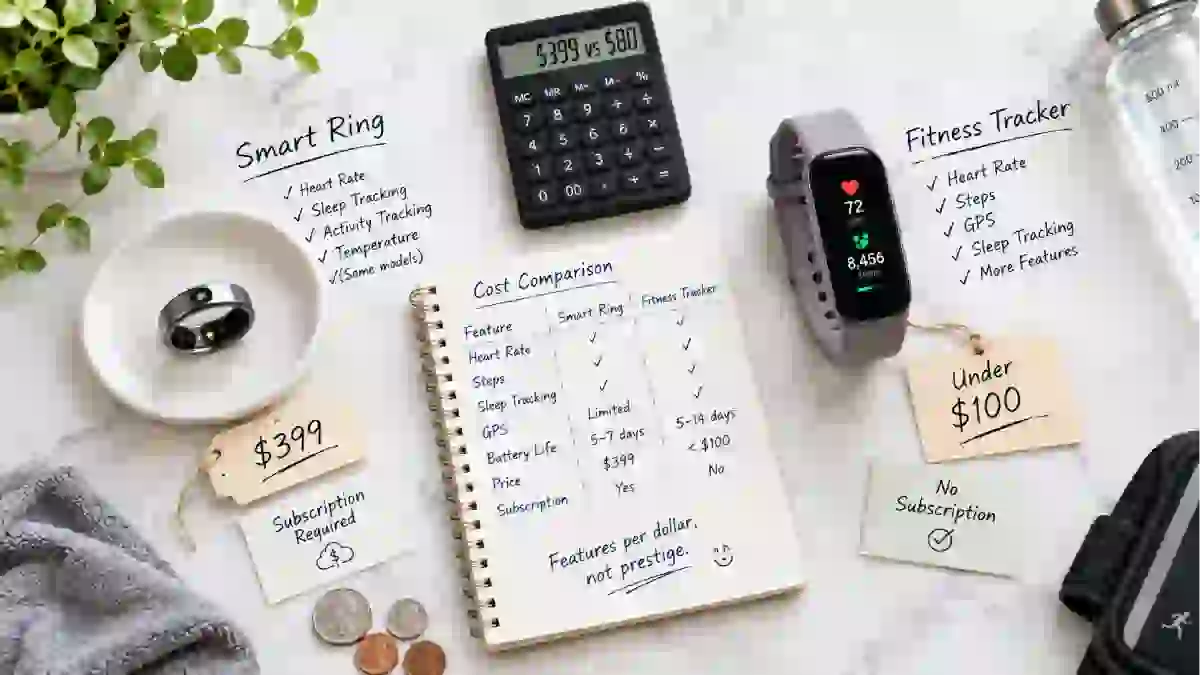
Smart rings have become the status symbol of the wearable tech world — sleek, discreet, and priced like it. A single Oura Ring 5 starts at $399, and that’s before the optional membership fee that unlocks its full feature set. Meanwhile, a genuinely capable fitness tracker wristband can be had for under $100, sometimes well under $50. The marketing around rings leans heavily on the idea that you’re paying for premium hardware and superior sleep tracking — but once you actually total up the dollars against the features, the picture gets considerably more complicated.
This breaks down exactly what you get, feature by feature and dollar by dollar, across both categories, including the subscription costs that rarely show up in the headline price.
Jump Links
- The Fundamental Trade-Off
- Price Comparison: What You’re Actually Paying
- The Subscription Factor: Oura’s Hidden Cost
- Feature-by-Feature Comparison
- GPS: The Biggest Functional Gap
- Sleep Tracking: Where Rings Genuinely Shine
- Comfort and All-Day Wearability
- 2-Year Total Cost of Ownership Table
- Full Comparison Table
- Which One Actually Delivers More Value
- Who Should Choose Each Category
- FAQ
- The Bottom Line
The Fundamental Trade-Off
The core difference between these two categories comes down to one simple design decision: a ring has no screen, and a wristband almost always does. That single difference cascades into nearly every other feature comparison in this article. No screen means no real-time workout feedback, no on-device notifications, and generally no built-in GPS — but it also means a dramatically smaller, lighter, more discreet device that’s genuinely easier to wear 24/7 without noticing it’s there.
Wristbands, in exchange for being slightly bulkier and more visible, typically pack in a screen for live stats, broader smartphone notification support, and — in the better models — actual built-in GPS. Neither trade-off is objectively correct; it depends entirely on what you’re actually trying to get out of the device.
Price Comparison: What You’re Actually Paying
Smart rings (starting prices):
- Amazfit Helio Ring: $199
- RingConn Gen 3: $349
- Samsung Galaxy Ring: ~$399
- Oura Ring 4: $349 (plus required membership for full features)
- Oura Ring 5: $399–$499 (plus required membership)
Fitness tracker wristbands (starting prices):
- Xiaomi/Amazfit budget bands: $30–$60
- Fitbit Inspire 3: ~$100
- Fitbit Charge 6: ~$160
- Garmin Vivosmart 5: ~$150
The price floor for a smart ring sits roughly where the price ceiling for a budget-to-midrange fitness band sits. Even the cheapest smart ring on the market, the Amazfit Helio Ring at $199, costs about double what a well-reviewed Fitbit Inspire 3 wristband runs, and several multiples more than a capable budget band from Xiaomi or Amazfit’s own wristband lineup.
The Subscription Factor: Oura’s Hidden Cost
This is genuinely the single most important number missing from most ring-versus-band comparisons. Oura, the best-known smart ring brand, requires an ongoing membership ($5.99 per month or $69.99 per year) to access its full feature set — without it, a lot of the ring’s advanced insights are locked. Over two years, an Oura Ring 5 in Silver works out to roughly $399 plus about $140 in membership fees, landing total cost of ownership around $539.
RingConn, by contrast, has specifically built its brand around the opposite approach: no subscription fee required for full feature access, a genuine structural pricing advantage over Oura for anyone comparing total cost rather than just the sticker price. Fitbit occupies a middle ground — most core features are free to use, though some deeper sleep and health insights, along with features like video workouts, require a Google Health Premium subscription.
Feature-by-Feature Comparison
- 24/7 heart rate monitoring: Available on both rings and bands at essentially every price point in this comparison.
- Sleep tracking: Available on both, though rings are frequently rated as more accurate and more comfortable for overnight wear specifically (more on this below).
- SpO2 (blood oxygen) tracking: Common across both categories at this point.
- Stress and readiness scoring: Available on premium rings (Oura, RingConn) and mid-to-premium bands alike.
- Water resistance: Smart rings frequently carry a notably strong water rating — the Oura Ring 4’s titanium shell carries a 10 ATM rating, outperforming most fitness bands in the same comparison.
- Screen/real-time feedback: Universal on wristbands; absent entirely on rings, by design.
- Smartphone notifications: Standard on wristbands with a screen; absent on rings, which have no display to show them on.
- Built-in GPS: Present on some premium wristbands (notably the Fitbit Charge 6); absent on every smart ring currently on the market, which instead rely on connected GPS via a paired phone.
- Menstrual cycle tracking: Available on several ring models (Oura, RingConn) as a notable feature.
- Workout mode selection: A genuine weak point for rings — since there’s no screen, you generally can’t manually select a specific workout type the way you can on a wristband or smartwatch; rings depend more heavily on automatic activity detection.
GPS: The Biggest Functional Gap
This is worth calling out specifically, since it’s one of the most concrete, measurable differences between the two categories rather than a matter of preference. Among well-known devices directly compared in recent testing, the Fitbit Charge 6 is specifically noted as the only tracker with documented built-in GPS (using GPS plus GLONASS satellite support), while the Oura Ring 4 has no onboard GPS at all, relying entirely on a connected phone’s GPS instead. This pattern holds across the smart ring category broadly — no current smart ring on the market includes its own independent GPS chip, a direct consequence of the form factor simply not having room for the additional hardware and battery draw that would require.
For anyone specifically prioritizing phone-free GPS tracking during runs or hikes, this is a genuine, structural limitation of the ring category that no amount of software improvement will solve without a fundamental hardware redesign.
Sleep Tracking: Where Rings Genuinely Shine
This is the category where rings most consistently earn their premium pricing in actual reviewer testing. Smart rings consistently outrank wristbands and watches on dedicated sleep-tracker scoring, largely because a ring’s slim, lightweight design interferes far less with natural sleep positioning than a bulkier wristband, and finger-based pulse readings can offer cleaner, more stable signal data overnight compared to wrist-based sensors in some comparisons.
RingConn specifically has been noted in hands-on testing as particularly accurate for sleep tracking, including naps throughout the day — a genuinely strong endorsement in a category where sleep data quality varies significantly between devices and manufacturers.
Comfort and All-Day Wearability
A titanium ring weighing just a few grams is dramatically lighter and less noticeable during 24/7 wear than even the slimmest fitness band, which matters enormously for anyone specifically prioritizing continuous, unbroken tracking data (a genuine requirement for accurate sleep and recovery metrics, which depend on the device staying on through sleep without being removed out of discomfort). This comfort advantage is one of the most consistently cited reasons people choose a ring over a band despite the higher price, independent of any specific feature comparison.
2-Year Total Cost of Ownership Table
| Device | Upfront Price | 2-Year Subscription Cost | Total 2-Year Cost |
|---|---|---|---|
| Amazfit Helio Ring | $199 | $0 | $199 |
| RingConn Gen 3 | $349 | $0 | $349 |
| Oura Ring 5 | $399–$499 | ~$140 | $539–$639 |
| Xiaomi/Amazfit budget band | $30–$60 | $0 | $30–$60 |
| Fitbit Inspire 3 | ~$100 | $0 (optional Premium ~$10/mo if added) | $100 (~$340 with Premium) |
| Fitbit Charge 6 | ~$160 | $0 (optional Premium ~$10/mo if added) | $160 (~$400 with Premium) |
Full Comparison Table
| Category | Smart Rings | Fitness Tracker Wristbands |
|---|---|---|
| Starting price | $199–$499 | $30–$160 |
| Screen/real-time feedback | No | Yes (most models) |
| Built-in GPS | No (any model currently on market) | Yes (select premium models) |
| Sleep tracking accuracy | Generally rated higher | Generally rated slightly lower |
| Comfort for 24/7 wear | Excellent | Good to very good |
| Water resistance | Often excellent (up to 10 ATM) | Varies, generally lower |
| Smartphone notifications | No | Yes |
| Subscription required for full features | Oura only (not RingConn) | Rare, usually optional |
| Workout mode selection | Limited (automatic detection) | Full manual selection |
Which One Actually Delivers More Value
Running the numbers directly: a $30–$60 budget wristband delivers 24/7 heart rate, sleep tracking, SpO2, and step tracking — the core feature set most people actually use daily — at roughly a tenth of the price of a premium smart ring, with zero subscription cost. On pure features-per-dollar, budget and midrange wristbands win decisively.
Where rings justify their price isn’t raw feature count — it’s specific, qualitative advantages: superior sleep-tracking comfort and accuracy, significantly better water resistance, and a level of all-day wearability that genuinely changes how consistently people actually keep the device on. These are real, meaningful advantages for the right user, but they’re premium refinements on an already-covered feature set, not entirely new capabilities a budget band lacks.
Who Should Choose Each Category
Choose a fitness tracker wristband if:
- Maximizing features per dollar is your primary goal.
- You want real-time workout feedback, on-wrist notifications, or built-in GPS.
- You’re not willing to pay an ongoing subscription for full functionality.
- You want the ability to manually select and track specific workout types.
Choose a smart ring if:
- Sleep tracking accuracy and comfort are your top priority.
- You specifically dislike wearing a visible device and want something discreet.
- You’re comfortable paying a premium for superior build quality and water resistance.
- You’re choosing RingConn or a similar no-subscription model, or you’ve budgeted for Oura’s membership cost as part of the total price.
📌 YOU MIGHT ALSO LIKE:
The $15 Smart Scale from Walmart: Does It Actually Track Body Fat Accurately?
Open-Ear Headphones vs. Bone Conduction: Best Budget Options for Outdoor Runners
FAQ
Is a smart ring really worth two to five times the price of a fitness band?
For raw feature count, no — budget and midrange wristbands cover most core tracking features at a fraction of the cost. Rings justify their premium through specific qualitative advantages like sleep-tracking comfort, accuracy, and superior water resistance, which matter more to some users than others.
Why don’t smart rings have built-in GPS?
The ring form factor doesn’t have room for a GPS chip and the additional battery capacity it would require, given how small and lightweight rings are designed to be. Every smart ring currently on the market relies on connected GPS from a paired smartphone instead.
Does Oura really require a subscription, or is that optional?
Oura requires a membership to access its full feature set; without it, some of the ring’s deeper health and sleep insights remain locked. This adds a genuine ongoing cost (roughly $70/year) that should be factored into any price comparison with wristbands, most of which don’t require a subscription.
Are smart rings actually more accurate for sleep tracking than wristbands?
In multiple independent comparisons, yes — rings tend to outrank wristbands and smartwatches on sleep-tracking-specific scoring, largely due to their lighter weight interfering less with natural sleep position and generally stable finger-based signal readings overnight.
Can I manually select a specific workout type on a smart ring, like I can on a fitness band?
Generally no. Since rings have no screen, they rely primarily on automatic activity detection rather than manual workout selection, which is a meaningful limitation compared to the full manual control most wristbands offer.
Is there a smart ring option without a subscription fee?
Yes, RingConn is specifically built around a no-subscription model, offering full feature access without an ongoing fee, unlike Oura, which requires a membership for its complete feature set.
The Bottom Line
On pure features per dollar, fitness tracker wristbands win decisively — a $30 to $100 band delivers the core tracking features most people actually use, with no subscription and often a screen and GPS that no smart ring currently offers at any price. Smart rings earn their premium through specific, genuine advantages in sleep tracking, comfort, and water resistance rather than a broader feature set, and that premium is worth paying only if those specific advantages matter enough to you to justify two to five times the cost, plus a potential ongoing membership fee depending on which brand you choose.
For more budget-friendly tech and wellness guides, check out more posts over at The Frugal Glow.
Sources: