
Outlet vs. Retail: Why Most ‘Outlet’ Items are Actually Lower Quality (And How to Tell)
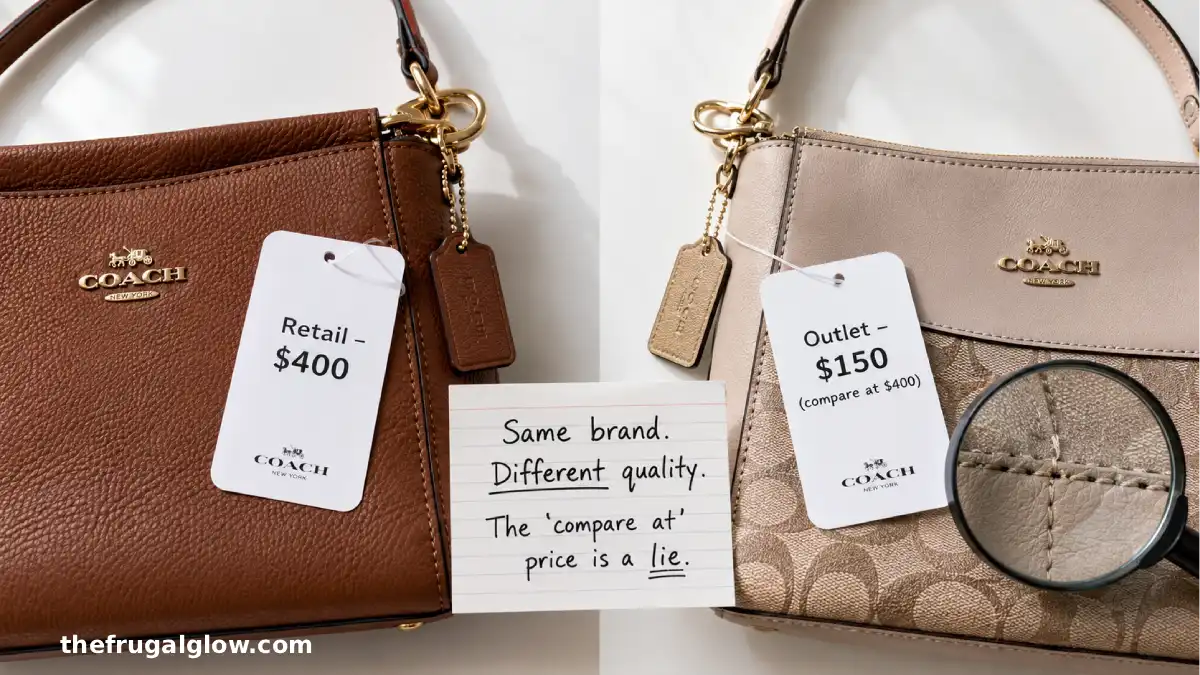
Let me tell you about the “Coach” bag that fell apart in three months.
I was thrilled when I found it at an outlet mall. The price tag said $150, marked down from $400. What a steal, right? I bought it, carried it proudly, and told everyone about my amazing outlet deal.
Ninety days later, the strap was fraying. The stitching was coming undone. The leather looked worn and tired. I took it to a Coach store. The salesperson looked at it and said something that made my stomach drop.
“This isn’t the same bag we sell in our retail stores. It was made specifically for the outlet.”
Made for the outlet. Meaning it was never worth $400. It was a cheaper version, made with cheaper materials, sold at a “discount” that wasn’t really a discount.
I felt cheated. Not because the bag was bad (it was fine for $150). But because I had been tricked into thinking I was getting a $400 bag for $150. I wasn’t. I was getting a $150 bag for $150.
That was the day I learned the truth about outlet stores. Most of them don’t sell overstock or last season’s items. They sell lower-quality products made specifically for the outlet channel. Same brand name. Lower quality. Higher profit margin.
Today, I’m sharing everything I’ve learned about outlet vs. retail. How to tell the difference. Which outlets are worth it. Which ones are ripoffs. And how to spot an “outlet special” from a mile away.
Let’s get into it.
Jump Links
- The Coach Bag That Taught Me a $250 Lesson
- What Most People Get Wrong About Outlet Stores
- How to Tell If an Item Is ‘Made for Outlet’ (5 Red Flags)
- Which Brands Make Good Outlet Items (And Which Don’t)
- The Secret ‘Factory’ vs. ‘Retail’ Code on Tags
- How to Shop Outlets the Smart Way (Without Getting Tricked)
- When Retail Items Actually End Up at Outlets (Real Deals)
- The Math: Outlet vs. Retail vs. Thrift vs. Sale
- Frequently Asked Questions (FAQ)
- Final Thoughts: Don’t Fall for the ‘Original Price’ Lie
The Coach Bag That Taught Me a $250 Lesson
I need to describe that moment in the Coach store.
I was holding my outlet bag, showing the salesperson the fraying strap. I expected her to offer to repair it. Instead, she turned it over and pointed to the tag.
“See this?” she said. “It says ‘Made for Factory.’ That means it was made specifically for outlet stores. It’s not the same leather we use in our retail bags. The stitching is different. The hardware is lighter.”
I looked closer. She was right. The leather was thinner. The stitching was looser. The hardware was hollow and light.
She showed me a retail version of a similar bag. The difference was obvious. Retail leather was thicker and softer. Retail hardware was solid and heavy. Retail stitching was tight and even.
“Your bag was never worth $400,” she said. “That ‘original price’ was fake. It was always a $150 bag.”
I was furious. Not at her. At myself. For believing the marketing. For assuming that an outlet store was selling the same products at a discount.
I started researching. I learned that most major brands have two production lines. One for retail stores (high quality). One for outlet stores (lower quality). The outlet products are designed to look like the retail products, but they’re made with cheaper materials and less labor.
The “original price” on the tag is made up. The “discount” is fake. You’re not getting a deal. You’re just buying a cheaper product.
That was ten years ago. I still shop at outlets, but I shop differently. I know what to look for. I know which brands to trust. And I know how to spot a fake discount from a mile away.
What Most People Get Wrong About Outlet Stores
Let me clear up some myths.
Myth #1: Outlet stores sell overstock from regular stores.
Sometimes, but rarely. Most brands now produce separate “outlet lines” specifically for their outlet stores. These products are designed and manufactured to be sold at a lower price point.
Myth #2: Outlet items are last season’s products.
Again, sometimes. But usually not. Last season’s products go to clearance racks at regular stores, not to outlets. Outlets want new products that look like current styles, but made cheaper.
Myth #3: The “original price” on the tag is real.
Almost never. That “compare at $400” price is made up. The item was never sold at that price. It’s a marketing tactic to make you feel like you’re getting a deal.
Myth #4: Outlet quality is the same as retail quality.
Not for most brands. The leather is thinner. The stitching is looser. The hardware is cheaper. The fabric is lower thread count. The buttons are plastic instead of metal.
Myth #5: You’re saving money by shopping at outlets.
Sometimes. But often, you’re just buying a cheaper product at its actual value. The “discount” is an illusion.
The truth: Outlet stores are not discount stores. They are separate retail channels selling different products at different price points. The products are not “deals.” They are just cheaper versions.
The exception: Some brands don’t have separate outlet lines. For these brands, outlets actually sell overstock and last season’s items. More on that below.
How to Tell If an Item Is ‘Made for Outlet’ (5 Red Flags)
Here’s how to spot an outlet special before you buy it.
Red Flag #1: The price is too perfectly discounted.
If the “original price” is $400 and the “outlet price” is $199, that’s a suspiciously round discount. Real discounts are uneven. $47.83 off, not 50% exactly.
Red Flag #2: The product has a “factory” or “outlet” tag.
Many brands mark their outlet products. Look for words like “Factory,” “Made for Outlet,” “Special Edition,” or “Premium Outlet.” These are code for “cheaper version.”
Red Flag #3: The hardware feels light.
Pick up the item. Does the zipper feel hollow? Does the buckle feel like plastic? Is the metal thin and lightweight? Outlet products use cheaper hardware to save money.
Red Flag #4: The stitching is uneven.
Look at the seams. Are the stitches straight and even? Or are they crooked, loose, or inconsistent? Outlet products have lower quality control.
Red Flag #5: The fabric feels thin.
Feel the material. Is it substantial? Or does it feel thin and flimsy? Outlet products use less material per item.
The ultimate test: Compare the outlet product to a retail product from the same brand. Go to the regular store first. Feel the fabric. Test the hardware. Look at the stitching. Then go to the outlet. The difference will be obvious.
Which Brands Make Good Outlet Items (And Which Don’t)
Not all outlets are created equal. Here’s the breakdown.
Brands with separate outlet lines (lower quality):
| Brand | Outlet Quality vs. Retail | What to Expect |
|---|---|---|
| Coach | Significantly lower | Thinner leather, lighter hardware, looser stitching |
| Michael Kors | Significantly lower | Similar to Coach – made for factory |
| Kate Spade | Lower | Cute designs, but quality is cheaper |
| J.Crew | Lower (J.Crew Factory) | Thinner cotton, cheaper buttons, simpler construction |
| Banana Republic | Lower (Banana Republic Factory) | Less structured, cheaper fabrics |
| Gap | Lower (Gap Factory) | Thinner denim, simpler details |
| Nike | Lower (some items) | Lower-grade materials for outlet-specific shoes and apparel |
Brands that sell real overstock (good quality):
| Brand | Outlet Quality vs. Retail | What to Expect |
|---|---|---|
| Brooks Brothers | Often same | Real overstock from retail stores |
| Nordstrom Rack | Often same | Real overstock and last season’s items |
| Saks Off 5th | Often same | Real overstock from Saks stores |
| Last Call (Neiman Marcus) | Often same | Real overstock and previous seasons |
| Ann Taylor | Often same (but check) | Mix of real overstock and outlet line |
| Levi’s | Often same | Real overstock and discontinued styles |
The safest brands for outlet shopping:
Department store outlets (Nordstrom Rack, Saks Off 5th) tend to have real overstock. They don’t manufacture their own products, so they can’t make separate outlet lines.
The trickiest brands:
Brands that have both retail and outlet stores (Coach, J.Crew, Banana Republic) are the most likely to have separate, lower-quality outlet lines.
The Secret ‘Factory’ vs. ‘Retail’ Code on Tags
Most people don’t know this. There’s a code hidden in the product tags.
How to decode the tag:
Look for a small number or symbol on the tag. For many brands, this code tells you whether the item was made for retail or factory.
J.Crew / J.Crew Factory:
- Retail tag has two diamonds (◊◊)
- Factory tag has two diamonds with a line through them (◊◊ with a slash) or says “Factory”
Banana Republic / Banana Republic Factory:
- Retail tag says “Banana Republic”
- Factory tag says “Banana Republic Factory” or has a different font
Gap / Gap Factory:
- Retail tag says “Gap”
- Factory tag says “Gap Factory”
Coach:
- Retail bag has a leather creed patch with a serial number
- Outlet bag has a “C” pattern and says “Made for Coach Factory”
Michael Kors:
- Retail bag has a metal “MK” logo that’s solid and heavy
- Outlet bag has a stamped or printed logo, lighter hardware
The strategy: Learn the code for your favorite brands. Google “[brand name] outlet vs retail tag” before you go. Knowledge is power.
How to Shop Outlets the Smart Way (Without Getting Tricked)
Here’s my strategy for outlet shopping. I use it every time.
Step 1: Do your research before you go.
Know which brands sell real overstock and which sell outlet lines. Focus your time on the good ones. Skip the ones that trick you.
Step 2: Go to the retail store first.
Before you go to the outlet, visit the regular store. Feel the fabrics. Test the hardware. Look at the stitching. Take photos. Then you’ll have a baseline for comparison.
Step 3: Compare the tag to the retail product.
Look for the “factory” code. Look for differences in logos, fonts, and labeling. If it says “Factory” or “Outlet,” it’s not the same as retail.
Step 4: Check the quality yourself.
Feel the fabric. Is it as thick as the retail version? Test the zipper. Does it feel smooth and solid? Look at the stitching. Is it straight and tight? Check the hardware. Is it heavy or hollow?
Step 5: Ignore the “original price.”
Assume it’s fake. The only price that matters is the one you’re paying. Ask yourself: “Is this item worth this price?” Not “Is this a good discount?” The discount is probably made up.
Step 6: Check the return policy.
Outlet return policies are often stricter than retail. Some are final sale. Some have a 14-day window. Know before you buy.
Step 7: Don’t buy anything you’re not sure about.
Walk away. There will always be another sale. Outlet stores are designed to create urgency. Don’t fall for it.
Pro tip: Shop outlet stores that are attached to regular stores. These are more likely to have real overstock. Standalone outlet malls are more likely to have separate outlet lines.
When Retail Items Actually End Up at Outlets (Real Deals)
Real deals do exist. Here’s when to find them.
After Christmas (late December – January):
Retail stores clearance out holiday inventory. Some of it ends up at outlets. Look for gift sets, holiday packaging, and seasonal items.
After spring and summer clearance (July – August):
Retail stores clear out warm-weather inventory. Outlets get some of these items. Look for shorts, sandals, swimwear, and summer dresses.
When a brand changes packaging (ongoing):
When a brand redesigns their logo or packaging, the old version gets liquidated. Outlets get these items. The product inside is the same. The box just looks different.
When a store closes (rare):
When a retail store closes, its inventory goes to outlets. These are real retail items at deep discounts. Follow store closing news in your area.
How to spot real retail items:
- The tag looks like a regular retail tag (no “factory” code)
- The quality matches retail products (thick fabric, solid hardware)
- The item is from a previous season (not the current one)
- The price is uneven (not a perfect 50% off)
The best outlet for real deals: Nordstrom Rack. They have a mix of real overstock and made-for-outlet items, but their made-for-outlet items are clearly labeled (Nordstrom Rack brand). The real overstock is easy to spot.
The Math: Outlet vs. Retail vs. Thrift vs. Sale
Let me compare the four ways to save money on clothes.
Retail (full price):
- Cost: $100
- Quality: Highest
- Time investment: Low
- Best for: Items you need immediately, basics you wear daily
Outlet (made-for-outlet):
- Cost: $50 (fake “original price” $100)
- Quality: Lower than retail (thinner fabric, cheaper hardware)
- Time investment: Medium
- Best for: Nothing, really. Skip made-for-outlet items.
Outlet (real overstock):
- Cost: $50-70 (real discount from $100 retail)
- Quality: Same as retail
- Time investment: Medium (hunting required)
- Best for: Previous season items, brands you love
Sale at retail store:
- Cost: $60-80 (20-40% off)
- Quality: Same as retail
- Time investment: Low (wait for email alerts)
- Best for: Current season items, basics
Thrift store:
- Cost: $5-15
- Quality: Variable (can find retail quality for pennies)
- Time investment: High (hunting required)
- Best for: Unique items, vintage, building a wardrobe over time
The winner for value: Thrift store (best price per quality). Second place: Retail sale (good price, low effort). Third place: Outlet real overstock (good price, medium effort). Last place: Outlet made-for-outlet (fake discount, lower quality).
My strategy:
- Basics (t-shirts, underwear, socks): Buy retail on sale
- Work clothes (pants, blazers, blouses): Thrift or retail sale
- Outerwear (coats, jackets): Thrift or retail sale
- Trendy items: Thrift only (don’t invest in trends)
- Luxury items (handbags, shoes): Thrift or retail sale, never outlet
The $10 ‘Marshalls’ Find: 5 Tips to Score Luxury Beauty for Under $15
Frequently Asked Questions (FAQ)
1. Are all outlet items lower quality than retail?
No. Some outlets sell real overstock from retail stores. Department store outlets (Nordstrom Rack, Saks Off 5th) are more likely to have real overstock. Brand-name outlets (Coach, J.Crew, Banana Republic) are more likely to have separate, lower-quality outlet lines.
2. How can I tell if an item is made for outlet?
Look for the “factory” or “outlet” label on the tag. Feel the fabric – is it thinner than you expect? Test the hardware – is it light or hollow? Look at the stitching – is it uneven or loose? Compare the item to a retail version of a similar product.
3. Is the ‘original price’ on outlet tags real?
Almost never. That “compare at $400” price is made up. The item was never sold at that price. It’s a marketing tactic to make you feel like you’re getting a deal. Ignore the “original price.” Only pay attention to the price you’re actually paying.
4. Which outlets are worth shopping at?
Nordstrom Rack is the best for real deals. Saks Off 5th and Last Call (Neiman Marcus) are also good. These are department store outlets, not brand outlets. They don’t manufacture their own products, so they can’t make separate outlet lines.
5. Are there any brand outlets worth shopping at?
Levi’s is okay – their outlet quality is similar to retail. Brooks Brothers often sells real overstock. Ann Taylor is a mix – check the tags carefully. For most other brands (Coach, Michael Kors, Kate Spade, J.Crew, Banana Republic, Gap), the outlet quality is noticeably lower than retail.
6. What’s the difference between ‘Factory’ and ‘Retail’ tags?
For J.Crew: retail tags have two diamonds (◊◊). Factory tags have two diamonds with a line through them. For Banana Republic: retail says “Banana Republic.” Factory says “Banana Republic Factory.” For Gap: retail says “Gap.” Factory says “Gap Factory.” Learn the codes for your favorite brands.
7. Can I return outlet items?
It depends on the store. Return policies at outlets are often stricter than at retail stores. Some outlets have a 14-day return window. Some are final sale. Ask before you buy. Keep your receipt.
8. Is it ever worth buying made-for-outlet items?
Sometimes, if you know what you’re getting. A $150 Coach outlet bag is still a decent $150 bag. The problem is thinking you’re getting a $400 bag for $150. You’re not. If you like the bag and the price seems fair for the quality, buy it. Just don’t be tricked by the fake discount.
Final Thoughts: Don’t Fall for the ‘Original Price’ Lie
Here’s what I want you to take away.
That Coach bag taught me a lesson I’ll never forget. Outlet stores are not discount stores. They are separate retail channels selling different products. The “original price” is a lie. The “discount” is a trick.
I’m not saying never shop at outlets. I still go to Nordstrom Rack. I still check Saks Off 5th. But I shop differently now. I know what to look for. I know which brands to trust. And I never, ever believe the “compare at” price.
The best deals are not at outlet malls. The best deals are at thrift stores (amazing quality for pennies), retail sales (real discounts on real products), and department store outlets (real overstock from retail stores).
So next time you see a “50% off” sign at an outlet mall, pause. Ask yourself: “Is this really a deal? Or am I just buying a cheaper version of something I thought was expensive?”
Your wallet will thank you.
That’s the frugal glow. And it’s not fooled by fake discounts. 💛
For more smart shopping guides, quality comparisons, and money-saving strategies, visit The Frugal Glow.