

Stop Getting Scammed! How to Spot ‘Fake Sales’ at Kohls and TJ Maxx
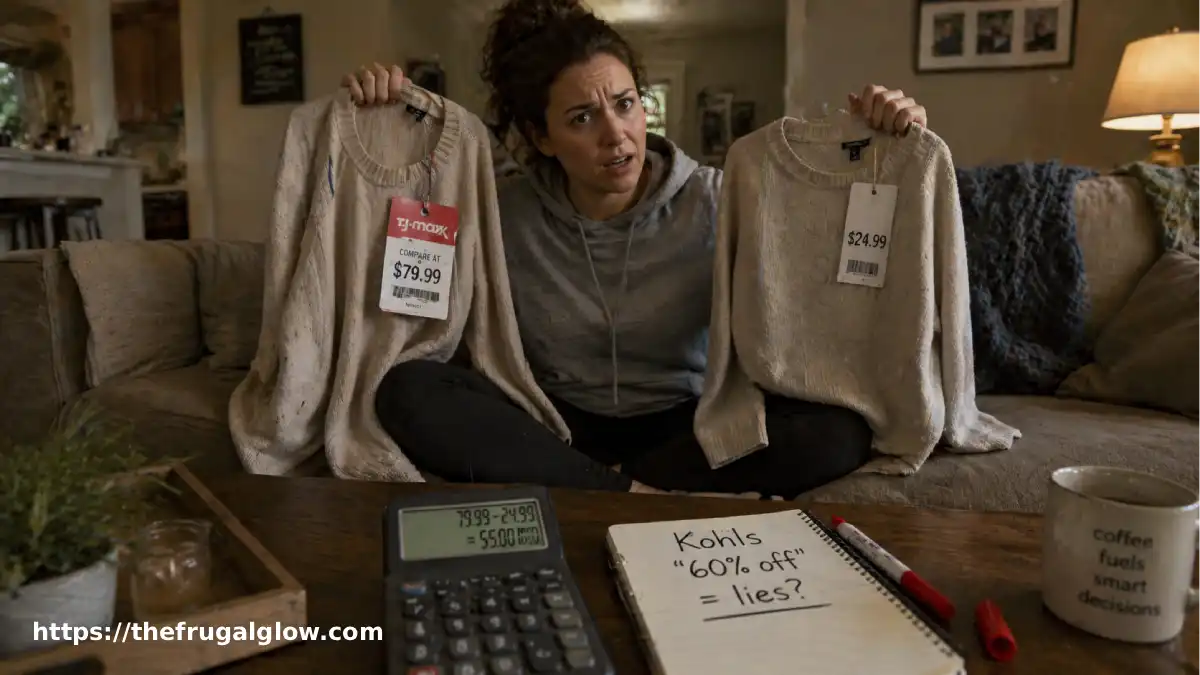
Let me tell you about the $70 “vintage” rug that broke my heart.
It was a Tuesday afternoon. The kids were at school for exactly three more hours. I had a rare hour to myself, and where did I go? TJ Maxx. Obviously.
I found this gorgeous distressed medallion rug. Cream, navy, a little bit of blush. It was perfect for my sad beige living room floor. The tag said: “Compare at $199. Our price: $69.99.”
I almost cried happy tears. Sixty-nine dollars for a $200 rug? That’s not a deal. That’s a steal. That’s a victory.
I bought it. I rolled it out at home. It looked amazing. I posted a photo on Instagram with the hashtag #tjmaxxfinds. I felt like a shopping queen.
Three weeks later, I walked into a HomeGoods (same company, same lies). And there it was. The exact same rug. Same brand. Same material. Same size.
Price tag: $39.99.
Not $199. Not even $69.99. Forty dollars. I had paid almost double for the “privilege” of thinking I was getting a deal.
I sat down right there on the floor of the HomeGoods aisle. I am not joking. I pulled out my phone. I did the math. And I realized something terrible: I have been getting scammed for years. And so have you.
Not illegally. Not obviously. But in that sneaky, psychological way that big retailers have perfected. They don’t need to lie. They just need to make you feel like you’re winning while you’re actually losing.
Today, I am going to show you exactly how Kohls, TJ Maxx, Marshalls, and Ross trick your brain. And more importantly, I am going to give you the tools to fight back. Because you deserve actual savings, not fake ones.
Jump Links
- The Big Lie: How ‘Compare At’ Prices Are Completely Made Up
- Kohls: The Coupon Casino (Why You’re Never Actually Saving 70%)
- The Secret TJ Maxx Color Code System They Don’t Want You to Know
- How to Spot a Fake Sale in 30 Seconds or Less
- Real Examples: What I Paid vs. What I Should Have Paid
- The ‘Reverse Image Search’ Hack That Saved Me $200 Last Month
- Why Ross Is Different (And Where You Should Actually Shop)
- The Frugal Mom’s 5-Question Test Before Any Purchase
- Frequently Asked Questions (FAQ)
The Big Lie: How ‘Compare At’ Prices Are Completely Made Up
Let me be very direct with you. And I want you to hear this in the voice of a friend who loves you too much to let you waste money.
The “Compare At” price on a TJ Maxx or Marshalls tag is not real.
I’ll say it again. It is not real. It has never been real. It is a marketing number that someone in an office made up to make you feel like you’re robbing the store when you’re actually just spending money you wouldn’t have spent otherwise.
Here is how it works:
A manufacturer makes a shirt. It costs them $8 to make. They sell it to TJ Maxx for $12. TJ Maxx wants to sell it to you for $19.99. That is their actual cost plus a reasonable profit.
But $19.99 doesn’t feel exciting. It feels like… a shirt.
So someone prints a tag that says “Compare at $59.99.” Now, $19.99 feels like a miracle. You feel smart. You feel lucky. You buy two.
But here is the truth: That shirt has never been sold anywhere for $59.99. Not at Nordstrom. Not at Macy’s. Not anywhere. The “compare at” price is often inflated by 300% to 500% for no reason other than to trick your brain.
I have tested this. I have taken items from TJ Maxx, looked up the exact brand and style number online, and found the same item at discount retailers for the same or lower price. I have never, not once, found evidence that the “compare at” price was accurate.
One time I found a handbag “compare at $149” at TJ Maxx for $49. I took a photo. I went home. I found the exact bag on the brand’s own website for $59 full price. Not on sale. Full price. So TJ Maxx was claiming the bag was $149 to sell it to me for $49, but the actual retail price was $59. I “saved” $100? No. I saved $10. And they tricked me into feeling like a hero.
The rule: Ignore the “compare at” price. Literally cover it with your thumb. Look only at the actual price tag. Then ask yourself: “Would I pay this amount for this item if there was no other number on the tag?” If the answer is no, put it back.
Kohls: The Coupon Casino (Why You’re Never Actually Saving 70%)
Oh, Kohls. My frenemy. I have a complicated relationship with Kohls because I genuinely love some of their stuff. But their pricing strategy is designed to make you feel like you’re gambling and winning, when really, the house always wins.
Let me explain the Kohls game.
Step 1: They mark everything up to an insane “original price.” A $30 sweatshirt is labeled “original price $80.”
Step 2: They put it on “sale” for $50. Wow, you’re saving $30! Except no, because the sweatshirt was never $80. It was always a $30 sweatshirt. Now you’re paying $50. You just lost $20.
Step 3: They give you “Kohls Cash.” Spend $50, get $10 Kohls Cash. This feels like free money. But Kohls Cash expires. It forces you to come back and spend more money to “use” your free money. And when you use Kohls Cash, you can’t use coupons on that transaction. So you’re locked in.
Step 4: They email you a 30% off coupon. But wait—the coupon doesn’t work on “exclusions.” And guess what? Almost everything you actually want is excluded. Name brands? Excluded. Nike, Under Armour, Levis? Excluded. The fine print is four paragraphs long.
Step 5: You think you saved 70%. You did not. You spent $120 on items that are worth $60, and you walked away with a $20 Kohls Cash certificate that will force you to come back and spend another $40 to use it.
This is not a sale. This is a loyalty program designed to look like a sale. It’s a casino where the chips are coupons and the house always wins.
Real example: I wanted a pair of Levi’s jeans at Kohls. “Original price: $89.99. Sale price: $59.99. Plus 30% off coupon!” I was so excited. I did the math: $59.99 minus 30% is about $42. Plus tax. Amazing.
Except the 30% off coupon had a tiny asterisk. Excludes Levi’s. I read the fine print. Levi’s was excluded. I went to Target the next day. Same Levi’s, same style, same wash. Target price? $44.99. No coupon. No game. Just $44.99.
I paid $2 more at Target. But I didn’t have to drive to Kohls, I didn’t have to play coupon roulette, and I didn’t have Kohls Cash burning a hole in my wallet. Target won. I won. Kohls lost.
The rule for Kohls: Ignore the “original price.” Ignore the percent-off claims. Add everything to your cart online, apply your coupon, and then look at your final out-of-pocket total. Ask yourself: “Is this a fair price for these items compared to Target, Walmart, Amazon, or Old Navy?” If the answer is no, close the tab.
The Secret TJ Maxx Color Code System They Don’t Want You to Know
Okay, this is where things get good. This is the insider knowledge that actual TJ Maxx employees have shared on Reddit and TikTok. And once you know it, you will never shop the same way again.
TJ Maxx (and Marshalls and HomeGoods) uses a color-coded price tag system to mark down items. Most shoppers don’t know this. They see a red tag and think “sale.” But not all red tags are created equal.
Here is the code:
- White tag (no color): Full price. This is what the store paid plus their standard markup. Do not buy white tags unless you genuinely love the item and the price feels fair to YOU.
- Red tag (clearance): This is a markdown. Usually 20-40% off their original ticket price. Red tags can be good. But wait—there’s more.
- Yellow tag: The real clearance. Yellow tags are items that have been marked down multiple times. This is where the actual deals live.
- Blue tag (the holy grail): Blue tags are “final clearance.” These items are often 70-90% off the original TJ Maxx price. But here is the catch: blue tags are rare. You have to hunt. And blue tags usually mean the item has been sitting in the store for 6+ months.
But here is the REAL secret: Look at the tiny numbers in the corner of the tag. Every TJ Maxx tag has a small date code. It looks something like “08/23” or “03/24.” That is the month and year the item arrived in the store.
If you see a tag from 6 months ago, that item is about to go on yellow or blue clearance. If you see a tag from 12 months ago, that item is ancient. You can often take it to the register and ask for an additional discount. I have done this. I got an extra 30% off just by asking nicely.
What the employees won’t tell you: If an item has been in the store for more than 8 weeks, the store is losing money on it every single day it sits there. They WANT to sell it to you. They will take a lower offer sometimes, especially if the tag is damaged or the item has a small flaw.
One more thing: Never buy beauty products or skincare at TJ Maxx. I know the $12 bottle of fancy shampoo is tempting. But those products are often expired, returned, or diverted (sold through illegal channels). I bought a “bargain” moisturizer once and broke out in a rash for two weeks. Not worth it.
How to Spot a Fake Sale in 30 Seconds or Less
You don’t have time to be a forensic accountant. You’re a mom. You have 30 seconds to decide if this “deal” is real. So here is my 30-second fake sale detection system.
Step 1: Check the “original” price against common sense. (5 seconds)
Ask yourself: Has this brand ever sold anything for that much? A no-name brand sweater “originally $129”? Unlikely. A pair of basic leggings “originally $89”? No. If the “original” price seems delusional, it is delusional.
Step 2: Feel the fabric. (5 seconds)
Fake sales are usually on poor-quality items. Run the fabric between your fingers. Does it feel cheap? Scratchy? Thin enough to see through? A “luxury” sweater should not feel like sandpaper. If the quality is bad, the “original” price is a joke.
Step 3: Do the 50% sniff test. (5 seconds)
Here is a rule I made up: If the “sale” price is less than 50% of the “original” price, it’s probably fake. A $100 shirt on sale for $49? Maybe real. A $100 shirt on sale for $89? That’s not a sale. That’s Tuesday.
Step 4: Check the seams and stitching. (5 seconds)
Turn the item inside out. Look at the seams. Are they straight? Are there loose threads? Is the hem even? If a brand is selling a $70 shirt, it should have perfect stitching. If the stitching is crooked, that shirt is worth $15 max.
Step 5: Pull out your phone. (10 seconds)
I know you hate when I say “use your phone” because you’re already on it too much. But this takes 10 seconds. Open Google Lens or the Amazon app. Click the camera icon. Take a photo of the item. It will show you the same item from other stores. I have caught SO many fake sales this way.
Example: I found a “designer” lamp at HomeGoods for $39.99. “Compare at $120.” I did Google Lens. The exact same lamp was on Amazon for $32 with free shipping. I laughed out loud in the store. Walked right out.
The ’72-Hour Rule’: The Simple Brain Hack That Saved Me $1,000 in Impulse Buys
Real Examples: What I Paid vs. What I Should Have Paid
Let me shame myself publicly so you can learn from my mistakes. These are real purchases I made before I knew better.
The “Cashmere” Scarf at TJ Maxx
- What I paid: $24.99 (compare at $89!)
- What I thought: “This is a steal! Cashmere!”
- The truth: It was 5% cashmere, 95% acrylic. The same scarf was on Amazon for $12.99.
- Real value: $13.
- I overpaid by: $12.
The “Designer” Sneakers at Kohls
- What I paid: $49.99 (original $110, plus 20% off coupon)
- What I thought: “I’m basically a genius.”
- The truth: The same sneakers were at DSW for $39.99, no coupon needed.
- Real value: $40.
- I overpaid by: $10.
The “Gourmet” Olive Oil at HomeGoods
- What I paid: $14.99 (compare at $35)
- What I thought: “Fancy European oil!”
- The truth: I looked up the brand. It’s a white-label product made by a company that also makes store-brand oil. The exact same oil was at Aldi for $5.99.
- Real value: $6.
- I overpaid by: $9.
The “Vintage” Rug That Broke Me (The one from the intro)
- What I paid: $69.99 (compare at $199)
- What I thought: “I am the queen of home decor deals.”
- The truth: HomeGoods had the same rug for $39.99 three weeks later.
- Real value: $40.
- I overpaid by: $30.
Over four purchases, I was scammed out of $61. That’s a whole dinner out. Or two months of Netflix. Or a really nice bottle of wine to drink while crying about the rug.
Learn from my pain. Please.
The ‘Reverse Image Search’ Hack That Saved Me $200 Last Month
This is my favorite tool. It takes 10 seconds. It has saved me over $200 in the past 30 days alone.
Here is what you do:
- At the store, pull out your phone.
- Open the Google app or the Google Lens app.
- Tap the camera icon.
- Take a photo of the item (clothing, home decor, toy, anything).
- Google will show you every other store selling that exact item or something very similar.
- Compare prices.
- Either buy it at the cheapest store, or leave and buy it online.
Real example from last week:
I found a beautiful ceramic planter at Marshalls. The tag said $24.99. “Compare at $65.” Cute, right? I did a reverse image search.
Google showed me the exact same planter at Walmart.com for $16.99. Then the exact same planter at Wayfair for $14.99 during a flash sale. Then the exact same planter at a random website for $12.99 plus shipping.
I bought it from Wayfair for $14.99. Free shipping. Saved $10. That’s a 40% savings over the Marshalls “deal.”
But wait, it gets better.
Sometimes you’ll find an item that is genuinely a good deal at TJ Maxx or Kohls. Reverse image search confirms it. That’s fine! Buy it! The point is not to never shop there. The point is to stop getting scammed.
I found a kids’ wooden toy at Kohls for $19.99 (original $35). I reverse image searched it. The same toy was $34.99 on Amazon and $36 at Target. Kohls was actually cheaper. So I bought it. No shame.
The tool is not the enemy of the store. The tool is your friend.
Why Ross Is Different (And Where You Should Actually Shop)
I need to talk about Ross Dress for Less. Because Ross operates differently than TJ Maxx and Kohls, and most people don’t know this.
Ross does not play the “compare at” game as aggressively. Their tags usually say “Compare at” but the number is often closer to reality. Why? Because Ross buys mostly overstock and closeouts from other stores. They aren’t manufacturing their own “compare at” numbers as much.
However, Ross has a different problem: the store is a disaster zone. Nothing is organized. Sizes are mixed up. It’s stressful to shop there. So you have to decide if the lower prices are worth the chaos.
Here is my honest ranking of where to actually find real sales:
1. Target (yes, really)
Target’s everyday prices are often lower than Kohls “sale” prices. And their clearance is real. When Target puts a red sticker on something, it’s because they need the shelf space. I have gotten $40 jeans for $8 at Target clearance.
2. Old Navy (wait for 50% off sales)
Old Navy runs a 50% off everything sale every 4-6 weeks. Never pay full price at Old Navy. Their “original” prices are fake too. But their 50% off sales are real.
3. Nordstrom Rack (clearance section only)
Nordstrom Rack’s regular prices are meh. But their “Clear the Rack” sales (extra 25-40% off clearance) are genuinely good. I bought $200 boots for $45.
4. Ross (for basics only)
Ross is good for socks, plain t-shirts, kids’ pajamas, and basic kitchen stuff. Do not go to Ross for “investment pieces.” The quality isn’t there.
5. TJ Maxx (with the color code system only)
Shop TJ Maxx only for yellow and blue tags. Ignore white and red. And always reverse image search.
6. Kohls (for Kohls Cash strategies only)
I only shop at Kohls if I have a 30% off coupon AND a $10 Kohls Cash coupon AND I am buying something I already know the real price of. Otherwise, skip it.
The Frugal Mom’s 5-Question Test Before Any Purchase
Before I buy anything at any store now, I ask myself these five questions. I literally say them in my head. You can steal them.
Question 1: If this item had no price tag and no “compare at” number, would I still want it?
- Why this matters: Fake sales work because they add excitement. Strip away the excitement. Is the object itself desirable on its own?
Question 2: Do I know the actual market price of this item within $5?
- Why this matters: If you don’t know what a fair price is, you can’t spot a fake sale. A $20 sweater is a good deal. A $40 sweater is fine. A $60 sweater is expensive. Know your numbers.
Question 3: Can I wait 48 hours to buy this?
- Why this matters: The 72-Hour Rule from my last article applies here too. If you can walk away, you can do a reverse image search from home and check other stores. The urgency is fake.
Question 4: Is this something I was looking for, or something the store convinced me I want?
- Why this matters: I call this “browsing creep.” You walk in for socks. You leave with a lamp, two candles, and a decorative pillow. The store won. You lost.
Question 5: Would I buy this if I saw it at a garage sale for the same price?
- Why this matters: This is my weirdest question, but it works. Garage sales have no marketing. No “compare at.” No coupons. If you would happily hand over cash at a garage sale for that price, then it’s a real deal. If you wouldn’t, then the “sale” is tricking you.
The Time I Almost Bought a “Designer” Handbag (And How I Saved $150)
I have to tell you this story because it’s my proudest frugal moment.
I was at TJ Maxx. In the glass case. You know the one. The locked case with the “designer” handbags. There was a “Marc Jacobs” bag. The tag said: “Compare at $450. Our price: $199.”
I wanted it so badly. My heart was racing. I could see myself carrying it. I could feel the compliments. I almost asked the employee to unlock the case.
But I stopped. I pulled out my phone. I reverse image searched the bag.
The first result: Marshalls (same company) had the exact bag for $179. Okay, not a huge difference.
The second result: The RealReal (a legit secondhand luxury site) had the same bag, authenticated, for $89. Used? Yes. But in “excellent condition.” Almost new.
The third result: I found a Reddit thread about this exact bag. People were saying it’s not even real leather. It’s bonded leather (glued together scraps). It falls apart in two years.
I put my phone away. I walked out. I did not buy the bag.
Two weeks later, I found a genuine leather crossbody bag at a consignment shop for $40. It’s not Marc Jacobs. It’s a no-name brand. But the leather is thick, the stitching is perfect, and I use it every single day.
Total savings: $159 (the difference between TJ Maxx’s $199 and my $40 bag).
That $159 bought my kids’ winter coats and boots that season.
Your First Step Starts Right Now
You are not dumb for falling for fake sales. You are human. These stores hire psychologists to design their price tags. They spend millions of dollars learning exactly how to make you feel smart while taking your money.
But now you know.
Now you know about the fake “compare at” prices. Now you know about Kohls’ coupon casino. Now you know about the TJ Maxx color code system and the reverse image search hack.
Here is what I want you to do. And I want you to do it today.
Open your wallet or your purse. Take out any receipts from Kohls or TJ Maxx from the past week. Look at them. For each item, guess what the real value is. Then go online and check. I promise you will find at least one item where you overpaid by $10 or more.
Don’t feel bad. Feel empowered. Because next time, you will know better.
And here is the best part: You don’t have to stop shopping at these stores. I still shop at TJ Maxx. I still shop at Kohls. I’m not a monster. But now I shop with my eyes open. I ignore the “compare at.” I look for yellow and blue tags. I reverse image search before I buy. I ask my five questions.
Last month, I saved $87 on one trip to HomeGoods just by reverse image searching three items and putting two of them back. That’s real money. That’s a week of groceries for my family.
You can do this. You are smarter than a price tag. You are stronger than a coupon. And you deserve to keep every single dollar you work for.
Now go out there and shop like the frugal queen you are. And if you see a “compare at” price that looks too good to be true? It is. Put it back. Walk away. And smile, because you just won.
This article was written after three cups of coffee, one very disappointing rug, and a burning desire to save other moms from the same mistakes I made.
Proudly published by The Frugal Glow — where we believe that being frugal doesn’t mean never shopping. It means shopping with your eyes wide open. No shame, no guilt, just real talk about how to keep your glow without letting the retail giants trick you out of your hard-earned cash. Thanks for being here. Now go save some money.