
How to Style One Silk Scarf in 10 Ways (The $5 Secret to a New Outfit Every Day)
The Frugal Glow | Budget Fashion & Style | Accessories
Jump Links
- The Most Underrated Accessory in Fashion Costs $5
- Where to Find Your $5 Silk Scarf
- What to Look for When Buying a Silk Scarf for Versatility
- The 10 Ways to Style It
- The Outfit-by-Outfit Week: How I Wore It Every Day
- The Frugal Glow Verdict
- FAQ — Questions People Are Actually Googling
The Most Underrated Accessory in Fashion Costs $5
Let me tell you about an accessory that has appeared on Audrey Hepburn’s neck, in Hermès windows at $400 a piece, on Grace Kelly’s head, in every major fashion week street style photograph for the past decade, and on the thrift store rack at your local Goodwill for $3 to $7 this week.
The silk scarf is fashion’s most versatile and most democratically available luxury item — a piece that the very wealthy buy at Hermès for $400 and the very smart buy at thrift stores for $5, with results that in actual wear are genuinely indistinguishable from a social distance of more than three feet.
I have been styling the same $5 silk scarf I found at a Goodwill eight months ago in ten different ways across my wardrobe. I have received compliments on it as a neck tie, as a hair ribbon, as a bag accent, and as a makeshift halter top. Nobody has asked where it’s from — people ask how I styled it. The styling is the point. The price of the scarf is entirely invisible in the outcome.
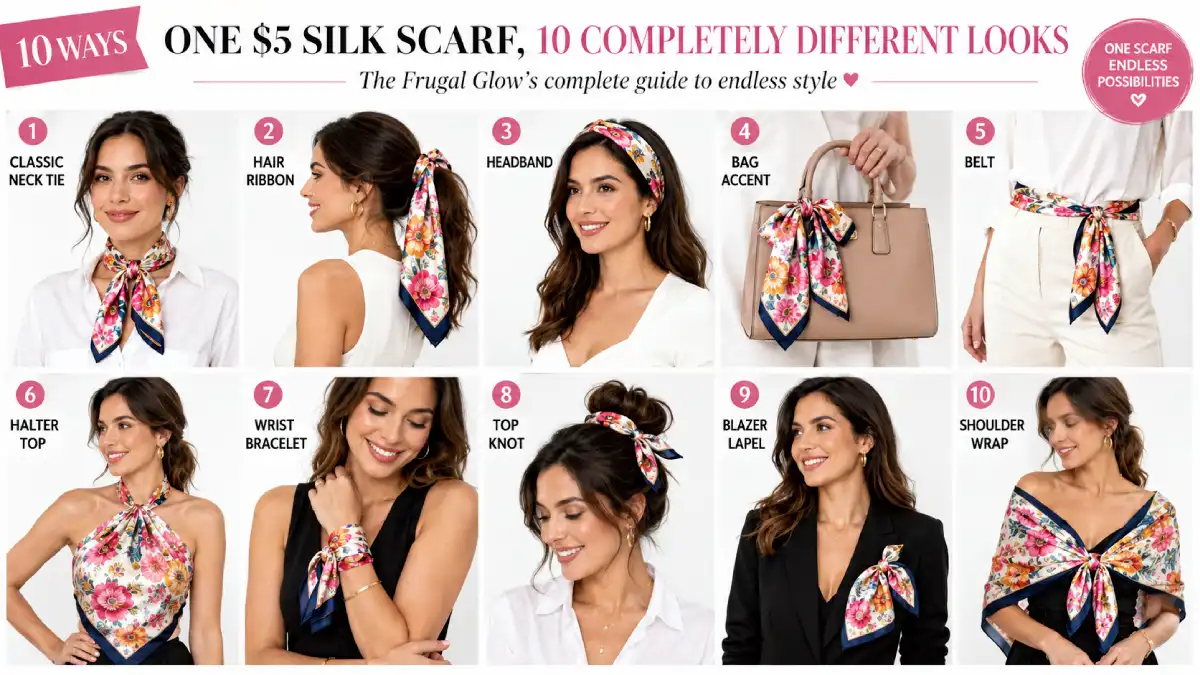
This article is the complete guide: where to find a $5 silk scarf worth styling, what to look for in a scarf that will work for all ten methods, and the exact step-by-step instructions for every look.
Where to Find Your $5 Silk Scarf
The single best source for silk scarves at the lowest prices is secondhand — and silk scarves specifically are one of the thrift store categories where quality is genuinely high and prices are genuinely low.
Goodwill and local thrift stores: Silk scarves donated to Goodwill and local thrift stores are almost always from women who owned them for decades and either inherited them or purchased them when silk scarves were the dominant accessory of their era — the 1970s through 1990s. This means the scarves are frequently genuine silk, frequently high quality, and frequently from recognizable brands. Prices are typically $2 to $8.
ThredUP: Online thrift shopping at ThredUP consistently surfaces silk scarves from brands including Hermès, Gucci, and Ferragamo — authentic designer scarves at prices from $15 to $60, dramatically below their retail equivalents. For non-designer quality vintage silk, ThredUP prices run $4 to $12.
Poshmark and Depop: Both platforms have significant silk scarf inventory from sellers who have specifically curated vintage scarves. Search “vintage silk scarf” and filter by size and price. Expect to pay $5 to $20 for non-designer vintage silk in excellent condition.
Target and H&M: For new silk-like scarves at budget prices — polyester satin that photographs and styles similarly to silk — Target’s A New Day line and H&M’s accessories section consistently offer printed square scarves for $8 to $15 that work for all ten styling methods below.
What you actually need: A square scarf approximately 26 to 35 inches on each side. This size is the sweet spot — large enough to tie as a top, small enough to fold down to a thin hair ribbon. A classic square in this size is the foundation for all ten looks.
What to Look for When Buying a Silk Scarf for Versatility
Not every silk scarf will work equally well for all ten styling methods. Here is what to look for specifically:
Size: The 26 to 35 inch square is the most versatile. Smaller scarves (under 20 inches) are limited to hair and wrist applications. Larger scarves (over 36 inches) can be bulky for neck and hair applications but work beautifully as tops and wraps.
Print: A classic print — floral, paisley, geometric, or abstract — works better than a solid for most applications because it adds visual interest to simple outfits without requiring the outfit to be interesting itself. The print should be colorful enough to read as an intentional styling choice rather than an afterthought but not so bold that it overwhelms.
Color: Choose a scarf whose print contains at least one color from your existing wardrobe. If your capsule is navy, white, and camel — look for a print that contains navy, cream, or warm tan. This ensures the scarf integrates with what you already own rather than requiring new pieces.
Fabric: Genuine silk has a weight and drape that makes tying and knotting easier and produces more elegant results than polyester alternatives. That said, high-quality polyester satin drapes similarly and is significantly more resistant to wrinkles — a practical advantage. Both work for all ten methods below.
The 10 Ways to Style It
Look #1 — The Classic French Neck Tie
The vibe: Parisian effortless, instantly polished, works with everything from a white tee to a blazer.
How to do it:
Fold the scarf diagonally to form a triangle. Then fold from the point toward the long edge repeatedly until you have a long, narrow band approximately 2 to 3 inches wide. Drape the center of this folded scarf around the back of your neck so the two ends hang in front. Tie the two ends in a loose, intentionally imperfect knot at the front — off-center ties better than centered. Let the ends fall naturally rather than tucking them in.
The key detail: The knot should look relaxed and slightly undone — not tight and symmetrical. The more deliberately casual the knot, the more intentionally stylish it reads. A perfectly centered, tight bow reads as trying too hard. An asymmetrical loose knot reads as effortless.
Best worn with: Simple white or black scoop-neck top, straight-leg jeans, white sneakers. This combination is the one that has generated the most “where is that scarf from?” questions in my experience.
The outfit transformation it creates: A plain white tee and jeans becomes a considered, editorial look with no additional effort or cost.
Look #2 — The Hair Ribbon Ponytail
The vibe: Feminine, retro, the kind of hair moment that photographs beautifully.
How to do it:
Fold the scarf down to a long, narrow band — approximately 1.5 to 2 inches wide. Put your hair in a ponytail using a regular elastic. Then take the folded scarf and tie it around the base of the ponytail, covering the elastic, with a bow or loose knot. Let the ends of the scarf trail down alongside the ponytail for maximum effect.
The key detail: The scarf ends trailing down alongside the ponytail — rather than being tucked in — create the signature visual of this look. Both ends should be approximately equal length and should drape naturally rather than stiffly.
Best worn with: A simple sundress or casual off-shoulder top. The scarf at the ponytail adds enough visual interest that the outfit can be minimal and the whole look still reads as complete and intentional.
Variation: The same technique works with a bun — wrap the scarf around the base of the bun and tie it on top in a bow for a more polished, editorial version.
Look #3 — The Headband Wrap
The vibe: Retro-glam, 1960s-inspired, the look that simultaneously keeps hair back and adds personality.
How to do it:
Fold the scarf into a narrow band approximately 2 inches wide. Starting at the nape of the neck, bring the scarf up over the ears and across the top of the head. Tie a knot or bow on top — either centered at the crown or slightly off to one side. Tuck the ends under the scarf or let them trail. Adjust so the band sits flat against the head rather than riding up or sliding back.
The key detail: The headband should sit approximately 2 inches back from the hairline rather than at the very front — this positioning is what distinguishes the elegant vintage look from the gym-practical look. An inch forward or back makes a significant visual difference.
Best worn with: Anything from a casual cotton dress to a blazer and trousers — the headband adds personality to any outfit it accompanies and works across dress codes in a way that few accessories do.
Look #4 — The Bag Accent Tie
The vibe: The Parisian detail that makes a simple tote or structured bag look a hundred dollars more expensive.
How to do it:
Fold the scarf into a long, narrow band. Tie it around the handle of a bag — either at the center of the handle, at the point where the handle meets the bag body, or looped around one handle end. Tie in a bow, a loose knot, or let the ends trail. For tote bags, tying at one of the handle-to-bag attachment points and letting the ends drape down the side of the bag produces a particularly polished result.
The key detail: This technique works best on bags with simple, solid-colored leather or canvas construction — the print of the scarf becomes the bag’s visual interest and a busy bag pattern competes rather than complements. A simple black or tan leather bag with a printed silk scarf tied at the handle is one of the most reliably elegant accessory combinations available.
Best worn with: The bag accent is passive — it accompanies whatever outfit the bag accompanies. The effect is that any ordinary bag in your existing collection suddenly looks intentionally styled rather than simply functional.
The investment math: A $200 structured leather tote with a $5 scarf tied at the handle photographs like a $400 bag. The scarf is the detail that communicates curation.
Look #5 — The Statement Belt
The vibe: Waist-defining, colorful, the styling move that creates proportion in oversized or untucked looks.
How to do it:
Fold the scarf into a band approximately 2 to 3 inches wide. Thread it through your belt loops as you would a regular belt, or simply tie it at the front of high-waisted pants or a skirt over a tucked blouse. Tie in a bow at the center front — a full bow with generous loops rather than a tight knot — or in an asymmetrical side knot. The looser and more intentional-looking the bow, the better the result.
The key detail: The scarf-as-belt works specifically with high-waisted bottoms — high-waisted trousers, a midi skirt, high-waisted jeans. Low-waisted bottoms make the scarf belt look accidental rather than intentional. The waist definition the scarf creates at the right waist height is the entire point of this look.
Best worn with: High-waisted wide-leg trousers with a tucked white shirt, the scarf tied at the waist in a bow. This specific combination is the one that consistently produces the “that looks like it’s from a magazine” response.
Look #6 — The Halter Top
The vibe: Vacation, summer-forward, the look that makes people ask if you bought a new top.
How to do it:
This technique requires a scarf at least 28 inches square. Fold the scarf diagonally to form a triangle with the point facing downward. Bring the two corner ends up and around your neck, crossing them at the back of the neck and bringing them forward to tie in a bow at the front — the resulting triangle of fabric drapes across the chest as a halter front. Adjust the bow tightness to ensure comfortable coverage.
The alternative tie method: Instead of crossing at the back of the neck, bring both corner ends up and tie them in a knot at the nape of the neck for a more secure hold. The remaining triangle of scarf covers the chest and the bottom point of the triangle drapes at the midriff.
The key detail: This look requires the scarf to be large enough for the triangle to provide genuine coverage — test coverage before wearing out. A 26-inch scarf provides minimal coverage suitable for layering under a blazer or over a bikini. A 32 to 35 inch scarf provides standalone coverage for a proper halter top look.
Best worn with: High-waisted trousers or a midi skirt. The halter top styling converts the scarf from an accessory into a clothing item — the most dramatic transformation of the ten methods and the one that produces the most genuine surprise when you tell people what the “top” actually is.
Look #7 — The Wrist Bracelet
The vibe: Effortlessly bohemian, the smallest use of the scarf with an outsized impact on outfit detail.
How to do it:
Fold the scarf down to its narrowest band — approximately 1 inch wide. Wrap it around the wrist two to three times, depending on the scarf length and the desired fullness. Tie in a small bow or knot at the wrist. Let the trailing ends fall naturally rather than tucking them in.
The key detail: The wrist scarf works as a bracelet substitute or bracelet complement — layered with simple gold bangles, the silk contrasts with metal in a way that looks intentional and editorial. Worn alone on an otherwise accessory-free wrist, it adds the one detail that makes a simple outfit look considered.
Best worn with: Simple, minimal outfits where the small detail of a wrist scarf can read clearly. A white t-shirt and jeans with a wrist-tied scarf and nothing else has a specific kind of understated style that reads as genuinely effortless.
Look #8 — The Blazer Lapel Knot
The vibe: Preppy-fashion-forward, the unexpected styling detail that makes a classic blazer look completely current.
How to do it:
Fold the scarf into a narrow band. Drape it through the buttonhole of a blazer or around the lapel notch and tie a small, casual knot at the front of the lapel. This can also be achieved by simply tucking the center of the folded scarf into the blazer breast pocket — the same position as a pocket square — and letting the ends drape out over the lapel.
The key detail: The lapel knot or pocket drape transforms a standard blazer into something editorial — a detail that signals fashion awareness rather than standard professional dressing. It is the styling move that fashion editors use in street style photographs to make a classic blazer interesting, and it requires approximately thirty seconds and $5 to execute.
Best worn with: A simple blazer in black, camel, or navy over a white t-shirt and straight-leg jeans — the minimalism of the outfit makes the scarf detail visible and intentional rather than competing with other styling elements.
Look #9 — The Top Knot Headscarf
The vibe: Retro-glamorous, old Hollywood, the head-covering look that works equally well on a bad hair day and a great hair day.
How to do it:
Place the center of the unfolded scarf at the back of the head, at the nape of the neck. Bring both ends forward over the top of the head, crossing them at the crown. Take the two ends back toward the nape, cross them again, and bring them back to the top of the head. Tie in a bow or knot at the top of the head — the layered wrapping creates volume and structure at the crown that distinguishes this from a simple tied headscarf.
The simpler version: Place the center of the folded (into a band) scarf at the hairline at the front of the head. Bring both ends back over the head, cross them at the crown, and tie in a knot or bow at the nape.
The key detail: The top knot headscarf reads as intentional and glamorous when the fabric is smoothed against the head rather than allowed to bunch or wrinkle. Take thirty seconds after tying to smooth the fabric flat against the head in the front and sides — the smoothness is what creates the polished result.
Best worn with: A simple, minimal outfit — the headscarf is bold enough that the rest of the look should be quiet. Solid color dresses, simple separates, or a crisp white shirt and trousers all work beautifully under a headscarf that is doing the visual heavy lifting.
Look #10 — The Shoulder Wrap
The vibe: Elegant evening layer, the addition that turns a simple top into a complete look for dinner or an event.
How to do it:
Unfold the scarf completely. Drape it over one shoulder, letting both ends fall on either side of the body — one end draping down the front and one down the back of the same shoulder. Secure by knotting the two ends loosely at the shoulder, or simply let the drape hold by the natural weight of the fabric. For more secure hold, pin invisibly with a small safety pin at the shoulder point.
The key detail: The shoulder wrap works because it adds color, pattern, and visual interest at the shoulder — the first thing people see when they look at you — without adding bulk or warmth, making it the perfect lightweight layer for warm-weather evenings when a full jacket is too much.
Best worn with: A simple strapless or spaghetti strap top with wide-leg trousers for an evening look that takes five seconds to achieve and reads as polished and intentional. The scarf draped at one shoulder in a print creates the visual center of the outfit.
The Outfit-by-Outfit Week: How I Wore It Every Day
To demonstrate that the ten methods aren’t theoretical — they’re genuinely wearable in a real week — here is how I wore my $5 silk scarf on seven consecutive days:
Monday (Work): Neck tie over a white button-down tucked into black trousers. Simple, polished, professional. Three colleagues commented on the scarf.
Tuesday (Casual): Hair ribbon ponytail with a simple white tee, straight-leg jeans, and white sneakers. The easiest look of the week and the one that generated the most “that’s so cute” responses.
Wednesday (Meeting): Blazer lapel knot on a camel blazer over a fitted black turtleneck with straight-leg trousers. The most editorial of the work looks and the one that required the most explaining when people asked how I’d styled it.
Thursday (Casual Work): Bag accent on my simple black leather tote with a neutral outfit behind it — the scarf did the accessory work for the entire day.
Friday (Evening): Shoulder wrap over a simple black slip dress for dinner. The most evening-appropriate look of the week with no additional accessory investment.
Saturday (Casual): Wrist bracelet with a minimal white t-shirt, wide-leg linen trousers, and simple sandals. The most subtle application and one of the most stylish in how it worked with the outfit’s minimalism.
Sunday (Errand Day): Top knot headscarf with a simple cotton dress. The most practical look — keeping hair back while looking entirely intentional.
Seven consecutive days. One scarf. Seven genuinely different looks. Total accessory investment: $5.
The ‘Thrift Store’ Handbag Guide: 5 Secrets to Finding Luxury Leather for $10
The Frugal Glow Verdict
The silk scarf is not a nostalgic accessory or a niche fashion reference. It is the most versatile, most photographable, most legitimately timeless accessory available in fashion — worn by icons across a hundred years of style history precisely because its applications are genuinely infinite and its visual impact is genuinely significant.
The fact that it is available at thrift stores for $5 while Hermès charges $400 for the same square of printed fabric is one of fashion’s most democratic and underexploited truths. The styling skill that makes the scarf beautiful is freely available. The scarf itself is freely available at Goodwill. The $395 you don’t spend on the Hermès version is yours to keep.
Ten ways to wear it. One scarf. Five dollars. A week of genuinely different, genuinely polished, genuinely complimented looks from a single accessory that takes thirty seconds to style in any of its applications.
That is the frugal glow in its purest form — not spending less and getting less, but spending less and getting exactly the same thing that the people spending twenty times more are getting. In this case, the thing is a beautiful silk square that the person wearing it knows how to use. The knowing is the value. The scarf is just the vehicle.
At The Frugal Glow, this is what we’re always looking for — the $5 version of the $400 result, the styling skill that makes the budget choice look indistinguishable from the luxury one, and the wardrobe wisdom that proves fashion has always been more about how you wear things than how much you paid for them. Bookmark us, share this with the friend who has a silk scarf in a drawer she has never known what to do with, and come back for more styling guides that prove one piece can do the work of ten. 💚✨
FAQ — Questions People Are Actually Googling
1. How do you tie a silk scarf stylishly?
The most consistently stylish silk scarf techniques share one characteristic: they look deliberately undone rather than perfectly symmetrical. The French neck tie should have an asymmetrical, loose knot rather than a centered bow. The hair ribbon should have trailing ends rather than tucked ends. The bag accent should be casual rather than rigid. The key to stylish scarf tying is deliberately introducing imperfection after completing the tie — loosening a knot slightly, pulling one end longer than the other, smoothing fabric in some places while letting it bunch naturally in others. Perfect symmetry reads as trying too hard. Deliberate imperfection reads as effortless. This principle applies across all ten styling methods in this guide and is the single most important technique insight for wearing scarves well.
2. What size silk scarf is most versatile?
The 26 to 35 inch square silk scarf is the most versatile size for the widest range of styling applications. This size folds down narrow enough for hair ribbons and wrist bracelets while unfolding large enough for halter top and shoulder wrap applications. The 27 inch Hermès Carré standard — the size that made the square scarf iconic — falls perfectly within this range for good reason. Below 20 inches, scarves are limited to hair and wrist applications. Above 36 inches, scarves become better suited to wrap and shawl applications but more cumbersome for neck and hair styling. For thrift store shopping, look specifically for square scarves in the 26 to 35 inch range — hold the scarf by two adjacent corners to confirm it forms a true square before purchasing.
3. Where can I find cheap silk scarves?
The best sources for affordable genuine silk scarves in order of price and reliability are: local thrift stores and Goodwill ($2 to $8, with frequent finds from the 1970s through 1990s when silk scarves were the dominant accessory and donations from that era are consistently available), ThredUP online ($4 to $20 for non-designer vintage silk, $15 to $60 for authenticated designer silk), Poshmark and Depop ($5 to $20 for curated vintage silk from sellers who specifically source scarves), and estate sales and flea markets ($1 to $10 with the highest variance in quality and condition). For new scarves at budget prices, Target’s A New Day accessories and H&M’s accessories section consistently offer printed square scarves in polyester satin — which styles similarly to silk — for $8 to $15. The polyester versions are more wrinkle-resistant and machine washable, which are genuine practical advantages over genuine silk at the budget price point.
4. How do you keep a silk scarf in place?
Keeping a silk scarf in place — particularly for neck, hair, and top applications — is the most common practical challenge in scarf styling and has several effective solutions. For neck applications, the initial knot should be tighter than it looks — silk is slippery and loose knots loosen further with movement. For hair applications, starting with a slightly textured or not freshly washed hair creates friction that holds the scarf more securely than freshly washed, conditioning-treated hair. For the halter top application, tying the neck knot tightly and using a small safety pin at the waist point of the triangle prevents shifting. For shoulder and body wraps, a small safety pin placed invisibly at the shoulder point where the scarf drapes provides secure hold without visible evidence. Double-sided fashion tape applied between the scarf and the clothing or skin beneath it is the professional’s solution for maximum security in any application.
5. Can you wear a silk scarf as a top?
A silk scarf worn as a halter top is entirely achievable and genuinely wearable with a scarf of at least 26 inches square — though 30 to 35 inches provides more coverage and more styling confidence. The technique involves folding the scarf diagonally into a triangle and tying the two corner ends around the neck, with the triangle of fabric draping across the chest and the point draping at the midriff. This look works best under a blazer (which provides additional coverage and structure), over a bikini top (the scarf becomes a cover-up that reads as a style choice rather than resort wear), or as a standalone top with high-waisted trousers or a midi skirt for summer events. The scarf halter top is one of the most commented-on styling methods in this guide specifically because people genuinely cannot identify the “top” as a scarf until it’s pointed out.
6. What outfits go with a silk scarf?
The silk scarf’s universality is its defining characteristic — it improves rather than complicates every outfit category it touches. For casual outfits, a silk scarf as a hair ribbon or neck tie over a white tee and jeans adds the finishing detail that elevates the combination from basic to intentional. For professional outfits, the blazer lapel knot or neck tie with a button-down adds personality to standard work dressing without departing from professional appropriateness. For evening outfits, the shoulder wrap over a simple slip dress or the neck tie over a strapless top adds the one layer of visual interest that makes a simple outfit feel complete for dinner or an event. The consistent principle: the more minimal the outfit, the more the scarf can do — the scarf provides the visual interest that complex outfits generate through layering and pattern, making it the ideal companion for the simple, high-quality basics that form the foundation of any well-edited wardrobe.
One scarf. Five dollars. Ten looks. This is what smart accessorizing actually looks like. At The Frugal Glow, we believe that the most stylish people have always known that it’s not about how many clothes you own or how much you paid for them — it’s about knowing exactly what to do with what you have. Bookmark us, share this with the friend who has a silk scarf in a drawer she’s never used, and come back for more styling guides that prove one piece in the right hands is always enough. 💚✨