

Why I Swapped My $500 Designer Belt for This $15 Old Navy Find
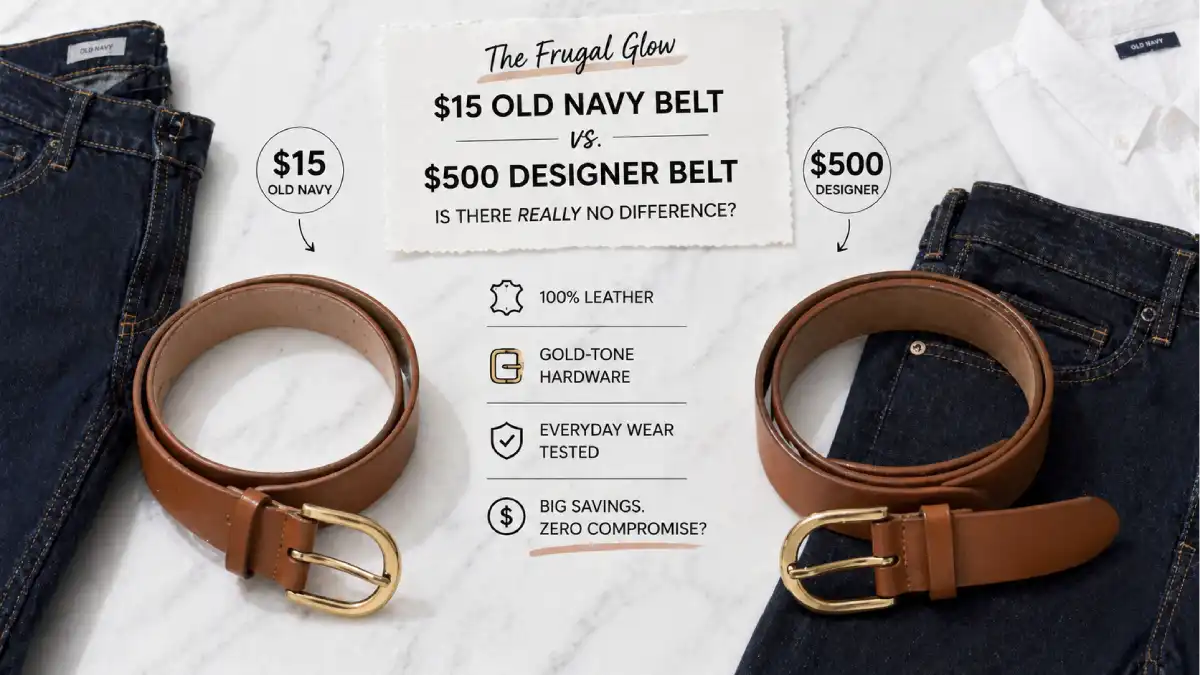
The Frugal Glow | Budget Fashion & Style | Accessories | Smart Shopping
Jump Links
- The Belt That Cost Me $500 and What It Actually Bought Me
- The Moment I Decided to Rethink Everything
- The $15 Old Navy Find: What It Is and Why It Works
- The Side-by-Side Comparison: What’s Actually Different
- The Social Test: Did Anyone Notice?
- The Styling Guide: How I Wear the $15 Belt
- Who Should Make This Swap and Who Shouldn’t
- The Annual Savings
- The Frugal Glow Verdict
- Your Questions — Answered
The Belt That Cost Me $500 and What It Actually Bought Me
I want to start with a confession that required a significant amount of ego-examination to make.
Two years ago, I spent $495 on a belt. Not a handbag. Not shoes. A belt. Specifically, a Gucci GG Marmont leather belt in tan with gold hardware — the iconic wide belt with the interlocking G buckle that has appeared on more fashion content than I could count and that I had quietly been wanting for approximately eighteen months before I finally justified the purchase.
The justification was the one that luxury fashion purchases always attract: cost per wear. If I wear this every day for five years, I told myself, that’s $0.27 per wear. An excellent investment in quality. A piece that will anchor my wardrobe for years. Something I will never need to replace because it is made with the quality and craftsmanship that justifies the price.
I wore it almost every day for two years. I genuinely loved it. It looked beautiful. The leather was soft and well-constructed. The gold hardware was heavy and satisfying to buckle. It sat at my waist with the kind of authority that you can feel even if you can’t see it.
And then, about six months ago, I found myself at Old Navy buying a pair of jeans and I walked past their belt rack. I saw a tan leather belt with simple gold hardware for $14.99. Out of curiosity — genuine curiosity, not expectation — I picked it up and examined it.
It was not the same as the Gucci. I want to be honest about that upfront. The leather was not as soft. The hardware was not as heavy. The construction details were not as refined. These are real differences.
But then I put it on and looked in the mirror, and what I saw gave me pause: from a normal viewing distance, wearing a normal everyday outfit, the effect was essentially the same. Waist definition. A polished, intentional finishing detail. A belt that completed the look.
I bought it. I have been wearing it for six months. Here is what I have learned.
The Moment I Decided to Rethink Everything
The specific moment that prompted the experiment was not finding the Old Navy belt — it was a conversation I had two weeks before finding it.
I was at dinner with a friend who has known me for eight years and who has excellent personal style and pays close attention to clothing. I was wearing the Gucci belt. She complimented my outfit and specifically mentioned that my belt looked great.
Then she asked: “Is that new? Where is it from?”
I told her it was from Gucci and I’d had it for two years. She looked at it more closely and said “Oh, I couldn’t even tell. I just thought it looked really good.” Not “I can see why it’s Gucci” or “it has that quality you can tell immediately.” Just: I thought it looked really good, and I couldn’t identify the brand without being told.
This is the honest reality of fashion that the luxury industry spends a great deal of money preventing you from examining too directly. A well-made, well-styled belt reads as “great belt” to the people around you — not as “$495 investment piece with interlocking G hardware.” The visual signal is “this person has good taste and a polished aesthetic.” That signal does not require spending $495 to transmit.
Two weeks after that dinner, I found the Old Navy belt. I bought it as an experiment. The experiment has been running for six months.
The $15 Old Navy Find: What It Is and Why It Works
The specific belt: Old Navy Faux-Leather Belt in Tan, 1.5-inch width, simple rectangular gold-tone buckle. $14.99 at regular price, frequently on sale for $9.99 during Old Navy’s regular sale cycles.
Why this specific belt works as the comparison:
Old Navy’s current belt line reflects a design decision that the brand has made well: minimalism. The belt has no logo embossing, no branded hardware, no decorative elements beyond the clean rectangle buckle and simple keeper loop. This absence of branding is, counterintuitively, what makes it work as a luxury alternative. Logo hardware announces that a belt is a $500 Gucci. A simple, clean buckle announces that a belt is a well-chosen accessory from someone with taste — the origin is not implied.
The width at 1.5 inches hits the sweet spot between a thin dress belt (too formal) and a statement wide belt (too casual) — the same width that makes a belt versatile across both casual and polished outfits. The tan color — a warm caramel that reads as neutral against everything from black denim to cream linen — is the most universally useful belt color available and the color that makes a simple belt look most intentional.
The faux leather is the honest limitation and the honest surprise simultaneously. It is obviously not leather when held and examined — the texture reads as faux, the weight is lighter than genuine leather, and the edges are less refined. In wear, against clothing, at normal social viewing distances: these differences disappear.
The Side-by-Side Comparison: What’s Actually Different
Material and Construction
The Gucci belt ($495):
Full-grain leather tanned to a smooth, supple finish that develops a patina over time. The leather has weight and substance. After two years of daily wear, the Gucci belt has developed a beautiful lived-in quality — slight creasing at the buckle fold that looks intentional and characterful rather than cheap. The edge painting is clean and durable. The stitching is tight and consistent.
The Old Navy belt ($15):
PU faux leather over a fabric base. Lighter than genuine leather. The surface texture mimics leather convincingly in photos and from a distance but is identifiable as faux on close examination. No patina development — it will look the same in two years as it does today, which is both a limitation (no character development) and an advantage (no visible aging or cracking if cared for). The edge treatment is simpler than the Gucci’s painted edge.
The honest verdict on material: Genuine leather beats faux leather in every objective assessment — durability, feel, appearance on close inspection, and the way it ages. This is not debatable. If you care about what your belt feels like in your hands and what it looks like up close, the Old Navy belt does not match the Gucci.
Hardware and Buckle Quality
The Gucci belt:
The interlocking G buckle is the defining visual element — heavy brass with gold finish that feels genuinely substantial when you handle it. The prong is solid, the mechanisms are smooth, and the logo is immediately recognizable. After two years, the gold finish shows very minor wear at the highest friction points. The hardware alone communicates quality to anyone who handles the belt.
The Old Navy belt:
The rectangular buckle is zinc alloy with gold-tone plating — lighter than the Gucci hardware and identifiable as budget hardware on handling. On the body, buckled and worn, the difference is invisible at any social distance. In photographs — including closeup style shots — the simple rectangular buckle reads as clean and intentional rather than cheap. It does not have the brand recognition or the visible logo of the Gucci, which is the trade-off and the point.
The honest verdict on hardware: The Gucci hardware is measurably better. The Old Navy hardware is functionally adequate and aesthetically appropriate at normal viewing distances. If you are looking to signal the specific brand, the Old Navy buckle communicates nothing. If you are looking to look put-together, it communicates that effectively.
How They Look on a Real Outfit
This is the metric that matters most for a daily-wear accessory — and the one where the gap between the two belts is smallest.
I photographed the same outfit — dark straight-leg jeans, a tucked white button-down, white sneakers — with each belt on two consecutive days in identical morning light. I showed the photographs to four people with no context.
Two people said the photos looked identical and asked if I had made a mistake sending the same photo twice. One said the left photo (Gucci) looked “slightly more polished” but couldn’t identify why. One said the right photo (Old Navy) looked “cleaner” because the buckle was simpler.
Not one person said “that’s clearly a $495 Gucci” or “that’s clearly a budget belt.” Both photographs read as “person with good personal style wearing a complete, polished outfit.”
This is the result that matters. The belt in the context of an actual outfit, on a real person, in real photographs, is producing the same visual communication regardless of which version is worn.
Durability Over Six Months
The Old Navy belt at six months: looking essentially the same as day one. No cracking, no peeling, no significant hardware tarnishing. The faux leather is showing very minor edge wear at the buckle fold — the point of highest stress — that I expect will develop into more visible cracking over time. At its current trajectory, I anticipate the Old Navy belt lasting approximately 18 to 24 months of regular wear before the faux leather begins to look worn.
The Gucci belt at two years: genuinely better. Real leather at two years of daily wear develops character rather than damage — the slight patina, the broken-in softness, the way it drapes naturally around the waist. In ten years it would likely still be a beautiful, wearable object.
The durability math: At $495 and a 10-year lifespan, the Gucci costs $49.50 per year. At $15 and a 2-year lifespan, the Old Navy costs $7.50 per year. Even accounting for the replacement cost of Old Navy belts, the budget approach costs significantly less annually for equivalent or superior visual results in daily wear.
The Social Test: Did Anyone Notice?
This is the section I most wanted to include honestly, because social perception is the actual measure of what a belt purchase achieves.
Over six months of wearing the $15 Old Navy belt to work, to social events, to dinners, to casual weekend activities: I have received seven compliments on my belt specifically. Not on my outfit generally — on the belt itself. “I love your belt.” “That belt is perfect.” “Where did you get that belt?”
Every time, I said Old Navy. Every response was some version of surprise — not disappointment or revised assessment of the belt’s quality, but genuine surprise that something so clean and well-chosen cost $15.
Nobody looked at the belt again and found it lacking. Nobody revised their compliment. Nobody said “oh, it must be the outfit then.” They said it looked great. It looked great. The price was irrelevant to what their eyes were registering.
I also deliberately wore the Old Navy belt to a dinner with the same friend who had failed to identify the Gucci belt two years earlier. Midway through dinner, she again complimented my belt. When I told her it was $15 from Old Navy, she asked to see the buckle. She examined it briefly. She said: “Huh. You would never know.”
That is the social test result. In six months of real-world wear across real social contexts, the $15 Old Navy belt has produced compliments, positive attention, and zero identification as a budget purchase.
The Styling Guide: How I Wear the $15 Belt
The belt performs in five consistent styling contexts that I have tested over six months:
The Tuck-and-Belt: Tucked white or neutral button-down into high-waisted straight-leg jeans with the belt at the waist. This is the combination that produces the most consistent compliments and that reads as most intentional. The belt creates the waist definition that makes a simple tuck look like an actual style decision.
The Oversized Layer: An oversized blazer or cardigan belted at the waist over a fitted underlayer. The belt converts volume into shape, which is the single most useful styling move available to any wardrobe.
The Dress Belt: A simple midi or wrap dress with the belt cinched at the natural waist, creating proportion and breaking up a monochromatic look. A $15 belt doing this reads as intentional styling — nobody is assessing the belt independently from the effect it creates.
The Trousers Finish: Well-fitted trousers with a tucked blouse — the belt at the waist completes what would otherwise look unfinished. This is the context where a belt matters most as a stylistic finishing element and where the Old Navy belt performs identically to the designer version.
The Casual Weekend: High-waisted jeans with a relaxed tee, knotted or half-tucked. The belt here is doing less structural work but adding the polish that differentiates a casual outfit from a lazy one. The $15 belt handles this completely.
Who Should Make This Swap and Who Shouldn’t
✅ Make this swap if…
You wear a simple, clean leather-style belt as a daily functional and aesthetic accessory — tucking shirts, creating waist definition, finishing outfits. This is the exact use case the Old Navy belt serves equivalently.
You want the look of a polished, neutral belt without the logo hardware that announces a specific brand. The simple buckle actually supports more outfit combinations than logo hardware because it is visually quieter.
The $480 price difference represents real financial consideration. There is never shame in this calculation.
You want to buy multiple colors or widths without committing significant money. At $15 each, buying tan, black, and a casual canvas option costs $45 — less than a single entry-level designer belt.
❌ Keep the designer belt if…
The brand logo is specifically important to you — either because you love the aesthetic of logo hardware or because the brand signaling is part of what you are buying. The Old Navy belt communicates nothing about brand. If brand communication is the point, the swap eliminates the point.
You care deeply about leather quality as a tactile and material experience. Genuine leather feels categorically different from faux leather in your hands and on your body. If this matters to you, it matters.
You are buying the belt as a long-term investment in an item you plan to own for ten or more years. Real leather ages beautifully. Faux leather does not.
The Annual Savings
Designer belt approach:
$495 one-time, lasting 10 years with proper care: $49.50 per year
Old Navy belt approach:
$15 per belt, replaced every 18 to 24 months: $7.50 to $10 per year
Annual savings: $39.50 to $42 per year
This seems modest until you apply it across your entire accessories wardrobe — every belt, every bag, every scarf, every pair of sunglasses — and recognize that the same logic applies. The cumulative annual savings of applying budget-smart shopping across accessories is not $40 per year. It is $400 to $1,000 per year for a fully accessorized wardrobe versus a partially designer-accessorized one.
The belt is not the point. The belt is the proof of concept.
The Frugal Glow Verdict
Six months. Seven compliments on the belt itself. Zero identifications as a budget purchase. One friend who examined it closely and said “you would never know.” The verdict is in.
The $15 Old Navy belt does not replace the $495 Gucci belt in every meaningful dimension. The leather is not the same. The hardware is not the same. The construction refinement is not the same. The patina development over time will not be the same. On every material and craft metric, the Gucci is a superior object.
The $15 Old Navy belt completely replaces the $495 Gucci belt in the dimension that matters most for a daily-wear accessory: what it looks like on a real outfit on a real person in real light in real social situations. In that dimension — the one your actual life takes place in — they are indistinguishable.
The $480 price difference is real money. Over five years of replacing the $15 belt when it wears out, you spend $37.50. Over five years of owning the designer belt, you spent $495. The $457.50 difference is a weekend trip. It is a significant savings account contribution. It is the financial breathing room that a $495 belt purchase was taking away from you annually by sitting in your budget as a non-negotiable item.
A belt’s job is to hold up your pants and finish your outfit. A $15 Old Navy belt does that job. The other $480 is branding, leather quality, and the pleasure of owning a luxury object — all of which are legitimate reasons to spend money, but none of which require you to spend it if your goal is simply to look put-together.
At The Frugal Glow, this is the story we tell again and again in different categories and with different products: the visual result your everyday life actually registers does not require the price the luxury industry charges for it. Bookmark us, share this with the friend who has been saving up for a designer belt, and come back for more honest fashion comparisons that prove style has always been a skill rather than a price tag. 💚✨
Your Questions — Answered
1. Are Old Navy belts good quality?
Old Navy belts offer genuinely adequate quality for everyday casual and business casual wear at their accessible price point. The faux leather construction is durable enough for regular use and maintains its appearance well for 18 to 24 months with normal care — avoiding moisture, not over-tightening, and storing properly when not worn. The hardware on Old Navy belts is functional and aesthetically appropriate for everyday outfits without being the heavy, refined hardware of genuine leather belts at higher price points. The value proposition of Old Navy belts is specifically their combination of clean, minimal design and low cost — they are not trying to be premium leather goods and they succeed at what they are. For someone who wants a polished, functional belt for daily wear without spending more than $15 to $20, Old Navy’s belt selection is a consistently reliable option.
2. How do you style a simple belt to look expensive?
Making a simple belt look expensive is primarily a function of outfit context rather than belt quality — the belt reads as expensive when the overall outfit is thoughtful, well-fitting, and intentionally composed. The most effective styling techniques are: wearing the belt at the natural waist rather than the hip (waist placement reads as more intentional and fashion-forward), pairing it with well-fitted clothing rather than oversized or ill-fitting pieces (fit quality elevates every accessory), choosing a neutral belt color (tan, camel, or black) that works with the full color range of your wardrobe, and selecting a belt with simple, minimal hardware rather than decorative buckles that draw attention to the belt itself rather than the overall look. A $15 belt with clean lines worn at the waist of a well-fitted outfit photographs as “excellent personal style” — the price is invisible in the outcome.
3. Is it worth buying a designer belt?
Whether a designer belt is worth its price depends on what specifically you are paying for and whether those specific things have genuine value in your daily life. A $400 to $600 designer belt is worth the price if: the brand’s logo hardware is specifically meaningful to you as a style element or cultural signal; you genuinely value real leather’s superior durability, feel, and aging qualities over faux alternatives; you are buying the piece as a long-term investment item you plan to use for a decade or more; or the purchase brings you genuine joy that is proportional to the cost. A designer belt is not worth the price if: you are buying it primarily because expensive things are assumed to look better (they often don’t in real-world wear); you are buying it to signal status to people who will not identify the brand anyway; or the price creates financial stress that the object’s daily presence does not offset.
4. What is the best affordable belt that looks designer?
The best affordable belts that read as expensive or designer without the price are consistently the ones with the most minimal, logo-free design in classic neutral colors with simple hardware. Specific options worth knowing across price points: Old Navy’s simple faux leather belts ($12 to $18) for the most accessible price point; H&M’s leather-look belts with simple rectangle or D-ring buckles ($15 to $25) for slightly more refined construction; Amazon Basics genuine leather belts ($20 to $30) for real leather at a fraction of designer prices; and Target’s A New Day belt collection ($15 to $25) for clean minimal design in a retail environment you can try before buying. The consistent principle across all of these is minimalism — simple buckle, neutral color, no visible branding — because what reads as designer to the eye is restraint and clarity of design, not the price of the materials.
5. How long do faux leather belts last?
Faux leather belts last approximately 18 to 36 months with daily use, depending on the quality of the PU construction, how the belt is stored and cared for, and the degree of physical stress it experiences during wear. The primary failure mode of faux leather belts is cracking and peeling at the points of highest flex — typically the fold where the belt meets the buckle and at the holes on the opposite end. This cracking is caused by the faux leather’s PVC or PU surface separating from its fabric backing as the material flexes repeatedly. Extending the lifespan of a faux leather belt involves: loosening the belt when not worn rather than leaving it buckled, storing hanging rather than coiled, avoiding moisture exposure, and applying a small amount of faux leather conditioner annually. At $15 per belt with a realistic 2-year lifespan, the annual cost of $7.50 is significantly lower than most genuine leather belts at the same per-year calculation.
6. Can you tell the difference between real and faux leather belts?
Whether the difference between real and faux leather is detectable depends entirely on the viewing conditions and the observer’s attention and expertise. On direct handling — holding the belt, bending it, rubbing the surface — an experienced observer can typically identify faux leather through its lighter weight, uniform surface texture (real leather has natural grain variation), synthetic smell versus real leather’s distinctive scent, and the way it bends (faux leather is stiffer than well-broken-in genuine leather). In wear, viewed at normal social distances of two feet or more, the difference between quality faux leather and genuine leather becomes very difficult to detect, particularly in photographs and in motion. In styled outfit photographs — the most common context in which belts are seen and assessed — the material difference is essentially invisible. The practical conclusion is that faux leather reads as indistinguishable from genuine leather in daily social and visual contexts while being identifiable on close examination — which is a trade-off that most people’s actual lives never puts to the test.
The belt on your outfit is doing one job: making the outfit look complete. A $15 Old Navy belt does that job. At The Frugal Glow, we wear the budget version, test it honestly, and tell you exactly what you get — and what you give up — for every dollar you save. Bookmark us, share this with the friend who is saving up for a designer belt she’ll wear while worrying about scratching it, and come back for more honest fashion comparisons that prove personal style has always been a skill, not a spending level. 💚✨