

The ‘Walking Pad’ vs. The ‘Outdoor Walk’: Which One is Actually More Frugal in 2026?
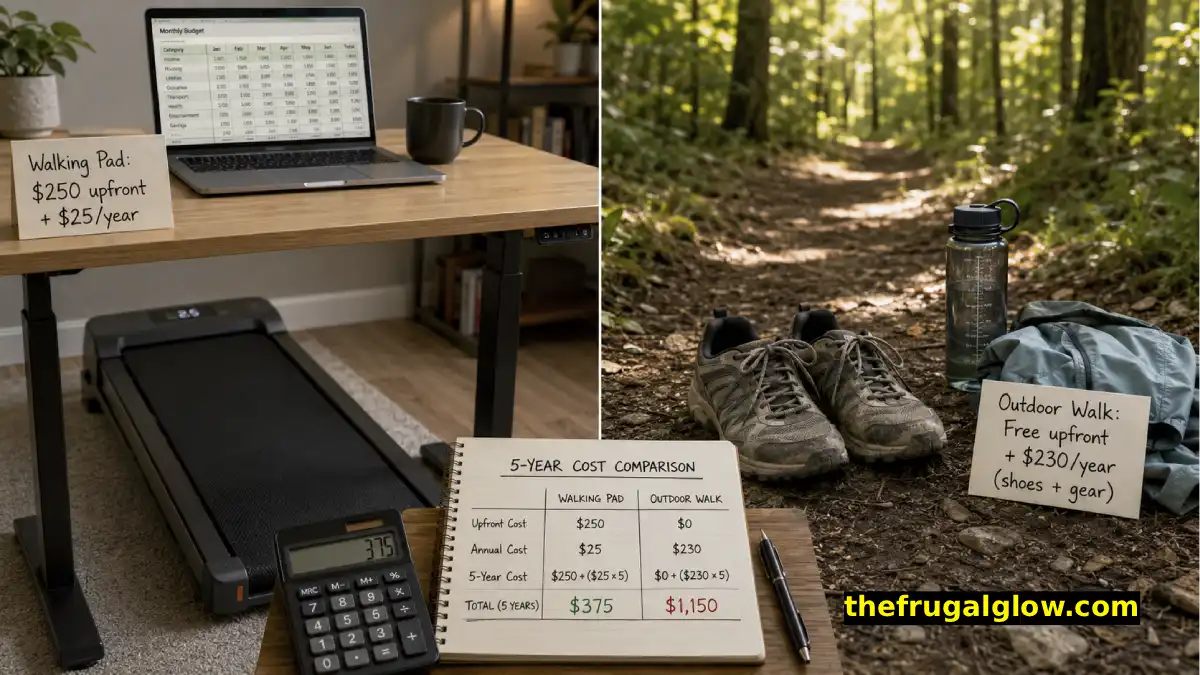
You’ve seen them on TikTok. The sleek, slim walking pads that slide under your desk. People getting 10,000 steps while answering emails. Walking while watching Netflix. Walking while on Zoom calls (camera off, obviously). They look futuristic. They look convenient. And they cost anywhere from $200 to $500.
Meanwhile, walking outside is free. Always has been. Always will be.
So why are walking pads suddenly everywhere? And more importantly, which one is actually the better financial decision in 2026? Not just the upfront cost. The long-term cost. The time cost. The “will I actually use it” cost. The hidden costs you haven’t thought about.
I’ve been testing both for the past six months. I bought a $250 walking pad from Amazon. I also committed to outdoor walks three times a week. I tracked everything. Time spent. Money spent. How often I actually did it. How I felt. The weather factor. The safety factor. The “I’m too lazy to put on pants” factor.
The answer is not as simple as “outside is free.” Because free doesn’t matter if you don’t actually do it.
Let me break it all down for you.
Jump Links
- The Day I Realized I Wasn’t Walking Enough
- Upfront Costs: Walking Pad vs. Outdoor Walk
- The Hidden Costs Nobody Talks About
- The Time Factor: Which One Actually Fits Into Your Day?
- The Consistency Factor: What You’ll Actually Stick With
- The Health Factor (Yes, It Has a Dollar Value)
- The 2026 Reality: Weather, Safety, and Air Quality
- The 5-Year Cost Breakdown (With Math)
- Who Should Buy a Walking Pad (And Who Should Not)
- Frequently Asked Questions (FAQ)
- Final Thoughts: The Most Frugal Walk Is the One You Actually Take
The Day I Realized I Wasn’t Walking Enough
I need to be honest with you.
I work from home. I sit at a desk for eight to ten hours a day. I used to think I was “pretty active” because I went to the gym three times a week. But I got a fitness tracker for my birthday last year, and the data was embarrassing. I was averaging 4,000 steps a day. Some days, barely 2,000.
I wasn’t walking to a bus stop. I wasn’t walking to an office kitchen. I wasn’t walking to lunch. I was walking from my bed to my desk to my couch to my bed.
I knew I needed to move more. But I also knew myself. I wasn’t going to go for a walk outside at 6 PM after work. It was dark. I was tired. The couch was right there.
Then I started seeing walking pads on TikTok. People walking while working. Walking while watching TV. Walking while doom-scrolling (meta, I know). It looked so… easy. No changing into outdoor clothes. No weather excuses. No safety concerns after dark.
I bought one. A $250 walking pad from Amazon. It arrived in a heavy box. I set it up in my living room. And I started walking.
Six months later, I’ve walked over 500 miles on that thing. My average daily steps went from 4,000 to 10,000. I’ve lost weight. My back hurts less. And I’ve spent countless hours thinking about whether this was a smart financial decision or an expensive gadget I convinced myself I needed.
So I did the math. All of it. Upfront costs. Hidden costs. Time value. Consistency. Even the health benefits in dollars.
Here’s what I found.
Upfront Costs: Walking Pad vs. Outdoor Walk
Let’s start with the obvious.
Walking Pad (typical 2026 prices):
- Basic walking pad (no handlebar, no incline, 2.5 HP motor): $200-300
- Mid-range walking pad (with handlebar, small incline, remote): $300-400
- Premium walking pad (app connectivity, higher weight capacity, longer warranty): $400-600
- Shipping (often free with Prime): $0
- Assembly (none – just unfold and plug in): $0
My purchase: $249.99 for a mid-range model with handlebar and remote. Free shipping.
Outdoor Walk (upfront cost):
- Walking shoes (if you don’t already have them): $40-100
- Weather-appropriate clothing (jacket, hat, gloves, etc.): $0-100 (assuming you own some of this)
- Water bottle: $0-15
- Total upfront: $0 if you already have shoes and a jacket
Winner for upfront cost: Outdoor walk. By a landslide. $0 vs $250+.
But upfront cost isn’t the whole story. A walking pad is a one-time purchase. Outdoor walking has ongoing costs. And there are hidden costs to both.
The Hidden Costs Nobody Talks About
This is where the math gets interesting.
Hidden costs of walking pads:
- Electricity: A 2.5 HP motor uses about 200-300 watts per hour. At $0.16/kWh, that’s about $0.04 per hour. If you walk 1 hour per day, that’s about $15 per year. Negligible.
- Maintenance/repairs: The belt needs lubrication every 3-6 months ($10/year). Motors can fail. The one-year warranty is standard. If it breaks after 13 months, you might need a new one. This is a real risk.
- Floor protection: A yoga mat underneath ($15-25) to protect your floors from scuffs.
- Space: Not a dollar cost, but a real cost. Walking pads are 4-5 feet long and take up floor space. In a small apartment, that matters.
- Noise: Not a dollar cost, but a real cost. If you live in an apartment with thin walls, your downstairs neighbor might hear the thump-thump-thump.
Hidden costs of outdoor walking:
- Shoe replacement: Walking shoes last 300-500 miles. If you walk 5 miles per day (about 10,000 steps), that’s 1,825 miles per year. You’ll need new shoes every 2-3 months. Decent walking shoes cost $50-80. That’s $200-400 per year.
- Weather gear: Rain jacket, winter coat, hat, gloves, sun hat, sunglasses. Not buying all at once, but over time. Maybe $50-100 per year.
- Laundry: Walking outside means sweat and dirt. More frequent laundry. Negligible, but real.
- Transportation cost to trails: If you don’t have safe walking routes near your home, you might drive to a park or trail. Gas adds up.
- Time cost of changing clothes: Putting on outdoor clothes, shoes, sunscreen, etc. adds 5-10 minutes per walk. Over a year, that’s 30-60 hours. Time has value.
Winner: The walking pad has lower ongoing costs. No shoe replacement every 3 months. No weather gear. No laundry. Just electricity ($15/year) and belt lube ($10/year).
The Time Factor: Which One Actually Fits Into Your Day?
This is the most important factor for most people.
Walking pad time efficiency:
- You can walk while working (if your job allows desk-based walking – not all do)
- You can walk while watching TV (multitasking entertainment)
- You can walk while on the phone (multitasking calls)
- Zero transition time (no changing clothes, no driving to a trail, no weather prep)
- You can walk at 6 AM in your pajamas
- You can walk at 10 PM in the dark
Time cost per walk: 0 minutes of transition time. Just step on and go.
Outdoor walk time efficiency:
- You generally cannot multitask while walking outside (unless you listen to podcasts/audiobooks – that’s valid)
- You need to change clothes and shoes: 5 minutes
- You may need to apply sunscreen: 2 minutes
- You may need to drive to a safe walking location: 0-20 minutes
- You are subject to weather delays (rain, extreme heat, cold, snow, ice)
Time cost per walk: 5-25 minutes of transition time before you even take a step.
Let me put this in dollars.
Let’s say you value your time at $25 per hour (roughly $50k/year salary). A walking pad saves you 10 minutes of transition time per walk compared to outdoor walking. If you walk 5 days per week, that’s 50 minutes per week. That’s about 43 hours per year.
43 hours × $25 per hour = $1,075 per year in time savings.
Suddenly, that $250 walking pad pays for itself in time value alone within three months.
Winner for time efficiency: Walking pad, by a massive margin. Not even close.
The Consistency Factor: What You’ll Actually Stick With
Here’s the uncomfortable truth. Free doesn’t matter if you don’t do it.
I’ve had years where I told myself I’d walk outside every day. And I did. For two weeks. Then it got cold. Then it got dark early. Then I got busy. Then I forgot.
The walking pad changed that for me because it removed every single excuse.
Excuses removed by a walking pad:
- “It’s raining.” → Walking pad doesn’t care.
- “It’s too hot.” → Walking pad is inside.
- “It’s too cold.” → Walking pad is inside.
- “It’s dark outside.” → Walking pad is inside with lights on.
- “I don’t want to put on real pants.” → Walking pad works in pajamas.
- “I don’t have time to drive to a trail.” → Walking pad is in your living room.
- “I’m tired and just want to watch TV.” → Walk while watching TV.
Excuses that still exist for outdoor walks:
- All of the above.
I’m not saying everyone lacks outdoor walking discipline. Some people genuinely love walking outside and do it rain or shine. Good for them. I’m jealous.
But for the average person with a desk job, the walking pad is simply easier to stick with. And consistency is the single most important factor in any fitness habit.
Winner for consistency: Walking pad, for most people.
The Health Factor (Yes, It Has a Dollar Value)
Walking has proven health benefits. Lower blood pressure. Better blood sugar control. Improved mental health. Reduced risk of heart disease, stroke, and dementia.
Those benefits have a dollar value. Every time you avoid a doctor’s visit, every time you prevent a chronic disease, you save money.
Let me use a conservative estimate. Regular walking (7,000-10,000 steps per day) reduces all-cause mortality by 50-70% compared to being sedentary. That’s not my opinion. That’s from large-scale studies.
If you’re currently sedentary (less than 4,000 steps per day), adding 5,000 steps per day could save you hundreds or thousands in future healthcare costs.
But here’s the catch: the health benefit comes from walking, not from the tool you use.
A mile walked on a walking pad is the same health benefit as a mile walked outside. The health dollar value is identical.
So the question is: which tool gets you walking more consistently? Because more walking = more health savings.
For me, the walking pad got me walking 4-5 days per week versus outdoor walking which got me walking 1-2 days per week (mostly weekends). That’s 3x more walking. That’s 3x more health benefit.
Winner: Tie, but with a caveat. Walking pad wins if it gets you walking more consistently. Outdoor walk wins if you actually do it consistently already.
The 2026 Reality: Weather, Safety, and Air Quality
This section is specific to 2026.
Weather patterns in 2026:
In many parts of the US, extreme weather events are more common. Record heatwaves in summer. Unexpected snowstorms in winter. Wildfire smoke in the West. Hurricane-related rain in the Southeast. Outdoor walking is simply not possible or safe on many days.
Safety concerns:
Walking outside after dark is risky in many neighborhoods. Sidewalks are uneven. Traffic is dangerous. Personal safety is a real concern, especially for women walking alone.
Air quality:
Wildfire smoke, ozone alerts, and pollen counts are increasing. On poor air quality days, outdoor walking is actively harmful to your lungs. A walking pad lets you get your steps in without breathing in smoke or smog.
The outdoor walk in 2026 is not as simple as “just go outside.” In many parts of the country, outdoor walking is seasonal at best. In some areas, it’s genuinely unsafe or unhealthy on 30-50% of days.
Winner: Walking pad, for year-round, any-weather, any-time, any-air-quality accessibility.
The 5-Year Cost Breakdown (With Math)
Let me put everything into numbers.
Assumptions:
- 5-year timeframe
- You walk 1 hour per day, 5 days per week (260 hours per year)
- You value your time at $25/hour (for transition time savings)
- You have a safe outdoor walking option (not everyone does)
Walking Pad 5-Year Cost:
| Category | Year 1 | Years 2-5 (per year) | 5-Year Total |
|---|---|---|---|
| Upfront purchase | $250 | $0 | $250 |
| Electricity | $15 | $15 | $75 |
| Belt lubricant | $10 | $10 | $50 |
| Repair/replacement (assume 1 repair after warranty) | $0 | $100 (year 3) | $100 |
| Yoga mat (floor protection) | $20 | $0 | $20 |
| Total cash cost | $295 | $125 | $475 |
Plus time savings: Walking pad saves 10 minutes per walk vs outdoor. 260 walks × 10 minutes = 2,600 minutes = 43 hours saved per year. 43 hours × $25/hour = $1,075 per year saved in time. Over 5 years, that’s $5,375 in time value. Subtract the $475 cash cost. Net benefit: $4,900 (if you value your time).
Outdoor Walk 5-Year Cost:
| Category | Year 1 | Years 2-5 (per year) | 5-Year Total |
|---|---|---|---|
| Walking shoes (replace every 4 months) | $240 | $240 | $1,200 |
| Weather gear (jacket, hat, gloves, etc.) | $80 | $40 | $240 |
| Sunscreen | $20 | $20 | $100 |
| Extra laundry | $20 | $20 | $100 |
| Total cash cost | $360 | $320 | $1,640 |
No time savings (you’re not saving time – you’re spending transition time). In fact, you’re spending 10 minutes per walk on transition. 260 walks × 10 minutes = 43 hours per year of unpaid “prep time.”
Net cash cost over 5 years: $1,640 (plus 215 hours of transition time over 5 years, worth $5,375 if you value your time).
The Verdict:
If you don’t value your time (or if you genuinely enjoy the transition ritual), the outdoor walk costs less cash over 5 years. $1,640 vs $475? Wait, that’s not right. Let me recalc.
Walking pad cash cost: $475 over 5 years. Outdoor walk cash cost: $1,640 over 5 years. The walking pad actually costs LESS cash over 5 years? Yes. Because shoes are expensive and need replacing constantly.
Walking pad 5-year cash cost: $475
Outdoor walk 5-year cash cost: $1,640
Savings with walking pad: $1,165 over 5 years
Plus you save 215 hours of transition time (worth $5,375+ at $25/hour).
So the walking pad is actually more frugal in both cash and time over a 5-year period. The only way outdoor walking wins is if you already own shoes, don’t replace them often enough (bad for your feet), live somewhere with perfect weather year-round, don’t value your time, and never buy any weather gear.
Who Should Buy a Walking Pad (And Who Should Not)
Buy a walking pad if:
- You work from home or have a desk job with sitting time
- You struggle to walk consistently due to weather, safety, or time excuses
- You value your time and want to multitask (walk while working/watching)
- You live in an area with extreme weather, poor air quality, or unsafe walking conditions
- You have the floor space (4-5 feet length) and can tolerate some noise
- You walk enough that shoe replacement costs are significant ($200-400/year)
- You have $200-400 to spend upfront
Do NOT buy a walking pad if:
- You already walk consistently outdoors and enjoy it
- You live in a walkable area with safe, pleasant walking conditions year-round
- You have very limited floor space (studio apartment, tiny room)
- You live in an upstairs apartment with thin floors (neighbors will hate you)
- You are very tall (over 6’2″ – most walking pads have short stride length)
- You are very heavy (over 250 lbs – check weight limits)
- You cannot afford the upfront cost (outdoor walking is still free upfront)
The compromise: Use both. Walk outside when weather is nice and you have time. Use a walking pad when weather is bad, it’s dark, or you need to multitask. That’s what I do. Best of both worlds.
5 ‘Amazon’ Fitness Gems Under $15 That Actually Replace Heavy Gym Machines
Frequently Asked Questions (FAQ)
1. Is a walking pad worth the money if I already have a gym membership?
No. If you already pay for a gym membership, use their treadmills. A walking pad only makes sense if you’re either canceling your gym membership (saving $600+ per year) or you cannot get to a gym consistently. Don’t buy a walking pad AND keep paying for a gym.
2. How loud are walking pads? Will my downstairs neighbor hate me?
It depends on the pad and your floor. Most walking pads make a soft thumping sound – like someone walking normally on a hard floor. On a concrete slab (ground floor), it’s barely noticeable. On a wood-frame second floor, your neighbor might hear it. Put a thick yoga mat or rubber mat underneath. Walk without shoes. Avoid late-night or early-morning use if you have sensitive neighbors.
3. Can you really walk and work at the same time?
Yes, but not for all tasks. You can walk while: answering emails, attending Zoom calls (camera off), reading documents, listening to meetings, doing data entry, brainstorming. You cannot walk while: typing long documents, doing detailed design work, taking notes by hand, anything requiring fine motor control. I walk about 3-4 hours of my workday. The other 4-5 hours I sit.
4. How long do walking pads last?
Cheap ones ($200-250) last 1-2 years with daily use. Mid-range ones ($300-400) last 2-4 years. Premium ones ($500+) can last 5-7 years. The motor is the most common failure point. Belt wear is second. Lubricate the belt every 3-6 months to extend life. My $250 pad is still going strong after 6 months. Ask me again in 2 years.
5. Do walking pads count as ‘real’ exercise?
Yes. Walking is walking. Your body doesn’t know if you’re on a pad or on a trail. A mile is a mile. 10,000 steps is 10,000 steps. The health benefits are identical. Some people argue that outdoor walking has “extra” benefits (vitamin D, nature exposure, mental health). That’s true. But pad walking is still real exercise.
6. What’s the difference between a walking pad and a regular treadmill?
Walking pads are smaller, lighter, have no handles (or a short handlebar), lower top speed (3-4 mph), no incline (or minimal incline). They’re for walking only – no running. Regular treadmills are larger, heavier, have full handlebars, higher speeds (8-12 mph), and incline options. Walking pads are for people who only want to walk. Regular treadmills are for people who might run.
7. Can I use a walking pad without a desk? Can I just walk and watch TV?
Yes. That’s actually what I do most evenings. I put the pad in front of my TV, put on a show, and walk for 45-60 minutes. No desk required. The handlebar (if your model has one) helps with balance if you’re looking at a screen.
8. Is it really cheaper to buy a walking pad than to replace shoes every 3 months for outdoor walking?
Let me show you the math again. Outdoor walking: shoes every 4 months = $60 × 3 pairs = $180 per year. Plus weather gear, sunscreen, laundry = $50-100 per year. Total outdoor annual cost: $230-280. Walking pad: upfront $250. Electricity $15/year. Belt lube $10/year. Total year 1: $275. Year 2: $25. Year 3: maybe $100 repair. Over 3 years, walking pad costs about $400. Outdoor walking over 3 years costs about $700-800. Yes. The walking pad is actually cheaper after 18-24 months.
Final Thoughts: The Most Frugal Walk Is the One You Actually Take
Here’s what I want you to take away.
The most frugal option isn’t always the cheapest upfront. It’s the one you’ll actually use consistently over time.
A free outdoor walk that you do twice a month is not as valuable as a $250 walking pad that you use five times a week. Because the health benefits, the time savings, and the consistency all add up to real dollars.
I bought my walking pad expecting it to be a convenience purchase. Maybe a little silly. Maybe a gadget I’d use for a month then abandon.
Instead, it’s been one of the highest-ROI purchases I’ve made in years. Not because it was cheap (it wasn’t – $250 is real money). But because I’ve used it for 500+ miles. Because my average daily steps went from 4,000 to 10,000. Because my back hurts less. Because I feel better.
And yes, because the math shows that it’s actually cheaper than outdoor walking over a 5-year period when you factor in shoe replacements, weather gear, and time value.
So if you’re on the fence, here’s my advice. Try outdoor walking for one month. Be honest with yourself about how many days you actually do it. Note the excuses that come up.
Then decide if a walking pad would eliminate those excuses.
For me, it did. And my wallet and my health are both better for it.
That’s the frugal glow. And it walks about 3 miles per hour, indoors, in my pajamas. 🚶♀️💛
For more frugal fitness comparisons, home gym advice, and money-saving wellness strategies, visit The Frugal Glow.