I have a complicated relationship with my blonde. I love the way it looks for the first ten days after a salon visit. Then the toner starts to fade, the warm yellow creeps back in, and I’m staring at a shade that looks less “icy California blonde” and more “questionable brass.”
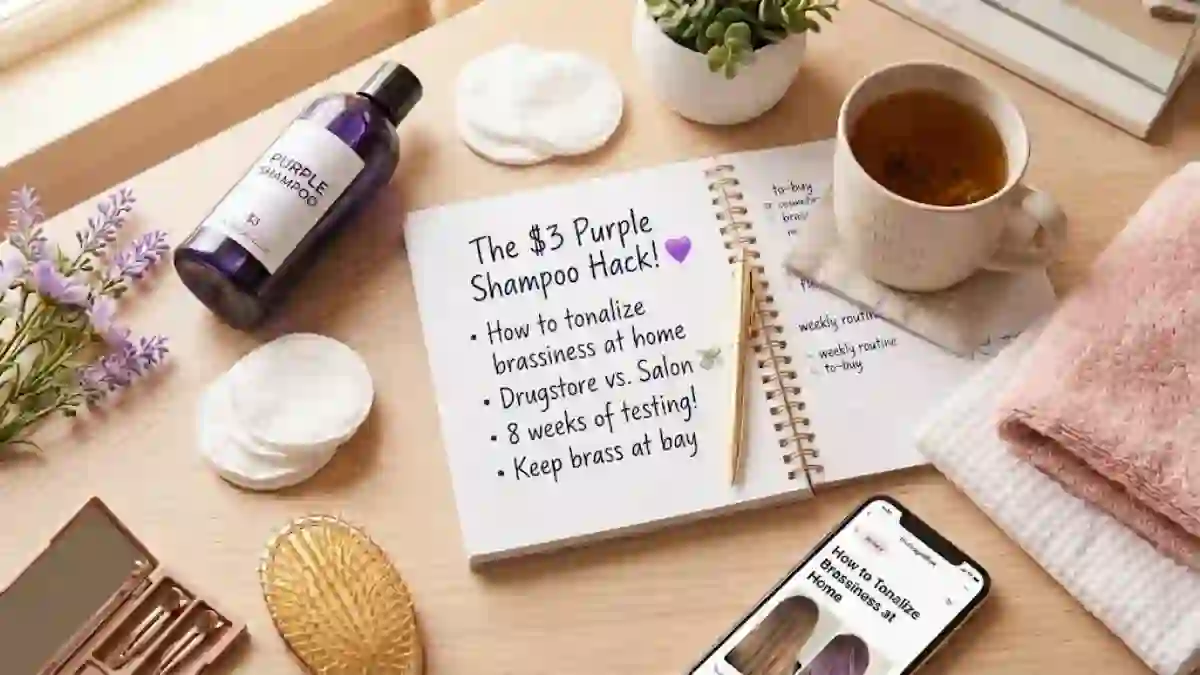
A salon gloss or toner runs $50 to $150 depending on where you live, and it fades in three to four weeks . That’s a lot of money to spend on a color that’s temporary by design. So I started experimenting with the cheapest option on the shelf: a $3 bottle of purple shampoo from the drugstore.
I spent eight weeks testing different methods, timings, and techniques. I made mistakes (including a faint lilac cast that took three washes to fix). But I also found a routine that genuinely extends the life of my toner and keeps the brass at bay for about $10 a month. This is the honest breakdown of what works, what doesn’t, and when you actually do need to book that salon appointment.
Jump Links
- Why Blonde Goes Brassy (And What Purple Shampoo Actually Does)
- Is It Yellow or Orange? (The Most Important Step)
- The $3 Product: What You’re Actually Buying
- The Purple Shampoo Routine That Actually Works
- The Dry Hair Hack (The NewBeauty Discovery)
- The Mistakes I Made (So You Don’t Have To)
- How to Make the Results Last (And Stop the Brass from Coming Back)
- When Purple Shampoo Isn’t Enough (And You Need a Salon)
- The Real Cost: Purple Shampoo vs. Salon Toner
- Frequently Asked Questions
- Final Thoughts: The Frugal Glow Verdict
Why Blonde Goes Brassy (And What Purple Shampoo Actually Does)
To understand why a $3 bottle can mimic a $75 salon service, you need to understand the color wheel.
When you bleach your hair, you lift out the natural melanin. But underneath that melanin are warm pigments—yellow, orange, and red—that become visible once the cool tones are stripped away . Your stylist applies a toner to neutralize those warm pigments and give you the cool, ashy blonde you wanted. But toner is semi-permanent. It fades every time you wash your hair, and the warm tones underneath start to show through again .
Purple shampoo works on the same principle as a toner, just in a much weaker form. On the color wheel, purple sits directly opposite yellow. So when you apply a violet pigment to yellow hair, the two colors cancel each other out, and the hair reads as a cooler, more neutral blonde.
Here’s the critical limitation: purple shampoo only cancels yellow. If your brass has drifted into orange or copper territory, purple won’t fix it. You need a blue-based product for orange tones . And purple shampoo doesn’t lift or lighten your hair—it just deposits a sheer layer of violet pigment on the surface that rinses out over a few washes.
Think of it as maintenance, not correction. It’s the tool you use between salon visits to slow the fade. It is not a replacement for a proper toner when the color has genuinely drifted.
Is It Yellow or Orange? (The Most Important Step)
Before you even touch a purple shampoo, you need to look at your hair in natural daylight. Not bathroom lighting, because that masks warm tones. Look at your ends, your roots, and your mid-lengths separately.
If your hair looks pale gold, straw-colored, or dull, you have yellow brassiness. This is most common for light blonde, platinum, silver, or grey hair. The fix is a violet (purple) shampoo.
But if your roots or mid-lengths look copper, peachy, or noticeably warm, you have orange brassiness. This is common for dark blonde, balayage, or bronde hair. The fix here is a blue shampoo, not purple .
Why does this matter? Because the color wheel doesn’t lie. Violet sits opposite yellow, so violet cancels yellow. Blue sits opposite orange, so blue cancels orange. If you use purple shampoo on orange hair, it will do absolutely nothing. Worse, if you use blue shampoo on very pale yellow hair, you risk turning it green .
If your hair has a mix of both (which is super common with balayage), alternate between a violet and a blue shampoo on different wash days.
The $3 Product: What You’re Actually Buying
I tested several drugstore purple shampoos. The one I kept coming back to was a $3 bottle from a generic drugstore brand—the kind of bottle that sits on the bottom shelf and doesn’t have a celebrity endorsement or a TikTok campaign.
What I learned is that the price tag doesn’t determine the pigment quality. A $3 bottle and a $30 bottle both use the same basic mechanism: violet pigment suspended in a cleansing base. The expensive versions might have better conditioners, nicer scents, or more sophisticated pigment delivery systems, but the fundamental chemistry is identical.
That said, there are a few things to look for on the label:
- Violet pigment content: Some cheap formulas are barely tinted. If the shampoo looks pale lavender in the bottle, it won’t do much. Look for a deep, saturated purple.
- Sulfate content: Many purple shampoos use harsh sulfates, which can strip moisture and make damaged hair look worse. If your hair is dry or porous, look for a sulfate-free option or alternate with a moisturizing shampoo .
- Blue vs. violet: Check the pigment. If your brass is more orange than yellow, a blue-toned shampoo will serve you better .
The bottle I used was a basic violet formula with sulfates. It dried my hair out slightly with repeated use, which is a known trade-off with cheap purple shampoos . I compensated by using a deep conditioner once a week. If your hair is already dry or damaged, I’d recommend spending $8 to $12 on a sulfate-free purple shampoo instead—it’s still far cheaper than a salon toner.
The Purple Shampoo Routine That Actually Works
After eight weeks of trial and error, here is the routine that gave me the best results without over-toning or drying out my hair.
Step 1: Start with a Regular Wash
Don’t use purple shampoo as your first cleanse. Wash your hair once with your normal shampoo to remove oils and product buildup. Purple shampoo works best on clean, wet hair because the pigment can deposit evenly .
Step 2: Apply to Damp, Not Sopping Wet, Hair
Squeeze excess water out of your hair until it’s about 80% damp . If your hair is dripping wet, the purple pigment gets diluted and slides right off. You want the hair damp enough for the shampoo to spread, but not so wet that the pigment can’t cling.
Step 3: Focus on the Brassiest Sections
Apply the purple shampoo to the areas where you see the most yellow. For me, that was my mid-lengths and ends—my roots tend to stay cooler because they’re less porous. Work the shampoo through those sections first, then spread the remaining product through the rest of your hair .
Step 4: Time It (This Is Where Most People Mess Up)
The instructions on most drugstore purple shampoos say to leave it on for one to three minutes. I found that two to three minutes is the sweet spot for mild to moderate brass. If your brass is stubborn, you can push it to five minutes, but don’t go beyond that.
The reason is simple: porous hair grabs pigment fast. The longer you leave it on, the more violet pigment deposits, and the higher your risk of a lilac or gray cast . If your hair is very light, very fine, or very porous, start with one minute and build up.
Step 5: Rinse with Cool Water
Cool water helps seal the cuticle and lock in the tone . Hot water opens the cuticle and can cause the pigment to rinse out faster.
Step 6: Condition Immediately
Purple shampoo is a cleansing product with pigment in it. It doesn’t condition. Follow with a moisturizing conditioner or a hair mask to restore softness and seal the cuticle.
How Often?
Once or twice a week is enough for most people. If your hair is very light or very porous, once a week may be sufficient. Using it every wash is the fastest way to end up with a dull, ashy, or lilac cast.
The Dry Hair Hack (The NewBeauty Discovery)
I tried the standard wet-hair method for weeks with okay results. Then I read a trick from NewBeauty that completely changed the game. According to celebrity colorist George Papanikolas, you should apply the purple shampoo to dry hair before you even step in the shower.
The logic is actually brilliant. Pre-lightened, dry hair is more porous. Because it’s dry, it acts like a sponge and absorbs more of the purple pigment molecules. If you apply it to wet hair, the water dilutes the pigment and blocks it from penetrating as deeply.
How to do it:
- Apply the purple shampoo directly to dry hair, focusing on the brassiest sections.
- Leave it on for 10 to 15 minutes (yes, really).
- Hop in the shower and rinse it out.
- Follow with your regular shampoo and conditioner (or just conditioner, if your hair is very dry).
This method is more intense, so you don’t want to do it every single wash. I use it once every two weeks when my brass is getting stubborn. The result is a much cooler, more neutral blonde that lasts longer than the standard wet-hair method.
The Mistakes I Made (So You Don’t Have To)
Mistake 1: Using It Every Wash
For the first two weeks, I used purple shampoo every time I showered. By day ten, my blonde had a faint grayish-purple cast that looked dull and unnatural. I had to wash with a clarifying shampoo three times to get it out. Lesson learned: once or twice a week, maximum.
Mistake 2: Leaving It On Too Long
I tried leaving it on for ten minutes to see if it would make the toner last longer. It didn’t. It just deposited more pigment and made my ends look slightly lavender. The sweet spot is two to three minutes.
Mistake 3: Using It on Orange Brass
At one point, my brass had drifted from yellow into a warmer orange. Purple shampoo did nothing. I needed a blue-based product. If your brass looks more orange than yellow, purple is the wrong tool.
Mistake 4: Skipping Conditioner
Purple shampoo, especially the cheap stuff, can be drying. I skipped conditioner one day because I was in a hurry, and my hair felt like straw. Always follow with a moisturizing conditioner.
Mistake 5: Applying It to Dry Hair
I tried applying it to dry hair thinking it would be more concentrated. It was patchy and uneven, and some sections grabbed way more pigment than others. Always use it on damp hair.
How to Make the Results Last (And Stop the Brass from Coming Back)
Fixing the brass is only half the battle. The other half is keeping it away. Here are the habits that make the biggest difference:
- Switch to Sulfate-Free Shampoo
Sulfates are harsh detergents that strip color molecules (including your toner and your purple pigment) with every wash. Switching to a sulfate-free formula for your regular washes is the single most impactful change you can make to slow down the fade. - Seal the Cuticle Weekly
Bleached hair has a raised cuticle. That means the pigment you just deposited can escape every time you wash or style. A weekly repair mask (like the HASK packets we tested in our surfer hair guide) helps smooth the cuticle and lock the toning pigment inside. - Protect from UV and Heat
UV rays break down color molecules, and heat styling opens the cuticle. If you’re going to be in the sun or using a flat iron, apply a heat protectant. The sun will fade your toner faster than anything else. - Address Hard Water
If you live in an area with hard water, minerals like calcium and iron build up on your hair. This buildup can shift your color toward yellow or orange, no matter what products you use. A monthly clarifying treatment strips the minerals and allows the purple shampoo to actually work. - Don’t Wait Until It’s Brassiest
Start toning before the brass appears. If you wait until your hair looks yellow, you’re in correction mode. If you start using purple shampoo immediately after a salon visit, you’re in maintenance mode, and it takes way less time and product to keep it cool.
When Purple Shampoo Isn’t Enough (And You Need a Salon)
Purple shampoo is a maintenance tool. It cannot fix everything. Here’s when you need to book a professional:
Your brass is orange, not yellow. Purple cancels yellow. Blue cancels orange. If your blonde has gone orange or copper, purple shampoo will barely make a dent.
Your roots have grown out significantly. Purple shampoo tones the hair that’s already blonde. It won’t tone new growth or cover regrowth. That’s a color appointment.
Your toner has faded completely. Purple shampoo slows the fade. It doesn’t reset the tone. If your color has drifted three or four shades warmer than when you left the salon, a proper toner or gloss is the only fix.
Your hair is severely damaged or porous. Very porous hair grabs pigment unevenly and can turn muddy or gray. A professional can assess your hair’s porosity and choose a gentler toning approach.
You want a significant change in tone. Purple shampoo nudges your color cooler. It won’t turn a golden blonde into platinum. If you want a dramatic shift, you need a salon service.
The honest math: purple shampoo extends the life of your toner by two to three weeks. That means instead of a $75 toner every four weeks, you might get away with one every six or seven weeks. That’s a real saving—but it’s not a permanent replacement.
The Real Cost: Purple Shampoo vs. Salon Toner
Let’s do the budget math.
| Expense | Salon Toner Route | Purple Shampoo Route |
|---|---|---|
| Toner/Gloss (every 4 weeks) | $50–$150 per visit | $0 |
| Toner/Gloss (every 6-7 weeks) | $0 | $50–$150 per visit |
| Purple Shampoo | $0 | $3–$12 per bottle |
| Bottles needed per year | 0 | 4–6 |
| Annual cost (toner only) | $600–$1,800 | $0 |
| Annual cost (hybrid) | $0 | $400–$1,200 + $20–$70 shampoo |
| Total annual savings | — | $200–$600+ |
If you were getting a toner every four weeks at $75, you’re spending $900 a year. If purple shampoo extends that to every six weeks, you’re spending $600 on toners plus about $30 on shampoo—a total of $630. That’s a $270 annual saving.
For me, the saving was closer to $300 because I was able to stretch my toner to every seven weeks. The purple shampoo cost me about $15 for the year (I bought three bottles). The math works.
📌 YOU MIGHT ALSO LIKE:
Frequently Asked Questions
Can purple shampoo really replace a salon toner?
No. Purple shampoo is a maintenance tool that deposits temporary violet pigment to cancel yellow tones. It cannot lift, lighten, or correct orange or copper brass. It extends the life of your toner between salon visits, but it doesn’t replace a professional toner when your color has genuinely drifted.
How often should I use purple shampoo?
Once or twice a week is sufficient for most people. If your hair is very light, fine, or porous, once a week may be enough. Using it every wash can lead to a dull, gray, or lilac cast.
How long should I leave purple shampoo on my hair?
Two to three minutes for mild to moderate brass. Up to five minutes for stubborn yellow tones. Do not exceed five minutes, especially if your hair is light or porous, as over-depositing pigment can leave a purple cast.
Can I use purple shampoo on orange brass?
No. Purple cancels yellow. Orange requires a blue-based product. If your brass has drifted into orange or copper territory, purple shampoo will not fix it.
What should I do if my hair turns purple or gray from purple shampoo?
Wash your hair with a clarifying or regular shampoo two to three times. The temporary pigment will lift out over a few washes. Do not panic—it is not permanent.
Is expensive purple shampoo better than cheap purple shampoo?
Not necessarily. The fundamental mechanism is the same: violet pigment in a cleansing base. Expensive formulas may have better conditioners or more sophisticated pigment delivery, but a $3 bottle can work just as well as a $30 bottle if you use it correctly.
Can I use purple shampoo on natural blonde hair?
Yes. Purple shampoo works on natural blonde, bleached blonde, highlighted hair, and gray or silver hair. It neutralizes yellow tones regardless of how the hair got to that shade.
Will purple shampoo dry out my hair?
Many purple shampoos, especially cheaper ones, contain sulfates and can be drying with repeated use. Always follow with a moisturizing conditioner. If your hair is already dry or damaged, consider a sulfate-free purple shampoo.
Final Thoughts: The Frugal Glow Verdict
The $3 purple shampoo hack is real, but it comes with caveats. It will not replace your salon toner. It will not fix orange brass. It will not turn a golden blonde into platinum. If you expect those things, you’ll be disappointed.
What it will do is extend the life of your toner by two to three weeks, keep the yellow at bay between appointments, and save you a few hundred dollars a year. For a $3 investment and five minutes in the shower twice a week, that’s a trade worth making.
My routine is simple now: purple shampoo once a week, a deep conditioner once a week, and a salon toner every six to seven weeks instead of every four. My blonde stays cooler for longer, my wallet stays happier, and I’ve stopped panic-booking emergency toner appointments.
If you’re a blonde on a budget, start with a cheap bottle. Test it. Time it. See how your hair responds. You might find that the $3 hack is all you needed to bridge the gap between salon visits.
For more honest cost breakdowns, real-world product tests, and practical ways to spend smarter on your routine, visit The Frugal Glow. We do the math so you don’t have to.
Sources & Further Reading
- Want to dig deeper into tackling stubborn warm undertones? Check out this complete guide on how to fix brassy hair at home from the experts at Oligo Professionnel.
- Looking for quick, game-changing application tricks? NewBeauty breaks down a super clever purple shampoo hack that helps keep your blonde looking fresh without over-toning.
- For a solid breakdown of how toning formulas actually work on lightened strands, read Redken’s guide on everything you need to know about purple shampoo for blonde hair.