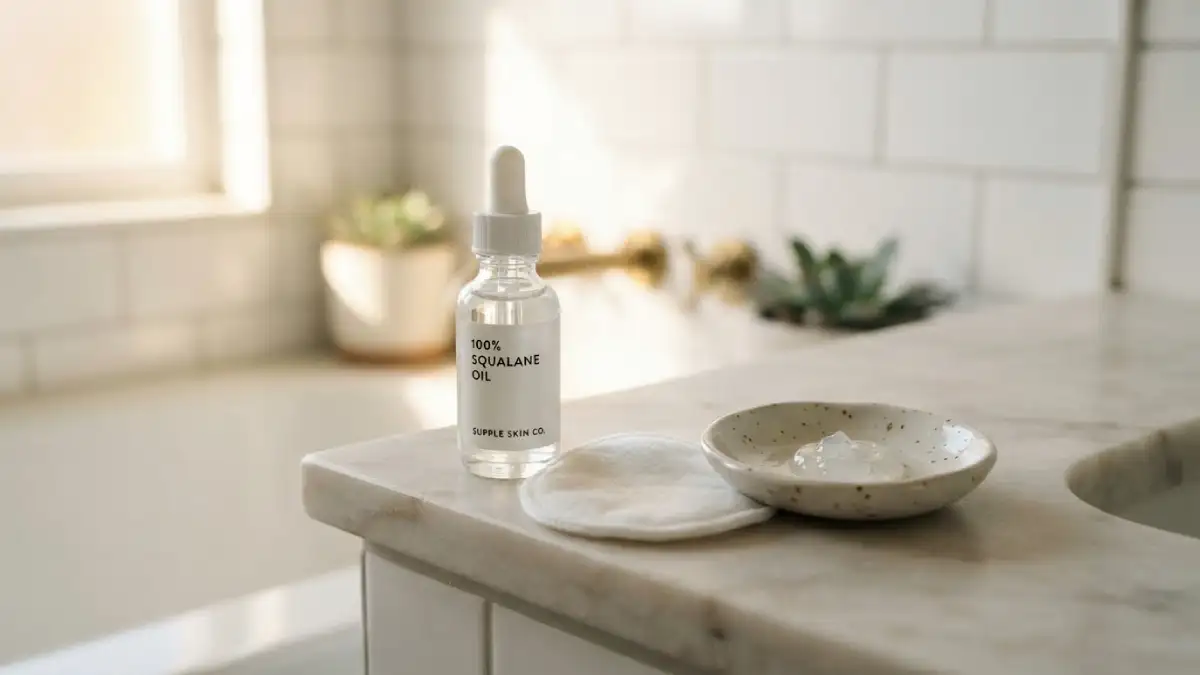
Walk into any beauty store and you’ll find face oils priced like designer handbags. A tiny bottle, a vague promise of “glow,” and a $60, $70, even $90 price tag. Here’s the funny part: one of the most popular hydrating ingredients in those pricey bottles, squalane oil, is also sold on its own for about the price of a fast-food combo meal.
That’s the idea behind this hack. A few drops of plain squalane on damp skin can help seal in the moisture you’ve just applied, and at drop-by-drop use, it works out to roughly $3 a month. It’s lightweight, easy to find, and generally considered low risk for pores.
But “low risk” isn’t the same as “no risk,” and “lock in hydration” doesn’t mean what a lot of social media posts imply. In this guide, we’ll break down what squalane actually does, what the research says about clogged pores, exactly how to use it, and where that $3 figure really comes from, so you can decide whether it belongs in your routine.
Jump Links
- Where the $3 Actually Comes From
- What Squalane Is (And What It Isn’t)
- How Squalane Helps Lock In Hydration
- Will Squalane Clog Your Pores? The Honest Answer
- What This Hack Can and Can’t Do
- How to Use Squalane Oil Step by Step
- How to Fit Squalane Into Your Routine by Skin Type
- How to Patch Test and Introduce It Safely
- Other Budget-Friendly Ways to Use Squalane
- The Real Cost Breakdown
- How to Choose a Squalane Bottle
- Common Mistakes and Quick Fixes
- Who Should Be Careful With Squalane
- Frequently Asked Questions
- Final Thoughts
Where the $3 Actually Comes From
Let’s start with the math, because the headline deserves a footnote. A bottle of squalane isn’t $3. The Ordinary’s 100% Plant-Derived Squalane, a popular single-ingredient option, is $10.40 for 30 mL at Sephora. The $3 figure comes from how little you actually use.
Most squalane oils come with a dropper, and the typical directions are to apply a few drops to your face daily or as needed. Droppers vary, but many deliver roughly 20 drops per milliliter, so treat the numbers below as an estimate:
- 3 drops per application, twice a day, equals 6 drops a day
- 6 drops a day for 30 days equals about 180 drops a month
- 180 drops at roughly 20 drops per mL equals about 9 mL a month
- 9 mL at about 35 cents per mL equals about $3.12 a month
That means a single 30 mL bottle can last around three months. If you only use it at night, your monthly cost drops to roughly $1.50. Compare that with a luxury face oil that includes squalane in the formula, like a $74, 30 mL vitamin C and squalane face oil, and the savings add up fast. We’ll run the full comparison in the cost breakdown section below.
Keep in mind that prices change, sales come and go, and your dropper may deliver more or fewer drops than average. The takeaway isn’t the exact dollar amount. It’s that plain squalane is one of the cheapest ways to add a smooth, soft-feeling finishing layer to your routine.
What Squalane Is (And What It Isn’t)
Squalane is a lightweight, oil-like ingredient used in moisturizers, serums, cleansers, and face oils. It’s a stable, hydrogenated form of squalene, a lipid that occurs naturally in human sebum. Because it resembles lipids your skin already makes, it tends to feel lighter and less greasy than many plant oils.
Most squalane on the market today is plant-derived. The Ordinary says its squalane is derived from sugarcane, and Biossance describes its pure squalane oil as sugarcane-derived too.
Squalane vs. squalene: one letter, big difference. Squalene (with an “e”) is unsaturated and prone to oxidation, and Typology’s review of the research notes that oxidized squalene, known as squalene peroxides, has proven comedogenic potential. Squalane (with an “a”) is saturated and stable, which is why it’s the version used in skincare. When you shop, check the spelling on the label.
Here’s what squalane is not:
- It isn’t a humectant. It doesn’t pull water into your skin the way glycerin or hyaluronic acid do.
- It isn’t sunscreen. A facial oil is not a substitute for SPF, so keep your sunscreen in your morning routine.
- It isn’t an acne treatment or a medical treatment. It’s a cosmetic moisturizing ingredient.
- It isn’t a heavy, ointment-style barrier. It’s generally lighter and less greasy than heavy occlusives like petrolatum, which is part of the appeal, but also means it may not be enough on its own for very dry or compromised skin.
How Squalane Helps Lock In Hydration
Here’s a fact that surprises a lot of people: dry skin is mostly about a lack of water, not a lack of oil. Harvard Health explains that the outer layer of skin takes in water easily but doesn’t bind it very well, so an oily or occlusive substance helps hold that water in.
That’s where the “damp skin” rule comes from. Board-certified dermatologists speaking for the American Academy of Dermatology (AAD) recommend applying moisturizer right after you get out of the shower. When your skin is damp, moisturizer works better because it traps water in the skin and keeps it from evaporating. A Gulf News guide to damp-skin moisturizing makes a similar practical point: damp means a light film of moisture after cleansing, not a dripping wet face.
Squalane fits into this picture as the sealing step. It softens and smooths the skin’s surface and helps slow water loss. So the real hack isn’t that squalane adds hydration. It’s that squalane helps you keep the hydration you already put there. Water first, oil second.
Here’s how the main ingredient types divide the work.
| Ingredient Type | Its Job | Common Examples | Where Squalane Fits |
|---|---|---|---|
| Humectant | Attracts and holds water near the skin | Glycerin, hyaluronic acid | Not squalane, so pair the two |
| Emollient | Softens and smooths the skin’s surface | Squalane, many plant oils | Yes, this is squalane’s main role |
| Occlusive | Forms a film that slows water evaporation | Petrolatum, dimethicone | Partly, with a lighter, less greasy feel |
Think of it like this: a humectant is the sip of water, and the emollient or occlusive is the lid on the cup.
Will Squalane Clog Your Pores? The Honest Answer
The short answer: squalane has a low-risk reputation, but no ingredient is guaranteed to be pore-friendly for everyone. Here’s what supports the reputation, and where the caveats are.
What supports the low-risk reputation
- Its comedogenic rating is low. Skinsort notes that squalane has a comedogenic rating of 1 on the classic scale, which originates from a 1972 study that tested raw ingredients under occlusion on rabbit ears. A rating of 1 means “unlikely to clog pores” in the original system. Curology also lists squalane among oils with low comedogenic ratings that are generally considered suitable for acne-prone or sensitive skin.
- It’s stable. In an experimental rabbit-ear study that Typology describes, UVA-irradiated squalene became highly comedogenic, while squalane didn’t cause comedones even after UVA exposure. The reason is that squalane’s saturated structure keeps it from oxidizing into irritating byproducts.
Where the caveats are
- Those ratings come from old animal tests. They’re rough guides, not promises about what will happen on your face.
- The whole formula matters more than one ingredient. Skinsort points out that a product’s overall formulation matters more than a few ingredients with comedogenic ratings. Pure squalane oil is one thing. A “squalane” cream packed with other rich ingredients is another.
- Marketing terms don’t guarantee anything. Skinsort also notes that “oil-free” isn’t a regulated term, so brands can define it however they like.
- Everyone’s skin is different. Some people break out from ingredients most people tolerate fine, and that can include a plain, gentle oil.
So the smartest mindset is “pore-friendly in theory, test it in practice.” Typology also recommends introducing squalane on its own rather than alongside several new products, so you can tell what’s responsible if something changes. We’ll walk through exactly how to do that in the patch test section.
What This Hack Can and Can’t Do
Before you add anything to your cart, let’s set expectations. Plenty of posts oversell squalane, and you deserve the straight story.
It can help seal in moisture you’ve already applied. Used on damp skin, especially over a water-based hydrator, squalane helps slow water loss and leaves skin feeling softer and smoother. That’s the real benefit.
It can’t add hydration by itself. Squalane isn’t a humectant. If you apply it to bone-dry skin in a dry room, there’s not much water to seal in. Harvard Health makes the larger point that dry skin is about water, so start with water.
It can be a low-cost, low-risk finishing step. For many people, a few drops are enough, and a bottle lasts months. That’s the budget win.
It can’t promise a breakout-free face. Squalane is considered low risk, but “low risk” is a probability, not a guarantee. If your skin is acne-prone, go slowly.
It can’t replace sunscreen, and it may not replace your moisturizer. If your skin is dry, you may still want a cream. The AAD notes that perimenopausal people and everyone 50 and older should be using a cream-based moisturizer, so a few drops of oil may not be enough on their own.
The reframed promise: a few drops of squalane on damp skin is a cheap, lightweight way to help hold in hydration, as long as you test it first and keep expectations realistic.
How to Use Squalane Oil Step by Step
The routine takes about 60 seconds. The only real “technique” is timing and amount.
- Cleanse gently. Use a mild cleanser and lukewarm water. Skin that feels tight after washing is a sign it’s lost water, which is the perfect moment for this hack.
- Leave your skin damp. Don’t towel off completely. Pat lightly so there’s a thin film of water left on your skin. The goal is damp, not dripping.
- Apply a water-based hydrator (optional but helpful). A simple glycerin or hyaluronic acid serum or toner gives the squalane something to seal in. This is the “water first” step.
- Warm 2 to 3 drops between your palms. Start small. You can always add more, but you can’t take it off once it’s on.
- Press, don’t rub. Gently press the oil over your face and neck, focusing on the driest areas like cheeks and around the mouth. Skip the eye area, since brands like Biossance recommend avoiding it.
- Finish with sunscreen in the morning. Give the oil a minute to settle, then apply SPF as the last step. If your sunscreen tends to pill over oil, use fewer drops or save squalane for nighttime.
- At night, let it be the last step. If you use a moisturizer, apply it first and finish with a drop or two of squalane on top for extra softness.
Pro tip: If your face feels greasy or looks shiny an hour later, you used too much. Cut back by a drop next time.
How to Fit Squalane Into Your Routine by Skin Type
Different skin types need different amounts and placements. Use this table as a starting point and adjust by feel. These are practical suggestions, not clinical rules.
| Skin Type | How to Use Squalane | Starting Amount | Best Time |
|---|---|---|---|
| Oily or acne-prone | On damp skin over a light, water-based hydrator, and skip heavy creams if it’s enough | 1 to 2 drops, every other night at first | Night |
| Combination | Focus on dry zones like cheeks, and go lighter on the T-zone | 2 drops | Night, or morning if it sits well under SPF |
| Normal | Use as a finishing layer after your hydrator or moisturizer | 2 to 3 drops | Morning or night |
| Dry | Apply over moisturizer, or mix a drop into your cream | 3 to 4 drops | Night, and morning if needed |
| Mature or very dry | Layer over a cream for extra softness | 3 to 4 drops | Night |
| Sensitive | Patch test first and choose a fragrance-free, single-ingredient oil | 1 to 2 drops | Night |
Don’t forget that damp skin matters in every row. If you apply squalane to completely dry skin, you lose most of the “lock in” benefit.
How to Patch Test and Introduce It Safely
A new product is a new variable, and squalane is no exception. This is especially important if your skin is acne-prone, reactive, or both. Here’s a simple way to introduce it.
- Patch test first. Dab a small amount on the inside of your forearm or just behind your ear. Wait 24 hours and look for redness, itching, or irritation. Biossance itself recommends a patch test if you’re particularly sensitive and advises seeing a dermatologist if irritation occurs.
- Start with one product at a time. Don’t add squalane in the same week as a new cleanser, serum, or retinoid. If you break out, you won’t know what caused it.
- Use a tiny amount. One or two drops, a few nights a week, for the first two weeks.
- Check in on your skin. Look for new bumps, rough texture, or persistent tiny white or flesh-colored dots, especially along the forehead, chin, and cheeks.
- Increase gradually. If your skin is calm after two weeks, move to nightly use and add drops as needed.
- Stop if something’s off. If you notice new breakouts or irritation, pause for a couple of weeks. If it persists, check in with a board-certified dermatologist.
Other Budget-Friendly Ways to Use Squalane
One of the best things about a single-ingredient oil is that it’s versatile, which stretches your money further. Some brands suggest using pure squalane in other ways too. Biossance’s directions, for example, include massaging a few pumps onto the body immediately after showering and smoothing a small amount through the hair for shine and frizz.
Here are a few low-cost ideas:
- Dry spots on the body. Press a few drops onto elbows, knees, or shins right after the shower while your skin is still damp.
- Cuticles and hands. A single drop massaged into each hand can soften dry cuticles.
- Flyaways and ends. Warm a drop between your palms and smooth it over dry ends or flyaways. Use very little, since too much can make hair look greasy.
- Mixing into your usual cream. A drop mixed into your moisturizer can make a basic cream feel richer without buying a new product.
As with the face, start small and keep oils away from your eyes.
The Real Cost Breakdown
Now for the numbers behind the headline. The table below compares three squalane options, using retailer listings referenced in this article and the same usage estimate as above: about 9 mL a month, or roughly 180 drops. Prices change, so treat these as ballpark figures.
| Option | Approximate Price | Size | Approximate Cost per mL | Estimated Monthly Cost (9 mL) |
|---|---|---|---|---|
| The Ordinary 100% Plant-Derived Squalane | $10.40 | 30 mL | About $0.35 | About $3.12 |
| Biossance 100% Sugarcane Squalane Oil | About $34 | 100 mL (3.4 fl oz) | About $0.34 | About $3.06 |
| Biossance Squalane + Vitamin C Rose Face Oil | $74 | 30 mL | About $2.47 | About $22.20 |
A few things stand out. First, the two single-ingredient squalane oils cost almost the same per milliliter, so buy the size you’ll actually finish. Squalane is a stable ingredient, but a 100 mL bottle is only a deal if you’ll use it. Second, the blended face oil costs roughly seven times more per month. To be fair, that product contains vitamin C and other ingredients, so it’s not an apples-to-apples comparison. But if all you want is a lightweight moisture seal, you may be paying a lot extra for features you don’t need.
Here’s one more way to look at it. If you use a few drops of plain squalane at night, a $10.40 bottle could last well over three months. That’s a tiny price for a step that can make your skin feel noticeably softer.
How to Choose a Squalane Bottle
Squalane products vary a lot, and the label tells you most of what you need. Here’s what to look for:
- A short ingredient list. For this hack, the best option is a bottle that lists only “squalane” (sometimes written as “plant-derived squalane”). Added fragrance, essential oils, and extras are more things your skin could react to.
- The right spelling. Make sure it says squalane with an “a,” not squalene with an “e.”
- A plant-derived source. Sugarcane is common, and some brands use olives. The label or the brand’s website will usually tell you.
- A dropper or pump. A dropper gives you precise control for a few-drops routine. A pump is convenient for body use but can dispense more than you need on your face.
- A size you’ll finish. Smaller bottles are lower risk if you’re still testing how your skin reacts.
- Beware of “squalane” products that are actually blends. A face oil that includes squalane isn’t the same as pure squalane. If you’re prone to breakouts, a single-ingredient oil makes it much easier to figure out what’s working.
Finally, store the bottle somewhere cool and out of direct sunlight, as you would with most skincare products, and follow any expiration or “period after opening” guidance on the packaging.
Common Mistakes and Quick Fixes
Most problems with squalane come down to a few avoidable habits. Here’s a quick troubleshooting guide.
| Mistake | What Happens | Quick Fix |
|---|---|---|
| Using too many drops | Skin feels greasy or looks shiny | Cut back to 1 or 2 drops and press in gently |
| Applying to bone-dry skin | Less moisture is sealed in, so skin still feels dry | Apply to damp skin, ideally over a water-based hydrator |
| Adding it alongside several new products | You can’t tell what caused a reaction | Introduce it solo for at least two weeks |
| Buying squalene instead of squalane | Different, less stable ingredient | Check the label for the spelling and ingredient list |
| Expecting it to treat acne or eczema | Disappointment, and possible delay in getting real care | Treat it as a moisturizing step and see a dermatologist for medical concerns |
| Skipping sunscreen because skin feels “protected” | No UV protection at all | Always finish your morning routine with SPF |
| Buying an expensive blend for the squalane | Overpaying for a common ingredient | Choose a single-ingredient oil if squalane is what you want |
Who Should Be Careful With Squalane
For most people, squalane is a gentle ingredient. Still, a few situations call for extra care:
- Active, persistent, or severe acne. Squalane isn’t a treatment, and a dermatologist can recommend proven options. If you want to try it, patch test and start slowly.
- Skin conditions you’re managing. If you have eczema, rosacea, seborrheic dermatitis, or suspected fungal acne, check with a dermatologist before adding a new product.
- Very reactive or sensitive skin. Choose a fragrance-free, single-ingredient oil and patch test first.
- A history of allergic reactions to skincare products. Read the label carefully, and stop using the product if you notice irritation.
- Skin that’s red, cracking, itchy, stinging, or rashy. The AAD notes these can be signs of excessively dry skin, and that may call for more than a drop of oil. Talk with a dermatologist.
📌 YOU MIGHT ALSO LIKE:
- How to Use Rice Water as a $0 Brightening Facial Toner (The Traditional Asian Glow Secret)
- The Best Budget Dupes for Luxury Niacinamide Serums (Under $15 Each)
- The $2 Green Clay Face Mask: How to Detox Oily Skin Without Stripping Your Barrier
Frequently Asked Questions
Is squalane the same as squalene?
No. They sound alike, but they’re different ingredients. Squalene is unsaturated and prone to oxidation, and oxidized squalene (squalene peroxides) has been shown to have comedogenic potential. Squalane is the saturated, stable version used in skincare. Always check that the label says squalane with an “a.”
Is squalane oil safe for acne-prone skin?
It’s generally considered low risk. Squalane has a comedogenic rating of 1 on the classic scale, which is described as unlikely to clog pores, and it’s listed among low-rated oils by sources like Curology. But those ratings come from old rabbit-ear tests, and everyone’s skin reacts differently. Patch test first, start with one or two drops, introduce it on its own, and check in with a dermatologist if you have persistent acne.
Can I use squalane oil every day?
Most product directions, including The Ordinary’s, suggest applying a few drops daily or as needed. If your skin is acne-prone or sensitive, ease in by using it every other night for the first two weeks, then increase if your skin stays calm.
Should squalane go before or after moisturizer?
A common approach is to apply water-based products first, moisturizer next, and oil last, which is also the layering order the Gulf News guide describes. The Ordinary’s directions similarly suggest applying squalane after water-based treatments. If you have oily or combination skin, you can skip the cream and use squalane over a hydrating serum instead.
Can squalane replace my moisturizer or sunscreen?
It can’t replace sunscreen. A facial oil does not protect you from UV rays, so always finish your morning routine with SPF. As for moisturizer, some people with oily or combination skin find a hydrating serum and a few drops of squalane are enough. If your skin is dry, you may still want a cream. The AAD notes that perimenopausal people and everyone 50 and older should be using a cream-based moisturizer.
How long does a bottle of squalane last?
It depends on how much you use. At about six drops a day and roughly 20 drops per milliliter, a 30 mL bottle lasts around 100 days, or a little over three months. Droppers vary, so your bottle may last more or less time. Store it in a cool place away from sunlight and follow the expiration or “period after opening” information on the packaging.
Final Thoughts
Here’s the bottom line. Squalane oil isn’t a miracle, and it isn’t truly “$3” in the sense of a single bottle. But at a few drops a day, the cost can land around $3 a month, and for that price you get a lightweight, gentle way to help seal in the hydration you’ve already applied.
The keys are simple. Apply it to damp skin. Start with a water-based hydrator. Use just a few drops. Patch test first and introduce it on its own, especially if your skin is prone to breakouts. And remember that low risk isn’t no risk, so pay attention to how your skin responds. Skip the $70 blends if all you want is a moisture seal, and keep your sunscreen in your morning routine.
Want more budget-friendly beauty swaps, simple routines, and honest breakdowns of what’s actually worth your money? Keep exploring The Frugal Glow for smart, wallet-friendly ways to look and feel your best.