

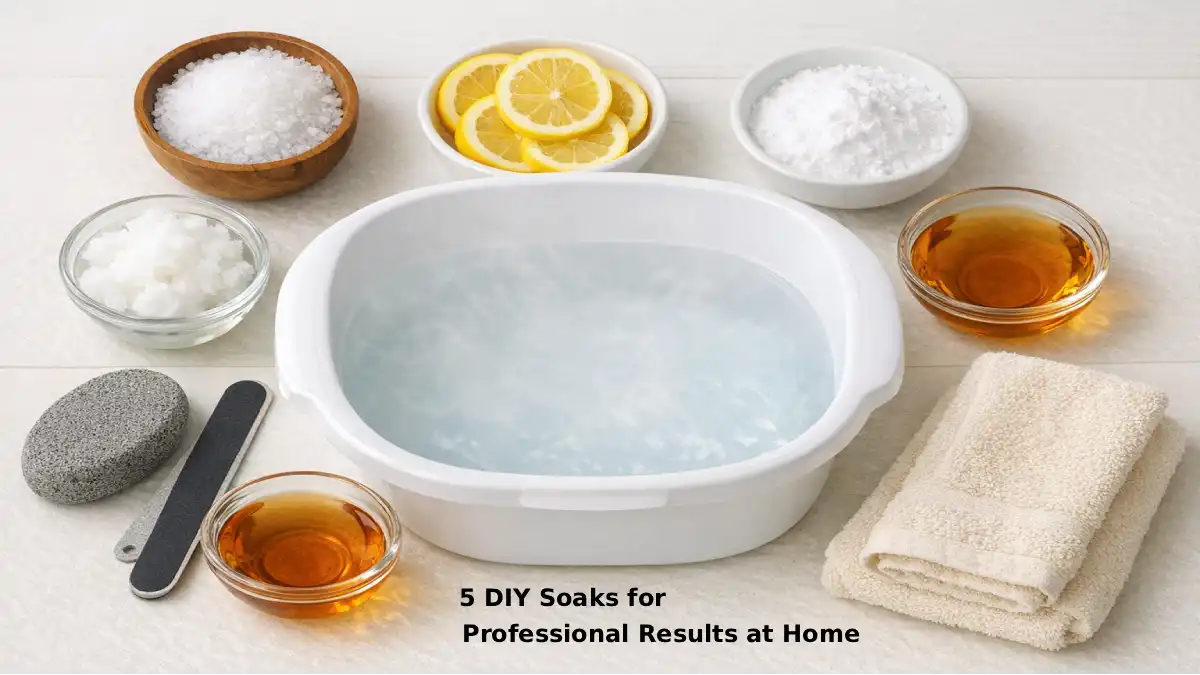
The Dollar Tree Pedicure: 5 DIY Soaks for Professional Results at Home
The Frugal Glow | DIY Beauty | Budget Wellness
Jump Links
- The Pedicure Price Tag Has Gotten Out of Hand
- Why a Foot Soak Is the Most Important Step You’re Skipping
- Your Dollar Tree Shopping List for All 5 Soaks
- The 5 DIY Foot Soaks for Every Concern
- The Complete Dollar Tree Pedicure Routine Step by Step
- What to Do After the Soak for Salon-Quality Results
- The Annual Savings: What Going DIY Actually Gets You
- The Frugal Glow Verdict
- All Your Questions, Answered Simply
The Pedicure Price Tag Has Gotten Out of Hand
Let me tell you what a professional pedicure actually costs in 2025.
The basic pedicure — the one at your neighborhood nail salon that includes a foot soak, a scrub, nail trimming and shaping, cuticle work, and a polish — runs $35 to $50 in most American cities. In major metropolitan areas, expect $55 to $75 for the basic version. Add a callus removal treatment and you’re looking at another $10 to $15. A spa pedicure with a paraffin wax treatment? Add another $20 to $30.
And the recommendation from podiatrists and nail technicians for healthy foot maintenance is a pedicure every four to six weeks. At $45 average every five weeks, that’s approximately $468 per year — on foot care.
I am not here to tell you that professional pedicures aren’t a wonderful experience. They are. The massage chair, the warm soak, the skilled hands doing things to your heels that you simply cannot replicate alone — these are genuine pleasures and if you love them and can afford them comfortably, keep going.
But here’s what the salon is actually doing to your feet that produces those results: it starts with a foot soak. Twenty minutes of warm water with specific ingredients that soften the skin, hydrate the calluses, and prepare the feet for exfoliation. That soak — that specific combination of ingredients in warm water for the right amount of time — is doing most of the transformative work you’re paying $45 for.
The nail technician’s skill matters for the shaping and polish. The foot soak? That part is entirely replicable at home for under $3 total, using ingredients from Dollar Tree.
Here are the five soaks that cover every common foot concern — and the complete routine that puts them together.
Why a Foot Soak Is the Most Important Step You’re Skipping
Most people who do occasional at-home pedicures skip the soak entirely — they clip their nails, maybe use a pumice stone on dry heels, apply some lotion, and call it done. They wonder why their results don’t last and why their heels still feel rough a day or two later.
The foot soak is not optional padding in the pedicure experience. It is the single most important step for lasting results. Here’s the physiology behind it.
The epidermis of the feet is uniquely thick. The skin on the soles and heels is the thickest on the body — five to ten times thicker than facial skin. This thickness is protective but it also means that topical products — lotions, creams, oils — penetrate this thick layer poorly without preparation. A foot soak softens and hydrates this thick epidermal layer, temporarily increasing its permeability and making it dramatically more receptive to exfoliation and subsequent moisturization.
Calluses and rough skin require hydration before removal. Attempting to file or pumice dry, unsoaked calluses is both less effective and more likely to cause micro-tears in the surrounding healthy skin. A proper soak hydrates calluses from the inside out — the water penetrates the keratinized cells and makes them soft enough for a pumice stone to remove them efficiently and safely. Ten minutes of soaking makes fifteen minutes of exfoliation work better than thirty minutes of exfoliating without soaking.
The specific ingredients in the soak determine what the soak accomplishes. Plain warm water softens the skin. Epsom salt adds magnesium absorption and muscle relaxation. Baking soda adds gentle exfoliation and pH normalization. Lemon juice adds brightening and antifungal protection. Each ingredient in each of the five soaks below has a specific, documented mechanism of action that produces a specific, measurable result.
Understanding this is what separates a mediocre foot soak from a salon-quality one — and what makes the Dollar Tree ingredients as effective as the branded alternatives sold in beauty stores for five times the price.
DIY Dry Shampoo: The $1 Magic Powder That Saves Me $15 a Month at CVS
Your Dollar Tree Shopping List for All 5 Soaks
Everything you need for all five soaks is available at Dollar Tree for $1 per item. Here is the complete shopping list:
| Item | Dollar Tree Price | Used In |
|---|---|---|
| Epsom Salt (16 oz) | $1.25 | Soaks #1, #3, #5 |
| Baking Soda | $1.25 | Soaks #2, #3 |
| Apple Cider Vinegar | $1.25 | Soak #4 |
| Coconut Oil | $1.25 | Soak #1 |
| Lemon (or lemon juice) | $1.25 | Soak #3 |
| Peppermint Essential Oil | $1.25 | Soak #5 |
| Honey | $1.25 | Soak #2 |
| Total for all 5 soaks | ~$8.75 one-time |
This one-time purchase of eight items provides multiple batches of each soak — most will last months before running out. The per-soak cost, amortized across multiple uses, works out to approximately $0.30 to $0.60 per soak session.
If you only want to try one or two soaks before committing to the full Dollar Tree run, Epsom salt and baking soda are the most versatile purchases — between them they cover four of the five soaks below in some form.
The 5 DIY Foot Soaks for Every Concern
Soak #1 — The Deep Softening Soak for Cracked Heels
Best for: Severely cracked heels, very rough skin, extremely dry feet
Cost per session: $0.35
Soak time: 20 minutes
Dollar Tree ingredients: Epsom salt, coconut oil, honey
The formula:
- Warm water (as hot as comfortable — warmth accelerates penetration)
- 3 tablespoons Epsom salt
- 1 tablespoon coconut oil
- 1 tablespoon honey
Why these ingredients:
Epsom salt (magnesium sulfate) draws out toxins and excess fluid from swollen, tired feet through osmosis while softening the thick epidermal layer. The magnesium is absorbed transdermally — research suggests meaningful magnesium absorption through the skin during Epsom salt soaks — and magnesium is involved in over 300 biochemical reactions in the body, including skin barrier function.
Coconut oil is one of the most penetrating natural oils available — its lauric acid content and small molecular structure allow it to penetrate the thick plantar skin more effectively than most other oils. Adding coconut oil to a foot soak rather than applying it topically after the soak allows the oil to work in synergy with the water’s hydration, penetrating along the same pathways the water opens rather than sitting on the skin’s surface.
Honey is a humectant — it draws moisture from the water into the skin’s cells and helps retain that moisture after the soak ends. It also has natural antimicrobial properties from its hydrogen peroxide content that protect any micro-fissures in cracked heels from infection.
The results:
This soak produces the most dramatic visible difference of all five — cracked heels that feel dry and rough before the soak become noticeably softer within 20 minutes, and significantly more receptive to pumice stone exfoliation afterward. For people with severely cracked heels, twice-weekly use of this soak for three to four weeks produces cumulative improvement that rivals professional callus removal treatments.
Why I Swapped My $30 Sephora Lip Scrub for This 50-Cent Kitchen Hack
Soak #2 — The Detox and Deodorizing Soak for Tired Feet
Best for: Foot odor, end-of-day exhaustion, sweaty feet, general foot refresh
Cost per session: $0.25
Soak time: 15 minutes
Dollar Tree ingredients: Baking soda, honey, optional peppermint essential oil
The formula:
- Warm water
- 3 tablespoons baking soda
- 1 tablespoon honey
- 3 drops peppermint essential oil (optional)
Why these ingredients:
Baking soda is sodium bicarbonate — a gentle alkaline compound that normalizes the pH environment of the feet. Foot odor is caused by bacteria that thrive in the warm, slightly acidic, moist environment of shoes and socks. Baking soda’s alkalinity creates a temporarily inhospitable environment for these bacteria, reducing odor at the source rather than masking it with fragrance. It also provides gentle mechanical and chemical exfoliation of dead skin cells from the surface of the feet.
Honey’s antimicrobial properties complement the baking soda’s bacterial suppression — together they create a soak environment that significantly reduces the bacterial load responsible for foot odor. Honey also softens the skin while the baking soda works on the bacterial population.
Peppermint essential oil — if you have it — adds two specific benefits: menthol, the active compound in peppermint oil, creates a cooling sensation that relieves the burning, tired feeling in feet that have been standing all day, and peppermint has documented antifungal and antibacterial properties that add to the deodorizing effect.
The results:
This soak is the most immediately satisfying of the five because the relief from foot fatigue is noticeable within the first five minutes. Tired, aching feet feel significantly better after 15 minutes in this soak. The deodorizing effect is genuine and lasting — several hours, sometimes through the following day. For people who stand all day or whose feet tend toward odor, this becomes a non-negotiable end-of-day ritual.
Soak #3 — The Brightening and Smoothing Soak for Rough Skin
Best for: Discoloration on heels, rough texture, dull-looking skin on feet, post-winter recovery
Cost per session: $0.40
Soak time: 15 to 20 minutes
Dollar Tree ingredients: Epsom salt, baking soda, lemon
The formula:
- Warm water
- 2 tablespoons Epsom salt
- 2 tablespoons baking soda
- Juice of half a lemon (or 2 tablespoons bottled lemon juice)
Why these ingredients:
Lemon juice contains citric acid — a gentle alpha hydroxy acid (AHA) that chemically exfoliates the top layer of dead skin cells from the feet through a process called keratolysis. This is the same mechanism used in professional chemical peels at significantly higher concentrations — at the mild concentration of fresh lemon juice in a foot soak, the effect is gentle enough for daily use while still producing meaningful brightening and smoothing of discolored, rough skin.
The combination of Epsom salt (physical softening) with baking soda (gentle chemical exfoliation and pH buffering) and lemon juice (AHA chemical exfoliation) creates a triple-action exfoliation system in a single soak. The lemon’s ascorbic acid also has mild brightening properties similar to the vitamin C used in skincare — for feet with yellowing or discoloration from polish staining or accumulated dead skin, lemon juice is a genuinely effective brightening agent.
Important note: Do not use this soak on cracked or broken skin — the citric acid in lemon juice will sting open fissures. Reserve this soak for intact, rough skin rather than actively cracked heels. The Deep Softening Soak (#1) is more appropriate for cracked heels; use this one once the skin has healed.
The results:
The most visible brightening results of all five soaks. After 15 to 20 minutes and subsequent pumice exfoliation, the feet look meaningfully smoother and more even-toned. For post-winter feet with months of accumulated dead skin, three to four weekly sessions produce dramatic improvement.
The $2 Target Face Mask Dupe: How I Get Glowy Skin Without the $50 Price Tag
Soak #4 — The Antifungal and Clarifying Soak for Foot Odor
Best for: Athlete’s foot, toenail fungus (preventive and mild treatment), persistent foot odor, fungal-prone feet
Cost per session: $0.30
Soak time: 15 to 20 minutes
Dollar Tree ingredient: Apple cider vinegar
The formula:
- Warm water
- Half cup apple cider vinegar (approximately 4 tablespoons)
- Optional: 3 tablespoons Epsom salt for additional softening
Why this ingredient:
Apple cider vinegar (ACV) has a pH of approximately 2 to 3 — strongly acidic. Dermatophytes, the fungi responsible for athlete’s foot and toenail fungus, cannot survive in strongly acidic environments. ACV soaks work by creating a temporary low-pH environment around the feet and between the toes that is inhospitable to fungal growth.
A 2018 study published in Scientific Reports confirmed ACV’s antifungal activity against Candida species. Multiple peer-reviewed studies have documented ACV’s effectiveness against common dermatophytes at concentrations achievable in a foot soak. This is not folk medicine — it is documented microbiology that explains what generations of home remedies have empirically demonstrated.
ACV also has documented antibacterial properties through its acetic acid content — relevant for the bacterial component of foot odor that the baking soda soak addresses through a different mechanism. For comprehensive odor treatment, alternating between the baking soda soak (Soak #2) and the ACV soak (Soak #4) addresses both bacterial and fungal contributions.
The results:
The most therapeutic of the five soaks rather than the most cosmetically dramatic. For people with active athlete’s foot or recurring foot odor, twice-weekly ACV soaks alongside over-the-counter antifungal treatment significantly accelerate resolution. For preventive use during high-risk periods (gym locker rooms, swimming pools, shared showers), weekly ACV soaks provide meaningful protection without pharmaceutical intervention.
Soak #5 — The Relaxation and Circulation Soak for Aching Feet
Best for: Tired feet after long workdays or workouts, poor circulation, foot and ankle swelling, stress relief
Cost per session: $0.35
Soak time: 20 minutes
Dollar Tree ingredients: Epsom salt, peppermint essential oil
The formula:
- Warm-to-hot water (as warm as comfortable without scalding)
- 4 tablespoons Epsom salt
- 5 drops peppermint essential oil
- Optional: Additional warm water added halfway through to maintain temperature
Why these ingredients:
This soak uses heat and magnesium in combination for maximum circulation benefit. Warm water dilates blood vessels in the feet and lower legs, improving circulation and delivering oxygen to tired muscles. The Epsom salt’s magnesium is absorbed transdermally and supports the enzymatic processes involved in muscle recovery — magnesium deficiency is associated with muscle cramping and poor recovery, and research supports meaningful absorption during extended Epsom salt soaks.
Peppermint oil’s menthol creates a vasodilatory effect — it expands blood vessels in the skin and creates the cooling-then-warming sensation that most people find deeply relaxing. The combination of warm water vasodilation and menthol’s sensory effect creates a powerful relaxation response in the feet and ankles that explains why peppermint foot soaks are universally described as immediately calming.
The results:
The most immediately pleasurable of the five soaks. Aching, swollen, tired feet feel significantly better within five minutes. This is the soak to use after long workdays, long runs, a day of walking in unsupportive footwear, or any time your feet need recovery. It is the soak most reminiscent of the spa pedicure experience — the warmth, the peppermint scent, the sensation of relief in the feet — at a cost of $0.35 per session.
The 3-Ingredient DIY Vitamin C Serum That Actually Works (And Costs Under $5)
The Complete Dollar Tree Pedicure Routine Step by Step
The soaks are the foundation — but the full routine is what produces the professional-quality result. Here is the complete sequence:
Step 1 — Choose your soak based on your primary concern today.
Cracked heels: Soak #1. Tired and smelly feet: Soak #2 or #5. Rough, discolored skin: Soak #3. Fungal prevention: Soak #4. End-of-day relaxation: Soak #5.
Step 2 — Prepare the foot basin.
Fill a basin, large bowl, or plastic tub with water as warm as comfortable. Add your soak ingredients. Stir briefly to dissolve Epsom salt and baking soda.
Step 3 — Soak for the recommended time.
15 to 20 minutes depending on the soak. Use the time to relax — read, watch something, listen to a podcast. This is not wasted time.
Step 4 — Exfoliate while skin is soft.
Remove one foot from the soak and immediately use a pumice stone or foot file on the heels and any rough areas. The skin is at its most receptive to exfoliation in the first 60 seconds out of the water — don’t dry off first. Work in circular motions on calluses and rough patches. The difference in exfoliation effectiveness between soaked and unsoaked skin is dramatic. Return the foot to the soak while working on the other.
Step 5 — Trim and shape nails.
Remove both feet from the soak and gently push back softened cuticles with an orange stick or cuticle pusher. Trim nails straight across — not curved at the corners, which can cause ingrown toenails. File to smooth any rough edges.
Step 6 — Rinse and dry thoroughly.
Rinse both feet with clean water. Dry completely — including between the toes. Moisture trapped between the toes is the primary environmental condition for fungal growth. Pat dry rather than rubbing to avoid irritating freshly exfoliated skin.
Step 7 — Apply moisturizer immediately.
Apply a thick foot cream, petroleum jelly, or coconut oil to both feet while the skin is still slightly damp — the hydration from the soak is still in the skin cells and applying moisturizer now seals it in. For severely dry feet, apply coconut oil or petroleum jelly, put on cotton socks, and leave overnight.
Step 8 — Polish if desired.
Apply a base coat, two coats of polish, and a top coat if you want color. The freshly exfoliated, moisturized nail beds hold polish significantly better than unprepared nails — this is part of why professional pedicures last longer than at-home applications that skip the soak.
What to Do After the Soak for Salon-Quality Results
The soak produces soft, receptive skin. What you do in the thirty minutes after the soak determines whether that result lasts three days or three weeks.
The most important post-soak step: Apply a thick emollient — petroleum jelly (Vaseline), coconut oil, or shea butter — to the heels and any rough areas immediately after drying. These occlusive ingredients create a seal over the freshly hydrated skin that prevents moisture evaporation. Dollar Tree sells Vaseline-equivalent petroleum jelly for $1.25 — applied to the heels under cotton socks overnight, it produces results comparable to the paraffin wax treatments that salons charge $20 to $30 extra for.
Frequency for best results:
For maintenance with normal, healthy feet: one foot soak per week.
For cracked heels or significant calluses: two soaks per week for the first three to four weeks, then once weekly for maintenance.
For fungal prevention: one ACV soak per week ongoing during high-risk periods.
The Annual Savings: What Going DIY Actually Gets You
Let me make the financial math concrete.
Professional pedicure cost:
$45 average × every 5 weeks = approximately 10 pedicures per year = $450 annually
Dollar Tree DIY pedicure cost:
$8.75 one-time ingredient purchase (lasts months)
Foot basin: $5 one-time (Dollar Tree or dollar store)
Annual replenishment of Epsom salt and baking soda: approximately $5
Annual DIY cost: approximately $15
Annual savings: $435
Over five years of consistent DIY pedicures instead of salon visits: $2,175 saved. For results that — on the softness, smoothness, and health of your feet — are genuinely equivalent to the salon version for every metric except the massage chair experience and the social aspect of a salon visit.
If you genuinely love the salon pedicure experience — the ambiance, the massage, the treat-yourself feeling — by all means keep it as an occasional indulgence. But replacing 8 of your 10 annual pedicures with a DIY Dollar Tree version and keeping 2 as true treat-yourself occasions saves $360 per year while preserving the parts of the salon experience that are genuinely irreplaceable at home.
5 Banana Peel Beauty Hacks for Glowing Skin (The $0.00 Glow)
The Frugal Glow Verdict
Five soaks. Eight ingredients. Under $9 total for everything. Results that the skin on your feet cannot distinguish from what you’d get at a $45 salon visit.
The Dollar Tree pedicure is not a consolation prize for people who can’t afford the salon. It is a complete, evidence-based foot care routine built on ingredients with documented mechanisms of action — magnesium absorption, citric acid exfoliation, ACV antifungal activity, menthol vasodilation — that address every common foot concern effectively and affordably.
The salon pedicure charges you for the skill of the nail technician, the ambiance of the space, the massage chair, and the experience of being cared for by someone else. All of those things are valuable and worth paying for occasionally. The soak itself — the part that does most of the foot health work — is worth exactly what Dollar Tree charges for Epsom salt and baking soda.
Your feet carry you everywhere. They deserve consistent care. That care should not require a monthly $45 appointment to deliver results you can get in your bathroom for $0.35 a session.
At The Frugal Glow, this is the story we exist to tell — the one where the $1 ingredient and the $45 service produce the same result for your skin, and where the $44 difference goes back into your life where it belongs. Bookmark us, share this with the friend who gets a pedicure every four weeks like clockwork, and come back for more DIY beauty content that proves professional results have always been available at grocery store prices. 💚✨
All Your Questions, Answered Simply
1. Does a DIY foot soak actually work as well as a salon pedicure?
For the skin preparation and foot health components of a pedicure — softening calluses, hydrating dry skin, smoothing rough heels, and addressing odor or mild fungal concerns — a properly executed DIY foot soak using the right ingredients produces results equivalent to the salon soak. The differences between a salon pedicure and a fully executed DIY pedicure are in the massage component (which requires another person’s hands), the nail shaping precision (which improves with practice), and the experience of being cared for in a dedicated space. The foot soak itself — the foundation of all pedicure results — is entirely replicable at home with Dollar Tree ingredients at a fraction of the cost.
2. What is the best thing to put in a foot soak for dry cracked heels?
For severely dry cracked heels, the most effective foot soak combination is Epsom salt plus coconut oil plus honey in warm water — the Deep Softening Soak described in this article. Epsom salt softens the thick plantar skin through osmosis, coconut oil penetrates the epidermal layer to moisturize from within, and honey’s humectant properties draw and retain moisture in the skin cells. After a 20-minute soak in this formula, the heels become significantly more receptive to pumice stone exfoliation, and the subsequent removal of softened dead skin reveals healthier tissue underneath. For maximum results, follow with petroleum jelly or coconut oil applied to the heels under cotton socks overnight — this seals the hydration achieved during the soak and produces the most dramatic improvement in cracked heel appearance and texture.
3. How long should you soak your feet in Epsom salt?
The recommended soak time for Epsom salt foot soaks is 15 to 20 minutes — sufficient for the magnesium to begin transdermal absorption, for the salt to soften the thick plantar skin, and for the foot tissues to hydrate fully. Soaking for less than 10 minutes reduces the softening effect and limits the effectiveness of subsequent exfoliation. Soaking for more than 30 minutes can over-hydrate the skin, causing it to become overly wrinkled and sensitive — and can actually dry the skin out as the extended osmotic effect pulls moisture out rather than in after the initial hydration phase. Twenty minutes is the research-supported sweet spot for both skin softening and magnesium absorption benefits.
4. Can I use apple cider vinegar to treat toenail fungus?
Apple cider vinegar’s strongly acidic pH has documented antifungal activity against the dermatophytes and Candida species responsible for toenail fungus and athlete’s foot. Regular ACV foot soaks can reduce mild fungal infections and provide meaningful prevention against recurrence. However, for established toenail fungus infections — particularly those involving significant nail thickening, discoloration extending to the nail bed, or nail separation — ACV soaks alone are typically insufficient as a complete treatment. They are best used as a complementary approach alongside over-the-counter antifungal treatments (clotrimazole, terbinafine) or as a preventive measure and early-stage treatment. For severe or persistent toenail fungus, consultation with a podiatrist or dermatologist is recommended — prescription oral antifungals produce significantly better outcomes than topical treatments for advanced infections.
5. How often should you do a foot soak at home?
For healthy feet with normal care needs, one foot soak per week is sufficient for maintenance — keeping skin soft, calluses managed, and feet refreshed. For feet with specific concerns, frequency should be adjusted: twice weekly for cracked heels during the active treatment phase (reducing to weekly once improvement is achieved), twice weekly for athlete’s foot during an active infection (alternating between ACV soaks and baking soda soaks), and as needed for foot fatigue or odor following demanding activity. Over-soaking — more than three times per week — is generally unnecessary and can over-hydrate the plantar skin, temporarily reducing its natural protective toughness. The most important consistency principle is regularity: one weekly soak performed consistently produces better long-term results than occasional intensive soaking.
6. What is a good homemade foot soak for foot odor?
The most effective homemade foot soak for foot odor addresses both the bacterial and fungal contributors to the problem. Baking soda (sodium bicarbonate) creates an alkaline environment that suppresses the bacteria responsible for odor. Apple cider vinegar creates an acidic environment that suppresses fungal growth. The most comprehensive approach is to alternate between these two soaks — baking soda soak one session, ACV soak the next — rather than combining them in the same water, since their opposing pH levels would neutralize each other. Adding peppermint essential oil to the baking soda soak provides additional antimicrobial activity alongside the immediate sensory relief of menthol. For persistent foot odor that doesn’t respond to these interventions within two to three weeks of consistent use, consultation with a dermatologist is recommended as some cases of persistent foot odor are related to hyperhidrosis (excessive sweating) or specific bacterial overgrowth that requires targeted treatment.
7. Can you do a pedicure at home without professional tools?
A complete, professional-quality pedicure at home requires fewer specialized tools than most people assume. The essential tools are: a foot basin or large bowl (any container deep enough to submerge both feet simultaneously), a pumice stone or foot file for callus removal, nail clippers and an emery board, a cuticle pusher (an orange stick from the nail care section at any dollar store works perfectly), and a thick moisturizer or petroleum jelly for post-soak application. Optional but helpful additions are a nail brush for cleaning under nails during the soak, a base coat and top coat if applying polish, and toe separators for comfortable polish application. All of these items are available at Dollar Tree for $1 to $1.25 each — a complete pedicure tool kit can be assembled for under $10. The skill requirement for a good at-home pedicure is minimal once the foot soak has properly softened the skin — the hard work of callus removal becomes dramatically easier with properly soaked feet, and the learning curve is primarily in the nail shaping, which improves with practice.
Professional feet at Dollar Tree prices — and the evidence-backed science to explain why it works just as well. At The Frugal Glow, we believe beautiful, healthy, well-cared-for feet are not a luxury that requires a $45 appointment. They are the result of consistent, informed care using ingredients that cost less than a cup of coffee. Bookmark us, share this with the friend who’s been getting a pedicure every four weeks for the past three years, and come back for more DIY beauty content that keeps every part of you looking great for almost nothing. 💚✨