

The ’72-Hour Rule’: The Simple Brain Hack That Saved Me $1,000 in Impulse Buys
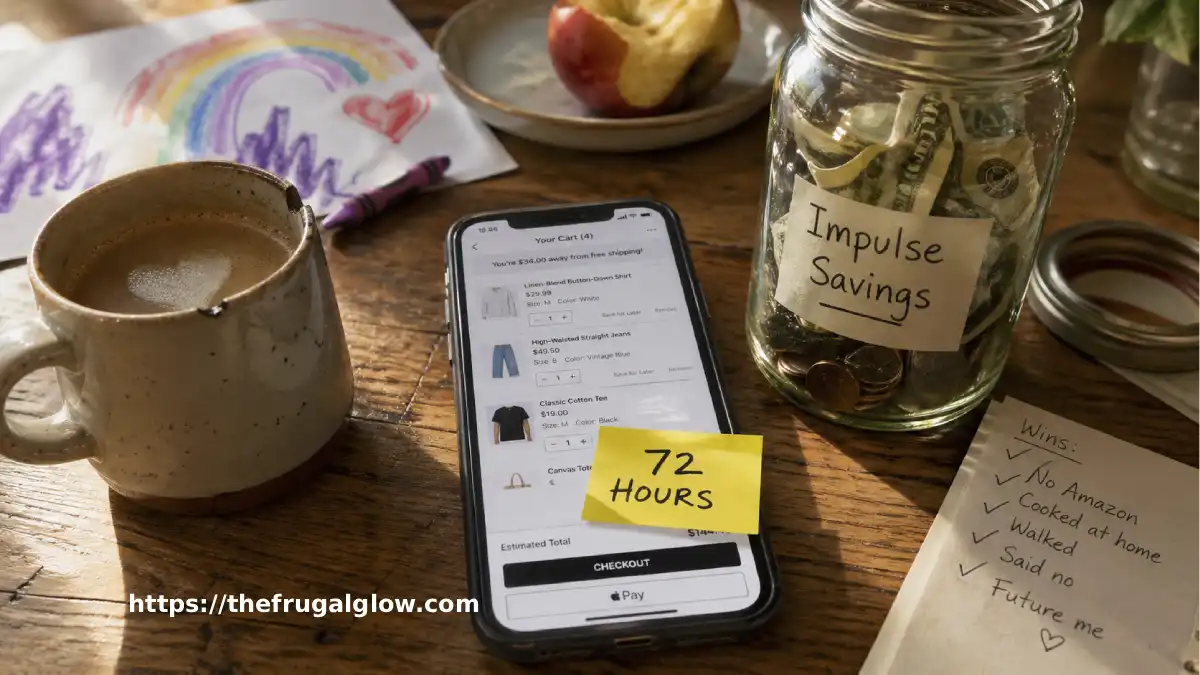
Let me tell you about the $70 candle.
It was 11 PM. Both kids were finally asleep. I was scrolling Instagram while eating shredded cheese straight from the bag (no judgment, you’ve been there). And there it was. A “hand-poured, small-batch, sacred space” candle that supposedly smelled like “fresh rain and old books.”
I wanted it so badly my chest actually hurt.
I added it to my cart. Then two more candles for “free shipping.” Then a matching ceramic lid. Total? $112. My finger hovered over “Buy Now.”
And then I remembered the mess in my closet.
You see, three weeks before that night, I had done something terrifying. I pulled my credit card statement from the past two months and highlighted every single purchase that was not groceries, gas, or bills. Do you know what color my highlighter was? Pink. My entire statement was pink.
- $38 on “mystery sale” bath salts I never used.
- $52 on a sweater that was “such a good deal” (it was not. It pilled after one wash).
- $19 on a water bottle because the internet told me I’d drink more water if it had time markers on it. (I did not.)
- And fourteen other random, small, “it’s only $15” purchases that added up to $347 in two months.
That was my wake-up call. I wasn’t buying things I needed. I was buying feelings. The feeling of treating myself. The feeling of control. The feeling that a new object would fix the exhaustion of motherhood.
That’s when I discovered the 72-Hour Rule. And honey, it changed everything.
Jump Links
- What Exactly Is the 72-Hour Rule? (And Why It Works on Your Brain)
- The Psychology of the Impulse Buy: Why You Craze the “Add to Cart” Dopamine
- How I Saved $1,000 in Six Months Without Feeling Deprived
- The Step-by-Step 72-Hour Rule System (With Scripts You Can Use Tonight)
- Real-Life Examples: What Stayed and What Got Canceled
- What If It’s a Limited-Time Sale? The Five-Question Emergency Test
- How to Include Your Spouse or Partner Without Starting a Fight
- Frequently Asked Questions (FAQ)
What Exactly Is the 72-Hour Rule? (And Why It Works on Your Brain)
The 72-Hour Rule is painfully simple. Embarrassingly simple. So simple that you might roll your eyes. But stick with me.
Here it is: Whenever you want to buy something that is not a necessity (groceries, medicine, diapers, gas), you do not buy it immediately. You wait 72 hours. Three full days. Seventy-two hours.
That’s it.
No complicated spreadsheets. No deleting your credit card from your phone (though you should eventually do that too). Just a pause. A breath. A three-day waiting period between “I want this” and “I buy this.”
And here is why it works like magic: Impulse urges have a half-life of about 20 to 30 minutes. I am not making this up. Behavioral economists have studied this. The intense “I NEED THIS RIGHT NOW” feeling is a chemical spike in your brain. It feels permanent in the moment. But if you distract yourself for even 20 minutes, the intensity starts to fade.
By 72 hours? For 90% of the things you wanted to buy, the feeling is completely gone. You wake up on day three and think, “Wait, why did I want a bread maker? I don’t even like bread.”
The 72 hours forces your rational brain (the prefrontal cortex) to come back online. Your emotional brain (the limbic system) runs the show when you’re tired, lonely, bored, or stressed. And what is motherhood if not all four of those things at once?
Seventy-two hours gives your thinking brain time to catch up and say, “Hey, we have three loaves of bread in the freezer. We do not need a bread maker.”
The Psychology of the Impulse Buy: Why You Craze the “Add to Cart” Dopamine
Let’s get honest about why you and I click “buy” on things we don’t need. It’s not because we’re bad with money. It’s because we’re human.
Reason 1: The Dopamine Loop
Every time you see something you want, your brain releases a tiny squirt of dopamine. That’s the “excitement” chemical. And here is the cruel trick: anticipating a reward gives you more dopamine than actually receiving the reward. So when you add something to your cart, your brain feels amazing. By the time the package arrives? Meh. The magic is gone. You’re already chasing the next hit.
Reason 2: You’re Exhausted (Like, Really Exhausted)
Decision fatigue is real. By 8 PM, after you’ve made 400 decisions (what’s for breakfast, whose turn to wipe, do we need more wipes, is that a fever, etc.), your willpower is gone. Your brain is looking for an easy reward. And Amazon is right there. You are not weak. You are depleted. There’s a difference.
Reason 3: The “Treat Yourself” Lie
We tell ourselves we deserve it. And you know what? You probably do. You worked hard. The kids were feral today. Your partner forgot to take out the trash again. You deserve a little something. But here is the truth bomb: a new eyeshadow palette will not make you feel less tired tomorrow. It will not make your toddler nap. It will arrive, you’ll open it, feel a 30-second thrill, and then it’ll sit in a drawer. You deserve rest, not stuff.
Reason 4: Social Media Is a Store Now
TikTok, Instagram Reels, even Pinterest—they are designed to sell to you. When you see an influencer “unboxing” a product with soft lighting and happy music, your brain mistakes them for a friend. You trust them. You want what they have. But that influencer got paid $5,000 to show you that sweater. She would wear a trash bag if the sponsor paid enough.
Recognizing these four reasons changed everything for me. I stopped blaming myself for being “bad with money” and started realizing I was just a normal tired mom living in a world designed to take my money.
Stop Getting Scammed! How to Spot Fake Sales at Kohl’s and TJ Maxx
How I Saved $1,000 in Six Months Without Feeling Deprived
Let me give you the real numbers. Not the “I saved $10,000 in a month” influencer lies. Real, messy, mom-life math.
Month One (January):
I started the 72-Hour Rule on January 3rd. In the first month alone, I put 27 items on my “72-hour list.” Do you know how many I actually bought after three days? Four. That’s it. The other 23 items? I looked back at my list on day four and genuinely laughed at myself. A $90 juicer? I hate cleaning juicers. A “motivational” desk calendar? I work from the couch. A third black t-shirt? I already own two.
Savings in January: $412.
Month Two (February):
The novelty wore off a little. I had 19 impulse urges. I bought eight of them after 72 hours. But here is the key—the ones I bought were things I actually needed or truly wanted. A new pan because mine was scratched and flaking. A replacement phone charger. A birthday gift for my niece. The other 11? Canceled. Including a $65 “anti-aging” face roller that I now realize would have just rolled dust around my tired cheeks.
Savings in February: $187.
Month Three through Six:
It got easier. The habit started to stick. By month six, I was automatically pausing before every non-essential purchase. Not because I was forcing myself. But because my brain had rewired. The 72-Hour Rule became automatic, like brushing my teeth.
Total savings after six months: $1,043.
I took that money and did something that actually made me happy. I didn’t “invest it wisely” like a boring finance article would tell you. I put $500 in my kids’ savings accounts. I spent $200 on a massage (a real one, not a gadget). And I used the rest to take my family out for a nice dinner where I didn’t cook or clean.
That is what saving money should feel like. Freedom. Not guilt.
Why I Never Shop at Target Without These 3 Secret Apps (Save $20 Every Trip)
The Step-by-Step 72-Hour Rule System (With Scripts You Can Use Tonight)
Okay, you’re convinced. But how do you actually do this when you’re standing in Target at 8 PM with a screaming toddler and a $25 scented candle in your hand?
Here is the exact system. Copy it. Use it tonight.
Step 1: Identify the Impulse (10 seconds)
Ask yourself one question: Do I need this to survive or function in the next 24 hours?
- Diapers? Yes. Buy now.
- Milk? Yes. Buy now.
- A fourth throw pillow “to complete the vibe”? No. That’s an impulse.
If the answer is no, go to Step 2.
Step 2: The Pause Script (Say This Out Loud)
Here is what I say to myself. You can steal it word for word.
“I see this. I want this. I am allowed to want things. But I am not buying this right now. I am putting this on a 72-hour pause. If I still want this on [say the day in three days], I will come back. The store will still exist. The internet will not run out of this item.”
Say it out loud. It sounds silly. Do it anyway. Speaking activates your rational brain.
Step 3: Capture It, Don’t Buy It
- Online: Add it to your cart. Then close the tab or app. Do not enter your payment info. Do not save your password. Just close it.
- In a store: Take a photo of the item and the price tag. Then put it back on the shelf. Walk away.
I keep a note in my phone called “The 72-Hour Zoo.” Every time I pause on an item, I write it down with the date and the price. Here is what my list looked like last week:
April 12 – $48 – Pink lampshade (Target)
April 13 – $29 – Gardening gloves that say “Plant Mama” (Amazon)
April 14 – $89 – Wireless earbuds (I already have earbuds)
Step 4: Wait. Actually Wait. (72 Hours)
This is the hardest part. Your brain is going to scream at you. “It’s on sale!” “Only three left!” “You work hard!”
Let the brain scream. It’s just noise. Go for a walk. Clean out a drawer. Call your sister. The feeling will pass. I promise.
Step 5: The Day-Four Review (2 minutes)
After 72 hours (set a calendar reminder), open your list. Go through each item and ask yourself three questions:
- Did I even remember I wanted this? (If no, delete it.)
- Do I have something that already does this? (If yes, delete it.)
- Will this actually make my life better, or am I just bored/tired/lonely? (Be honest.)
If the item passes all three questions, then and only then, you can buy it. But here is the secret: after 72 hours, less than 20% of items pass. You will save so much money without feeling a single ounce of deprivation.
The $0.00 Clothing Swap: How to Host a ‘Swap Party’ and Refresh Your Closet for Free
Real-Life Examples: What Stayed and What Got Canceled
Let me show you exactly how this played out in my real, messy life. No filters.
What Got Canceled (The 72-Hour Failures)
Item: A $120 air fryer
- Why I wanted it: TikTok told me I could make “perfect chicken wings.”
- 72 hours later: I remembered I have a regular oven. And I don’t like cleaning baskets. And I’ve used my friend’s air fryer exactly once. Canceled.
Item: A $45 “Mom Life” crewneck sweatshirt
- Why I wanted it: It was cute. I was tired. I wanted to feel seen.
- 72 hours later: I have seven sweatshirts. They all say nothing on them. That’s fine. Canceled.
Item: A $28 set of gel pens and a coloring book for “adults”
- Why I wanted it: I thought it would relax me.
- 72 hours later: I have not colored anything since 1994. I will not start now. I will take a bath instead for free. Canceled.
Item: A subscription to a “self-care” box ($35/month)
- Why I wanted it: I thought a surprise in the mail would make me happy.
- 72 hours later: I realized I don’t want surprise lotions. I want to choose my own stuff. Canceled.
What Actually Got Bought (The Keepers)
Item: A $60 pair of running shoes (on sale from $100)
- Why I wanted it: My current shoes have holes. My feet hurt.
- 72 hours later: Still needed shoes. Still had holes. Bought. No guilt.
Item: A $25 children’s book about emotions
- Why I wanted it: My son is hitting his brother. I need help.
- 72 hours later: Still have a hitter. Still need help. Bought.
Item: A $15 replacement lunch box (old one had a broken zipper)
- Why I wanted it: My kid’s food kept falling out.
- 72 hours later: The zipper did not magically fix itself. Bought.
See the difference? The things I bought solved a real problem. The things I canceled were feelings disguised as products.
What If It’s a Limited-Time Sale? The Five-Question Emergency Test
I hear you. “But what if it’s a flash sale? What if it’s ‘only 10 left’? What if the price goes up tomorrow?”
Retailers use that exact fear to bypass your 72-hour pause. It’s called scarcity marketing. And it works on every single human being, including me.
So here is the emergency protocol. If something is “time-sensitive” and you cannot physically wait 72 hours, run it through these five questions. Answer honestly.
Question 1: Have I wanted this exact item for more than two weeks before today? (Not “I saw it yesterday.” Actually, two weeks.)
Question 2: If this sale ended and I never bought this item, would my life be meaningfully worse in three months?
Question 3: Could I find this item for a similar price somewhere else if I waited?
Question 4: Is this for someone else’s birthday or holiday that is less than 7 days away?
Question 5: Am I currently hungry, tired, angry, lonely, or bored? (If yes, do not buy. Eat a snack. Take a nap. Text a friend. Then come back.)
If you answered yes to Question 1 AND Question 2, you can buy it. Otherwise, you’re being tricked by the flashing countdown timer. Close the tab. The world will not end.
I have personally fallen for the “only 2 left” pop-up before. You know what happened? I closed the tab. Two days later, I got an email saying “We’ve restocked!” It was a lie. There was never a limit. There is never a limit.
How to Include Your Spouse or Partner Without Starting a Fight
Money fights are the #1 cause of stress in relationships. And if you start the 72-Hour Rule alone while your partner is still buying $80 worth of power tools at 11 PM, you are going to feel resentful. Trust me. I’ve been there.
Here is how to bring it up without sounding like a nag or a control freak.
The Wrong Way: “You need to stop buying stupid stuff. We’re broke because of you.” (This will start a fight. Don’t do this.)
The Right Way: “Hey, I’m trying this new thing for myself called the 72-Hour Rule. It’s helped me save money without feeling deprived. I’m wondering if you’d be open to trying it together for one month as an experiment. No pressure. We can stop if we hate it.”
That’s it. Invite, don’t accuse. Frame it as a team experiment. Most partners will say yes because you’re asking, not demanding.
My husband was skeptical at first. He’s a “buy it now or I’ll forget” guy. But I made a shared note on our phones called “The 72-Hour Family List.” Whenever either of us wants something non-essential, we add it to the list with the date. On Friday nights, we review the list together with a glass of wine.
It has become weirdly fun. We laugh at the stuff we forgot about. We high-five when we “cancel” something dumb. And we’ve saved over $600 together just from his side of the list (turns out he does not need a third drill, who knew?).
If your partner refuses? That’s okay. You can still do it for yourself. Lead by example. When they see your bank account growing and your stress shrinking, they’ll come around.
Frequently Asked Questions (FAQ)
Q: Does the 72-Hour Rule apply to everything? What about groceries or takeout?
No. Necessities are exempt. Groceries, gas, medicine, diapers, and basic toiletries (toothpaste, shampoo) are fine to buy immediately. The rule is for discretionary spending: clothes, home decor, gadgets, books, candles, subscriptions, takeout that’s not replacing a meal you would have cooked (that’s a gray area—use your judgment). If you’re hungry and tired and ordering pizza because you have no food in the house? That’s a necessity. If you’re ordering $40 of sushi because you’re bored? Put it on the 72-hour list.
Q: What about Amazon Prime Day or Black Friday? Those are one-day sales.
The emergency test above applies here. But I will tell you a secret: almost every “one-day” sale happens again. Black Friday deals come back for Cyber Monday, then Christmas, then New Year’s, then President’s Day. There is always another sale. Always. I have never, not once, missed a “one-time” deal and regretted it. Not once.
Q: I have ADHD. Waiting 72 hours feels impossible. Do you have a modified version?
Yes. I have friends with ADHD who struggle with “out of sight, out of mind.” They will literally forget to buy something they needed. So modify it: wait 1 hour instead of 72 hours. Set a timer. Go do something else (fold laundry, watch a YouTube video, play a phone game). When the timer goes off, ask: “Do I still want this, or was that a dopamine chase?” For many ADHD brains, one hour is enough to break the impulsive spell.
Q: What about gifts for other people? Can I buy those right away?
If the gift is for a birthday happening in less than 7 days, buy it. You don’t want to be the person giving a late gift. If the birthday is 3 weeks away, put it on the 72-hour list. You might find a better gift or a better price. And honestly? Half the time I realize the person doesn’t even want that thing, so I save money and give a gift card instead.
Q: I’m worried I’ll forget about something I actually need.
That’s the beauty of the list. You write it down. If you genuinely need it, you’ll remember to check your list on day four. If you forget about it entirely? Then you never needed it. That’s the whole point. Your brain is great at remembering what matters. If it slips your mind, it wasn’t important.
Q: How do I handle the “little treats” like a $4 latte or a $2 ice cream?
Great question. For me personally, small treats under $5 that are consumable (coffee, a donut, a magazine) are fine. Because the joy of a $4 latte is immediate and real, and the damage to my budget is minimal. But if you’re buying a $4 latte every single day ($120 a month), then put it on the 72-hour rule. Ask yourself: “Would I rather have this latte today, or put $4 toward a massage next month?” That perspective shift helps.
Q: What if I’m buying something to support a small business or a friend’s MLM?
Oof. This is a tough one. Here is my rule: if your friend is selling something you genuinely want and would buy from a stranger, buy it. If you are buying it only because you feel guilty or obligated, put it on the 72-hour rule. Nine times out of ten, you’ll realize you don’t want the overpriced leggings or the essential oils. A real friend will understand a polite “I’ll think about it.” If they pressure you, that’s not a friendship; that’s a sales pitch.
Q: I tried this and I still bought things after 72 hours. Did I fail?
Absolutely not. The goal is not perfection. The goal is fewer impulse buys. If you used to buy 10 things a month and now you buy 6, you saved money on those 4 items. That’s a win. Do not let perfect be the enemy of better. Just keep practicing. It takes about 66 days to form a new habit. Be patient with yourself.
The Night I Almost Broke the Rule (And Why I’m Glad I Didn’t)
Let me tell you about that $112 candle.
I put it in my cart at 11 PM on a Tuesday. I closed the tab. I wrote it in my 72-Hour Zoo list. Wednesday came. I thought about the candle five times. Thursday came. I thought about it twice. Friday came.
I opened my cart on Friday evening. And I just… stared at it.
I realized something. I didn’t want the candle. I wanted the feeling the candle represented. I wanted a quiet evening where no one needed me. I wanted to feel like the kind of woman who has “sacred space” and reads old books in the rain. But a candle cannot give you that. Only rest can. Only boundaries can.
So I didn’t buy it.
Instead, I took the $112 I would have spent. I put $50 in my savings account. I spent $20 on a used book from the library sale. I used $30 to buy fancy hot chocolate and marshmallows. And I gave my husband the last $12 and said, “Please pick up a cheap candle from the drugstore. Any scent. I just want the pretty light.”
He came home with a $6 vanilla candle. I lit it that night after the kids went to bed. I drank my hot chocolate. I read ten pages of my book before falling asleep on the couch. And I felt exactly as peaceful as I had imagined that $112 candle would make me feel.
The peace was never in the product. It was in the permission to pause.
Your First Step Starts Tonight (Yes, Tonight)
Here is your homework. It will take less than two minutes.
Open your phone. Go to your notes app. Create a new note called “72-Hour Zoo.”
Right now, think of one thing you have been wanting to buy. Not a necessity. A “want.” Maybe it’s a pair of shoes you’ve had in an open tab for three days. Maybe it’s a kitchen gadget you saw on Instagram this morning. Maybe it’s a sweater you almost bought last weekend.
Write it down in your note with the date and the price.
Now, here is the magic part: You are not buying it tonight.
You are going to wait. Seventy-two hours. That’s it. On [three days from today], you are going to open that note, look at that item, and ask yourself the three questions from Step 5.
I would bet you $20 (but I won’t, because I’m saving money now) that you will not buy it. And you will feel so powerful. Not because you’re “good at discipline.” But because you finally have a system that works with your tired mom brain instead of against it.
You are not broken. You are not bad with money. You are a human being living in an economy designed to take your attention and turn it into purchases. The 72-Hour Rule is just a tool to take back the steering wheel.
And that saved me $1,043. It can save you even more.
Now go close that tab, put down the phone, and go hug your babies (or your dog, or your pillow). You’ve got this. And your bank account is about to thank you.
This article was written in the real world, with real laundry, real tired eyes, and real gratitude for every single reader who made it this far.
Proudly published by The Frugal Glow — where we believe that being frugal isn’t about saying “no” to everything. It’s about saying “yes” to what actually matters, and giving yourself the space to figure out what that is. No shame. No perfection. Just real strategies for real moms who want to keep their glow without emptying their wallets. Thanks for being here. Now go enjoy your 72 hours of freedom.