
Stop Getting Scammed! How to Spot Fake Sales at Kohl’s and TJ Maxx
The Frugal Glow | Smart Shopping | Budget News & Trends
Jump Links
- The Retail Pricing Game Nobody Explains to You
- How Kohl’s Fake Sale System Actually Works
- How TJ Maxx’s “Compare At” Pricing Actually Works
- The 7 Red Flags of a Fake Sale
- The Real Tools for Checking Whether a Deal Is Genuine
- Category-by-Category Guide: Where the Fake Sales Are Worst
- How to Actually Save Money at Both Stores
- The Frugal Glow Verdict
- Frequently Asked Questions (FAQ)
The Retail Pricing Game Nobody Explains to You
I want to start with a number that I think will fundamentally change how you read a price tag.
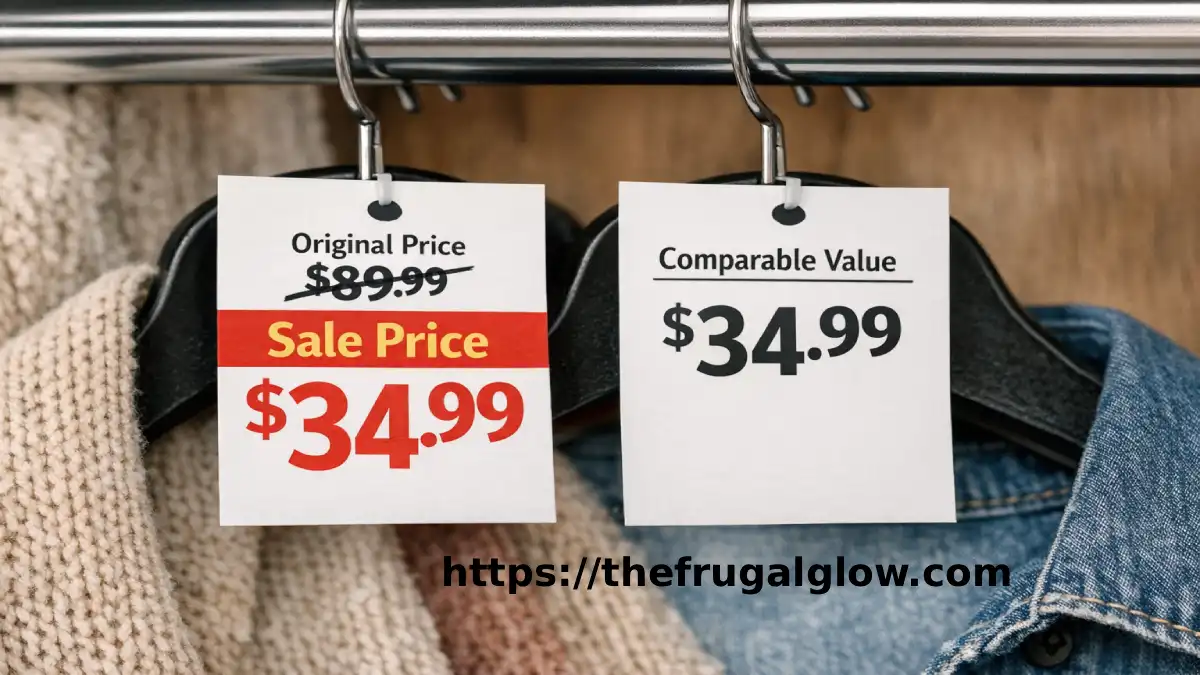
When you see a tag at Kohl’s that says “Original Price: $89.99 — Your Price: $34.99” and feel the specific pleasure of a good deal found, you are experiencing something that was deliberately engineered by a team of pricing strategists to produce exactly that feeling — regardless of whether you are actually saving anything.
This is not a conspiracy theory. It is a documented retail practice with a name — “high-low pricing” or “reference price manipulation” — that has been the subject of federal regulatory scrutiny, state attorney general investigations, and academic research in consumer psychology. The Federal Trade Commission has published guidance on deceptive pricing. Multiple states have won settlements against retailers for inflating “original” or “compare at” prices.
The two retailers most consistently associated with these practices in American retail are Kohl’s and TJ Maxx — not because they are uniquely dishonest but because their entire business models are structured around the psychological mechanism of “discount from original price,” making the accuracy of that original price the foundation of every value proposition they offer.
Understanding exactly how each store’s pricing system works — and what it means for whether the tag on the item you’re holding represents a genuine deal — is the single most valuable piece of shopping knowledge I can give you.
How Kohl’s Fake Sale System Actually Works
Kohl’s pricing model is one of the most extensively documented examples of reference price manipulation in American retail. Here is how it works, step by step.
The Mechanism:
Kohl’s sets an “Original Price” or “Regular Price” for items that is established primarily for the purpose of being discounted from — not because items are regularly sold at that price. The original price is set at a level that allows Kohl’s to advertise significant percentage discounts while selling items at their actual intended selling price.
The documented reality: A 2014 lawsuit filed in federal court in California alleged that Kohl’s “regularly” prices were fictitious — that items were sold at the “sale” price almost all of the time and rarely or never at the “original” price. The lawsuit resulted in a settlement in which Kohl’s paid $6.15 million without admitting wrongdoing.
How the cycle works in practice:
An item enters the Kohl’s system with an “Original Price” of $89.99. It goes on “sale” immediately for $44.99 — “50% off.” After a few weeks, there’s a “Kohl’s Cash” event where you earn $10 Kohl’s Cash for every $50 spent. The item might be briefly available at $89.99 — technically establishing the “original” price — before returning to its perpetual sale pricing. When the next “big sale event” comes, the item is offered at “60% off” for $35.99.
The item was never genuinely worth $89.99 in the market. It was always intended to be sold at $35 to $45. The $89.99 tag is the mechanism that makes $35 to $45 feel like a deal.
The Kohl’s Cash System:
Kohl’s Cash compounds the complexity. When you earn $10 in Kohl’s Cash for every $50 spent, the effective price reduction is 20% — but only if you return to spend the Kohl’s Cash before it expires and only if you spend additional money to redeem it. The psychological mechanism makes spending more money feel like saving money. Many customers spend more on a Kohl’s Cash redemption visit than they would have if Kohl’s Cash didn’t exist.
The honest Kohl’s bottom line:
The actual price of an item at Kohl’s — the price you should evaluate the deal against — is the price you’re paying, not the “original” price crossed out in red. Ask yourself: “Would I pay this specific dollar amount for this specific item at a store that didn’t have the sale theater?” If yes, it’s a reasonable purchase. If no, the discount is not making it a reasonable purchase.
Why I Never Shop at Target Without These 3 Secret Apps (Save $20 Every Trip)
How TJ Maxx’s “Compare At” Pricing Actually Works
TJ Maxx’s pricing model is different from Kohl’s — and in some ways more defensible — but it contains its own significant misleading elements that most shoppers never examine.
The “Compare At” Claim:
Every TJ Maxx item carries a “Compare At” price alongside the TJ Maxx selling price. The implied message is clear: this item normally sells for [Compare At price] at full-price retailers, and TJ Maxx is selling it for significantly less. This is the foundational value proposition of the off-price retail model.
Where it gets complicated:
TJ Maxx sources merchandise through multiple channels — each with very different implications for what the “Compare At” price actually means:
Channel 1 — Genuine overstock from legitimate retailers:
A department store ordered too much of a specific style. TJ Maxx buys the excess inventory at a significant discount and passes the savings to consumers. The “Compare At” price in this case reflects what the item actually sold for (or was intended to sell for) at a legitimate retailer. This is the genuine deal — and it does exist at TJ Maxx.
Channel 2 — Closeout merchandise:
End-of-season merchandise, discontinued styles, and clearance items from brands and retailers. The “Compare At” may reflect the item’s original price before it became a closeout — which means you’re not necessarily getting it for less than it sold for, but rather for less than it originally retailed for before the market decided it wasn’t worth that price.
Channel 3 — Made-for-off-price merchandise:
This is the most significant and least understood channel. Many brands manufacture items specifically for the off-price retail channel — items that will never be sold at a full-price retailer and have no “Compare At” reference in any legitimate retail environment. The “Compare At” price on these items is set by TJ Maxx’s pricing team based on what comparable items sell for at full-price retailers — not on any actual retail history for the specific item.
The FTC has specific guidance on this: The “Compare At” price is only legitimate if the item was actually offered for sale at that price by a third-party retailer within a recent, reasonable period. A price that was never actually charged at a real retailer for that specific item is not a legitimate comparison price.
How to identify made-for-off-price merchandise at TJ Maxx:
Check the label. Brands that manufacture for the off-price channel frequently use modified brand names — “Saks Fifth Avenue OFF 5TH” (not Saks Fifth Avenue), “Nordstrom Rack” brands (not Nordstrom brands), and private labels that sound like premium brands but have no presence in full-price retail. The presence of a recognizable brand name does not guarantee the item was ever sold at a full-price retailer.
Research the specific item online. If the exact item — same style number, same colorway — cannot be found at any full-price retailer past or present, it was likely made specifically for the off-price channel and the “Compare At” price has no legitimate basis.
The 7 Red Flags of a Fake Sale
Whether you’re at Kohl’s, TJ Maxx, or any other retailer that leads with discount pricing, these seven signals indicate that the “deal” deserves skepticism:
Red Flag #1: The item is always on sale.
If a product is perpetually discounted — if every time you see it the tag says “sale” — the sale price is the real price. At Kohl’s specifically, if an item’s “regular” price has never been available since you started shopping there, the regular price is not a real reference point.
Red Flag #2: The “Compare At” or “Original” price seems implausibly high.
A $29.99 TJ Maxx throw pillow with a “Compare At” of $89.99 should trigger immediate skepticism. Search the specific item online and compare to comparable products at full-price retailers. If similar quality items retail for $35 to $45 elsewhere, the $89.99 “Compare At” is inflated.
Red Flag #3: You can’t find the item at the “Compare At” price anywhere.
If a TJ Maxx item claims to compare at $120 but the item cannot be found at any full-price retailer at that price — or at all — the comparison price is not based on an actual retail offer. Genuine off-price deals involve items that did sell at the reference price at legitimate retailers.
Red Flag #4: The brand is unrecognizable or sounds like a premium brand but isn’t.
Made-for-off-price brands frequently use names that imply premium positioning — “Madison Avenue Collection,” “Fifth Avenue Design,” “Heritage Luxury” — with no presence in full-price retail. These items have no legitimate “Compare At” basis.
Red Flag #5: The discount requires purchasing a minimum amount.
Kohl’s “15% off your entire purchase” coupons and “spend $50, get $10 Kohl’s Cash” promotions are designed to increase basket size, not to genuinely reduce the price of what you were already going to buy. The savings only materialize if you were already planning to spend that amount.
Red Flag #6: The sale is time-limited in a way that creates urgency.
“Today only,” “this weekend only,” “limited quantities” — these time pressure mechanisms are designed to bypass the rational evaluation that would reveal the deal isn’t as good as it appears. A genuine deal does not require urgency to be a good purchase.
Red Flag #7: The item quality doesn’t support the “original” price.
Handle the item. Examine the construction. Feel the fabric. If the quality is clearly commensurate with the price you’re paying rather than the “original” price crossed out on the tag, the original price was not a legitimate reference.
The $0.00 Clothing Swap: How to Host a ‘Swap Party’ and Refresh Your Closet for Free
The Real Tools for Checking Whether a Deal Is Genuine
Google Shopping:
Search the exact product name, style, and color in Google Shopping. If the item appears at multiple retailers at a price close to the “Compare At” or “Original” price, the reference is legitimate. If it only appears at TJ Maxx or Kohl’s, treat the reference price skeptically.
PriceGrabber and Camelcamelcamel:
For items also sold on Amazon, Camelcamelcamel tracks the full price history — showing you the actual highest, lowest, and average prices an item has sold for over its entire Amazon listing history. A “sale” price that is actually the regular Amazon price is not a deal.
Honey and Capital One Shopping:
Browser extensions that automatically check current prices across multiple retailers and show you price history. Install both before any significant retail purchase. They surface the actual market price of an item in seconds, making reference price manipulation immediately visible.
The manufacturer’s website:
For branded items, the brand’s own website shows the genuine retail price. If a TJ Maxx “Compare At” exceeds the brand’s own MSRP, the comparison price is inflated — even legitimate off-price deals don’t generally claim to save you more than the brand itself charges.
Reddit’s r/frugalmalefashion and r/femalefashionadvice:
Both communities actively discuss pricing practices, flag fake deals, and share genuine value finds at off-price and discount retailers. Community knowledge is often more current and specific than any pricing tool.
Category-by-Category Guide: Where the Fake Sales Are Worst
Clothing and Apparel
At Kohl’s, clothing is where the high-low pricing is most aggressively applied. Brand names like Sonoma, Croft & Barrow, and Apt. 9 are Kohl’s private labels — their “original prices” are set entirely by Kohl’s with no external market reference. A Sonoma sweater with an “original price” of $54 and a “sale price” of $21.60 is a $21.60 sweater with theatrical pricing. Evaluate it at $21.60 against comparable quality sweaters at other retailers — not against the $54 crossed out in red.
At TJ Maxx, watch for modified brand labels in clothing. “DKNY Sport” and “Calvin Klein Performance” are different product lines from “DKNY” and “Calvin Klein” and are often manufactured specifically for the off-price channel. The Compare At prices on these items frequently don’t correspond to any legitimate full-price retail offer.
The genuine deals in clothing at both stores: Brand-name items you can verify were sold at full-price retailers at the reference price — specifically, items whose exact style appears on brand websites or department store websites at the Compare At price. These do exist and represent the genuine value proposition of off-price retail.
Bedding and Home Goods
This is the category where TJ Maxx’s made-for-off-price manufacturing is most prevalent. Home goods are frequently manufactured specifically for the off-price channel with “Compare At” prices that have no basis in any legitimate retail offer.
How to check: Search the specific thread count, size, and brand of any bedding item on Amazon and at Bed Bath & Beyond. If the same product doesn’t appear at or near the “Compare At” price, it’s not a genuine comparison.
The genuine deals here: Overstock from legitimate home goods brands — particularly after-season decorative items and surplus hotel-quality linens — do appear at TJ Maxx at genuine discounts. The quality signal is the brand name: known hotel supply brands and recognizable home textile brands with full-price retail presence are the categories where genuine deals occur.
Handbags and Accessories
At TJ Maxx, handbags are among the most complex categories for pricing authenticity assessment. Genuine designer overstock does appear — authenticated Coach, Kate Spade, and Michael Kors bags at genuine discounts from legitimate retail prices do exist in TJ Maxx’s buying. These are real deals.
However, the same shelves carry bags from brands that exist only in the off-price channel — names that sound like luxury brands but have no full-price retail presence. The “Compare At” prices on these bags are entirely fictional.
The red flag: A leather-look handbag from an unfamiliar brand name with a $189.99 Compare At and a TJ Maxx price of $59.99. Search the brand name. If it doesn’t appear at any full-price retailer, the $189.99 comparison has no basis.
The genuine deal signal: A recognizable brand name with a verifiable full-price retail history at or near the Compare At price. Coach bags with a TJ Maxx price 30 to 50 percent below Coach’s own retail price represent what the TJ Maxx model is supposed to be doing.
Beauty and Fragrance
At TJ Maxx, the beauty and fragrance section contains some of the most genuinely legitimate off-price deals available — and some of the most deceptive.
Genuine deals: Name-brand fragrances at significant discounts from department store prices. MAC, Urban Decay, and other recognizable cosmetic brands at prices below their official retail. These are typically genuine overstock or discontinued products.
The fake deal pattern: “Luxury” skincare sets — gift sets of products from brands that don’t appear at any full-price retailer, with Compare At prices of $80 to $120 and TJ Maxx prices of $29.99. These sets are manufactured specifically for the off-price channel at a manufacturing cost that supports the $29.99 price and the Compare At of $80 to $120 is completely fictitious.
The check: Can you find any of the individual products in the gift set at any full-price retailer at prices that would support the gift set’s Compare At? If the brand doesn’t exist in full-price retail, the Compare At doesn’t either.
Is It Really a Deal? How to Spot “Fake Sales” and Inflated Prices During Black Friday
How to Actually Save Money at Both Stores
Having dismantled the fake deal mechanisms, let me be clear about where genuine value exists at both retailers — because it does exist, and both stores can be excellent value when shopped strategically.
At Kohl’s — the genuine value strategy:
Ignore the “original price” entirely when evaluating purchases. Evaluate everything at the price you’re paying. Kohl’s prices for name-brand items (Nike, Under Armour, Levi’s, Carter’s) frequently represent genuine value compared to those brands at other retailers — particularly during Kohl’s Cash events when the effective discount is real. Kohl’s private label at clearance prices (not “regular sale” prices — actual clearance, typically 60 to 80 percent off the “original”) frequently represents genuine value for basics.
Download the Kohl’s app and stack discounts: Kohl’s Cash, percentage-off coupons, and App Exclusive deals can stack in a way that produces genuine price reductions on items you were already going to buy. The key is starting with an item you need at a price you’d pay without the discounts — and then stacking coupons on top rather than letting coupons justify purchases you wouldn’t otherwise make.
At TJ Maxx — the genuine value strategy:
The genuine deals are in recognizable brands with verifiable full-price retail history. Before any TJ Maxx purchase above $30, quickly Google the brand and item. If the brand appears at full-price retailers at or near the Compare At price, you have identified a genuine off-price deal. If the brand doesn’t appear in full-price retail, evaluate the item solely at the price TJ Maxx is charging — without reference to the Compare At.
The best TJ Maxx categories for genuine value: name-brand fragrances, recognizable home goods brands, and verified brand-name clothing and accessories. The worst categories for genuine value: made-for-off-price private label clothing, home goods from unrecognizable brands, and any beauty gift set from a brand with no full-price retail presence.
The Frugal Glow Verdict
Neither Kohl’s nor TJ Maxx is a scam in the criminal sense. Both retailers operate within legal frameworks that permit reference pricing as long as the reference price was offered at some point. Both also offer genuine value for informed shoppers who know what to look for.
What they both are is deliberately engineered discount theater — retail environments designed from the floor plan to the price tag to produce the specific psychological experience of finding a deal, regardless of whether a genuine deal is present. The crossed-out price, the red “SALE” sticker, the “Compare At” reference, the Kohl’s Cash mechanism — these are not incidental features of the shopping experience. They are the shopping experience, engineered to bypass the rational price evaluation that would reveal whether the item in your hand is actually worth buying.
The good news is that the engineering is visible once you know what to look for. Evaluate Kohl’s items at the price you’re paying, not the price crossed out in red. Verify TJ Maxx “Compare At” prices against actual full-price retail before crediting them as legitimate savings. Use Google Shopping, Camelcamelcamel, and the Honey extension to ground your price assessment in market reality rather than retail theater.
The deal you feel at these stores is real — the psychology of saving is a genuine emotional experience that has value. The savings the deal represents are only real if you verify them. With five minutes of price checking per significant purchase, you can separate the genuine off-price bargains from the theatrical ones and shop both stores as the intelligent, informed consumer you actually are.
At The Frugal Glow, this is what we’re here for — the honest look at how retail pricing actually works so you can spend your money on deals that are real rather than deals that feel real. Bookmark us, share this with the friend who goes to Kohl’s every time there’s a “Kohl’s Cash event” and comes home spending more than she planned, and come back for more smart shopping content that keeps your budget and your consumer intelligence both in excellent shape. 💚🛒
Frequently Asked Questions (FAQ)
1. Are Kohl’s sales actually real?
Kohl’s sales are legally structured but frequently misleading in terms of how much you’re actually saving compared to a fair market price. Kohl’s sets “Original” or “Regular” prices that are established primarily as reference points for discounting rather than prices at which items regularly sell — a practice documented in multiple consumer protection lawsuits and a $6.15 million California settlement. The practical implication is that many items at Kohl’s are sold at the “sale” price essentially all of the time, making the “sale” price the real price and the “original” price a reference designed to create the perception of savings. Genuine value at Kohl’s exists in recognizable name-brand merchandise (Nike, Levi’s, Under Armour) whose prices can be verified against other retailers, and in actual clearance merchandise at the back of departments. The most reliable approach is to evaluate any Kohl’s purchase at the price you’re paying and ask whether you’d pay that amount at a store without the discount theater.
2. Is TJ Maxx’s “Compare At” price accurate?
TJ Maxx’s “Compare At” price is sometimes accurate and sometimes not, depending entirely on the sourcing channel of the specific item. For genuine overstock from legitimate full-price retailers — brand-name items that were actually sold at or near the Compare At price at department stores, specialty retailers, or brand websites — the Compare At is a legitimate reference. For merchandise manufactured specifically for the off-price channel — which a significant portion of TJ Maxx’s inventory is — the Compare At has no basis in any actual retail offer and is set by TJ Maxx’s pricing team based on comparable items rather than the item’s actual retail history. The reliable way to assess a TJ Maxx Compare At price is to search the exact item (brand name, style, color) online and verify whether it appears at any full-price retailer at or near the Compare At. If it does, the deal is likely genuine. If the brand doesn’t appear in full-price retail at all, the Compare At is not a legitimate reference.
3. How do I know if a sale price is genuinely discounted?
Verifying whether a sale price represents genuine savings from a legitimate reference price requires three steps. First, search the exact item — brand name, style number if available, colorway — on Google Shopping to see whether it appears at other retailers at or near the “original” or “Compare At” price. If it does, the reference is legitimate and the discount is real. Second, for items also available on Amazon, use Camelcamelcamel to check the complete price history — showing what the item has actually sold for over time rather than what a single retailer claims it originally cost. Third, for any item above $50, install the Honey or Capital One Shopping browser extension before shopping and let it automatically check current prices across retailers. A sale price that matches or exceeds the lowest current price at other retailers is not a deal regardless of what the crossed-out “original” price claims.
4. What is reference price manipulation in retail?
Reference price manipulation is the retail practice of establishing a high “original,” “regular,” or “Compare At” price for an item that is intended to be sold at a lower price, creating the perception of a discount even when the item has never genuinely been sold at the reference price in the current market. The Federal Trade Commission’s guidelines on deceptive pricing specify that a reference price is only legitimate if the item was actually offered for sale at that price by a bona fide retailer within a recent, reasonable period — typically the last 30 days. Reference prices that were never actually charged, or that were charged only briefly and at artificially high levels before being permanently discounted, are deceptive regardless of their technical legality under specific state statutes. Multiple major retailers have faced regulatory action and class action lawsuits over reference price manipulation including Kohl’s, JCPenney, Macy’s, and Michael Kors.
5. Is it worth shopping at TJ Maxx for designer brands?
Shopping TJ Maxx for designer brands can represent genuine value — but requires verification before purchase to distinguish authentic off-price deals from made-for-off-price merchandise. The legitimate off-price deal at TJ Maxx involves recognizable designer or premium brands whose items can be verified at full-price retailers at or near the Compare At price — Coach bags, recognizable fragrance brands, brand-name athletic wear, and similar merchandise. These represent the model that TJ Maxx’s parent company TJX Companies was built on and these deals do exist. The less legitimate scenario involves brands that appear premium — luxury-sounding names, sophisticated packaging — but have no presence in full-price retail and exist only in the off-price channel. For these items, the Compare At price is fictional and the TJ Maxx price should be evaluated on its own merits against comparable items at any retailer rather than against the inflated reference price.
6. How do I use Kohl’s Cash without spending more money?
Using Kohl’s Cash without increasing your total spending requires treating Kohl’s Cash as a discount on purchases you were already planning to make rather than as a reason to make additional purchases. The most effective strategy is to identify items you genuinely need and would buy at fair market prices, wait to purchase them during a Kohl’s Cash earning period, earn Kohl’s Cash on those purchases, and then apply the Kohl’s Cash toward a subsequent purchase you were also already planning. The trap is the psychological mechanism the program creates — the feeling that Kohl’s Cash must be “spent” before it expires, which drives visits and purchases that wouldn’t otherwise happen. If you find yourself making a purchase primarily to redeem expiring Kohl’s Cash on something you wouldn’t have bought otherwise, the Kohl’s Cash has succeeded in its actual purpose — increasing your total spending — rather than reducing what you paid for things you needed.
Knowing how the pricing game works is how you win it. At The Frugal Glow, we decode the retail systems that are designed to make you feel like you’re saving while you’re actually spending — so your money goes where you decide it goes rather than where the pricing strategists decided it should. Bookmark us, share this with the friend who has never questioned a Kohl’s “original price” in her life, and come back for more smart shopping content that treats your budget with the intelligence it deserves. 💚🛒