

The ‘Latte Factor’ 2026: How Swapping Starbucks for At-Home Brew Saves You $2,100 a Year
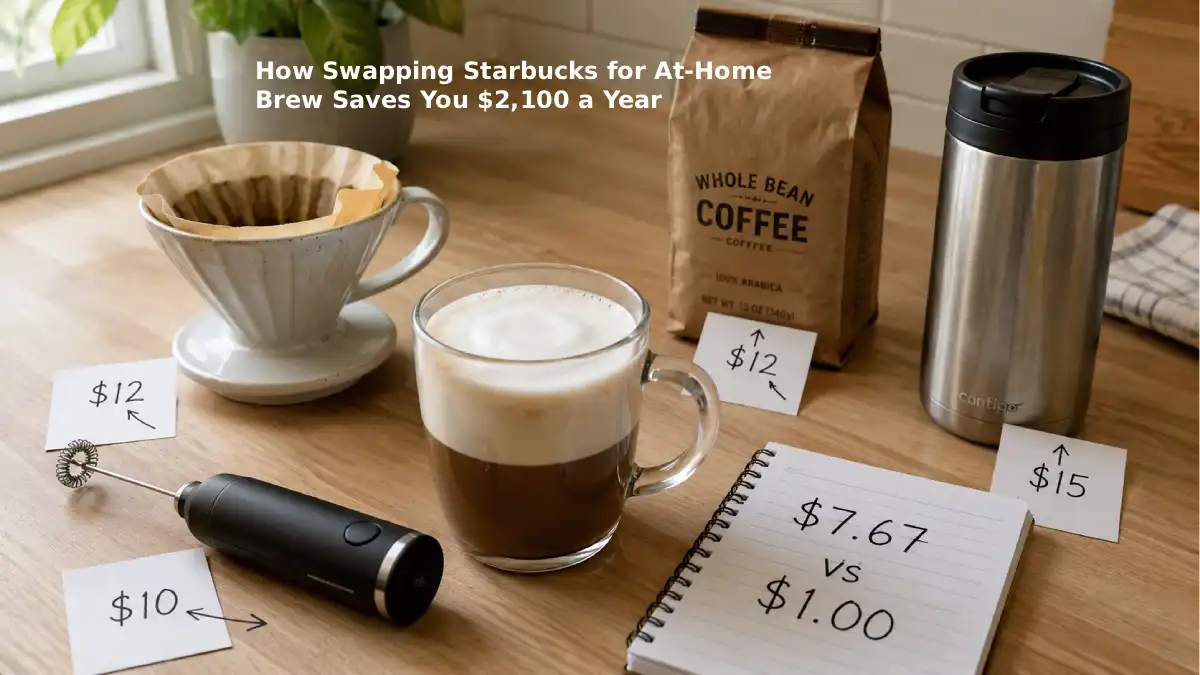
If you’re spending $6 on a latte every morning, you’re not just buying coffee. You’re buying convenience, ambiance, and a little daily treat. And that’s fine. But have you actually done the math on what that adds up to over a year? I did. And I almost choked on my cold brew.
Jump Links
- The Morning That Changed My Coffee Routine
- What Is the ‘Latte Factor’ Anyway?
- The Exact Math: Starbucks vs At-Home Brew (2026 Prices)
- My At-Home Coffee Setup (Under $60 Total)
- How to Make Starbucks-Quality Coffee at Home (Without the Barista Skills)
- The $2,100 Question: What Could You Do With That Money?
- But What About the Social Aspect? (Honest Answer)
- The ‘Latte Factor’ for Other Daily Expenses
- How to Start Without Feeling Deprived
- Frequently Asked Questions (FAQ)
- Final Thoughts: Your Latte Isn’t the Enemy, But the Math Doesn’t Lie
The Morning That Changed My Coffee Routine
I need to tell you about a Tuesday morning that made me feel genuinely stupid.
It was raining. I was tired. I pulled into the Starbucks drive-thru like I had done probably 200 times before. Ordered my usual: a grande oat milk latte with an extra shot. Handed over my card. $6.85. Didn’t think twice.
Later that day, I was scrolling through my banking app, just killing time. And I decided to do something I had never done before. I searched for “Starbucks” in my transaction history. Just for the last 30 days.
I almost dropped my phone.
$187 in one month. On coffee.
Not groceries. Not rent. Not a night out. Coffee.
I sat there for a full minute, just staring at the number. Then I did more math. $187 times 12 months. $2,244 a year. On coffee.
That was the moment I realized I had a problem. Not a coffee addiction – I’m fine with that. A money problem. I was spending over two thousand dollars a year on something I could make at home for a fraction of the cost.
So I changed things. I bought a $40 coffee maker, a $12 bag of beans, and a $6 milk frother. My first homemade latte cost me about $1.20. It wasn’t as good as Starbucks. But it was close. And after two weeks of practice, it was just as good.
That was six months ago. I still go to Starbucks sometimes – maybe once a week as a treat. But the daily habit? Gone. And my bank account is genuinely healthier because of it.
This is the story of the “Latte Factor” – a concept that’s been around for decades but feels more relevant than ever in 2026, when everything is expensive and every dollar counts. I’m going to show you the exact math, my at-home setup, and how you can save over $2,000 a year without feeling like you’re depriving yourself.
Let’s get into it.
What Is the ‘Latte Factor’ Anyway?
The “Latte Factor” isn’t a new idea. Financial expert David Bach popularized it years ago. The concept is simple: small, regular expenses add up to huge amounts of money over time.
A $6 latte every weekday doesn’t feel like much in the moment. But over a month, it’s $120. Over a year, it’s over $1,500. Over a decade, with investment returns, it could be $30,000 or more.
The Latte Factor isn’t about shaming anyone for enjoying a coffee. It’s about awareness. Once you see the math, you can make an informed choice. Maybe you keep buying the latte because the joy is worth the cost. Maybe you cut back. Maybe you find a middle ground.
For me, seeing the $2,200 number was enough to change my behavior. Not because I’m cheap. Because that money could go toward so many other things that matter more to me than a 5-minute morning ritual.
In 2026, with inflation still biting and wages not keeping up for many people, the Latte Factor matters more than ever. Small savings add up fast. And coffee is just the beginning.
The Exact Math: Starbucks vs At-Home Brew (2026 Prices)
Let me break this down in a way that’s impossible to ignore.
Starbucks (Daily, 5 days a week):
| Item | Price (2026 average) |
|---|---|
| Grande latte (with oat milk) | $6.25 |
| Add extra shot | $0.85 |
| Tax (varies, ~8%) | $0.57 |
| Total per latte | $7.67 |
Now do the multiplication:
- Per day: $7.67
- Per week (5 days): $38.35
- Per month (4 weeks): $153.40
- Per year: $1,992.40
But wait. That’s just weekdays. If you also go on Saturday and Sunday? Add another $15.34 per week. That brings your annual total to $2,796.00.
At-Home Brew (Daily, 7 days a week):
| Equipment (one-time cost) | Price |
|---|---|
| Coffee maker (basic drip or pour-over) | $25 |
| Milk frother (handheld) | $10 |
| Reusable travel mug | $15 |
| Total equipment | $50 |
| Ongoing costs (per month) | Price |
|---|---|
| Bag of good coffee beans (12 oz) | $12 |
| Oat milk (or your milk of choice) | $5 |
| Total monthly consumables | $17 |
Cost per homemade latte:
- Beans per cup: ~$0.60
- Milk per cup: ~$0.40
- Total per latte: $1.00 (rounded up)
Now do the multiplication for a daily (7 days/week) homemade latte:
- Per day: $1.00
- Per week: $7.00
- Per month: $28.00
- Per year (consumables only): $364.00
Add the one-time equipment cost of $50. Your first year total: $414.00
The Comparison:
| Scenario | Annual Cost |
|---|---|
| Starbucks daily (weekdays only) | $1,992 |
| Starbucks daily (7 days/week) | $2,796 |
| At-home brew (7 days/week, first year) | $414 |
| Year one savings (7 days/week) | $2,382 |
| Year two+ savings (consumables only) | $2,432 per year |
Let that sink in. Over two thousand dollars a year. For most people, that’s a vacation. That’s a car payment for several months. That’s a significant chunk of a retirement contribution. That’s a new laptop, a Peloton membership, or a really nice dinner out every single week.
My At-Home Coffee Setup (Under $60 Total)
I’m not a coffee snob. I’m also not a “any brown liquid will do” person. I found a middle ground that costs almost nothing and makes coffee I genuinely look forward to every morning.
Here’s exactly what I bought:
1. Basic Pour-Over Cone ($12) – Hario or any generic ceramic cone. No machine. No plastic pods. Just hot water and a filter. It takes 3 minutes.
2. Handheld Milk Frother ($10) – The little battery-powered whisk thing. Yes, the one from TikTok. It works perfectly for foaming oat milk.
3. Reusable Travel Mug ($15) – Contigo or Zojirushi. Keeps coffee hot for hours. No leaks. Fits in my car’s cup holder.
4. Electric Kettle ($20 – optional) – I already had one. If you don’t, just heat water on the stove. It’s fine.
5. Coffee Beans ($12 per bag) – I buy whole beans from a local roaster or, on a budget, Peet’s or Starbucks bagged beans from the grocery store. They’re $10-$14 and last me 2-3 weeks.
6. Oat Milk ($5 per carton) – Oatly barista blend is my favorite. It froths beautifully. A carton lasts me about a week.
Total one-time cost: $57 (if you buy the kettle) or $37 (if you use your stove).
That’s less than eight Starbucks lattes. After one week of homemade coffee, the equipment pays for itself.
How to Make Starbucks-Quality Coffee at Home (Without the Barista Skills)
I am not a barista. I have zero training. But after a few weeks of trial and error, I figured out a simple system that works every time.
Step 1: Heat your water.
Bring it to just below boiling (about 200°F). If you don’t have a thermometer, boil it and let it sit for 30 seconds.
Step 2: Grind your beans.
If you buy whole beans (recommended for freshness), grind them to a medium-fine consistency – like sand. Not powder (espresso grind). Not gravel (French press grind).
Step 3: Wet the filter.
Put a paper filter in your pour-over cone. Pour hot water over it to rinse out the paper taste. Dump that water.
Step 4: Add coffee.
Use about 15-18 grams of coffee (roughly 2-3 tablespoons). More coffee = stronger brew.
Step 5: The “bloom” pour.
Pour just enough hot water to saturate the grounds. Let it sit for 30 seconds. This lets the coffee release trapped gases.
Step 6: The main pour.
Slowly pour the remaining water in a circular motion, keeping the water level steady. Don’t dump it all at once.
Step 7: Froth your milk.
Heat your milk (microwave for 45 seconds or in a small saucepan). Use the handheld frother for 20-30 seconds until it doubles in size and looks like thick foam.
Step 8: Assemble.
Pour your coffee into a mug. Add the frothed milk. If you’re fancy, hold back the foam with a spoon and pour the liquid milk first, then spoon the foam on top.
That’s it. The whole process takes 5 minutes. Most of that is waiting for water to boil or coffee to drip. The active time is maybe 90 seconds.
Pro tips I learned the hard way:
- Cold milk doesn’t froth well. Warm it first.
- Don’t boil your coffee water. Burnt coffee tastes bitter.
- Clean the frother immediately after use. Dried milk is a nightmare.
- Buy a digital kitchen scale ($10) if you care about precision. Worth it.
The $2,100 Question: What Could You Do With That Money?
This is the part that changed my mindset. Once I realized I was spending over $2,000 on coffee, I started thinking about what else I could do with that money.
Option 1: Invest it.
If you take that $2,100 and put it into a basic index fund earning 7% annually, in 10 years it becomes $4,132. In 20 years, it becomes $8,127. In 30 years (hello retirement), it becomes $15,985. For coffee. That you made at home.
Option 2: Take a vacation.
A $2,100 budget gets you a very nice trip. Round-trip flight to Mexico: $400. A week at an all-inclusive resort: $1,200. Spending money: $500. That’s a whole vacation from your morning coffee.
Option 3: Pay off debt.
If you have credit card debt at 18% interest, paying an extra $2,100 per year changes everything. On a $10,000 balance, that extra payment cuts your payoff time by years and saves you thousands in interest.
Option 4: Upgrade your life in small ways.
$2,100 broken down:
- A gym membership for a year: $500
- A massage once a month: $720
- A new iPhone (every two years): $500/year
- A nice dinner out every month: $600
- A subscription to a meal kit service: $1,000
- A house cleaner twice a month: $1,200
Mix and match. Or pick one big thing.
Option 5: Do nothing. Just save it.
An extra $2,100 in your savings account is an emergency fund buffer. A flat tire? Covered. A medical bill? Handled. A job loss? You have breathing room.
For me, I split the difference. I saved half and used half for a nicer vacation. Best of both worlds.
But What About the Social Aspect? (Honest Answer)
I’m not going to pretend that coffee is just coffee. For many people, the Starbucks run is social. It’s walking to the cafe with a coworker. It’s catching up with a friend. It’s a break from your desk. It’s a ritual.
I get it. I felt that loss when I switched to at-home brewing.
Here’s how I handled it:
I still go to coffee shops. Just not every day.
Once a week, I meet a friend for coffee. I buy the latte. I enjoy it. I don’t feel guilty because it’s a treat, not a default.
I invite people over instead.
My homemade coffee is good. Not Starbucks-good, but good enough. Inviting a friend over for coffee costs me maybe $1.50 instead of $8. And we get to hang out without the background noise and crowded tables.
I make coffee at work.
If your office has a coffee maker, use it. Bring your own beans and milk. You’ll save the drive time and the money.
I redefined my morning ritual.
Making coffee at home became its own kind of meditation. The pouring. The waiting. The smell. It’s slower. Quieter. I genuinely prefer it now.
So yes, you lose something when you stop the daily coffee shop run. But you also gain something: time, money, and a new ritual that’s yours.
The ‘Latte Factor’ for Other Daily Expenses
Coffee is just the most famous example. The same principle applies to dozens of other small daily purchases.
Bottled water: $2 per day, 5 days a week = $520/year. Buy a reusable bottle and a filter. Almost free.
Lunch out: $15 per day, 5 days a week = $3,900/year. Meal prep on Sundays. Cut that to $5/day. Save $2,600/year.
Energy drinks: $4 per day = $1,460/year. Buy a case at Costco for $1.50 each. Save $900/year.
Convenience store snacks: $5 per day = $1,825/year. Buy in bulk. Keep snacks in your desk or bag. Save $1,500/year.
Rideshares (short trips): $10 per day, 3 days a week = $1,560/year. Walk or bike when possible. Take public transit. Save $1,000+/year.
Delivery fees + tips: $8 per delivery, 2x per week = $832/year. Pick up your own food. Save $800/year.
Add just a few of these up, and you’re looking at $5,000 to $10,000 per year in completely optional spending. That’s life-changing money for most people.
I’m not saying cut everything. I’m saying choose what actually matters to you. Pay for the things that bring you real joy. Cut the autopilot spending that doesn’t.
How to Start Without Feeling Deprived
The biggest mistake people make when trying to save money is going cold turkey. They decide to cut every single “unnecessary” expense. They last two weeks. Then they binge-spend and feel guilty.
Here’s a better way.
Step 1: Track for one week.
Write down every single purchase. Don’t judge yourself. Just observe. At the end of the week, total up your small daily expenses.
Step 2: Pick one thing.
Just one. Maybe it’s coffee. Maybe it’s lunch. Maybe it’s energy drinks. Don’t try to change everything at once.
Step 3: Set a realistic goal.
Not “I will never buy coffee again.” Instead: “I will make coffee at home 4 days a week. I can still buy coffee on Fridays.” Or: “I will only buy coffee with friends, not by myself.”
Step 4: Automate the savings.
Set up an automatic transfer of the money you’re saving. If you used to spend $30/week on coffee, transfer $30/week into a separate savings account. You won’t miss what you never see.
Step 5: Reward yourself.
When you hit a milestone (one month, $500 saved, etc.), use a small portion of the savings for something fun. A nice dinner. A movie. A new book. Positive reinforcement works.
Step 6: Be kind to yourself.
If you slip up, it’s fine. Don’t abandon the whole plan. Just start again tomorrow. Perfection isn’t the goal. Progress is.
$100 Drunk Elephant vs. $15 The Ordinary: A 30-Day Cost-to-Result Breakdown
Frequently Asked Questions (FAQ)
1. Is the ‘Latte Factor’ even realistic in 2026? Everything is more expensive.
Yes, that’s exactly why it matters more now. When prices are high, small savings add up faster. The math works whether a latte costs $5 or $8. The percentage saved is the same. The absolute dollars saved are actually higher now.
2. I don’t drink coffee. What’s my ‘latte factor’?
Anything you buy daily or almost daily. Bottled water. A can of soda from the vending machine. A breakfast sandwich. A bag of chips. A rideshare. A parking garage fee. Find your version of the latte.
3. Isn’t this just “poor people can’t have nice things” advice?
No, and I hate when that criticism gets thrown around. The Latte Factor isn’t about shaming people for enjoying small luxuries. It’s about awareness. If you know exactly what you’re spending and you’re happy with it, keep doing it. The problem is unconscious spending – buying things on autopilot without realizing the cumulative cost.
4. What if I genuinely can’t make coffee at home that tastes as good?
Practice, or upgrade your setup slightly. A better grinder ($30-50) makes a huge difference. Good beans ($12-15) matter more than expensive equipment. Watch a few YouTube tutorials. Most people give up after two mediocre attempts. Give yourself a week of practice.
5. At-home coffee seems like a lot of work in the morning.
It takes me 5 minutes. The same amount of time I’d spend in a drive-thru line. You’re not saving time by buying coffee. You’re just outsourcing the work. If 5 minutes genuinely breaks your morning, make cold brew once a week. Then you just pour and go.
6. How much should I spend on an at-home coffee setup?
Start small. A $20 pour-over cone and a $10 frother. That’s $30. Use it for two weeks. If you love it, upgrade piece by piece. If you hate it, you’re only out $30 – less than a week of Starbucks.
7. What about the environmental impact?
Homemade coffee creates less waste. No single-use cups. No plastic lids. No paper sleeves. You’ll throw away a paper filter (compostable) or use a reusable metal filter. That’s it. Your carbon footprint drops significantly.
8. I use Starbucks for the Wi-Fi and workspace. What’s the alternative?
A public library. A coworking space day pass (many are $10-15). A coffee shop still, but buy the cheapest thing on the menu ($2 tea). Or work from home if you can. Don’t let “I need a place to work” become a $2,000/year line item.
9. How do I calculate my own Latte Factor?
Pick an expense. Write down how often you buy it (e.g., 5x per week). Multiply by the cost (e.g., $6). Multiply by 52 weeks. That’s your annual cost. Then decide if that number feels worth it to you.
10. I tried this and felt deprived. What went wrong?
You cut too much, too fast. Or you’re focusing on the wrong thing. Don’t think of it as “I can’t have coffee.” Think of it as “I’m choosing to put that money toward a vacation (or debt, or savings).” Frame it as a positive choice, not a punishment.
Final Thoughts: Your Latte Isn’t the Enemy, But the Math Doesn’t Lie
Here’s what I want you to take away.
I’m not here to tell you that buying coffee is bad. I still buy coffee. I bought one yesterday. It was delicious. I don’t feel guilty.
But I don’t buy it every day anymore. Because once I saw the number – $2,200 a year – I couldn’t unsee it. That money matters to me more than the 5 minutes of convenience.
The Latte Factor isn’t about coffee. It’s about awareness. It’s about looking at your spending with open eyes and asking yourself: “Is this actually making me happy? Or am I just doing it because I always have?”
For me, the homemade coffee ritual became something I genuinely enjoy. The quiet morning. The smell of fresh grounds. The satisfaction of making something with my own hands. I didn’t just save money. I gained a new habit that I like.
So try it. For one month. Make coffee at home. Or cut out one other small daily expense. See how you feel. See how much you save.
You might be surprised.
That’s the frugal glow. And it tastes like coffee you didn’t overpay for. ☕💛
For more personal finance tips, frugal living advice, and honest money conversations, visit The Frugal Glow.