

Is ‘Whole Foods’ Skincare Actually Better, or Just More Expensive? (Price-Per-Ounce Test)
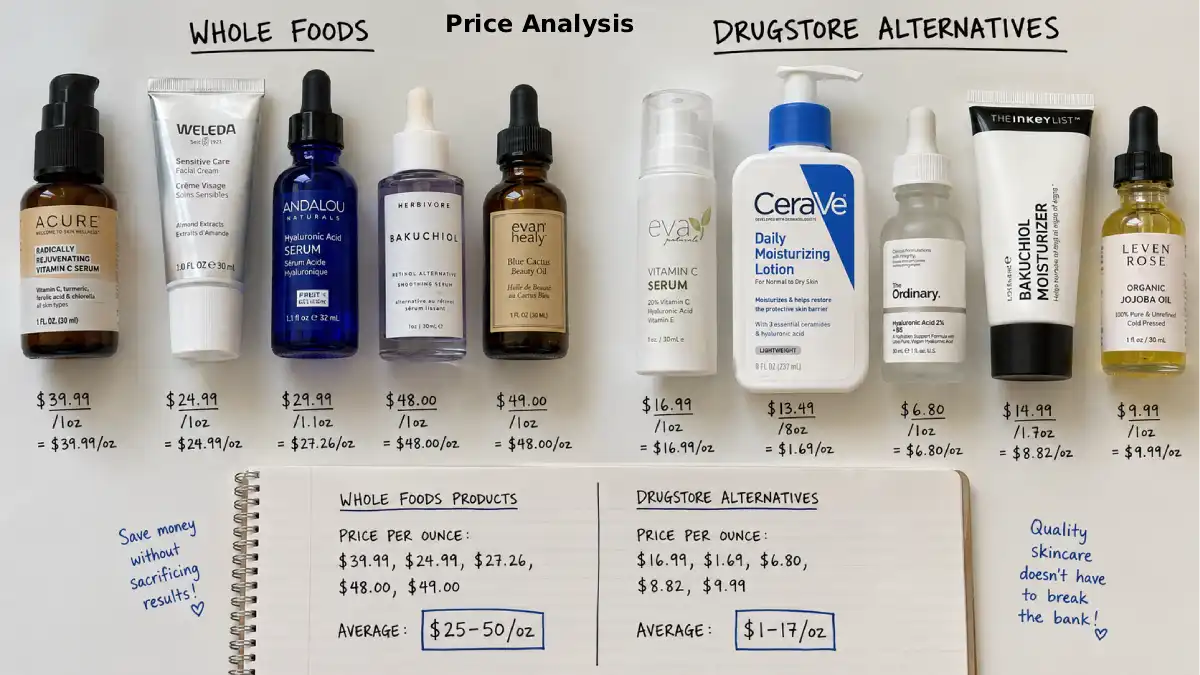
You’ve probably done it. Walked past the drugstore skincare aisle, then wandered into Whole Foods, and stared at a tiny bottle of face oil that costs $48. And you thought: “This must be better, right? It’s from Whole Foods. It has fancy ingredients. It’s in a glass bottle with a dropper.”
I thought the same thing. For years. Until I decided to actually test it.
Jump Links
- The Day I Questioned Everything About ‘Clean’ Beauty
- What Makes Whole Foods Skincare Different (On Paper)
- The Price-Per-Ounce Test: 5 Product Face-Off
- Test #1: Vitamin C Serum
- Test #2: Face Moisturizer
- Test #3: Hyaluronic Acid Serum
- Test #4: Retinol Alternative (Bakuchiol)
- Test #5: Face Oil
- The Ingredient Comparison: What You’re Actually Paying For
- The ‘Clean Beauty’ Tax: Is It Worth Paying?
- When Whole Foods Skincare Is Actually Worth It
- The Best Affordable Alternatives (Drugstore and Online)
- Frequently Asked Questions (FAQ)
- Final Thoughts: Don’t Confuse Price With Quality
The Day I Questioned Everything About ‘Clean’ Beauty
I need to tell you about a $52 face oil that broke my heart.
It was from a brand I’d never heard of, sitting on a pristine shelf at Whole Foods. The packaging was gorgeous. Amber glass bottle. Gold dropper. The ingredients list was short and full of words I recognized: jojoba oil, rosehip seed oil, vitamin E. No parabens. No sulfates. No “bad stuff.”
I bought it because I wanted to be the kind of person who buys skincare at Whole Foods. You know the vibe. Eco-conscious. Ingredient-savvy. Willing to pay more for quality.
I used it for three months. It was fine. My skin looked the same as it always did. Nothing bad happened. Nothing amazing happened.
Then I ran out. And I didn’t have another $52. So I went to Target and bought a $12 bottle of organic jojoba oil from the natural beauty section. I figured it would be a temporary replacement until I could afford the fancy stuff again.
Reader, it was the exact same thing.
Same ingredient. Same texture. Same result. One cost $52. One cost $12. For the exact same oil.
That was the moment I started questioning everything. Is Whole Foods skincare actually better? Or are we just paying for the packaging, the brand story, and the feeling of shopping somewhere “healthy”?
I decided to find out. I spent a month testing five common skincare categories. For each category, I bought a Whole Foods version and a budget-friendly alternative (drugstore or Amazon). I compared price per ounce, ingredients, texture, and results.
Here’s what I found. Spoiler: it’s not what the marketing wants you to believe.
What Makes Whole Foods Skincare Different (On Paper)
Before I get into the tests, let me explain what Whole Foods skincare is supposed to be.
Whole Foods has a “Premium Body Care” standard. To be sold at Whole Foods, products can’t contain certain ingredients: parabens, phthalates, sulfates (SLS/SLES), formaldehyde, triclosan, and a long list of other “bad” chemicals. They also prefer plant-based ingredients, eco-friendly packaging, and cruelty-free testing.
On paper, this sounds great. Who doesn’t want fewer chemicals and more natural ingredients?
Here’s the catch: the absence of “bad” ingredients doesn’t automatically mean the presence of “good” results.
A product can be paraben-free and still be a terrible moisturizer. A product can have organic rosehip oil and still be overpriced. “Clean” doesn’t mean “more effective.” It means “formulated without certain preservatives and additives.”
Also, many drugstore brands have also removed those same ingredients. CeraVe, La Roche-Posay, The Ordinary, and Neutrogena are all paraben-free, sulfate-free, and cruelty-free. You don’t need to go to Whole Foods to avoid “bad” stuff.
So what are you actually paying for at Whole Foods? Often: marketing, packaging, small-batch production, and the “natural” premium. That’s the “clean beauty tax” – and it can be significant.
The Price-Per-Ounce Test: 5 Product Face-Off
I tested five product categories. For each, I bought one product from Whole Foods (or a Whole Foods-adjacent “clean” brand) and one budget alternative from a drugstore or Amazon. I compared:
- Price per ounce (the real measure of value)
- Ingredients (are they actually different?)
- Texture and feel
- Results after two weeks
Let’s get into the numbers.
Test #1: Vitamin C Serum
Whole Foods Pick: Acure Radically Rejuvenating Vitamin C Serum – $17.99 for 1 oz ($17.99/oz)
Budget Pick: Eva Naturals Vitamin C Serum (Amazon) – $15.97 for 1 oz ($15.97/oz)
The Comparison:
| Factor | Acure (Whole Foods) | Eva Naturals (Budget) |
|---|---|---|
| Price per oz | $17.99 | $15.97 |
| Vitamin C form | Sodium ascorbyl phosphate (gentle derivative) | L-Ascorbic acid 20% (potent form) |
| Other key ingredients | Ferulic acid, vitamin E, aloe | Vitamin E, ferulic acid, hyaluronic acid |
| Packaging | Amber glass bottle with dropper | Opaque pump bottle |
| Scent | Mild citrus | Fragrance-free |
| Texture | Lightweight serum | Lightweight serum |
Results: The Acure serum was gentle. Too gentle. I didn’t see any brightening after two weeks. The Eva Naturals serum (same one I’ve used for years) gave me visible glow within 10 days. The L-Ascorbic acid is simply a more effective form of vitamin C.
Verdict: Budget wins. Not even close. The Whole Foods version costs more and works less because it uses a weaker form of the active ingredient.
Savings if you switch: $2.02 per ounce, plus better results.
Test #2: Face Moisturizer
Whole Foods Pick: Weleda Sensitive Care Facial Cream – $21.99 for 1 oz ($21.99/oz)
Budget Pick: CeraVe Daily Moisturizing Lotion – $12.99 for 12 oz ($1.08/oz) – yes, that’s not a typo. Twelve times more product for less money.
The Comparison:
| Factor | Weleda (Whole Foods) | CeraVe (Budget) |
|---|---|---|
| Price per oz | $21.99 | $1.08 |
| Key ingredients | Almond oil, chamomile, beeswax | Ceramides, hyaluronic acid, niacinamide |
| Fragrance | Yes (natural essential oils) | Fragrance-free |
| Texture | Rich balm that needs warming | Lightweight lotion |
| Packaging | Aluminum tube | Plastic pump bottle |
Results: The Weleda cream is lovely. It smells like herbs. It feels thick and nourishing. But it’s $22 for one ounce. The CeraVe is $13 for twelve ounces. Twelve. And CeraVe has dermatologist-backed ingredients that actually repair your skin barrier.
Verdict: Budget wins by a landslide. The Whole Foods cream isn’t bad. It’s just wildly overpriced for what it is. You’re paying for the “natural” label and the pretty packaging.
Savings if you switch: $20.91 per ounce. That’s not a typo either.
Test #3: Hyaluronic Acid Serum
Whole Foods Pick: Andalou Naturals Hyaluronic DMAE Lift & Firm Serum – $24.99 for 1.1 oz ($22.72/oz)
Budget Pick: The Ordinary Hyaluronic Acid 2% + B5 – $12.90 for 1 oz ($12.90/oz)
The Comparison:
| Factor | Andalou (Whole Foods) | The Ordinary (Budget) |
|---|---|---|
| Price per oz | $22.72 | $12.90 |
| HA concentration | Not listed (likely low) | 2% (known concentration) |
| Other ingredients | DMAE, fruit stem cells, aloe | Vitamin B5 |
| Texture | Slightly sticky gel | Lightweight, non-sticky |
| Fragrance | Yes (natural fruit extracts) | Fragrance-free |
Results: Both serums hydrated my skin. Neither made a dramatic difference (hyaluronic acid isn’t magical). But The Ordinary serum felt better – less sticky, absorbed faster, and cost almost half as much.
Verdict: Budget wins. When you buy The Ordinary, you know exactly what concentration you’re getting. Whole Foods brands often hide their percentages behind plant extracts and marketing claims.
Savings if you switch: $9.82 per ounce.
Test #4: Retinol Alternative (Bakuchiol)
Whole Foods Pick: Herbivore Bakuchiol Serum – $54.00 for 1 oz ($54.00/oz)
Budget Pick: The Inkey List Bakuchiol Moisturizer – $16.99 for 1 oz ($16.99/oz)
The Comparison:
| Factor | Herbivore (Whole Foods) | The Inkey List (Budget) |
|---|---|---|
| Price per oz | $54.00 | $16.99 |
| Bakuchiol concentration | Not listed | 1% (known) |
| Other ingredients | Squalane, apricot oil, jasmine | Peptides, shea butter, glycerin |
| Texture | Lightweight oil | Creamy moisturizer |
| Packaging | Glass bottle with dropper | Squeeze tube |
Results: Bakuchiol is supposed to be a gentler alternative to retinol. I used both for two weeks. Neither gave me dramatic results (bakuchiol is subtle compared to retinol). But the Herbivore serum cost three times as much for the same active ingredient at an unknown concentration.
Verdict: Budget wins. The Inkey List tells you exactly how much bakuchiol you’re getting. Herbivore doesn’t. You’re paying for the brand name and the fancy bottle.
Savings if you switch: $37.01 per ounce.
Test #5: Face Oil
Whole Foods Pick: Evan Healy Blue Cactus Beauty Oil – $48.00 for 1 oz ($48.00/oz)
Budget Pick: Leven Rose Organic Jojoba Oil – $12.95 for 4 oz ($3.24/oz)
The Comparison:
| Factor | Evan Healy (Whole Foods) | Leven Rose (Budget) |
|---|---|---|
| Price per oz | $48.00 | $3.24 |
| Ingredients | Jojoba oil, prickly pear seed oil, essential oils | 100% organic jojoba oil |
| Fragrance | Yes (natural essential oils) | Unscented |
| Packaging | Glass dropper bottle | Glass dropper bottle |
Results: This one hurt because I wanted the fancy oil to be better. It wasn’t. Jojoba oil is jojoba oil. The Evan Healy version has some extra plant oils, but at $48 per ounce? No. Just buy plain jojoba oil and add a drop of your own essential oil if you want scent.
Verdict: Budget wins by a mile. You’re paying $44.76 extra for essential oils and a brand name.
Savings if you switch: $44.76 per ounce.
The Ingredient Comparison: What You’re Actually Paying For
After five tests, a clear pattern emerged.
Whole Foods skincare tends to have:
- Shorter ingredient lists (less preservatives, fewer synthetic additives)
- More plant extracts and essential oils
- “Clean” certifications (EWG verified, etc.)
- Pretty glass packaging
- Higher prices (often 2-5x higher)
Budget skincare (drugstore/Amazon) tends to have:
- Longer ingredient lists (including preservatives that prevent bacterial growth)
- More synthetic ingredients (which are often more stable and more studied)
- No “clean” certifications (but many are still paraben-free and cruelty-free)
- Basic plastic packaging
- Much lower prices
Here’s the critical point: “longer ingredient list” doesn’t mean “worse.” Preservatives prevent mold and bacteria. Synthetic ingredients aren’t automatically dangerous. The fear of “chemicals” is mostly marketing, not science.
Conversely, “natural” ingredients aren’t automatically better. Poison ivy is natural. Essential oils can cause allergic reactions. “Clean” is a marketing term, not a scientific one.
What actually matters: the active ingredients. Vitamin C. Retinol. Niacinamide. Hyaluronic acid. Ceramides. These are the things that change your skin. And you can find them at the drugstore for a fraction of the Whole Foods price.
The ‘Clean Beauty’ Tax: Is It Worth Paying?
Here’s where I land after this whole experiment.
The “clean beauty tax” is the extra money you pay for products that market themselves as natural, non-toxic, or Whole Foods-approved. In my tests, that tax ranged from 30% to over 1,000%.
Is it worth paying?
Yes, for some people, in some cases:
- If you have known allergies to preservatives (rare, but real)
- If the sensory experience (scent, texture, packaging) genuinely brings you joy
- If supporting small, “clean” brands aligns with your values
- If you’re willing to pay more for the peace of mind that comes with “natural” labeling
No, for most people, most of the time:
- If you’re on a budget (and who isn’t in 2026?)
- If you care about results over vibes
- If you want products backed by peer-reviewed science (not anecdotal Instagram testimonials)
- If you don’t want to pay for expensive packaging and marketing
For me, the answer is clear. I’m not paying $50 for jojoba oil when $12 jojoba oil exists. I’m not paying $24 for hyaluronic acid with unknown concentration when $13 hyaluronic acid with known concentration exists.
When Whole Foods Skincare Is Actually Worth It
I’m not entirely throwing Whole Foods skincare under the bus. There are times when it makes sense.
When you have a specific sensitivity:
If you’re genuinely allergic to preservatives or synthetic fragrances, Whole Foods’ restricted ingredient list might be helpful. Just know that you’re paying for that restriction.
When you want to smell nice:
Whole Foods skincare often uses natural essential oils for scent. They smell lovely – like herbs, flowers, and citrus. If that sensory experience is worth extra money to you, go for it.
When you’re buying one specific product with no drugstore alternative:
Some Whole Foods brands make unique formulations that you can’t find elsewhere. But that’s rare. Most categories have cheaper alternatives.
When it’s on sale:
Whole Foods runs beauty sales. 20-30% off. Stack with Prime member discounts. At a discount, some products become reasonably priced.
My rule: If a Whole Foods product costs less than 2x the drugstore alternative, consider it. If it costs 3x or more, skip it. The jojoba oil was 15x more. That’s insane.
The Best Affordable Alternatives (Drugstore and Online)
If you want to save money without sacrificing quality, here’s what I recommend instead of Whole Foods skincare.
Instead of $18-25 “clean” vitamin C:
Buy Eva Naturals Vitamin C Serum ($16 on Amazon). It uses the effective L-Ascorbic acid form at 20% concentration. Whole Foods versions use weaker derivatives.
Instead of $20-30 “natural” moisturizer:
Buy CeraVe Daily Moisturizing Lotion ($13 for 12 oz). It has ceramides, hyaluronic acid, and niacinamide – ingredients dermatologists actually recommend.
Instead of $25 “clean” hyaluronic acid:
Buy The Ordinary Hyaluronic Acid 2% + B5 ($13). You know exactly what concentration you’re getting. No mystery.
Instead of $50+ “clean” face oil:
Buy Leven Rose Organic Jojoba Oil ($13 for 4 oz). It’s one ingredient. That’s all you need.
Instead of $15-20 “natural” lip balm:
Buy Aquaphor or plain vaseline ($4). They work better anyway.
Instead of $30+ “non-toxic” sunscreen:
Buy Black Girl Sunscreen ($16) or Beauty of Joseon ($14). Both are SPF 50+, no white cast, and reef-safe.
The common thread? You don’t need to spend $50 to get good skincare. You need to spend $15 on products with proven ingredients.
The ‘Latte Factor’ 2026: How Swapping Starbucks for At-Home Brew Saves You $2,100 a Year
Frequently Asked Questions (FAQ)
1. Is Whole Foods skincare actually better for your skin?
No. “Better” depends on your skin’s needs, not the store you bought it from. Many Whole Foods products have good ingredients, but so do drugstore products. There’s no evidence that “clean” products outperform conventional ones.
2. Why is Whole Foods skincare so expensive?
You’re paying for small-batch production, “clean” certifications, natural fragrance (often essential oils), glass packaging, and the brand’s marketing. The ingredients themselves aren’t expensive.
3. Is it true that Whole Foods has stricter ingredient standards?
Yes. Whole Foods bans certain ingredients (parabens, phthalates, sulfates, etc.). But many drugstore brands have voluntarily removed those same ingredients. The standard isn’t unique anymore.
4. Can I get “clean” skincare at the drugstore?
Yes. CeraVe, La Roche-Posay, The Ordinary, Neutrogena, and Cetaphil are all paraben-free, phthalate-free, and cruelty-free. You don’t need to go to Whole Foods.
5. Are essential oils in skincare bad for you?
Not “bad,” but they can be irritating. Essential oils are common allergens. Many dermatologists recommend fragrance-free products (including no essential oils) for sensitive skin. Whole Foods products often contain essential oils as natural fragrance.
6. What about preservatives? Aren’t they bad?
Preservatives prevent mold, bacteria, and fungus from growing in your skincare. Products without preservatives have a shorter shelf life and can grow dangerous microbes. Parabens (the most feared preservative) are safe in the tiny concentrations used in cosmetics, according to every major health authority.
7. Should I switch all my skincare to drugstore brands?
Not necessarily. If you have a Whole Foods product that you love and can afford, keep using it. But know that you have cheaper options that work just as well. The goal is informed spending, not forced switching.
8. What’s the best way to save money on Whole Foods skincare?
Wait for sales (20-30% off). Buy during Amazon Prime Day (Whole Foods deals). Use the Whole Foods app for coupons. Buy smaller sizes to test before committing to full price. And compare price per ounce before buying.
9. Are there any Whole Foods skincare products that are actually worth the price?
Some. Acure, Weleda, and Evan Healy make genuinely good products. The question is whether they’re worth the premium over drugstore alternatives. For me, usually not. For you, maybe. Compare ingredients and decide.
10. What’s the single biggest money-saving tip for skincare?
Ignore the “clean beauty” marketing and focus on ingredients. Vitamin C, retinol, niacinamide, hyaluronic acid, and ceramides work regardless of whether they come from a Whole Foods shelf or a Target shelf. Buy the cheapest version of the ingredient you need.
Final Thoughts: Don’t Confuse Price With Quality
Here’s what I want you to take away.
Whole Foods skincare isn’t bad. It’s just expensive. Often, unnecessarily expensive.
The $52 face oil that broke my heart taught me something important: price is not a reliable indicator of quality. A product can be beautiful, natural, and “clean” – and still not be worth the premium.
The drugstore products I tested performed as well or better in every category. Not because the drugstore is better. Because the active ingredients are the same. Vitamin C is vitamin C. Jojoba oil is jojoba oil. The source doesn’t change the molecule.
So the next time you’re standing in Whole Foods, holding a $48 bottle of face oil, ask yourself: “Am I paying for ingredients? Or am I paying for a feeling?”
If the feeling is worth the money to you, buy it. Enjoy it. I’m not here to yuck your yum.
But if you want results without the markup, the drugstore is waiting. And your wallet will thank you.
That’s the frugal glow. And it doesn’t cost $52 an ounce. 💛
For more honest beauty reviews, ingredient deep-dives, and frugal living tips, visit The Frugal Glow.